A $280 Million Lesson! The 2026 DeFi Security Guide to Avoiding Pitfalls

marsbitPublicado a 2026-04-08Actualizado a 2026-04-08

Resumen

"DeFi Security Lessons from a $280M Hack: A 2026 Guide to Avoiding Pitfalls" The rapid growth of DeFi has turned it from a niche interest into a mainstream pursuit for high yields. However, this comes with significant risks, highlighted by a major attack on Solana's Drift Protocol in April 2026, resulting in losses between $220-$285 million. This event underscores that in DeFi, users bear full responsibility for their assets. Most losses occur during normal operations through common vulnerabilities: 1. **Excessive Token Approvals**: Granting unlimited contract permissions can lead to complete asset drainage. 2. **Phishing Websites**: Fake sites mimic legitimate projects to steal wallet credentials. 3. **Contract Exploits**: Code vulnerabilities allow hackers to legally drain funds. 4. **Rug Pulls**: Malicious projects withdraw liquidity, causing tokens to crash. The guide outlines five essential pre-interaction checks: 1. **Contract Security**: Verify contracts are open-source and audited by firms like CertiK. Avoid unaudited or newly deployed contracts. 2. **Authorization Management**: Avoid unlimited approvals; use minimal permissions and regularly revoke unused allowances via tools like revoke.cash. 3. **Official Access Points**: Bookmark official sites from trusted sources (e.g., project Twitter/Discord) to avoid phishing scams, which cause over 60% of losses. 4. **Abnormal Yields**: Extreme APYs (e.g., stablecoins >20%) often signal scams. Compare rates to est...

Author: Zero Time Technology

Preface

With the rapid development of DeFi, "Decentralized Finance" has evolved from a niche toy for geeks into fertile ground for ordinary people chasing high yields. Staking, liquidity mining, lending for interest... various strategies emerge endlessly, with annual percentage yields (APY) often reaching tens or even hundreds of percent, making it hard to resist.

However, the flip side of yield is risk. On April 1, 2026, Solana's leading perpetual contracts DEX, Drift Protocol, suffered a major attack, with losses estimated between $220 million and $285 million, making it the largest DeFi hack of 2026 so far.

This event once again sounds the alarm: In the DeFi world, there is no customer service to help you recover funds, no bank to back you up. Every interaction is your full responsibility for your assets.

To help everyone avoid risks, the Zero Time Technology security team, based on real attack cases, has summarized 5 key security checks that must be completed before participating in DeFi. These will help you identify risks before you act and safeguard the bottom line of your asset security.

How is DeFi Risk Actually Happening?

Many people think hacker attacks are far away from them, but the reality is: most asset losses occur during users' "normal operations."

You didn't do anything particularly wrong, you were just negligent in one step. Here are the four most common risk pathways:

1. Improper Approval → Assets Transferred Away

You clicked "Approve" once, granting the contract unlimited permission to access your wallet. Once the contract turns malicious or gets hacked, assets are emptied instantly.

2. Visiting a Phishing Website → Wallet Compromised

You searched for a project, clicked the top ad link, and the page looked exactly like the official site. After connecting your wallet, your seed phrase or signature was already captured by the hacker.

3. Contract Vulnerability → Funds "Legally Stolen"

The project itself is legitimate, but the code has a vulnerability. Hackers exploit the vulnerability to bypass restrictions and extract funds from the protocol's treasury—your assets are among them.

4. Project Rug Pull → Liquidity Drained

The project team was a scam from the start. Once enough of your funds are deposited, they directly withdraw the coins from the liquidity pool, and the token's value instantly drops to zero.

Understanding where the risks come from, the following 5 checks will show you exactly where each measure strikes.

Check 1: Contract Security — Open Source + Audit is the Baseline

Many people have their assets stolen not because hackers are highly skilled, but because the project contract itself is "toxic."

⚠️Your goal is not to "trust the project," but to:

Is the code open source: Check on a block explorer (like Etherscan, Solscan) if the contract is "Verified." An unopen-sourced contract is like hiding the rules in a black box—don't touch it.

Has it been audited: Go to audit firm websites like CertiK, PeckShield, SlowMist, search for the project name, confirm there is a genuine audit report, and that critical vulnerabilities have been fixed.

Does it have a history of vulnerabilities: Use third-party platforms like DeFi Safety, RugDoc, input the contract address, and check the security score and past risk records.

🚩High-Risk Signals:

•Contract not open source

• No third-party audit report, or only "self-audited"

• Contract deployed just days before launch

🔗Pro Tip: On the block explorer's "Contract" page, if you see "Source Code Not Verified," close the page immediately.

Check 2: Authorization Management — Don't Let Contracts Have "Unlimited Withdrawal"

Many people have their assets stolen not by being hacked, but by approving contracts they shouldn't have. Clicking "Approve" once is like giving the contract a key—if that key is a "master key," the contract can open the door to all assets of that type in your wallet at any time.

⚠️Key Checks

Is it requesting "unlimited approval": In the approval pop-up, if the amount shows "unlimited" or the uint256 maximum value. This means the contract can transfer an unlimited amount of your assets, not limited by the amount you deposited.

Is it an unfamiliar contract address: Carefully verify the contract address of the approval target. Does it match the address published by the project's official channels? A difference of one letter could be phishing.

👉Recommendations

Prefer "Minimum Approval": When approving, manually change the amount to the quantity needed for the current transaction. For example, if you are only depositing 0.1 ETH, set the approval amount to 0.1 ETH. Wallets like Rabby and customized MetaMask versions support this feature.

Regularly Review Approvals: Visit revoke.cash or etherscan.io/tokenapprovalchecker to see which contracts you have approved. If you find suspicious or unrecognized ones, revoke them with one click.
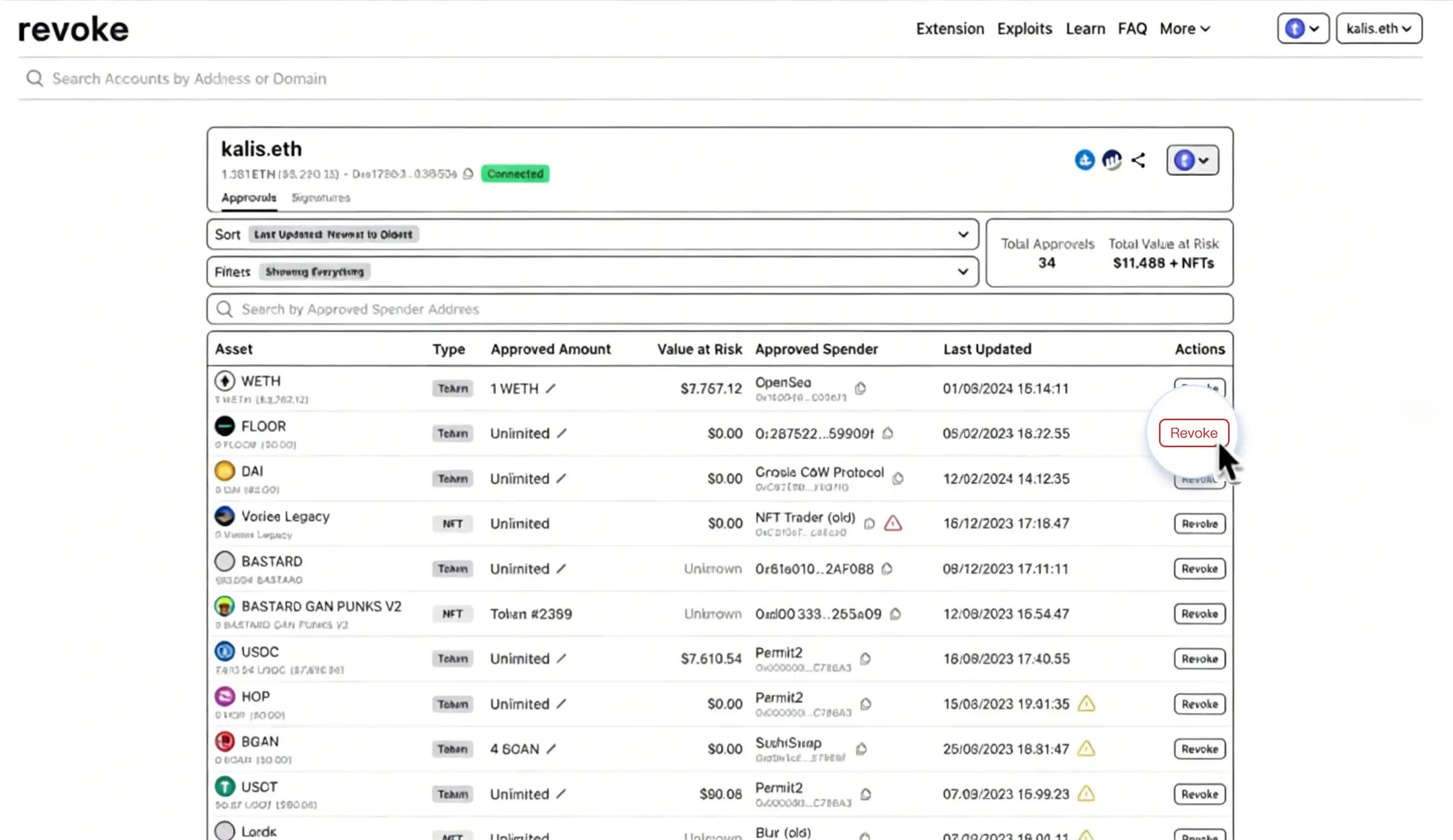
Example interface from revoke.cash website. The circled "Unlimited" approvals are recommended to be revoked promptly.

Check 3: Official Entry Points — Phishing Sites Are Scarier Than Hackers

According to statistics, over 60% of DeFi asset losses come from phishing attacks, not contract vulnerabilities.

⚠️Common Tactics

Imitating Official Websites: Domain names differ by only one letter (e.g., uniswap.com vs uniswao.com), with the page completely copied.

Fake Airdrop Pages: Promoting "free XX airdrop claims" on Twitter, Discord. After connecting your wallet, approvals are used to transfer assets away.

Search Engine Ad Poisoning: Searching for "Uniswap," the first ad might be a phishing site with a domain name extremely similar to the official one.

👉Recommendations

Only Enter Through Official Channels: Get the official link from the project's official Twitter, Discord announcements, or GitHub repository. Do not trust search engine ads.

Bookmark Frequently Used DeFi Sites: Add the official websites of protocols you often use to your browser bookmarks and always enter from there.

Don't Click Unfamiliar Links: Be suspicious of any link sent by anyone (including group members, private messages).

🔗Pro Tip: Install wallet extensions like Rabby or MetaMask's phishing detection version; they automatically block known phishing domains.

Check 4: Abnormal Yields — High Returns Inevitably Hide High Risks

If a project:

• Offers APY far above the average market rate (e.g., stablecoin APY over 20%)

• Emphasizes "risk-free arbitrage," "guaranteed profits"

• Encourages "early participation, quick investment," creating FOMO (Fear Of Missing Out) sentiment

It can basically be judged: Risk ≈ Promised Return × 10

Many Rug Pull projects use "high yield" to attract liquidity. Their initial yields might come from new users' principal (a Ponzi scheme). Once the inflow of new funds slows down, the project team directly pulls the liquidity and runs away.

👉Recommendations

Compare to Market Benchmarks: Mainstream DeFi protocols (like Aave, Compound) typically offer stablecoin APY between 2% - 8%. Be highly vigilant if it's 3 times higher than this range.

Check the Project's Lifespan: Projects offering super high yields just days after launch are likely "honeypots."

Search Project Name + scam / rug: Use Google or Twitter search to see if there are user reports.

🚩 One Rule: If it seems too good to be true, it probably is.

Check 5: Asset Isolation — Don't Put All Your Eggs in One Wallet

Many users only have one main wallet, where all assets, all DeFi interactions, and all NFT mints are done. Once this wallet is phished, approves a malicious contract, or has its private key leaked, all assets are wiped out at once.

Recommend establishing a "Three-Wallet" system:
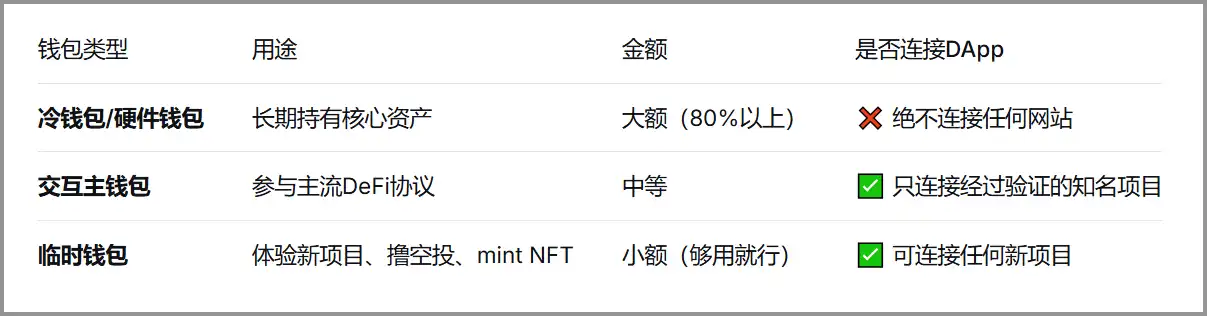
⚠️The essence is: Control single-point risk, avoid "total loss in one go"

• Participate in new projects or unverified protocols always using a temporary wallet, depositing the minimum amount required for testing.

• Regularly clean approvals for the interaction wallet (weekly or monthly).

• Keep core assets in a cold wallet, never sign, never approve, never connect to any website.

More Frightening Than Hackers Are the "Insiders"

Besides external attacks, there is another often overlooked risk—malicious insiders. They could be developers, operations staff, or even customer support.

⚠️Where do internal threats come from?

• Developers or auditors planting backdoors: Developers and auditors have commit access and system access. If any one of them turns malicious, they can plant backdoors, steal sensitive keys, and it's hard to detect as it's disguised as normal development activity.

• Core permission managers stealing: Those holding the admin private keys, if they have ill intentions, can empty all user assets in one go.

• Employees exploiting job permissions to steal user information: In February 2026, a 34-year-old network engineer at a Hong Kong cryptocurrency investment company used his system access rights to unauthorizedly log into the company database and stole approximately 2.67 million USDT (about HK$20.87 million) from about 20 clients. This employee had been with the company for 4 years, responsible for APP development and maintenance—it was this "legitimate access" that enabled the theft.

👉How to prevent?

• Individual Users: Choose protocols with a "timelock" (major operations require a 24-48 hour delay), pay attention to whether the project's multi-signature managers are publicly transparent.

• Project Teams: Core permissions must be managed with multi-signature wallets, set a timelock buffer period, and regularly audit internal access logs.

Why Do You "Get Hit" Even When You're "Very Careful"?

Because attacks have shifted from "technical vulnerabilities" to "human vulnerabilities."

⚠️Common Psychological Pitfalls

• "This project is hot, it should be fine"

• "Everyone is using it, nothing will happen"

• "I'll only do it once, it won't be me"

👉 The reality is: Attackers only need you to make one mistake

⚠️New Trend: AI + Phishing Attacks

• Highly imitated official website pages

• Automatically generated customer service dialogues

• Precisely targeted user投放 (投放 -投放 means delivery/targeting)

👉It's becoming increasingly difficult for users to distinguish real from fake

The Simplest Set of DeFi Security Principles

If you can't remember all the checks, remember these 3 👇

• Don't approve recklessly

• Don't click unfamiliar links

• Don't go All in on one project

🔑 In a nutshell: The risk in DeFi is not in the code you don't understand, but in every operation you overlook.

Conclusion

DeFi has brought openness and freedom, but also new security challenges. From the Drift Protocol incident to daily phishing attacks, risk has long shifted from "extreme events" to "constant threats."

Facing the complex on-chain environment, what truly protects assets is not luck, but awareness and habits.

If you have doubts about the DeFi project you are currently using, it is recommended to conduct a security check as soon as possible.

👉In the on-chain world, security is not an add-on; it's the entry ticket.

Preguntas relacionadas

QWhat was the approximate financial loss in the Drift Protocol attack on Solana in April 2026?

AThe estimated financial loss from the attack on Drift Protocol was between 220 million and 285 million US dollars.

QWhat are the four most common risk paths that lead to asset loss in DeFi according to the article?

AThe four most common risk paths are: 1. Improper authorization leading to assets being transferred away. 2. Visiting a phishing website leading to wallet takeover. 3. Contract vulnerabilities leading to funds being 'legally stolen'. 4. Project Rug Pulls leading to liquidity being drained.

QWhat is the first key security check a user should perform before interacting with a DeFi project?

AThe first key security check is Contract Security: verifying that the project's smart contract is open-source, has been audited by a third-party firm like CertiK or PeckShield, and has no known historical vulnerabilities.

QWhat tool is recommended for users to check and revoke their existing token approvals?

AThe article recommends using tools like revoke.cash or etherscan.io/tokenapprovalchecker to check and revoke token approvals granted to smart contracts.

QWhat is the recommended 'three-wallet system' for managing risk and assets in DeFi?

AThe recommended 'three-wallet system' consists of: 1. A Main Wallet for interacting with well-known, trusted protocols. 2. A DeFi Wallet for testing new or unverified projects with minimal funds. 3. A Cold Storage Wallet for holding core assets, which never signs transactions or connects to any websites.

Lecturas Relacionadas

Diálogo con Ray Dalio: Nos encontramos en una burbuja de IA actualmente, el 1% de mi cartera de inversiones está en Bitcoin

**Fuente: The Diary Of A CEO** **Resumen: Felix, PANews** Ray Dalio, fundador de Bridgewater Associates, advierte sobre una burbuja en la inteligencia artificial actual, comparable a burbujas históricas como la de Internet en 2000. Según Dalio, los signos clásicos están presentes: precios inflados, endeudamiento basado en ganancias especulativas y una posible corrección brusca si suben las tasas de interés o cambian las condiciones económicas. Dalio explica que esta burbuja se enmarca en un "gran ciclo" más amplio —de unos 80 años— caracterizado por tres dinámicas: creciente desigualdad interna, déficits fiscales gubernamentales y cambios en el orden geopolítico mundial. Estados Unidos y otros países occidentales se encuentran en una fase de declive relativo dentro de este ciclo. Para proteger la riqueza personal, Dalio recomienda diversificar las inversiones más allá del efectivo, incluyendo activos como oro, acciones y bonos. Aunque revela que alrededor del 1% de su cartera está en Bitcoin —considerándolo un activo escaso—, prefiere el oro físico por su seguridad histórica y su rol como reserva de los bancos centrales. Sobre el impacto laboral de la IA, Dalio prevé que aumentará la desigualdad, beneficiando sobre todo a los dueños de capital. Sin embargo, destaca que las habilidades humanas —como la intuición y la emoción— seguirán siendo valiosas y complementarias a la IA. En el ámbito geopolítico, Dalio anticipa un mundo más regionalizado, con EE.UU. y China como potencias líderes en sus respectivas esferas, y advierte que conflictos como el de Irán han expuesto debilidades estratégicas de Estados Unidos, acelerando un cambio en el equilibrio global de poder.

marsbitHace 2 hora(s)

Diálogo con Ray Dalio: Nos encontramos en una burbuja de IA actualmente, el 1% de mi cartera de inversiones está en Bitcoin

marsbitHace 2 hora(s)

¡Récord de compras netas extranjeras de 7,2 billones de wones en un solo día! Wall Street: Los vientos en contra de los flujos de capital en el mercado coreano se han disipado

La situación de los flujos de capital en el mercado de valores surcoreano está mostrando un cambio sustancial. El 31 de julio, la inversión extranjera realizó una compra neta récord de aproximadamente 7.2 billones de wones en acciones del KOSPI, marcando una reversión fundamental tras meses de importantes salidas de capital. Según análisis de Citi Research, las ventas netas mensuales de inversores extranjeros se redujeron drásticamente a 9.8 billones de wones en julio, comparado con 48.4 y 44.5 billones en junio y mayo, respectivamente. Paralelamente, los fondos de pensiones y fondos de inversión nacionales se convirtieron en compradores netos en julio (1.0 billón de wones), luego de ser vendedores netos en los dos meses anteriores. Además, la Comisión de Servicios Financieros de Corea implementó nuevas regulaciones que restringen el acceso de inversores minoristas a los ETF apalancados, lo que ha reducido significativamente su volumen de negociación y se espera que mitigue la volatilidad del mercado. Citi Research mantiene su objetivo para el KOSPI en 10,000 puntos, destacando fundamentos sólidos en el sector de chips de memoria, valoraciones históricamente bajas, una fuerte economía local y un entorno político favorable como factores de apoyo. La firma considera que los vientos en contra relacionados con los flujos de capital se están disipando, mientras que los impulsores fundamentales y políticos están ganando fuerza, creando condiciones para una mejora en el mercado.

marsbitHace 2 hora(s)

¡Récord de compras netas extranjeras de 7,2 billones de wones en un solo día! Wall Street: Los vientos en contra de los flujos de capital en el mercado coreano se han disipado

marsbitHace 2 hora(s)

Cómo Convertirse en Algo que la Inteligencia Artificial Jamás Podrá Reemplazar

**Resumen: Cómo ser irremplazable por la IA** Ante el temor de que la IA elimine trabajos, la solución no es resistirse, sino volverse "inempleable": un individuo autónomo que construya su propio proyecto vital y económico. El artículo critica la "esclavitud salarial"—depender de un empleo sin sentido—y propone escapar de ella desarrollando estas cinco capacidades clave: 1. **Agencia**: Capacidad de actuar sin pedir permiso. 2. **Gusto**: Criterio para discernir qué vale la pena crear. 3. **Persuasión**: Habilidad para conectar y lograr que otros valoren tu trabajo. 4. **Persistencia**: Resiliencia para ver los errores como aprendizaje. 5. **Iteración**: Proceso constante de ajuste basado en la retroalimentación. Estas habilidades se cultivan únicamente **haciendo**: creando algo propio. Se recomienda enfocarse en **crear contenido (medios)** más que solo en código, ya que el valor del contenido es subjetivo y requiere un criterio humano que la IA no puede replicar fácilmente, abriendo espacio para talentos auténticos. **Cómo empezar:** El cambio real requiere una transformación de identidad. Para ello: 1. Cambia radicalmente tu entorno (físico y digital). 2. Elige un "vehículo" (como crear contenido) que te dé retroalimentación real del mundo. 3. Dedica 15 minutos a responder preguntas introspectivas para encontrar tu "material en bruto" único y tu perspectiva contraria a la convencional. 4. **Publica tu primera idea mañana mismo.** La acción, el feedback y la iteración constante son el único camino. La conclusión es clara: en lugar de temer a la IA, conviértete en un creador que utilice todas las herramientas (incluida la IA) para construir una vida y un trabajo con significado, autonomía e impacto personal.

marsbitHace 4 hora(s)

Cómo Convertirse en Algo que la Inteligencia Artificial Jamás Podrá Reemplazar

marsbitHace 4 hora(s)

Los lanzamientos de dados mantienen las claves de Bitcoin en un modo aislado, pero no todo el mundo se molestará

El título sugiere que las claves de Bitcoin pueden almacenarse fuera de línea mediante lanzamientos de dados, aunque no todos los usuarios adoptarán este método. El artículo comienza explicando la entropía en la teoría de la información, utilizando ejemplos como monedas y dados. Tras un escándalo reciente con Coldcard, se popularizó la generación de semillas de billetera mediante dados. El texto explica que, aunque físicamente determinista, el lanzamiento es impredecible en la práctica, lo que lo hace útil para la seguridad. Se detalla cómo convertir los resultados en datos binarios, con métodos que van desde el simple "par/impar" hasta el uso de funciones hash para preservar más entropía. Para una frase de recuperación de 12 palabras (128 bits de entropía), se necesitan unos 50 lanzamientos; Coldcard recomienda 99 para mayor seguridad. La vulnerabilidad en Coldcard, relacionada con su generador de números aleatorios, puso en riesgo fondos. Las semillas generadas manualmente con dados no se vieron afectadas, pero el investigador Kevin Loaec señaló que otras funciones del dispositivo (como creación de billeteras de papel o claves de coproreseguridad) sí podían estar comprometidas, incluso si la semilla principal era segura. El artículo argumenta que, aunque técnicamente robusto, el proceso de lanzar dados es lento, propenso a errores y poco práctico para la mayoría, especialmente para nuevos usuarios. Concluye que, aunque debe ser una opción para expertos, el objetivo a largo plazo es que el hardware y software generen aleatoriedad fuerte de forma fiable y accesible. Se aconseja a los usuarios de Coldcard verificar su firmware y las funciones utilizadas, y se destaca la utilidad de las billeteras multisig con dispositivos de diferentes fabricantes para mitigar riesgos.

cryptonews.ruHace 7 hora(s)

Los lanzamientos de dados mantienen las claves de Bitcoin en un modo aislado, pero no todo el mundo se molestará

cryptonews.ruHace 7 hora(s)

Trading

Spot
活动图片





