The Launch Event Became a Make-up Ceremony? Why Hasn't Pools.trade Spawned a High-Market-Cap Meme Coin Yet?

marsbitPublicado a 2026-08-07Actualizado a 2026-08-07

Resumen

Uniswap's new token launchpad, Pools.trade, debuted on Robinhood Chain but was overshadowed by pre-launch trading, raising fairness concerns. Despite generating over $150M in pre-launch volume and becoming a top platform by daily trade volume, it has failed to produce a high-market-cap meme coin. Key features include Instant and Crowd Launch modes, with a low 0.25% transaction fee (vs 1% on rivals), most of which is auto-reinvested into liquidity. However, its top two tokens by market cap, FRONG (~$7M) and POOLS (~$1.8M), were both minted days before the official announcement, leading to accusations of insider advantage ("sniping") and dampening community enthusiasm. The article concludes that while Pools.trade has Uniswap's infrastructure and Robinhood Chain's hype, a perceived lack of a fair launch has prevented a breakout meme coin. Success may hinge on the next token with a compelling narrative and a clean, uncontested launch.

Author | Asher(@Asher_ 0210)
The 'P Army' had already memed hard even before the Pools.trade frontend officially opened.

At 00:00 on August 5th, with a 24-hour countdown to the official launch of Uniswap's Pools.trade beginning. During this countdown period, the community found the platform's early-deployed contracts ahead of time, directly trading the already-issued tokens on-chain. By the time the Pools.trade frontend officially opened, these early contracts had already accumulated over $150 million in trading volume.

Regarding this, Uniswap founder Hayden Adams stated that the massive volume of early transactions forced the team to re-adjust the website and data indexing, simultaneously making it compatible with both test and final version contracts, which disrupted the originally planned launch schedule.

This sense of disarray shown by a DeFi veteran like Uniswap felt somewhat 'amateurish,' yet the trading data was undeniably high. Dune data shows that on August 5th alone (the frontend didn't officially open until the morning of August 6th Beijing time, with most of this volume generated pre-launch), Pools.trade trading volume reached $99.1 million, accounting for approximately 54.2% of the total trading volume on the Robinhood Chain token launch platform that day, far exceeding the previously top-ranked Pons for two weeks.
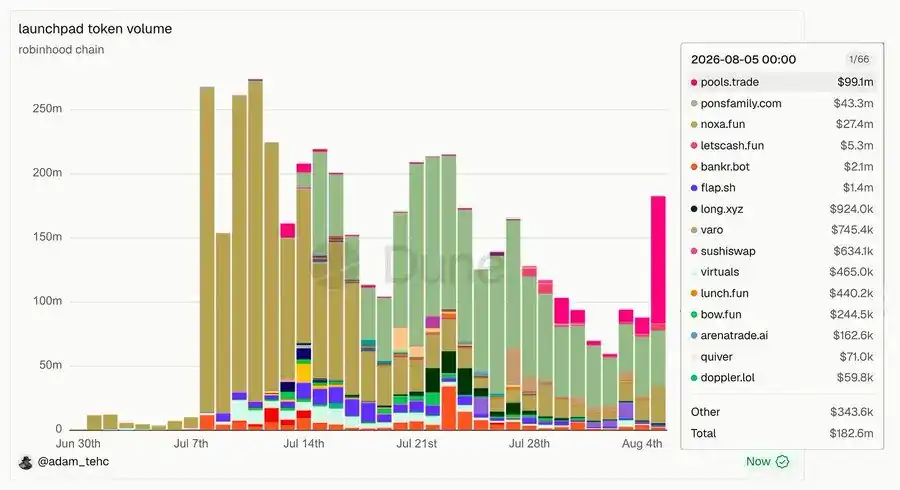
Pools.trade: The Token Launch Platform Introduced by Uniswap Itself

Project Overview

Pools.trade is a token launch platform launched by Uniswap Labs on Robinhood Chain. Officially positioned as a Meme coin launchpad, users can create new tokens, discover new coins, and trade—all on the same page. Each token has a fixed total supply of 1 billion tokens, ultimately entering Uniswap v4 with liquidity permanently locked.

Tokens launched on Pools.trade are immediately integrated into the Uniswap web interface, wallet, Launches page, and Trading API, reaching MetaMask, Ledger, and multiple DEX aggregators. Compared to new platforms starting from scratch to find trading entry points, Pools.trade launched with Uniswap's ready-made user base and distribution channels.

Two Launch Methods

Pools.trade offers Instant Launch and Crowd Launch modes, respectively:

  • Instant Launch: Launch immediately. After the creator fills in the name, ticker, image, and description, the token opens for trading directly. The price fluctuates with market buying and selling, with no minimum market cap requirement or fixed end time.
  • Crowd Launch: Employs a four-hour launch window. Participants submit budgets in advance, with orders executed progressively throughout the remaining time—typically the earlier the participation, the lower the price. After the launch ends, if the token's FDV reaches $10,000, it enters trading; if it fails to meet the threshold, all participating funds are refunded. This mode primarily aims to reduce the impact of bot front-running and bundle transactions at launch.

The Platform's Most Prominent Feature: Trading Fees Only a Quarter of Pons and Flap

Pools.trade does not charge additional launchpad fees. Each transaction incurs a 0.25% Uniswap v4 pool fee. If the creator enables the fee split, 0.05% goes to the creator, and 0.20% is automatically reinvested into the permanently locked liquidity pool. Uniswap Labs does not take a share.

Trading fees for both Pons and Flap are 1%. Calculating with $10 million in trading volume: Pools.trade generates $25,000 in fees, with the token creator receiving $5,000; Pons generates $100,000 in fees, and based on a 70% creator share, the token creator would receive $70,000.

Pools.trade lowers transaction costs and keeps most of the fees within the liquidity; Pons and Flap offer higher direct income incentives for token creators. The former benefits trading more, while the latter provides more direct motivation for creators.

For a detailed introduction, recommended reading: "Uniswap Launches Token Launch Platform Pools.trade, Reshuffling the Robinhood Launchpad Ecosystem?".

Only Two Tokens Surpass $1 Million Market Cap, Early Minting Raises Fairness Concerns

Compared to the impressive number of token launches and platform trading volume, Pools.trade has not yet produced a high-market-cap Meme coin. As of now, only two tokens on Pools.trade have a market cap above $1 million, namely FRONG and POOLS; additionally, tokens with a market cap above $400,000 include HOOKR, UNIPEG, CHWDR, and PosM.
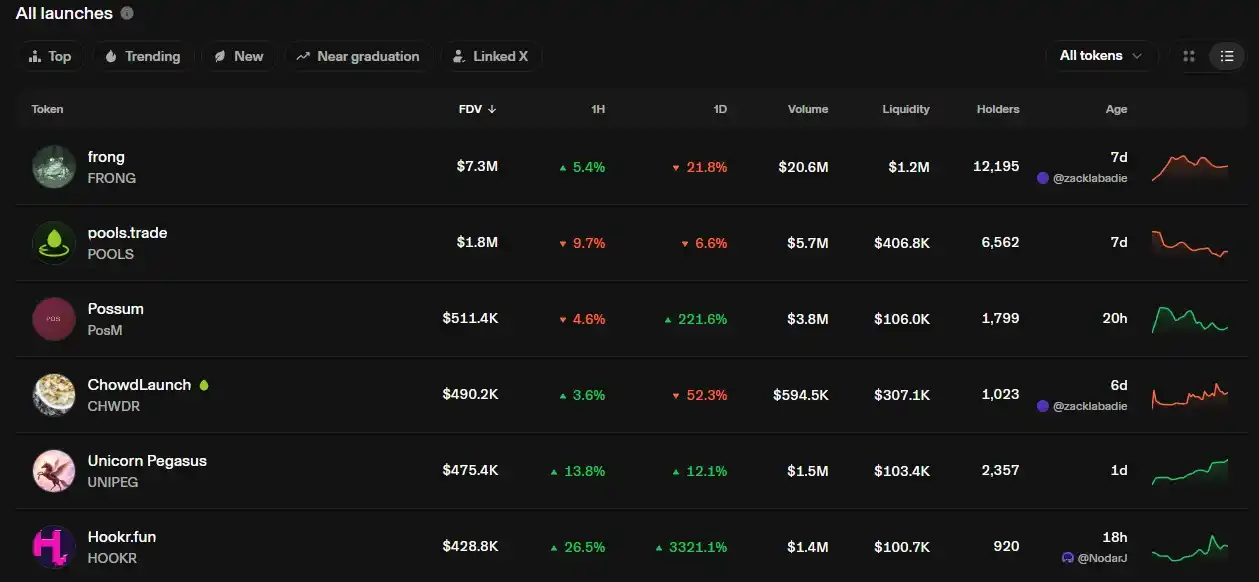
FRONG: Market Cap Once Touched $18 Million

FRONG is currently the highest-market-cap Meme on Pools.trade. At 00:00 on August 5th, Uniswap's official Twitter account began the 24-hour countdown for Pools.trade's launch, posting a video of a frog "playing" by a pond.

After the tweet was posted, the community quickly noticed the frog-themed Meme coin—FRONG—issued through the Pools.trade early contract and began to view it as the platform's mascot concept coin. Driven by this FOMO sentiment, FRONG's market cap briefly touched $18 million.
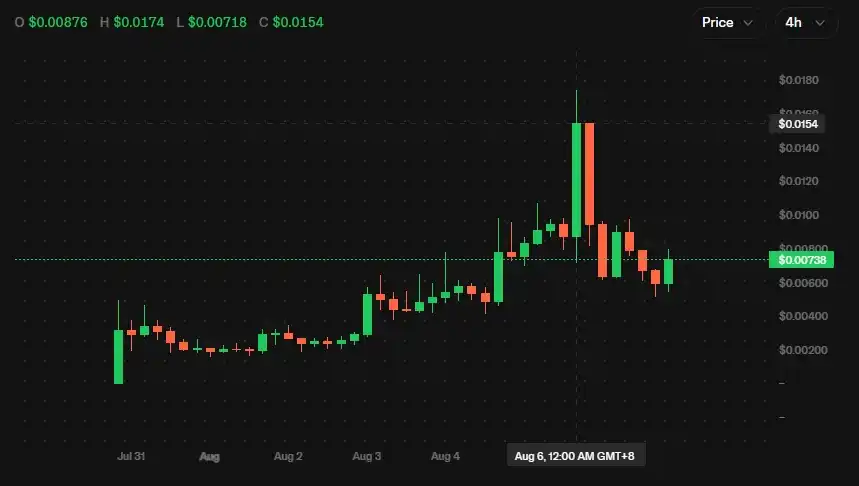
However, FRONG had already been minted via contract before Uniswap even started the Pools.trade launch countdown. On-chain records show that FRONG was minted and a trading pool was established as early as July 30th, five days before Uniswap's countdown announcement; related contracts were even deployed roughly three weeks prior, at that time with no indication of affiliation with Uniswap or Pools.trade.

As this time gap was discovered, questions arose about the fairness of FRONG's launch, and its market cap rapidly retreated from its highs. Even after Pools.trade officially launched yesterday at 00:00, FRONG did not receive strong community enthusiasm, its market cap remaining below $10 million, currently reported at around $7 million.

POOLS: Market Cap Once Broke $4 Million

POOLS, currently the second-highest market cap token on Pools.trade, shares a similar situation with FRONG—it was also a Meme coin minted before the platform's official launch.

Compared to FRONG's "frog mascot" narrative, POOLS's logic is more direct—its name matches the platform, so the community treated it as the Pools.trade concept coin. Its market cap once exceeded $4 million before falling back to around $1.8 million.
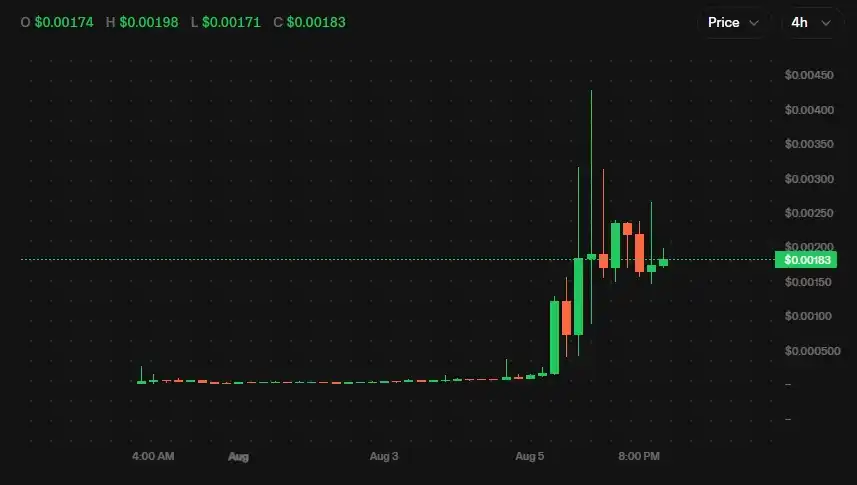
FRONG relied on the "frog mascot" narrative, POOLS on the platform's namesake—both should have had higher market cap expectations. However, both faced diminished community FOMO sentiment due to the "insider trading" controversy arising from early minting, resulting in market caps below $10 million.

The most fundamental logic of Meme coins is that everyone wants to believe they are starting from the same line. Once fairness is questioned, even the best token narrative struggles to sustain spontaneous community propagation. This is perhaps why Pools.trade, despite impressive data, has yet to produce a high-market-cap Meme coin.

However, Uniswap stands behind Pools.trade, and Robinhood Chain is one of the most discussed public chains for Memes at the moment. Currently, the platform lacks not for traffic, but for a new narrative that is intriguing enough and free from "insider trading" controversy. The first "speedrun" on Pools.trade might not be far off.

Criptos en tendencia

Preguntas relacionadas

QWhat was the main reason why Pools.trade's launch did not go as planned according to the article?

AThe main reason was that the community discovered and started trading tokens on the early deployed contracts before the official front-end launch, generating over $150 million in volume and forcing Uniswap to scramble to adjust the site and data indexing, disrupting the planned launch schedule.

QWhat are the two token launch modes offered by Pools.trade?

APools.trade offers two modes: Instant Launch (immediate token creation and trading with no minimum market cap or fixed end time) and Crowd Launch (a 4-hour launch window where orders are filled progressively, with a $10,000 FDV threshold for the token to go live post-launch).

QHow does the transaction fee structure of Pools.trade compare to platforms like Pons and Flap?

APools.trade charges a 0.25% fee per transaction (0.05% to the creator and 0.20% auto-reinvested into the permanently locked liquidity pool), while Pons and Flap charge a 1% fee, which offers creators a higher direct revenue share.

QAccording to the article, why haven't any high-market-cap meme coins emerged on Pools.trade despite its high volume?

AThe primary reason is that the early high-profile tokens like FRONG and POOLS were minted before the official platform announcement, leading to 'fair launch' controversies and 'rat warehouse' accusations, which severely dampened community FOMO and trust, undermining their potential for sustained growth.

QWhat key advantage does Pools.trade have over new token launch platforms, as mentioned in the article?

APools.trade's key advantage is that it launches with immediate access to Uniswap's existing user base, distribution channels, and integrations (like the Uniswap web interface, wallet, Launches page, Trading API, MetaMask, Ledger, and DEX aggregators).

Lecturas Relacionadas

Las acciones se disparan un 655%, dos hermanos de Sichuan logran una OPV de semiconductores de 50.000 millones de yuanes

La empresa china de componentes para equipos de semiconductores Chengdu Ultra-Pure Applied Materials Co., Ltd. (Ultra-Pure) cotizó en la Bolsa de Shenzhen. Su precio de apertura fue de 450 yuanes por acción, un aumento del 581,92% respecto al precio de emisión de 65,99 yuanes, alcanzando una capitalización bursátil de más de 500.000 millones de yuanes. La oferta pública recaudó aproximadamente 1.680 millones de yuanes. Fundada en 2005 y calificada como empresa "pequeña gigante" especializada, Ultra-Pure es un proveedor clave de piezas especiales con revestimiento y componentes ópticos de precisión para equipos de fabricación de semiconductores, incluidos procesos de 5 nm o inferiores. Según un informe, ocupó el primer lugar en cuota de mercado entre las empresas locales de piezas con revestimiento especial para equipos de semiconductores en China en 2024. Sus ingresos principales provienen de las piezas con revestimiento especial, que representaron el 95,53% de los ingresos en 2025. Los ingresos totales de 2023 a 2025 superaron los 900 millones de yuanes, con un crecimiento significativo. La empresa tiene una alta concentración de clientes, siendo sus principales compradores empresas como Naura y AMEC. Los hermanos Chai Jie (Presidente) y Chai Lin (Director de Ingeniería) controlan conjuntamente la empresa. El mercado global de estos componentes está dominado por empresas de EE.UU., Europa y Japón. Con la aceleración de la localización de la cadena de suministro de semiconductores en China, se espera que aumente la tasa de sustitución de importaciones, ofreciendo espacio para el crecimiento de empresas locales como Ultra-Pure. Los fondos recaudados en la cotización se destinarán a expandir la capacidad y la I+D.

marsbitHace 25 min(s)

Las acciones se disparan un 655%, dos hermanos de Sichuan logran una OPV de semiconductores de 50.000 millones de yuanes

marsbitHace 25 min(s)

Opinión: Los altcoins quizás aún tengan salvación, pero los "VC coins" realmente no tienen futuro.

Autor: Haotian. Tras conversar profundamente con varios expertos en cadenas de bloques, existe un alto consenso sobre las reglas de supervivencia en el ciclo actual: el mercado ha cambiado completamente de "escuchar historias y especular con expectativas" a "observar el flujo de caja y verificar la implementación". Se comparten algunas ideas clave (solo como referencia): 1) Priorizar activos con capacidad real de capturar valor. En mercados bajistas, solo importan el flujo de caja real y los registros de recompra y destrucción. El "salvoconducto" este ciclo son protocolos que generen tarifas de forma sostenida y las devuelvan a los holders mediante recompra, destrucción o dividendos. Ejemplos: plataformas de lanzamiento como $UNI, $PUMP, $PONS, y el destacado $HYPE. 2) Elegir solo proyectos con Product-Market Fit (PMF) verificado y un ciclo completo implementado. Los enfoques narrativos futuros probablemente serán "tokenización de activos" y "Economía Agéntica" (Perps, predicciones, stablecoins, pagos). El mercado validará la utilidad práctica. Proyectos sin usuarios reales, ciclos de transacción o ingresos serán filtrados rápidamente. Ejemplos a seguir: $ONDO, $VVV, $VIRTUAL, evaluando métricas como AUM, volumen real y capacidad de generar tarifas. 3) Optar por activos con un fuerte "consenso" orgánico y duradero, no fabricado. Los únicos que han resistido múltiples ciclos son aquellos con consenso auténtico de la comunidad. Ejemplos: memes antiguos como $DOGE, $PEPE, $PEOPLE, o líderes de nicho como $ZEC y $TAO, que mantienen liquidez y vitalidad comunitaria. 4) Evitar en lo posible las "monedas VC". A diferencia de las altcoins, que pueden tener ciclos, las monedas respaldadas principalmente por capital de riesgo (VC) enfrentan un desafío estructural: alta valoración fully diluted (FDV), baja circulación y desbloqueos continuos de grandes sumas. Dependen del hype previo al lanzamiento (TGE) y, sin capacidad de capturar valor, sufren presión vendedora masiva tras cada desbloqueo, disuadiendo a los inversores minoristas. Nota: Estas son conclusiones de discusiones personales. Los ejemplos de tokens son solo ilustrativos y no constituyen consejo de inversión.

marsbitHace 55 min(s)

Opinión: Los altcoins quizás aún tengan salvación, pero los "VC coins" realmente no tienen futuro.

marsbitHace 55 min(s)

Trading

Spot

Artículos destacados

Cómo comprar CAP

¡Bienvenido a HTX.com! Hemos hecho que comprar Cap (CAP) sea simple y conveniente. Sigue nuestra guía paso a paso para iniciar tu viaje de criptos.Paso 1: crea tu cuenta HTXUtiliza tu correo electrónico o número de teléfono para registrarte y obtener una cuenta gratuita en HTX. Experimenta un proceso de registro sin complicaciones y desbloquea todas las funciones.Obtener mi cuentaPaso 2: ve a Comprar cripto y elige tu método de pagoTarjeta de crédito/débito: usa tu Visa o Mastercard para comprar Cap (CAP) al instante.Saldo: utiliza fondos del saldo de tu cuenta HTX para tradear sin problemas.Terceros: hemos agregado métodos de pago populares como Google Pay y Apple Pay para mejorar la comodidad.P2P: tradear directamente con otros usuarios en HTX.Over-the-Counter (OTC): ofrecemos servicios personalizados y tipos de cambio competitivos para los traders.Paso 3: guarda tu Cap (CAP)Después de comprar tu Cap (CAP), guárdalo en tu cuenta HTX. Alternativamente, puedes enviarlo a otro lugar mediante transferencia blockchain o utilizarlo para tradear otras criptomonedas.Paso 4: tradear Cap (CAP)Tradear fácilmente con Cap (CAP) en HTX's mercado spot. Simplemente accede a tu cuenta, selecciona tu par de trading, ejecuta tus trades y monitorea en tiempo real. Ofrecemos una experiencia fácil de usar tanto para principiantes como para traders experimentados.

468 Vistas totalesPublicado en 2026.06.26Actualizado en 2026.06.26

Cómo comprar CAP

Discusiones

Bienvenido a la comunidad de HTX. Aquí puedes mantenerte informado sobre los últimos desarrollos de la plataforma y acceder a análisis profesionales del mercado. A continuación se presentan las opiniones de los usuarios sobre el precio de CAP (CAP).

活动图片