DeepSeek V4 Official Version Arrives, New Capabilities Emerge, Value-for-Money King Enters the Fray

marsbitPublicado a 2026-07-31Actualizado a 2026-07-31

Resumen

On July 31st, DeepSeek officially launched the public API beta for its DeepSeek-V4-Flash model. A key highlight is its performance on multiple Agent benchmark tests, reportedly nearing or even surpassing the level of the V4-Pro preview version from three months ago. Notably, the Flash model achieves this with significantly smaller scale (130B active parameters vs. Pro's 490B), suggesting that post-training optimization and data quality may be as crucial as raw model size. DeepSeek emphasized that the V4-Flash-0731 uses the same model architecture and size as its preview version, with improvements attributed solely to "re-trained post-training." The update also marks the official debut of DeepSeek's self-developed Agent framework, "Harness." The move signals DeepSeek's strategic push to position its cost-effective Flash model as a competitive base for Agent applications—scenarios requiring autonomous planning, tool usage, and complex task execution—where inference speed and cost are critical. By natively supporting OpenAI's Responses API format and adapting for code-generation scenarios, DeepSeek aims not just to be a cheaper alternative but to establish its own ecosystem in the Agent era. This release follows DeepSeek's record-breaking ~$50 billion fundraising round roughly two months prior, underscoring market confidence in its technology and commercialization prospects. The company is reportedly preparing for another funding round at a valuation of approximately $71 bill...

On the afternoon of July 31st, Phoenix Net Technology discovered upon checking the DeepSeek official website that the DeepSeek-V4-Flash official version API has been launched for public beta testing. Unlike the previous hierarchical logic of “Pro strong, Flash weak”, this update signals a noteworthy shift—the performance of the Flash official version in multiple Agent benchmark tests has approached or even surpassed the level of the V4-Pro preview version from three months ago.
The official update log shows that the V4-Flash official version scored 82.7 points on Terminal Bench 2.1, 54.2 points on NL2Repo, 76.7 points on Cybergym, and 70.3 points on Toolathlon verified. In contrast, the V4-Pro preview version scored 67.9 points on Terminal Bench 2.0.
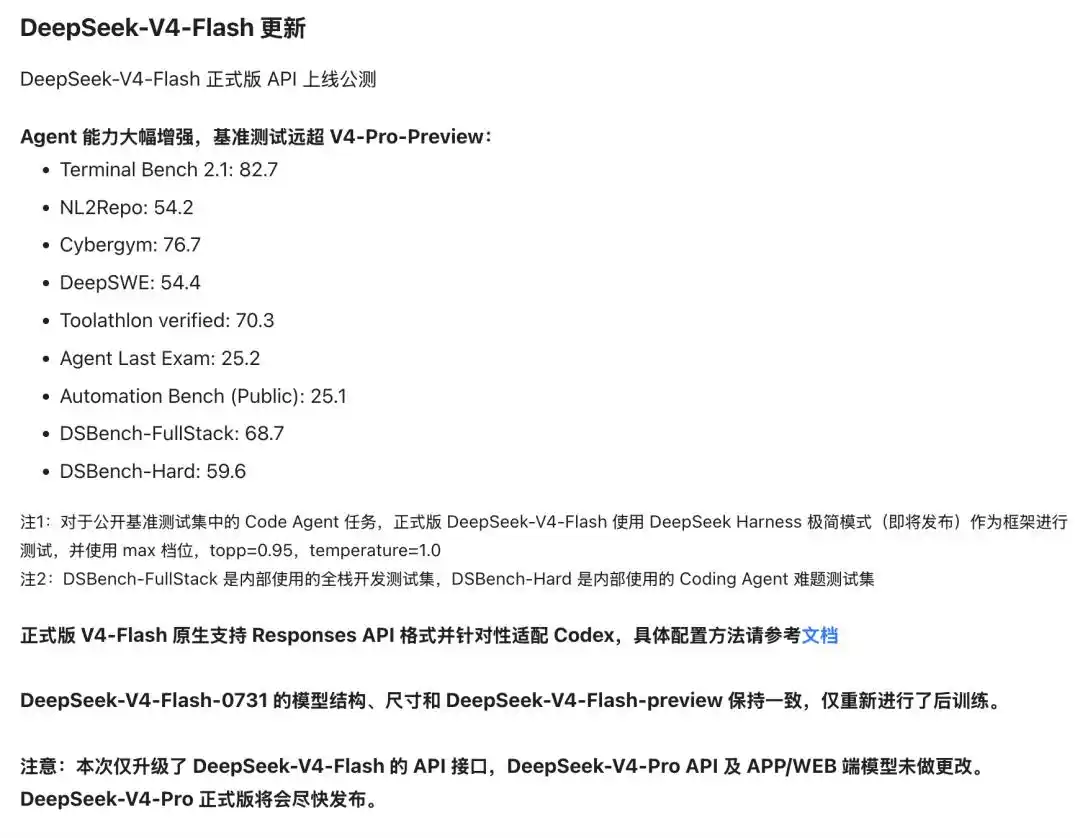
It is important to note that Terminal Bench 2.0 and 2.1 are not the same version of the test suite, so a direct comparison is not entirely fair. However, for a lightweight version with only 13 billion activation parameters to achieve such scores in Agent capabilities suggests that the optimization space in the post-training phase might offer greater leverage than simply scaling up parameters.

Additionally, DeepSeek also specifically noted that the current public beta is limited to the API, and the latest capabilities are not yet available on the App and web interface. The DeepSeek-V4-Pro official version will be released as soon as possible.

“Only Underwent Post-Training Again”

The DeepSeek official statement in the update log indicates, “The model architecture, size, and parameters of DeepSeek-V4-Flash-0731 remain consistent with DeepSeek-V4-Flash-preview; only post-training was conducted again.”

According to DeepSeek's official technical report, V4-Flash has 284 billion total parameters and 13 billion activation parameters; V4-Pro has 1.6 trillion total parameters and 49 billion activation parameters. The two differ by an order of magnitude in model scale. If Flash can bring its Agent capabilities close to Pro's level through post-training, it implies that for specific tasks, model scale is not the decisive factor—the weight of training methods and data quality is rising.

The official also specially noted that for the Code Agent tasks in the public benchmark tests, the DeepSeek Harness minimal mode was used as the framework for testing, with max setting, topp=0.95, temperature=1.0. This detail suggests that DeepSeek may have made targeted optimizations at the Agent framework level, not just improvements in the model itself.

This is also the first time DeepSeek's self-developed Harness has appeared under an official name. Previously, Liang Wenfeng compared the path to AGI to climbing stairs: language models are the first step, CoT (Chain-of-Thought) was addressed last year, this year's step is Agent, and the problem that must be solved after Agent is continuous learning—enabling models to accumulate experience over time like humans, rather than requiring the full context to be fed in every time to work. Beyond that lies the “singularity” of self-iteration and embodied intelligence. “AI currently lacks not taste or intuition, but the ability for continuous learning,” he said. “Investors look at Agent; we look at how to solve learning.”

Continuous learning sounds like a model-level proposition, but its engineering focal point lies precisely in the Harness. DeepSeek's Agent Harness team was formed in March this year. Leading it is Cui Tianyi, born in the 1990s, a Zhejiang University computer science graduate, holder of six ACM Asia Regional Competition gold medals, who previously worked for nine years at top quantitative firm Jane Street, joined DeepSeek in March this year, and subsequently aggressively recruited in May.

It is reported that DeepSeek plans to launch the Harness concurrently with the V4 official version release. Furthermore, as DeepSeek stated at the end of the log, “The DeepSeek-V4-Pro official version will be released as soon as possible.”

A Direct Confrontation at the Ecosystem Level

If large model competition in 2023 was about “competing on general capabilities” and 2024 was about “competing on long context,” then the keyword for 2026 is undoubtedly Agent.

Agent capability—the model's ability to autonomously plan, call tools, and execute complex tasks—is becoming the new yardstick for measuring large model strength. From Terminal Bench (terminal operations) and NL2Repo (code repository generation) to Cybergym (cybersecurity tasks) and SWE-bench (software engineering), a series of Agent benchmark tests are redefining what makes a good model.

Globally, the first tier of Agent capability is still dominated by closed-source giants. According to data from third-party evaluation platforms like benchlm.ai, GPT-5.6 Sol and the Claude Opus series rank at the top in most Agent benchmark tests. Among domestic players, GLM, Qwen, and others are also catching up quickly.

DeepSeek's significant boost to Flash's Agent capabilities this time has a clear strategic intent: to enter the vast market of Agent applications with a high-value, lightweight model.

After all, Agent scenarios are far more sensitive to inference speed and cost than pure dialogue scenarios. An Agent task requiring repeated tool calls and multi-step reasoning could cost several times or even tens of times more to run on a flagship model compared to Flash. If Flash's Agent capability reaches a level that is “sufficient or even good,” its cost-performance advantage will be highly disruptive.

The two internal test sets officially released also have clear targets. DSBench-FullStack (internal full-stack development test set) scored 68.7, and DSBench-Hard (internal Coding Agent difficult problem test set) scored 59.6. This indirectly confirms DeepSeek's positioning—to build Flash as the preferred foundation for developers and Agent applications.

A quiet ecosystem battle is also brewing. The official V4-Flash natively supports the Responses API format and is specifically adapted for Codex.

The Responses API is a new-generation API format strongly promoted by OpenAI. Compared to the traditional Chat Completions, it is more suitable for Agent scenarios—supporting more flexible tool calls, more complex multi-turn interactions, and finer-grained output control.

DeepSeek's native support for this format means developers can migrate Agent applications developed based on the OpenAI ecosystem to DeepSeek at a lower cost. This will be a direct confrontation between the two at the ecosystem level.

The adaptation for Codex targets the vertical scenario of code generation and software development. Codex is OpenAI's model for the code domain. DeepSeek's targeted adaptation is a direct challenge in OpenAI's traditional area of strength.

Viewed together, these moves indicate that DeepSeek's ambition is not just to be a “cheap alternative” but to establish its own niche in the Agent era.

After the 50 Billion RMB Financing: Time Window Under High Valuation

This update comes less than two months after DeepSeek completed its first round of external financing.

A little over a month ago, DeepSeek completed its first external financing round since its founding nearly three years ago, raising over 50 billion RMB, setting a single-round financing record in China's AI industry, with a post-money valuation of approximately $52 billion (about 350 billion RMB). Investors included industry giants like Tencent, CATL, JD.com, as well as several state-owned industrial funds.
In mid-July, DeepSeek intended to advance a new round of private financing with a pre-money valuation of about $71 billion (approximately 480 billion RMB), a roughly 37% increase from the $52 billion valuation after the first round. The interval from $52 billion to $71 billion was less than six weeks.

Behind the high valuation lies market recognition of DeepSeek's technical strength and bets on its commercialization prospects. However, high valuation also means high expectations and high pressure.

According to multiple media reports, DeepSeek founder Liang Wenfeng personally contributed approximately 20 billion RMB in the first financing round, maintaining firm control of the company through a special structure. This founder, who emerged from the quantitative firm Phantom, had insisted on self-funding for nearly three years previously. The shift from “no financing, no IPO” to actively embracing capital is itself a strong signal—DeepSeek is accelerating toward commercialization and an IPO.

The launch of the Flash official version can perhaps be seen as a technological realization by DeepSeek under the support of capital. But the real test lies ahead: Can the Pro official version arrive on schedule? Can the improvement in Agent capability translate into solid revenue? Under the pressure from giants like OpenAI and Anthropic, how will DeepSeek leverage its high-value route?

The curtain on the Agent war has just risen. DeepSeek, with a significant evolution of a lightweight model, poses a new question to the industry—when the dividends of post-training are fully exploited, when efficiency gains begin to offset the parameter gap, the competitive logic of large models may need to be rewritten.

This article is from the WeChat public account “Phoenix Net Technology,” author: Phoenix Net Technology


Criptos en tendencia

Preguntas relacionadas

QWhat key feature of DeepSeek-V4-Flash's official release is highlighted by the updated benchmark scores, and how does it compare to the V4-Pro preview?

AThe key feature is the significant enhancement of Agent capabilities. Although direct comparison is limited because Terminal Bench 2.0 and 2.1 are different versions, the article notes that the smaller V4-Flash model (with 130B activated parameters) achieved benchmark scores that approach or even surpass those of the much larger V4-Pro preview model (with 490B activated parameters) from three months prior, particularly in Agent-related tests. This suggests that post-training optimizations can be highly effective, challenging the notion that model size alone determines performance.

QAccording to the article, what does the release of the DeepSeek-V4-Flash official version represent in the broader AI model competition landscape?

AThe release represents a strategic move in the Agent-centric competition era of 2026. By boosting the Agent performance of its more cost-effective, lighter Flash model, DeepSeek aims to capture the growing market for Agent applications where inference speed and cost are critical. This positions it as a high-value, 'good enough' alternative to more expensive flagship models like GPT-5.6 Sol and Claude Opus, directly challenging OpenAI and others on their home turf, especially in tool-use and code generation scenarios.

QWhat role does the newly named DeepSeek Harness play, as mentioned by CEO Liang Wenfeng, in the path toward AGI?

ACEO Liang Wenfeng likens the path to AGI to climbing stairs. While 2023 focused on language models and 2024 on long-context, the current step is Agent capability. Beyond that, he identifies 'sustained learning'—the ability for models to accumulate experience like humans without needing full context every time—as the critical next challenge. The DeepSeek Harness, their self-developed Agent framework, is identified as the key engineering tool for enabling this crucial 'sustained learning' capability, making it central to their long-term AGI strategy.

QHow does the DeepSeek-V4-Flash's native support for the Responses API format and Codex adaptation impact its competitive position?

AIt represents a direct ecosystem-level challenge to OpenAI. Native support for OpenAI's Responses API format lowers the barrier for developers to migrate Agent applications built on OpenAI's ecosystem to DeepSeek's platform. Additionally, targeted adaptation for Codex, OpenAI's code-specific model, indicates a direct assault on OpenAI's traditional stronghold of code generation. These moves are part of a strategy for DeepSeek to establish its own ecosystem in the Agent era, moving beyond just being a cost-effective alternative to becoming a primary platform.

QWhat recent financial event for DeepSeek does the article connect to this technical release, and what pressures does it imply?

AThe article connects the V4-Flash release to DeepSeek's recent record-breaking fundraising of over 50 billion RMB (~$5.2 billion post-money valuation) and its subsequent plans for a new round at a valuation of approximately $71 billion. The high valuation reflects market confidence in its technology and commercialization potential but also creates significant pressure to deliver results. This technical release is seen as an initial 'delivery on the promise' following the capital influx. The true test will be whether improved Agent capabilities can translate into real revenue growth and if the upcoming V4-Pro official version can meet high expectations amidst intense competition.

Lecturas Relacionadas

El 'Aguafiestas' más famoso de Wall Street vuelve a apuntar a Nvidia

Un informe reciente reveló que Michael Burry, el famoso gestor de fondos conocido por predecir la crisis de las hipotecas subprime y retratado en "The Big Short", ha tomado posiciones cortas en varias empresas tecnológicas, destacando su apuesta contra Nvidia. Según sus declaraciones en Substack, Burry cuestiona la sostenibilidad del auge de la IA, señalando dos problemas principales: una posible "financiación circular fuera de balance" y una "sobreestimación de la vida útil de depreciación" de los chips de IA por parte de los clientes de Nvidia, como Microsoft, Google y Meta. Esto, argumenta, podría inflar artificialmente la rentabilidad reportada en toda la cadena de suministro. La reacción del mercado fue mixta. Tras los anuncios de Burry, el precio de las acciones de Nvidia experimentó volatilidad, cayendo cerca de un 5% en un día después de un informe sobre posibles avales financieros a clientes, antes de estabilizarse alrededor de los 200 dólares. Las posiciones cortas de Burry, abiertas a 198,09 dólares y aumentadas a 210,28 dólares, mostraban ligeras pérdidas flotantes a finales de julio. El artículo analiza el historial de Burry después de su éxito en 2008, señalando aciertos en crisis estructurales (como la pandemia de 2020) pero también notables errores de tiempo, como sus apuestas fallidas contra Tesla y Palantir en el pasado. Su metodología, basada en el análisis minucioso del flujo de caja libre y los documentos financieros originales, es efectiva para identificar riesgos subyacentes pero no para predecir su momento de materialización. La posición de Burry no es unánime. Otros inversores destacados, como Steve Eisman (otro protagonista de "The Big Short"), se muestran cautelosos pero no apuestan directamente contra Nvidia, citando su fuerte crecimiento de ingresos. Jim Chanos coincide en la preocupación por las prácticas contables, pero enfoca sus ventas en corto hacia empresas de capital privado con alta exposición inmobiliaria, no contra los fabricantes de chips. El artículo concluye que, más allá de si Burry acertará esta vez, el verdadero valor para los inversores reside en el tipo de preguntas críticas que plantea: cómo se pueden maquillar las cifras contables, qué riesgos estructurales se pasan por alto y qué investigar cuando todo el mundo asume que "esta vez es diferente". Replicar sus apuestas específicas es menos relevante que adoptar un enfoque escéptico y fundamentado.

marsbitHace 8 min(s)

El 'Aguafiestas' más famoso de Wall Street vuelve a apuntar a Nvidia

marsbitHace 8 min(s)

Selección Semanal: Terremoto épico en la bolsa, la salida a bolsa de Changxin Technology redefine el panorama del almacenamiento, Saylor apunta a reanclar STRC alrededor del 8 de septiembre

**Resumen del artículo:** PANews presenta una selección semanal de contenido destacado. La IA impulsa nuevos campos de batalla en cripto, como las carteras para agentes de IA, con gigantes como Coinbase posicionándose. La volatilidad extrema sacude los mercados: la bolsa coreana sufre múltiples suspensiones, arrastrada por acciones como SK Hynix, mientras que el mercado de cripto muestra cierta calma en comparación. En macro, destaca la salida a bolsa de ChangXin Technology, alcanzando una capitalización de 3.35 billones tras una década de pérdidas y un trimestre extraordinario. Citi advierte sobre riesgos extremos en materias primas para 2026. La Fed mantiene tasas, pero revela una rara división interna con un sesgo "halcón". Figuras como Tom Lee ven la caída de acciones de IA como una liquidación de apalancamiento, no el fin de la burbuja. Raoul Pal insta a mantener la perspectiva a largo plazo en cripto. La escasez de canales de inversión para minoristas chinos impulsa la búsqueda de alternativas como activos tokenizados. Se exploran oportunidades en protocolos como Fake World Assets (FWA), que combina NFT y loterías, y en mecanismos como las "tarifas prioritarias" de Hyperliquid. El sector RWA crece, pero enfrenta problemas de utilización. En Web3, Ethereum proyecta mejoras masivas para 2030. Lido ejecuta una migración histórica de staking. La "guerra de las stablecoins" se intensifica con nuevos retadores como OUSD frente a USDC. **Información clave:** Alzas en índices bursátiles y acciones de mineros de Bitcoin que se转型 (transicionan) hacia IA. Michael Saylor apunta a realinear STRC alrededor del 8 de septiembre. Empresas cotizadas en EE.UU. poseen el 92.7% de las tenencias corporativas globales de BTC. Financiaciones significativas en startups de IA.

marsbitHace 14 min(s)

Selección Semanal: Terremoto épico en la bolsa, la salida a bolsa de Changxin Technology redefine el panorama del almacenamiento, Saylor apunta a reanclar STRC alrededor del 8 de septiembre

marsbitHace 14 min(s)

Cuando el mercado empieza a cuestionar el gasto de capital en IA: análisis completo de los resultados del Q2 de las cinco grandes tecnológicas

A finales de julio de 2026, los gigantes tecnológicos Alphabet (Google), Intel, Microsoft, Meta y Apple presentaron sus resultados del segundo trimestre. La narrativa común fue un fuerte crecimiento en los ingresos y ganancias, impulsado por la demanda de IA, pero una creciente inquietud del mercado sobre los masivos gastos de capital (CapEx) en infraestructura de IA y el momento en que se materializarán los retornos. **Google y Meta** experimentaron fuertes caídas en sus acciones (Google -7%, Meta casi -10%) después de informar aumentos significativos en su guía de gastos de capital para 2026 y un flujo de caja libre que se volvió negativo o casi desapareció. Los inversores castigaron la presión sobre la generación de efectivo a corto plazo. **Intel** mostró su crecimiento de ingresos más fuerte en 15 años, pero sus acciones tuvieron una volatilidad extrema ("montaña rusa") después de que también elevó su perspectiva de gastos de capital, lo que generó preocupaciones sobre la deuda y el flujo de caja libre. En contraste, **Microsoft** fue el claro favorito del mercado. Sus acciones registraron su mejor día en 18 años después de superar las expectativas, alcanzar los $100 mil millones en ingresos anualizados con Azure y, crucialmente, *reducir* su guía de gastos de capital para 2026 prometiendo un flujo de caja libre positivo, lo que calmó los temores de los inversores. **Apple**, a pesar de reportar récords de ingresos y ganancias, vio su valor evaporarse en $300 mil millones en un día debido a una guía de ingresos para el próximo trimestre inferior a lo esperado, citando limitaciones en la cadena de suministro y presión cambiaria. En resumen, los resultados confirmaron la sólida demanda de IA, pero marcaron un punto de inflexión: el mercado ya no premia solo el crecimiento, sino que exige claridad sobre el camino y el ritmo hacia la rentabilidad y el retorno del flujo de caja libre de estas enormes inversiones.

Odaily星球日报Hace 21 min(s)

Cuando el mercado empieza a cuestionar el gasto de capital en IA: análisis completo de los resultados del Q2 de las cinco grandes tecnológicas

Odaily星球日报Hace 21 min(s)

a16z: De la empresa al DAO, DUNA podría convertirse en la próxima forma organizativa

A lo largo de la historia, el principal desafío empresarial ha sido cómo hacer colaborar a extraños con intereses diversos. Las formas organizativas han evolucionado para resolverlo: desde las estructuras familiares y las *commenda* medievales hasta la revolucionaria invención de la corporación con la Compañía Neerlandesa de las Indias Orientales (VOC), que permitió la colaboración a gran escala con responsabilidad limitada. Sin embargo, la corporación tradicional, diseñada para la era industrial, introduce problemas de agencia y burocracia. En la era digital, las Organizaciones Autónomas Descentralizadas (DAO) surgieron como una promesa de coordinación sin autoridad central. No obstante, se enfrentan a un vacío legal: carecen de reconocimiento formal, exponiendo a sus miembros a responsabilidad ilimitada, y su modelo desafía los marcos regulatorios existentes, como la prueba *Howey* de la SEC. La DUNA (Asociación No Incorporada Sin Fines de Lucro Descentralizada) se presenta como una innovación legal crucial. Reconocida ya en algunos estados de EE.UU., proporciona personalidad jurídica y responsabilidad limitada a un grupo descentralizado, permitiéndole celebrar contratos y operar como una entidad única. No resuelve todos los desafíos de gobernanza, pero llena el vacío legal, ofreciendo a las redes nativas de Internet una forma legítima para organizarse sin depender de estructuras jerárquicas forzadas o fundaciones en el extranjero. Así, la DUNA representa el siguiente salto evolutivo, extendiendo las protecciones de la colaboración empresarial moderna al ámbito de la gobernanza descentralizada.

marsbitHace 1 hora(s)

a16z: De la empresa al DAO, DUNA podría convertirse en la próxima forma organizativa

marsbitHace 1 hora(s)

Informe de mitad de año 2026 sobre RWA en cadena: El valor de mercado de las acciones tokenizadas se duplica en un año, pero el 90% de los derechos son solo una cáscara vacía

Informe intermedio de 2026 sobre RWA en cadena: La capitalización del mercado de acciones tokenizadas se duplica en un año, pero el 90% de los derechos son vacíos. Aunque los datos de valor bloqueado de activos tokenizados en cadena parecen sólidos, existe una contradicción fundamental: los productos con libre circulación a menudo carecen de derechos de propiedad reales, mientras que aquellos con validez legal efectiva carecen de liquidez. Según RWA.xyz, el valor de las acciones tokenizadas distribuidas casi se duplicó de marzo a julio de 2026, alcanzando los 1,890 millones de dólares. Sin embargo, este crecimiento está impulsado principalmente por unos pocos productos y plataformas, mostrando una concentración significativa (Ondo, xStocks y Securitize representan el 85.1%). El mercado se divide entre infraestructuras reguladas en EE.UU., que priorizan la seguridad jurídica, y productos offshore más accesibles. La tokenización de bonos del Tesoro muestra un mejor ajuste al mercado. El informe advierte que las cifras agregadas pueden ser engañosas, ya que combinan eventos económicos distintos (nuevas emisiones, cambios de precios), y subraya la falta de productos que combinen a escala la propiedad canónica, distribución amplia, liquidez institucional y descubrimiento de precios en cadena.

marsbitHace 1 hora(s)

Informe de mitad de año 2026 sobre RWA en cadena: El valor de mercado de las acciones tokenizadas se duplica en un año, pero el 90% de los derechos son solo una cáscara vacía

marsbitHace 1 hora(s)

Trading

Spot

Artículos destacados

Cómo comprar T

¡Bienvenido a HTX.com! Hemos hecho que comprar Threshold Network Token (T) sea simple y conveniente. Sigue nuestra guía paso a paso para iniciar tu viaje de criptos.Paso 1: crea tu cuenta HTXUtiliza tu correo electrónico o número de teléfono para registrarte y obtener una cuenta gratuita en HTX. Experimenta un proceso de registro sin complicaciones y desbloquea todas las funciones.Obtener mi cuentaPaso 2: ve a Comprar cripto y elige tu método de pagoTarjeta de crédito/débito: usa tu Visa o Mastercard para comprar Threshold Network Token (T) al instante.Saldo: utiliza fondos del saldo de tu cuenta HTX para tradear sin problemas.Terceros: hemos agregado métodos de pago populares como Google Pay y Apple Pay para mejorar la comodidad.P2P: tradear directamente con otros usuarios en HTX.Over-the-Counter (OTC): ofrecemos servicios personalizados y tipos de cambio competitivos para los traders.Paso 3: guarda tu Threshold Network Token (T)Después de comprar tu Threshold Network Token (T), guárdalo en tu cuenta HTX. Alternativamente, puedes enviarlo a otro lugar mediante transferencia blockchain o utilizarlo para tradear otras criptomonedas.Paso 4: tradear Threshold Network Token (T)Tradear fácilmente con Threshold Network Token (T) en HTX's mercado spot. Simplemente accede a tu cuenta, selecciona tu par de trading, ejecuta tus trades y monitorea en tiempo real. Ofrecemos una experiencia fácil de usar tanto para principiantes como para traders experimentados.

667 Vistas totalesPublicado en 2024.12.10Actualizado en 2026.06.02

Cómo comprar T

Discusiones

Bienvenido a la comunidad de HTX. Aquí puedes mantenerte informado sobre los últimos desarrollos de la plataforma y acceder a análisis profesionales del mercado. A continuación se presentan las opiniones de los usuarios sobre el precio de T (T).

活动图片