dogwifhat jumps 16% – but massive resistance stands in WIF’s path to more gains

ambcryptoPublicado a 2026-06-28Actualizado a 2026-06-28

Resumen

Dogwifhat (WIF) surged 16% in 24 hours, marking a potential rebound after a 38% year-to-date decline. However, the rally faces a major obstacle: a persistent descending resistance line that has rejected price advances three times previously. While key indicators like Accumulation/Distribution and the Money Flow Index signal strong buying pressure and capital inflow, WIF must achieve a confirmed breakout and close above this resistance to sustain its upward momentum. Additionally, liquidation data suggests limited near-term upside and room for further downside. The token's outlook hinges on decisively overcoming this key technical barrier.

dogwifhat [WIF] is staging a comeback after spending most of the year subdued, with the memecoin down 38% on a year-to-date basis yet up 16% over the past day.

Market analysis shows that a stronger rally could still take shape once the asset overcomes the key structural level that could keep its price from staging a surge.

A descending resistance line caps WIF’s rally

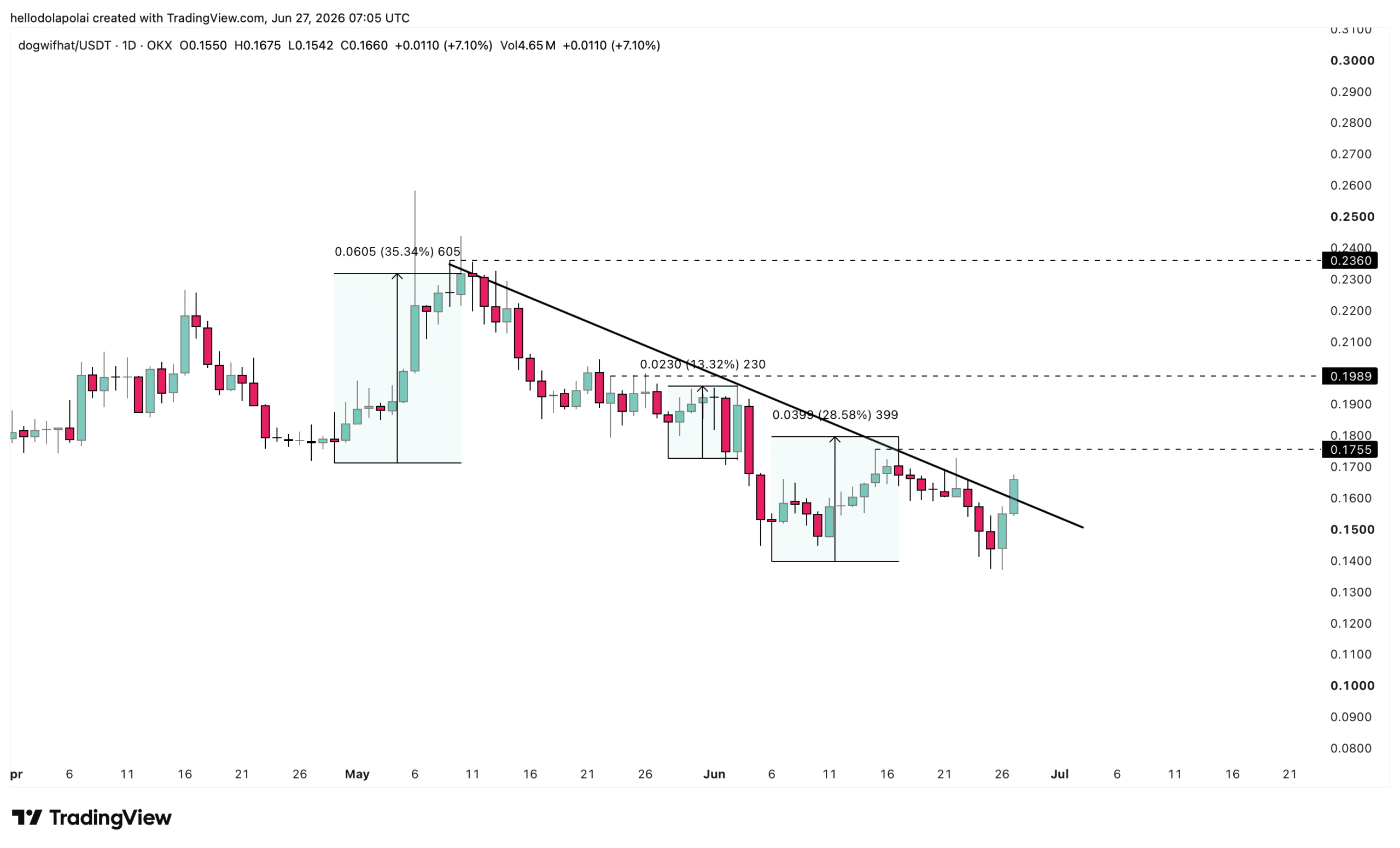
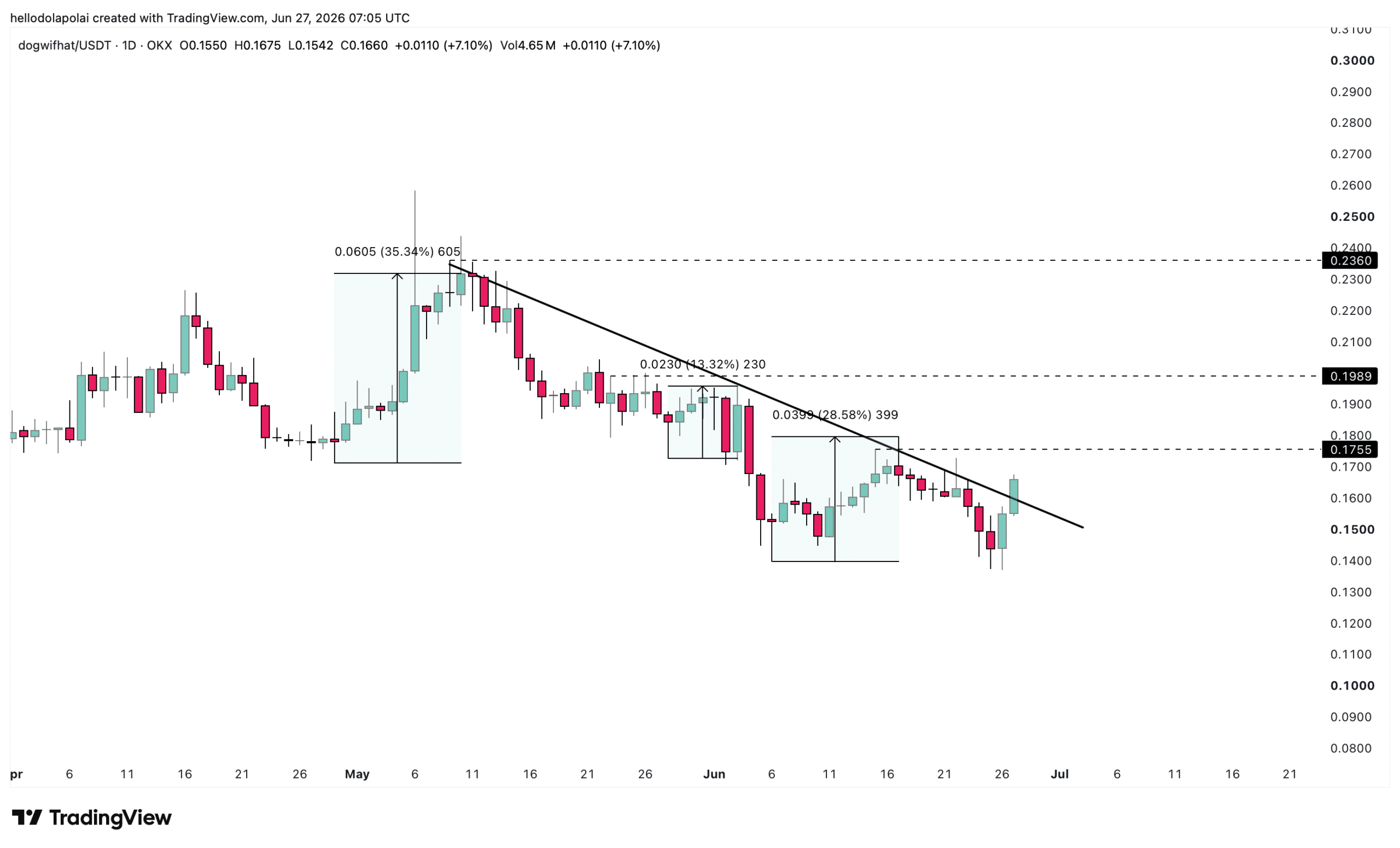
The major obstacle standing between WIF and a sizeable rally remains the descending resistance line that price has only marginally crossed.

The breakout cannot be confirmed as bullish yet. WIF’s price has not closed above the descending line, nor has it continued along the bullish path it began carving out days earlier.
Source: TradingView

For context, this same resistance has repeatedly capped WIF’s advances and forced the token to trade lower thrice in a row, even though each run leading into the level delivered double-digit gains.

A failure to push higher would leave WIF trudging beneath the resistance line for an extended period, adding to the 48 days it has already spent trading below this barrier.

Capital and buying indicators back WIF

WIF stands a strong chance of a major upswing, with the key indicators that track capital flow and buying activity all pointing in the same direction.

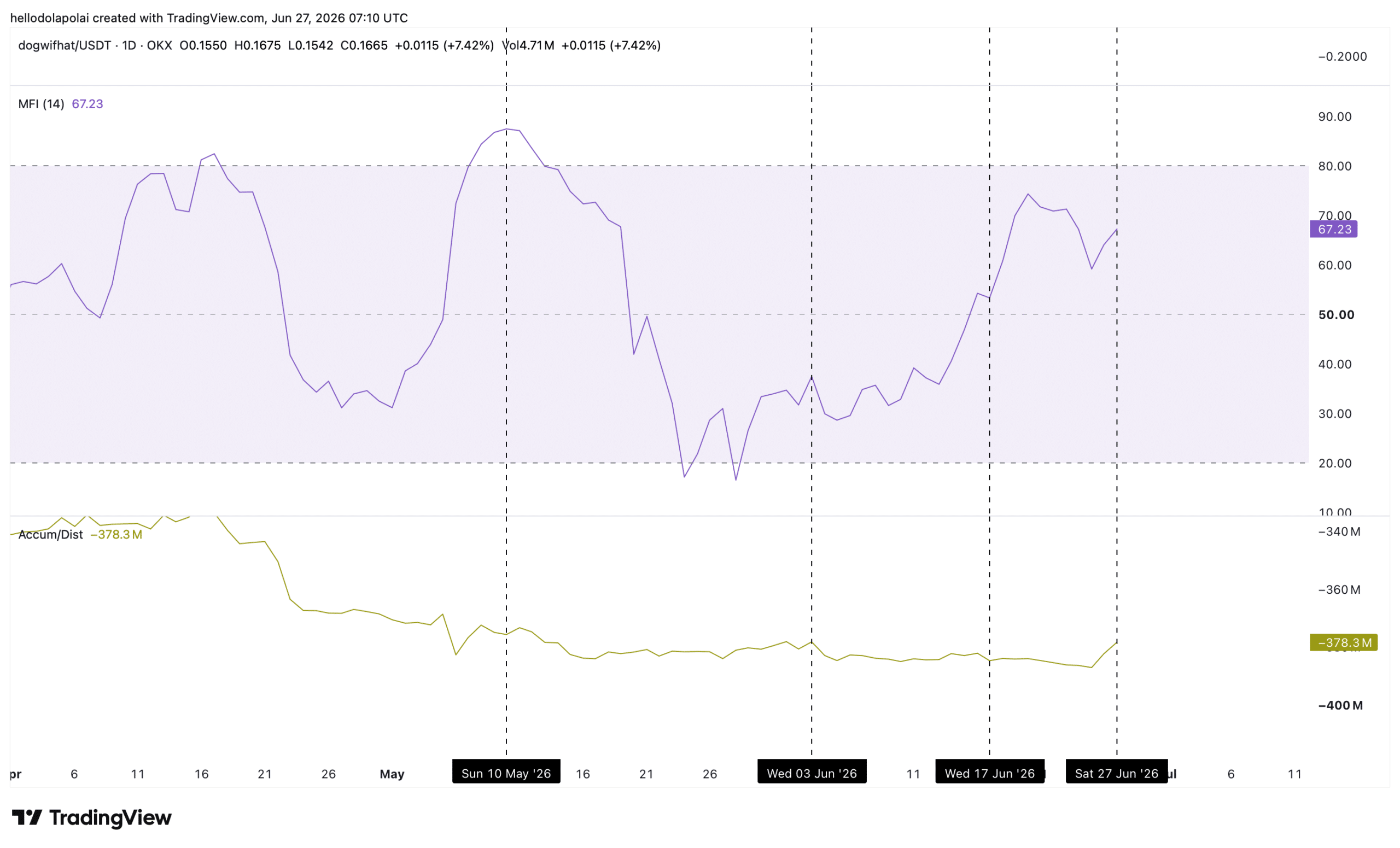
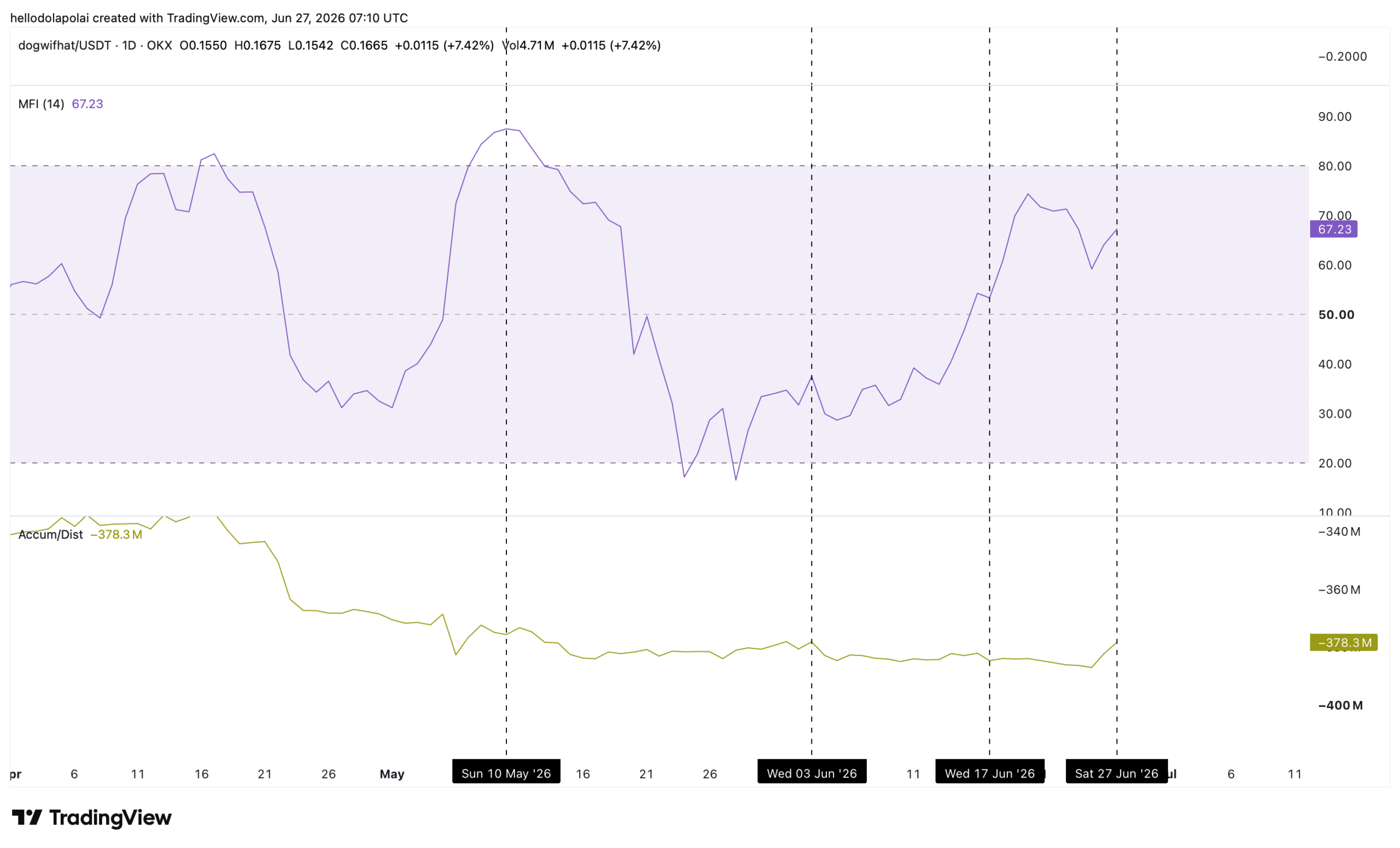
The accumulation/distribution indicator is showing a powerful upswing, which implies sustained buying, while total volume has settled at around 378 million WIF traded over the past 24-hour window.

Adding to this, the money flow index—which measures the movement of capital into and out of an asset—is surging upward at a reading of 67, signaling that more capital has flowed into WIF. More importantly, that reading sits in the bullish zone above 50, suggesting investors are actively buying.
Source: TradingView

The pattern worth noting appears at the vertical lines marking the points where price failed to breach the resistance mentioned earlier, where both indicators rallied into the level together—unlike previous instances in which one indicator rose while the other lagged, or one sat in overvalued territory.

A continued upward move would meaningfully reshape the outlook for WIF, since it would confirm a close above the resistance and establish a sustained bullish pattern.

Liquidation clusters limit WIF’s upside

The liquidation chart shows that WIF’s possible upside is limited, based on the arrangement of its clusters, which mark the levels where unfilled orders sit.

The downside below the current price level extends even further, suggesting WIF could still fall well beneath its present position despite the bullish momentum on display.

An important caveat applies here, as the liquidation heatmap offers only a glimpse rather than an extended view across a broader price spectrum. That leaves it unknown whether more buy orders sit beyond what the chart currently displays.


Final Summary

  • WIF has bounced 16% in a day after a rough year down 38%, and the signals that track buying activity suggest investors are stepping back in.
  • The rally isn’t safe yet, as WIF still needs to firmly clear a price ceiling that has rejected it three times before, and there’s room for it to slip lower first.


Preguntas relacionadas

QWhat is the current short-term performance of the dogwifhat (WIF) token mentioned in the article?

AAccording to the article, dogwifhat (WIF) has jumped 16% over the past day.

QWhat is identified as the major obstacle preventing WIF from a stronger rally?

AA descending resistance line is identified as the major obstacle. The price has not confirmed a bullish breakout as it hasn't closed above this line, which has rejected price advances three times before.

QWhat do the Accumulation/Distribution indicator and Money Flow Index suggest about buying activity for WIF?

AThe Accumulation/Distribution indicator shows a powerful upswing, implying sustained buying. The Money Flow Index is surging at a reading of 67, which is above 50, signaling that more capital is flowing into WIF and investors are actively buying.

QAccording to the article, what does the liquidation heatmap suggest about WIF's potential price movement?

AThe liquidation heatmap suggests that WIF's possible upside is limited by the arrangement of liquidation clusters. It also indicates that the downside below the current price level extends further, meaning WIF could still fall well beneath its present position despite the current bullish momentum.

QWhat two key points are summarized at the end of the article regarding WIF's outlook?

AFirst, WIF has bounced 16% with buying indicators suggesting investor interest is returning. Second, the rally isn't safe yet as WIF needs to firmly clear a key price resistance level that has rejected it three times, and there is room for the price to slip lower first.

Lecturas Relacionadas

Upbit se apresura: una contraofensiva apresurada para recuperar su participación en el mercado de stablecoins

Upbit lanzó una campaña promocional del 26 de julio al 9 de agosto, eliminando la comisión del 0.05% para transacciones con stablecoins en su mercado de won coreano, al tiempo que listaba rápidamente nuevas stablecoins como RLUSD y USDG. Estas medidas buscan recuperar participación en un mercado que ha cambiado drásticamente. Mientras Upbit dominaba con el 53.5% a inicios de 2025, para junio de 2026 su cuota había caído al 30.1%, superado por Coinone (34.8%) y Bithumb (31.1%). Este cambio se debe principalmente a la política de comisión cero permanente de Coinone para USDC, iniciada en octubre de 2025, que atrajo a usuarios sensibles a los costes. La demanda de stablecoins en Corea está fuertemente vinculada a la salida de capitales hacia intercambios y DeFi en el extranjero, mostrando una salida neta constante. La promoción de Upbit generó un aumento inicial del 162% en el volumen diario, impulsado casi en su totalidad por USDT. Sin embargo, el volumen ya mostraba signos de desaceleración en la segunda semana, y se espera que gran parte de las ganancias sean temporales una vez finalice la oferta, a menos que Upbit adopte una política de comisión cero permanente. El movimiento estratégico parece responder a un panorama regulatorio en evolución, con una futura ley coreana que regularía las stablecoins locales, y a la integración de Dunamu (matriz de Upbit) en Naver Financial, que planea un ecosistema de pagos con stablecoins. Aunque las regulaciones actuales podrían impedir que Upbit liste una eventual stablecoin de won emitida por Naver, fortalecer su posición como hub de distribución para stablecoins globales, especialmente las denominadas en dólares, se vuelve crucial de cara al futuro.

marsbitHace 1 hora(s)

Upbit se apresura: una contraofensiva apresurada para recuperar su participación en el mercado de stablecoins

marsbitHace 1 hora(s)

El Nasdaq operará 23 horas al día, ¿a quién le está quitando negocio?

La Bolsa de Nasdaq planea implementar un horario de negociación de 23 horas diarias a partir de diciembre de 2026, cubriendo el horario diurno de Asia (21:00-04:00 EST). El objetivo principal no es extender el tiempo para inversores estadounidenses, sino capturar el flujo de órdenes de Asia. Los datos muestran que en el horario nocturno actual la actividad se concentra en unos pocos ETF (como los del S&P 500) y megacap tecnológicas, utilizados principalmente para gestión de riesgo. Con esta medida, Nasdaq busca recuperar órdenes que actualmente se ejecutan en plataformas alternativas nocturnas (ATS) o sistemas internos de corredores, reforzando así la transparencia y su posición en el descubrimiento de precios. A largo plazo, pretende consolidar a EE.UU. como el centro de formación de precios globales, incluso para activos de otros países negociados a través de ETF estadounidenses. La expansión conlleva costos significativos para intermediarios y creadores de mercado, que probablemente se trasladen a los inversores mediante spreads más amplios. Además, la liquidez reducida en horario nocturno puede generar precios menos eficientes. Mientras Nasdaq compite por órdenes globales ampliando su horario, otras bolsas como la de Hong Kong enfrentan desafíos distintos, como la integración con el mercado continental, y su ventaja competitiva reside más en ofrecer acceso único a activos chinos que en extender el tiempo de negociación.

marsbitHace 2 hora(s)

El Nasdaq operará 23 horas al día, ¿a quién le está quitando negocio?

marsbitHace 2 hora(s)

¡Michael Saylor compara Bitcoin y el oro!

El fundador de la empresa Strategy, Michael Saylor, afirma que Bitcoin está transformando la forma en que se almacena y transfiere la riqueza, convirtiendo la escasez digital en valor económico. Saylor describe a Bitcoin como la primera red monetaria digital de la historia, que combina computadoras, redes digitales y criptografía. Explica que Bitcoin digitaliza completamente los activos monetarios, controlando su oferta mediante protocolos públicos en lugar de decisiones de individuos o instituciones. Al compararlo con el oro, Saylor destaca que es más difícil aumentar la oferta de Bitcoin, pero más fácil integrarlo con software y transferirlo. El mecanismo de prueba de trabajo vincula a Bitcoin con el mundo físico, consumiendo energía real para asegurar el libro mayor y aumentar el costo de alterar transacciones pasadas. Saylor argumenta que Bitcoin no es solo software fijo, sino un sistema adaptable compuesto por mineros, nodos, desarrolladores, capital y usuarios. Su simplicidad central permite que sea una base segura para activos digitales escasos, sobre la cual se pueden construir aplicaciones financieras complejas. El impacto más profundo, según Saylor, es la creación de una nueva forma de soberanía digital: las claves privadas permiten a los individuos controlar su poder económico sin permiso, verificando la propiedad mediante matemáticas en lugar de instituciones. Empresas, bancos y redes sociales pueden construir sistemas económicos sobre esta base. Concluye afirmando que así como la escasez física convirtió al oro en dinero, la escasez digital hace lo mismo con Bitcoin, describiéndolo como la "energía monetaria" de la era digital. *Esto no es una recomendación de inversión.

cryptonews.ruHace 2 hora(s)

¡Michael Saylor compara Bitcoin y el oro!

cryptonews.ruHace 2 hora(s)

Trading

Spot
活动图片