On the Eve of the Tech IPO Boom, Polymarket Joins Forces with NASDAQ to Seize 'Valuation Authority'

marsbitPublicado a 2026-05-20Actualizado a 2026-05-20

Resumen

At the dawn of a major tech IPO wave, prediction market platform Polymarket is forming an exclusive partnership with Nasdaq Private Market (NPM) to launch contracts predicting the valuations of pre-IPO giants like OpenAI, Anthropic, and SpaceX. This move aims to capture the "valuation adjudication right" in the booming but opaque private market, where accurate valuation data is scarce for retail investors. Facing stiff competition from rival Kalshi, which holds an 89% US market share and full regulatory approval, Polymarket's deal with NPM is a strategic counterattack. NPM provides crucial, real-time secondary market transaction data from employee stock sales to settle the new prediction contracts. In return, Polymarket's market-generated probability data becomes a valuable "institutional signal" for NPM's clients. This follows Polymarket's broader strategy of monetizing its prediction data through partnerships with giants like ICE (Intercontinental Exchange) and Dow Jones, integrating its signals into mainstream financial data feeds and media. The Nasdaq deal specifically targets the lucrative and high-profile arena of pre-IPO tech valuations, potentially raising the entry barrier for competitors in this niche.

In this wave of tech IPO frenzy, everyone wants to 'get on board,' including Polymarket.

The soonest SpaceX could list on Nasdaq is in 23 days, an IPO poised to break all records in human IPO history.

OpenAI's last round valuation was $5 trillion, Anthropic is rumored to be worth $4 trillion, and SpaceX $17.5 trillion. Globally, there are 1,600 unicorn companies with a cumulative valuation of $5 trillion. The returns from this sector have historically been available only to institutions and accredited investors. Directly buying shares in these companies requires a six-figure minimum, a one-year lock-up period, accredited investor certification, and a network of connections. Ordinary people have no access.

Furthermore, private companies are not obligated to disclose their valuations. Funding round valuations are lagging, secondary market quotes are scattered, and the actual transaction prices of employee stock are highly sensitive internal information. This, precisely, is the perfect entry point for prediction markets.

On May 19th, just before this critical timing, Polymarket announced an exclusive partnership with NASDAQ, launching a batch of prediction contracts targeting the market valuations of pre-IPO companies. Users can bet on whether OpenAI's valuation will break through $10 trillion by year-end, whether Anthropic will reach $11 trillion by December 31st, and if SpaceX can touch $15 trillion before June 30th. NASDAQ, as the data source, is responsible for the final settlement of the contracts.

Polymarket previously had a market on OpenAI's closing market cap on its first day. Bloomberg reported that it accumulated $1.6 million in trading volume since last September. On Kalshi, existing IPO contracts are even more concentrated: Cerebras Systems' probability of an IPO before 2027 is priced at 95%, Kraken at 83%, Databricks at 70%, Discord at 70%. OpenAI and Anthropic also have contracts.
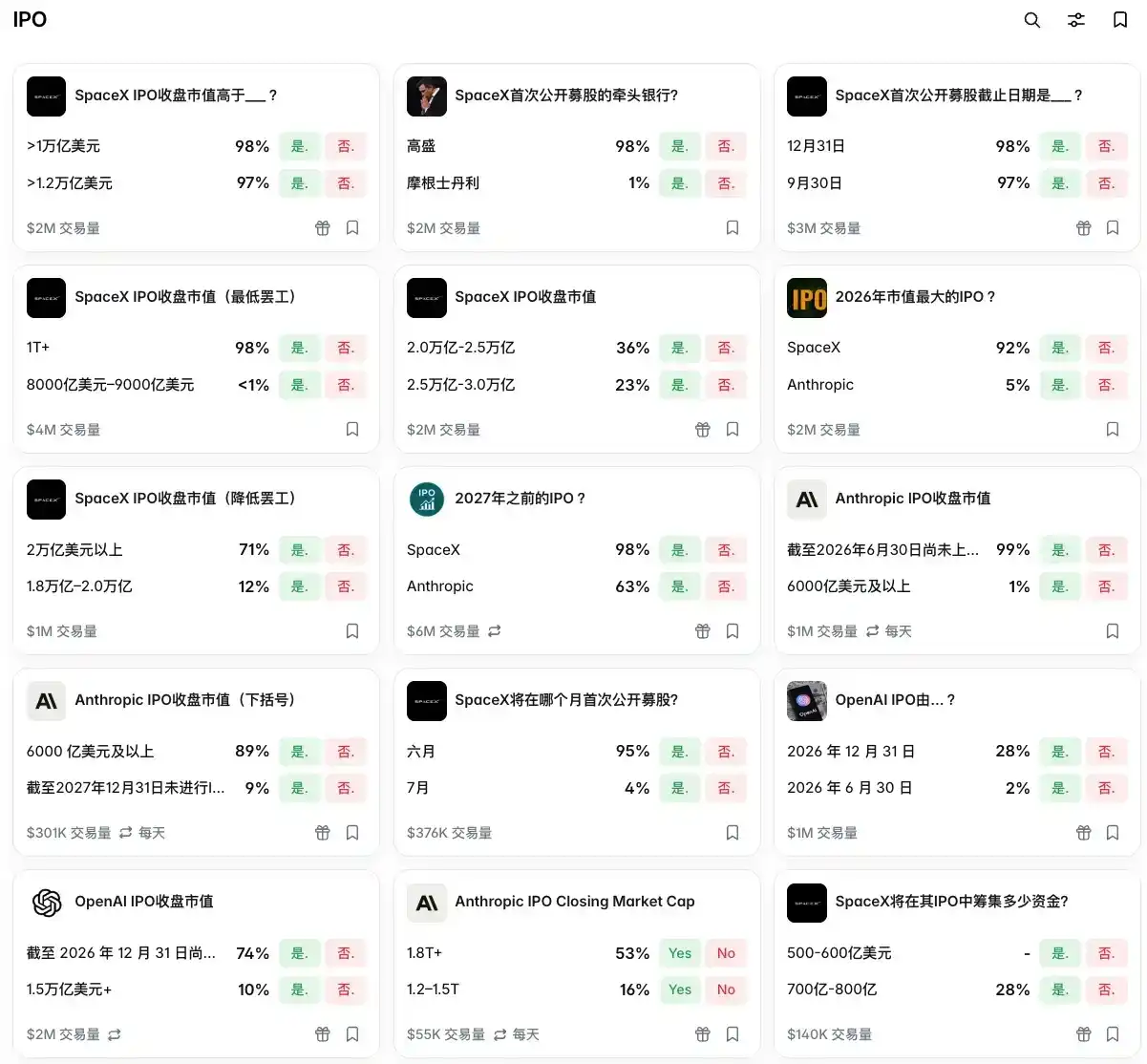
Both competing platforms are placing significant emphasis on this wave of pre-IPO frenzy.

Polymarket's Comeback Fight

Over the past eight months, Polymarket has been surpassed by Kalshi on nearly every visible metric.

In April, Kalshi's monthly trading volume was $14.8 billion, a 13% increase month-over-month. Polymarket's global volume plus the US App volume totaled $10.2 billion, a month-over-month decline of 8.9%. Active traders dropped from 733,000 in March to 643,000 in April, a 12% decrease. In valuation, Kalshi's latest round is $22 billion, while Polymarket is reportedly in talks for $15 billion.

A Bank of America report in April noted that among US-based prediction markets, Kalshi has captured approximately 89% of the market share.

Kalshi's journey over the past few years has been smoother than Polymarket's. In 2020, the CFTC granted it a Designated Contract Market (DCM) license, the first in the US and still the only one specifically issued to an event contract platform. This means Kalshi can accept USD, issue 1099 tax forms, integrate SDKs with platforms like Robinhood, and have its probability data cited by CNN and CNBC. In February of this year, Kalshi was selected by TIME for its TIME100 Most Influential Companies list, and its App Store ranking once approached that of ChatGPT.

Polymarket, fined $1.4 million by the CFTC in 2022, withdrew from the US market. It wasn't until July 2025 that the CFTC and the Department of Justice concluded a new round of investigations against it, allowing it to acquire a compliant trading license through the acquisition of QCEX.

However, Polymarket's partnership with NASDAQ this time is likely a signal of a counteroffensive.

The specific partner for Polymarket is Nasdaq Private Market (referred to as NPM), a company incubated by NASDAQ that specializes in serving private companies. Its main businesses are two-fold:

First, organizing secondary market liquidity programs for employee stock. Employees of companies like OpenAI, SpaceX, and Anthropic hold a large number of options or restricted stock units. Since the companies are not public, they cannot sell on the open market. NPM helps companies organize tender offers, allowing employees to sell their shares to approved external investors. NPM itself has disclosed facilitating nearly $80 billion in such transactions, covering over 1,000 company-sponsored liquidity programs and serving more than 200,000 employee shareholders.

Second, building a valuation database for private companies. NPM daily sees the transaction prices of employee stock for companies like OpenAI, Anthropic, and SpaceX on the secondary market. This data was previously sold only to institutional clients for a hefty annual fee.

The key step in this partnership is NPM's agreement to, for the first time, provide these valuation data to Polymarket for use.

Rodolfo Sanchez, NPM's Data Vice President, made a crucial statement in the press release: "The data flows in both directions." NPM provides data to Polymarket for contract settlement, while Polymarket's contract price curves become, in turn, "institutional signals" available to NPM's clients. Institutional clients buying NPM data also receive a probability curve priced in real-time by hundreds of thousands of retail traders.

Selling Data, Seizing Authority, Capturing Retail

This is not Polymarket's first time selling its data.

In October 2025, ICE announced an investment of up to $2 billion at an $8 billion pre-money valuation. The significance of this deal wasn't just the valuation, but the terms. ICE secured global exclusive distribution rights for Polymarket's data. The sales channels of the parent company of NYSE began selling Polymarket's probability data to global institutional clients.

In January 2026, an exclusive partnership with Dow Jones. Polymarket's prediction data was integrated into The Wall Street Journal, Barron's, MarketWatch, and Investor's Business Daily. The financial media matrix under News Corp began embedding Polymarket's probability signals as standard modules in their layouts, similar to the Dow Jones Index or VIX.

In February 2026, ICE formally launched the 'Polymarket Signals and Sentiment' product. Real-time quotes from thousands of contracts on Polymarket were standardized into structured data streams and distributed to institutional clients via the ICE Consolidated Feed, flowing through the same pipeline as NYSE stock data, bond prices, and corporate announcements. ICE President Ben Jackson mentioned this product alongside Reddit and Dow Jones in the Q1 earnings call, calling it one of the three pillars of ICE's alternative data services.

And this new partnership is about seizing the authority to determine valuations in this year's hottest private market.

We speculate Kalshi won't sit idle; its next move will likely involve partnering with a private market data provider to implement a similar structure. However, mainstream private data providers like Forge and PitchBook have smaller scales and cover fewer companies compared to NPM. NPM has already been exclusively secured by Polymarket. The cost for Kalshi to enter this track will be higher.


Preguntas relacionadas

QWhat is the key collaboration between Polymarket and Nasdaq, and what specific data is being shared?

APolymarket has launched an exclusive collaboration with Nasdaq, specifically its incubated company Nasdaq Private Market (NPM). The key aspect of this partnership is that NPM is providing its private company valuation database to Polymarket for use in settling prediction contracts. This database contains real-time transaction data on employee stock sales from pre-IPO companies like OpenAI, Anthropic, and SpaceX. In return, Polymarket's prediction market price curves serve as a 'crowd-sourced signal' for NPM's institutional clients.

QAccording to the article, how does Polymarket's current position compare to its competitor Kalshi in the US prediction market?

AAccording to the article, Kalshi currently holds a dominant position in the US prediction market. A Bank of America report cited in the article states that Kalshi has captured approximately 89% of the US market share. Key metrics for April show Kalshi with a monthly trading volume of $14.8 billion, compared to Polymarket's combined global and US app volume of $10.2 billion. Furthermore, Kalshi is reported to have a higher valuation and possesses a crucial regulatory advantage with its CFTC-issued Designated Contract Market (DCM) license.

QWhat are the two main business functions of Nasdaq Private Market (NPM) mentioned in the article?

ANasdaq Private Market (NPM) primarily serves two key functions for private companies: 1) Facilitating secondary market liquidity programs for employee shares. It organizes tender offers that allow employees of companies like OpenAI and SpaceX to sell their stock options or restricted shares to approved external investors. 2) Building a valuation database for private companies. NPM collects data on the transaction prices of employee stock sales, creating a valuable proprietary dataset on private company valuations.

QWhat previous steps has Polymarket taken to commercialize its prediction market data prior to the Nasdaq deal?

APrior to the Nasdaq collaboration, Polymarket had already taken significant steps to commercialize its data. In October 2025, Intercontinental Exchange (ICE) invested in Polymarket and secured the global exclusive distribution rights for its data. In January 2026, Polymarket entered an exclusive partnership with Dow Jones, integrating its prediction data into major financial publications like The Wall Street Journal. In February 2026, ICE formally launched the 'Polymarket Signals and Sentiment' product, streaming structured prediction data to institutional clients alongside traditional market data feeds.

QWhy is the pre-IPO company valuation market considered a significant opportunity for prediction markets like Polymarket?

AThe pre-IPO valuation market is a significant opportunity because it addresses a major information gap. Private companies are not obligated to disclose their valuations, and data from funding rounds is often lagging or incomplete. Secondary market quotes are fragmented, and internal transaction prices for employee stock are highly sensitive. This lack of transparent, real-time valuation data creates an ideal environment for prediction markets to aggregate crowd-sourced beliefs about a company's worth, providing an alternative signal that is otherwise inaccessible to the general public.

Lecturas Relacionadas

Bajo el impacto del precio del petróleo y la inflación, ¿qué país será el primero en vender todas sus reservas de oro?

Basado en el artículo: El sistema financiero global, comparado con una red eléctrica interconectada, podría enfrentar un colapso en cascada si un punto de presión crítico cede. El cierre del Estrecho de Ormuz, al restringir el 20% del suministro petrolero mundial, está generando tensiones en países emergentes importadores de petróleo como Turquía, India e Indonesia. Estas naciones, altamente dependientes de la energía importada, están agotando sus reservas en dólares para pagar el petróleo más caro, vendiendo activos clave como bonos del Tesoro estadounidense. Turquía, por ejemplo, ya ha vendido el 90% de sus bonos y ha comenzado a liquidar parte de sus reservas de oro. Este proceso, documentado cuando el petróleo estaba entre 70 y 105 dólares por barril, podría acelerarse drásticamente si el precio alcanza los 150-160 dólares, nivel predicho por ejecutivos del sector ante el agotamiento de las reservas globales de crudo. El agotamiento de las reservas externas puede llevar a crisis como la de Sri Lanka en 2022 (escasez de combustible, hiperinflación, inestabilidad política). Las ventas forzadas de bonos estadounidenses por parte de varios países podrían elevar los rendimientos de estos bonos, presionando la capacidad de financiación de EE.UU. y potencialmente forzando a la Reserva Federal a imprimir más dinero, lo que generaría inflación global. El artículo argumenta que, aunque la reapertura del Estrecho de Ormuz traería alivio temporal, el eventual declive del dólar como moneda de reserva mundial es inevitable históricamente. La vulnerabilidad del sistema se manifestará primero en las economías más dependientes. La lección clave es que los activos físicos como el oro y la energía, que no pueden crearse digitalmente, ofrecen mayor protección que el efectivo frente a esta posible crisis sistémica.

marsbitHace 7 min(s)

Bajo el impacto del precio del petróleo y la inflación, ¿qué país será el primero en vender todas sus reservas de oro?

marsbitHace 7 min(s)

Michael Saylor Rechaza la Rentabilidad a Nivel de Protocolo en la Pila de Activos Digitales de Bitcoin

Michael Saylor reitera su firme postura de separar Bitcoin de los sistemas criptográficos que generan rendimiento. En un marco conceptual llamado "Pila de Activos Digitales", coloca a Bitcoin en la base como capital digital puro, argumentando que su valor reside en la escasez y resistencia a la dilución. Sostiene que no necesita mecanismos de rendimiento a nivel de protocolo (como el staking), ya que introducirían riesgos que socavarían su propósito central. En su lugar, propone que los rendimientos se generen a través de productos financieros y estructuras de mercado de capitales construidas sobre Bitcoin, como créditos respaldados por BTC, deuda estructurada o envolturas corporativas como la de su empresa, MicroStrategy (ahora Strategy). Este modelo defiende la estrategia de su compañía y atrae tanto a puristas de Bitcoin, que desean mantener el protocolo simple, como a los mercados de capitales, que ven oportunidades para crear instrumentos de inversión. El debate es relevante porque los inversores a menudo comparan los activos criptográficos por su rendimiento nativo, un campo en el que Ethereum y otras redes de proof-of-stake compiten. Saylor argumenta que Bitcoin no debe competir allí, sino mantenerse como el activo de reserva alrededor del cual orbiten los productos de rendimiento. La cuestión clave es si los inversores aceptarán este marco o si el capital seguirá fluyendo hacia activos con ingresos a nivel de protocolo, una tensión que persistirá a medida que los productos institucionales de Bitcoin se vuelvan más complejos.

bitcoinistHace 27 min(s)

Michael Saylor Rechaza la Rentabilidad a Nivel de Protocolo en la Pila de Activos Digitales de Bitcoin

bitcoinistHace 27 min(s)

Detrás de los nuevos máximos históricos de HYPE, los «hermanos menores» del ecosistema no logran mantenerse al día

**HYPE alcanza máximos históricos mientras la ecosfera HyperEVM se contrae** El 16 de junio, el token HYPE tocó un nuevo máximo histórico de 76,965 USDT, con un alza diaria del 10% que liquidó más de 11,5 millones en posiciones cortas. Los ETF estadounidenses de HYPE han atraído unos 180 millones de dólares en su primer mes. Este impulso está impulsado por el sólido modelo económico de Hyperliquid: aproximadamente el 97% de las tarifas del protocolo (principalmente de los contratos perpetuos de HyperCore) se destinan a un fondo que recompra y quema HYPE de forma constante, actuando más como una "acción de aplicación" vinculada al rendimiento del negocio central que como un token de ecosistema tradicional. Sin embargo, en contraste con el éxito de HYPE, el ecosistema HyperEVM (la capa de contratos inteligentes) enfrenta una oleada de cierres de proyectos clave. Entre mayo y junio, protocolos importantes en préstamos (HypurrFi), NFTs (Drip.Trade), stablecoins (USDH/Native Markets), DEX (Felix) y mercados RWA (Ventuals) anunciaron su cierre de manera ordenada. Estos no eran proyectos marginales, sino infraestructura principal con usuarios y volumen reales. La raíz de esta divergencia parece estar en el diseño filosófico de Hyperliquid: un enfoque minimalista donde el núcleo (HyperCore) proporciona la infraestructura pero no interviene con grants, liquidez inicial o coordinación para los proyectos en HyperEVM. En un mercado saturado, esto deja a los nuevos protocolos luchando por arrancar sin apoyo. Además, el éxito del núcleo, particularmente de mercados HIP-3 como TradeXYZ que capturan la mayor parte de la atención y la liquidez, genera un efecto de acaparamiento que estructuralmente deja poco espacio para que prosperen los proyectos en la periferia de HyperEVM. En resumen, cuanto más fuerte es el núcleo de Hyperliquid, más difícil resulta sobrevivir para su ecosistema de aplicaciones descentralizadas.

Foresight NewsHace 1 hora(s)

Detrás de los nuevos máximos históricos de HYPE, los «hermanos menores» del ecosistema no logran mantenerse al día

Foresight NewsHace 1 hora(s)

Diálogo con Arthur Hayes: La IA agotó la liquidez del mercado; el BTC estará por debajo de los 100 mil para fin de año

En un reciente podcast, Arthur Hayes, cofundador de BitMEX, explicó por qué ha liquidado sus principales posiciones en criptomonedas (HYPE, NEAR, Worldcoin, Zcash) y reconfigurado su cartera hacia bonos del Tesoro y acciones energéticas. Su razonamiento se centra en una cadena de eventos macroeconómicos y políticos: el conflicto en Irán mantiene altos los precios del petróleo, alimentando la inflación. Ante las elecciones legislativas de noviembre de 2026 en EE.UU., Hayes argumenta que el presidente Trump podría virar retóricamente contra la industria de la IA para ganar votos populistas, atacando su regulación e impuestos. Esto, sumado a la matemática de la burbuja de la IA, donde el gasto de capital en centros de datos está alcanzando un pico y su ritmo de crecimiento (la "segunda derivada") está destinado a desacelerarse, podría desencadenar una corrección significativa. Hayes señala que la IA ha absorbido toda la liquidez del mercado (aproximadamente 1,5 billones en deuda emitida desde 2025), lo que explica el bajo rendimiento de Bitcoin frente a acciones tecnológicas. Además, anticipa que las próximas megas-OPIs como la de SpaceX (con una valoración "absurda" de 100 veces ventas) podrían decepcionar al mercado y actuar como catalizador de una corrección. En un escenario de colapso de la burbuja de IA, todos los activos de riesgo caerían juntos. Por ello, predice que Bitcoin terminará el año por debajo de los 100.000 dólares. Su estrategia actual es esperar a un lado hasta que la corrección ocurra y la liquidez, eventualmente, vuelva a buscar oportunidades fuera del ecosistema de la IA, posiblemente en las criptomonedas.

marsbitHace 1 hora(s)

Diálogo con Arthur Hayes: La IA agotó la liquidez del mercado; el BTC estará por debajo de los 100 mil para fin de año

marsbitHace 1 hora(s)

Trading

Spot
Futuros

Artículos destacados

Cómo comprar POL

¡Bienvenido a HTX.com! Hemos hecho que comprar Polygon Ecosystem Token (POL) sea simple y conveniente. Sigue nuestra guía paso a paso para iniciar tu viaje de criptos.Paso 1: crea tu cuenta HTXUtiliza tu correo electrónico o número de teléfono para registrarte y obtener una cuenta gratuita en HTX. Experimenta un proceso de registro sin complicaciones y desbloquea todas las funciones.Obtener mi cuentaPaso 2: ve a Comprar cripto y elige tu método de pagoTarjeta de crédito/débito: usa tu Visa o Mastercard para comprar Polygon Ecosystem Token (POL) al instante.Saldo: utiliza fondos del saldo de tu cuenta HTX para tradear sin problemas.Terceros: hemos agregado métodos de pago populares como Google Pay y Apple Pay para mejorar la comodidad.P2P: tradear directamente con otros usuarios en HTX.Over-the-Counter (OTC): ofrecemos servicios personalizados y tipos de cambio competitivos para los traders.Paso 3: guarda tu Polygon Ecosystem Token (POL)Después de comprar tu Polygon Ecosystem Token (POL), guárdalo en tu cuenta HTX. Alternativamente, puedes enviarlo a otro lugar mediante transferencia blockchain o utilizarlo para tradear otras criptomonedas.Paso 4: tradear Polygon Ecosystem Token (POL)Tradear fácilmente con Polygon Ecosystem Token (POL) en HTX's mercado spot. Simplemente accede a tu cuenta, selecciona tu par de trading, ejecuta tus trades y monitorea en tiempo real. Ofrecemos una experiencia fácil de usar tanto para principiantes como para traders experimentados.

385 Vistas totalesPublicado en 2024.12.11Actualizado en 2026.06.02

Cómo comprar POL

Discusiones

Bienvenido a la comunidad de HTX. Aquí puedes mantenerte informado sobre los últimos desarrollos de la plataforma y acceder a análisis profesionales del mercado. A continuación se presentan las opiniones de los usuarios sobre el precio de POL (POL).

活动图片












