Father of Claude Code's Latest Assessment: Team Division of Labor Rewritten in the AI Era, These 'Five Types' Are Most in Demand

marsbitPublished on 2026-06-30Last updated on 2026-06-30

Abstract

"In the era of AI reshaping software development, Anthropic's Claude Code team lead, Boris Cherny, proposes a future where traditional job titles dissolve. He identifies five fluid, behavior-based roles emerging in effective, AI-augmented teams: The Prototyper (generates disruptive ideas), The Builder (scales prototypes to production), The Sweeper (streamlines and refactors to combat bloat), The Growth (iterates on launched products for market fit), and The Maintainer (ensures long-term security and reliability). Crucially, these are not fixed positions. Individuals may span multiple roles depending on the project and its lifecycle stage. A designer might be a Prototyper and Sweeper; an engineer could be a Builder and Maintainer. Team composition should shift with product maturity: early-stage products need Prototypers, Builders, and Sweepers, while scaling products require more Builders, Growth roles, and Maintainers. The discussion highlights that role fluidity is key, as professionals often switch roles across different projects or as a single project evolves. While AI tools like Claude increasingly assist with tasks like building and sweeping, human adaptability and focus on goals over rigid job boundaries are seen as essential for future teams."

As Agent Coding goes viral and reshapes the software industry, it seems the field has gradually accepted the undeniable fact that the role of the "engineer" is changing. In reality, however, the change likely extends beyond just the "engineer" position; a more profound transformation is quietly occurring at the foundation of team organizational structures......

Recently, Boris Cherny, head of the Anthropic Claude Code team, shared a very interesting observation on X.

He pointed out that as functions like engineering, product, design, and data science increasingly merge, he has been pondering what these roles will evolve into in the future. Taking the Claude Code team as an example, the traditional "job labels" internally are being completely discarded, replaced by five new types of "unbundled" roles based on behavioral patterns: The Prototyper, The Builder, The Sweeper, The Growth, and The Maintainer.
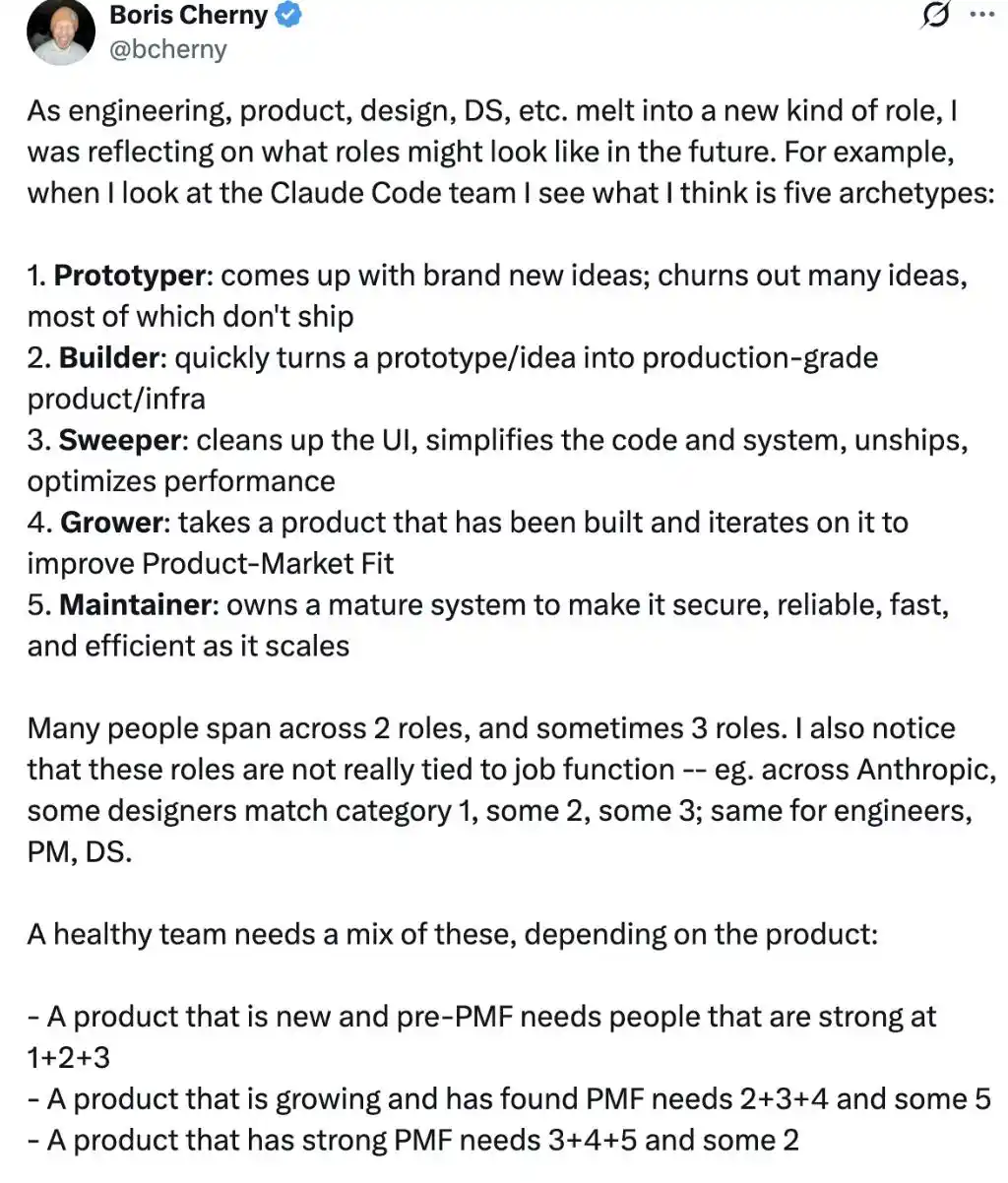
The Prototyper: Primarily responsible for proposing entirely new ideas, continuously generating a large volume of creativity, with most ideas ultimately not being launched. In other words, they pursue the quantity and disruptiveness of ideas, not fixating on whether each one must be implemented.

The Builder: Primarily responsible for quickly turning scattered ideas or rough prototypes into products or highly available infrastructure that can truly be deployed in production environments for massive user bases. In other words, they are responsible for solving the hardcore leap from 0.1 to 1.

The Sweeper: Primarily responsible for "subtraction." The most terrifying side effect of the AI era is the over-expansion of code and features. The Sweeper's duty is to clean up and streamline user interfaces, simplify and refactor messy code and system architectures, and remove unnecessary redundant functionalities to achieve high system performance and maintainability.

The Growth: Takes over a finished, built product. When a product enters the market, The Growth is responsible for continuous, rapid iteration. They must care about: how to bring the product closer to the market? How to make users more willing to stay? How to make a product evolve from "usable" to "needed." However, this role is not equivalent to traditional growth operations; it is more of a combination of product, data, user understanding, and experimentation capabilities.

The Maintainer: Responsible for the long-term operation of a mature system. They may not chase flashy new features but obsess over security, reliability, extreme operational efficiency, and system resilience, ensuring services remain rock-solid under any extreme traffic conditions.

It's important to note, however, that these five roles do not correspond to traditional positions. That is to say, unlike traditional organizational management where a person's role is fixed in a job title.

Boris Cherny believes that many people might span two roles, and sometimes even three.

"I've also noticed these roles aren't truly tied to specific jobs. For example, internally at Anthropic, some designers align more with type 1, some with type 2, and some with type 3; the same goes for engineers, product managers, and data scientists."

This implies that in efficient, AI-empowered teams, many members are no longer 'single-purpose cogs.' A designer can be a Prototyper or a Sweeper; an engineer can be a Builder or a Maintainer; a product manager can take on Growth or become a Prototyper; a data scientist might not only perform analysis but also directly participate in product growth and system optimization......

In other words, the way future teams look at people might change. The past question might have been mainly "What is your job title?" while the future—or the present—is becoming "Which stage of the product lifecycle can you advance?"

Boris Cherny analyzed that the specific combination of these roles needed for a healthy team depends on the product's current stage:

A brand new product that hasn't yet found product-market fit needs people skilled in roles 1, 2, and 3.

A product that is growing and has found product-market fit needs roles 2, 3, and 4, supplemented by some role 5.

A product with strong product-market fit needs roles 3, 4, and 5, while retaining some role 2.

"Perhaps future product roles will look more like this, rather than today's division by specialized fields."

Once this post was published, it immediately sparked lively discussion among netizens, with most expressing agreement.

"This perfectly matches how people actually work. In some projects, I am indeed a 1+3 combo, while in others, I'm almost pure 4. Job titles have never truly captured these."

A data scientist also "stepped forward," saying that as a data scientist, they often find themselves doing Sweeper-type work while also building products with a data science sensibility. "So does that make me a 2+3 type?"

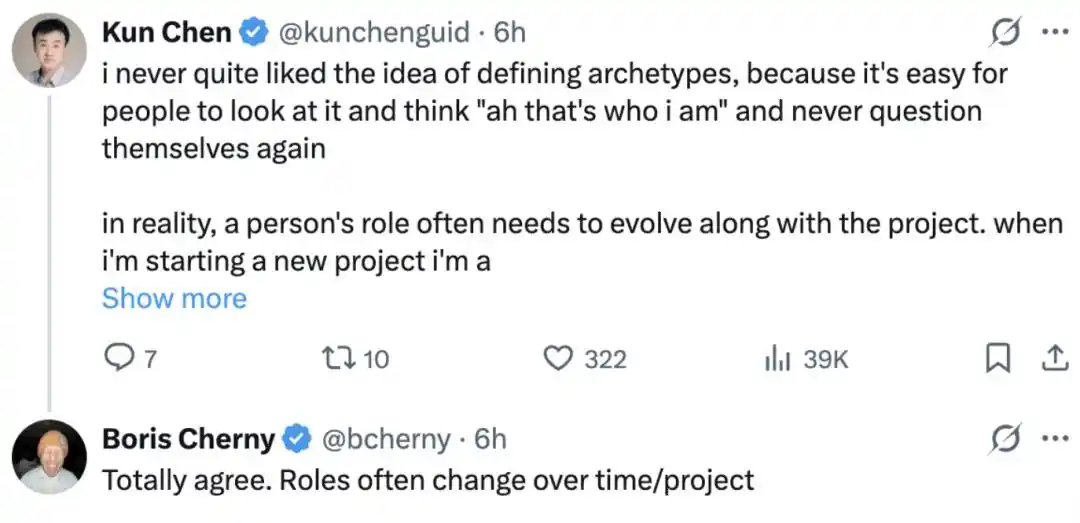
Netizen Kun Chen@kunchenguid expressed strong resonance. He said he never liked defining "role archetypes" because people easily see them and think, "Ah, so this is me," and then stop reflecting. In reality, "a person's role often needs to change along with the project."

He gave an example: when starting a new project, he typically acts as a Prototyper and Builder; but soon, as rough, unfinished parts become bottlenecks, he turns into a Sweeper. As the project matures, he shifts towards Growth and Maintainer... "If I box myself into one specific role, then when the project reaches a certain stage, I'd have to let go."

Another reality is that people now often work on multiple projects simultaneously, requiring them to play different roles in different projects. "Categorizing oneself into a fixed archetype often limits a person's ability to expand their ambitions."

Therefore, his advice is: Stay flexible, focus attention on the most important things needed to achieve the goal, and worry less about role boundaries. Because these boundaries will only continue to blur over time.

Boris Cherny responded, saying this completely captured his own thoughts: "Completely agree. Roles often change over time and project phases."
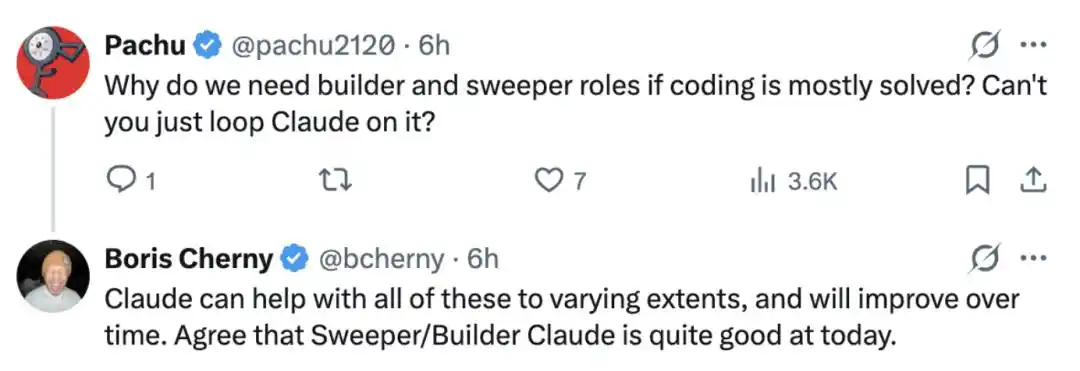
Some netizens expressed skepticism: "Since AI writing code is basically solved, why are roles like Builder and Sweeper still needed? Can't we just let Claude run in a continuous loop?"

In response, Boris Cherny explained that Claude can help with all these things to varying degrees and will continue to become stronger over time. Currently, today's Claude is already quite good at taking on Sweeper and Builder-type work.
What about you? How do you view this change in job roles? Feel free to leave a comment and discuss!

Reference Links:

https://x.com/bcherny/status/2071379474277613732

https://x.com/kunchenguid/status/2071382977628795289

This article is from the WeChat public account "Almost Human" (ID: almosthuman2014), author: Focus on AI


Trending Cryptos

Related Questions

QAccording to Boris Cherny, what are the five new 'unbundled' roles emerging in AI-augmented teams?

AThe five new 'unbundled' roles are: The Prototyper, The Builder, The Sweeper, The Growth, and The Maintainer.

QHow do these five new roles differ from traditional job titles in a company?

AThese roles are not fixed to traditional job titles. They are based on behavioral patterns and how individuals contribute to a product's lifecycle. A person can span multiple roles, and roles can change based on the project or product stage.

QWhich role is responsible for turning rough prototypes into production-ready products?

AThis is the primary responsibility of 'The Builder.' They handle the hard leap from a 0.1 version to a 1.0 version that is ready for the production environment.

QHow should the mix of these five roles in a team change as a product matures?

AFor a new product seeking product-market fit, you need Prototypers, Builders, and Sweepers. For a growing product with established fit, you need Builders, Sweepers, and Growth roles, with some Maintainers. For a mature product with strong fit, you need Sweepers, Growth, and Maintainers, with some Builders retained.

QWhat was Boris Cherny's response to the skepticism about needing human Builders or Sweepers if AI can write code?

ABoris Cherny stated that Claude can already help with these tasks to a significant degree and is getting better. Currently, it is particularly good at assisting with the Sweeper and Builder type of work.

Related Reads

Private Credit in US Dollar

Stablecoins are evolving into a new type of money market fund, channeling crypto deposits into the $2 trillion private credit market. This mirrors the 1970s innovation where money market funds pooled small deposits to buy high-yield government securities, bypassing bank restrictions. Today, platforms like Apollo's ACRED tokenized fund and Figure's on-chain lending system allow stablecoin holders to access institutional private credit strategies with no minimum investment, offering yields of 8-12%. On-chain tokenization enables greater liquidity and DeFi composability (e.g., using tokens as collateral for leveraged positions) compared to traditional, locked-up private credit funds. Consequently, on-chain private credit has grown 15x in a year to $5.87 billion, though it remains a tiny fraction (0.3%) of the global market. However, this model carries significant risks, as illustrated by the failure of Goldfinch. Launched in 2021, it directed crypto deposits to motorcycle loans in Kenya and Nigeria. Critical issues included a lack of local oversight, leading to unauthorized fund transfers and borrower defaults. With $56 million now trapped in non-performing loans, its collapse highlights that while blockchain streamlines capital transfer, the essential 90% of lending—underwriting, monitoring, and recovery—remains a costly, localized challenge. Success requires robust, traditional credit infrastructure, not just on-chain execution.

marsbit8m ago

Private Credit in US Dollar

marsbit8m ago

Goldman Sachs: How to Invest in Tech Stocks in the Second Half of the Year?

Goldman Sachs remains bullish on tech stocks in the second half of the year, advising a shift from "buying the sector" to "picking individual companies." The firm's latest report indicates the AI-driven tech cycle shows no signs of peaking, with supply exceeding demand or technological progress slowing yet to materialize. Recent pullbacks are viewed as healthy corrections following rapid gains, not a trend reversal. Three core investment themes are highlighted: 1) Maintain overweight positions in AI server and data center-related hardware stocks. 2) Conduct more nuanced risk-reward assessments in sub-sectors where supply and demand are tightening. 3) During periods of declining risk appetite, consider software and IT services companies leveraging AI to create new business opportunities as a defensive play. The report emphasizes that future outperformance will depend more on individual company competitiveness (alpha) rather than broad sector momentum (beta). Companies likely to excel are those benefiting from price increases, possessing strong capacity expansion capabilities, having undervalued AI growth potential, or holding unique catalysts. For defense, Goldman suggests focusing on AI-enabling software and service firms—such as those in AI consulting, data infrastructure, and cybersecurity—which may see efficiency gains and new demand, rather than retreating to traditional defensive sectors. Overall, the strategy balances offensive exposure to AI infrastructure with defensive positioning in AI-applicable software and services.

链捕手13m ago

Goldman Sachs: How to Invest in Tech Stocks in the Second Half of the Year?

链捕手13m ago

Wall Street's Take on the June Fed Meeting Minutes: Focus on Core Inflation, No Short-Term Urgency to Hike Rates

Wall Street's View on Fed June Minutes: Inflation is the Key, No Urgency for Near-Term Hike The minutes of the Federal Reserve's June FOMC meeting revealed a unified Wall Street interpretation: inflation remains the true determinant for future policy moves. Major institutions including Goldman Sachs, Morgan Stanley, and Citigroup concluded that the Fed remains data-dependent, with its path hinging on upcoming inflation data. Key takeaways from the minutes: * **No Immediate Tightening**: Despite "a few" participants seeing reasons to hike, none actively advocated for it at the June meeting. The consensus was to hold the federal funds rate steady at 3.5%-3.75%. * **Inflation as the Decisive Factor**: The Fed outlined two primary scenarios. If inflation declines "soon" toward the 2% target, "almost all" officials would support maintaining or eventually cutting rates. If inflation persists high due to factors like AI demand or supply shocks, "almost all" would see some policy tightening as necessary. * **Patience is Warranted**: Officials noted inflation remains above target but cited anchored inflation expectations and a labor market not currently driving price pressures as reasons for patience. The Fed is focused on the *direction* of inflation over the next few months. * **No Policy Framework Shift**: The minutes reaffirmed a data-dependent approach rather than a fundamental shift toward pre-emptive tightening. Institutional Forecasts: * **Morgan Stanley**: Expects rates on hold in 2026, with potential cuts in 2027 if inflation cools. * **Goldman Sachs**: Baseline scenario sees rates unchanged through 2026, with inflation moderating gradually. * **Citigroup**: Takes a more dovish view, suggesting market pricing for a July hike is too aggressive and forecasting potential rate cuts starting in late 2026. Overall, the minutes were perceived as marginally dovish, emphasizing a watchful stance on inflation data with no near-term urgency to hike.

marsbit19m ago

Wall Street's Take on the June Fed Meeting Minutes: Focus on Core Inflation, No Short-Term Urgency to Hike Rates

marsbit19m ago

Trump Earns $2.2 Billion Annually, Two-Thirds from Cryptocurrency, with 87 Stock Trades Daily

Former U.S. President Donald Trump reported a personal income exceeding $2.2 billion in 2025, the highest annual income for a sitting president, according to U.S. government financial disclosures. This income primarily stemmed from cryptocurrency ventures and investments, starkly contrasting the standard presidential salary of $400,000. More than two-thirds ($1.4 billion) of his income originated from cryptocurrency-related activities. This includes over $1 billion in Bitcoin and Ethereum holdings, approximately $800 million from World Liberty Financial (a crypto project co-founded with his son), and about $635 million from sales of the TRUMP meme coin. Overall, Trump family crypto operations reportedly generated over $2.3 billion in profit after his 2025 inauguration. Trump's stock portfolio showed heavy trading activity, with over 22,000 trades executed in 2025—averaging 87 trades per day. Major holdings included tech giants like Google, Apple, Nvidia, and Microsoft. Notably, some large-scale stock purchases coincided with major policy announcements, such as tariffs, raising questions about potential insider trading. His traditional business empire, centered on real estate and branding, contributed $575 million. Additionally, he earned nearly $60 million through numerous "DT Marks" licensing companies, which leverage the Trump brand globally in locations like Dubai and Abu Dhabi. The report highlights significant conflicts of interest, as countries like the UAE and Saudi Arabia, whose entities invested in Trump's businesses, later received favorable U.S. policy treatment. Trump has stated he delegates financial management and is not directly involved in day-to-day investment decisions.

Odaily星球日报20m ago

Trump Earns $2.2 Billion Annually, Two-Thirds from Cryptocurrency, with 87 Stock Trades Daily

Odaily星球日报20m ago

Trading

Spot

Hot Articles

Discussions

Welcome to the HTX Community. Here, you can stay informed about the latest platform developments and gain access to professional market insights. Users' opinions on the price of S (S) are presented below.

活动图片