Private Credit in US Dollar

marsbitPublished on 2026-07-09Last updated on 2026-07-09

Abstract

Stablecoins are evolving into a new type of money market fund, channeling crypto deposits into the $2 trillion private credit market. This mirrors the 1970s innovation where money market funds pooled small deposits to buy high-yield government securities, bypassing bank restrictions. Today, platforms like Apollo's ACRED tokenized fund and Figure's on-chain lending system allow stablecoin holders to access institutional private credit strategies with no minimum investment, offering yields of 8-12%. On-chain tokenization enables greater liquidity and DeFi composability (e.g., using tokens as collateral for leveraged positions) compared to traditional, locked-up private credit funds. Consequently, on-chain private credit has grown 15x in a year to $5.87 billion, though it remains a tiny fraction (0.3%) of the global market. However, this model carries significant risks, as illustrated by the failure of Goldfinch. Launched in 2021, it directed crypto deposits to motorcycle loans in Kenya and Nigeria. Critical issues included a lack of local oversight, leading to unauthorized fund transfers and borrower defaults. With $56 million now trapped in non-performing loans, its collapse highlights that while blockchain streamlines capital transfer, the essential 90% of lending—underwriting, monitoring, and recovery—remains a costly, localized challenge. Success requires robust, traditional credit infrastructure, not just on-chain execution.

Written by: Vaidik Mandloi

Compiled by: Block unicorn

In the 1970s, Bruce Bent and Henry Brown created the first-ever money market fund. The idea was remarkably simple. Due to a regulation from the Great Depression era, the interest rate on savings at U.S. banks was capped at 4.5%. Although U.S. Treasury yields were over 9% at the time, the minimum investment to purchase Treasuries was as high as $10,000. Bent and Brown decided to pool small deposits, buy Treasuries on a large scale, and return the profits to investors. Today, money market funds have reached a scale of approximately $8 trillion.

Stablecoins are engaging in a similar practice, only this time the assets are private credit, a market worth $2 trillion where a minimum of $1 million is required to enter. Yield-bearing stablecoins are being used to pool small deposits and channel them into the credit space.

Today, I will delve into how this is happening and how Goldfinch (the first-ever attempt to conduct such operations with real funds) collapsed, resulting in $56 million of depositor funds being trapped in Kenyan motorcycle loans.

How Stablecoins Became Money Market Funds for Private Credit

In the 1990s, U.S. banks provided about half of the debt capital to businesses and consumers, but today that figure is around 20%. This is because after 2008, new capital rules took effect, making it too costly for banks to hold leveraged loans. Consequently, banks entirely withdrew from the mid-market lending business, and private credit funds took their place.

Apollo, Blackstone, and KKR raised funds from pension funds and insurance companies and began lending to companies abandoned by banks, charging high premiums because these borrowers had no alternative.
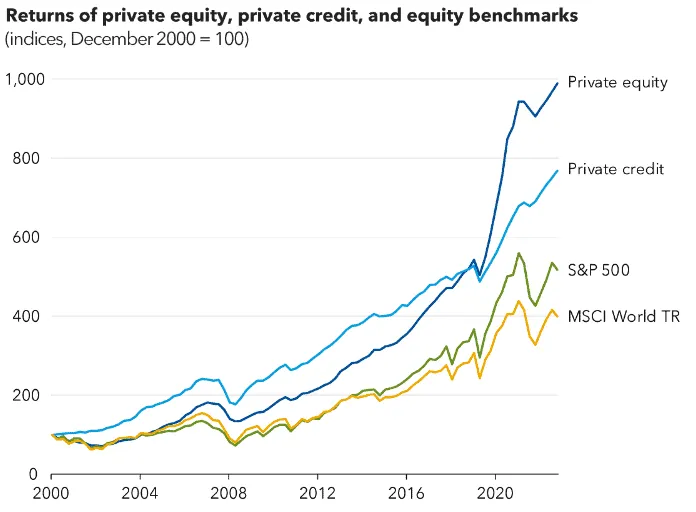
The market has grown from less than $200 billion in 2008 to over $2 trillion today, and almost all of this capital comes from institutional investors writing checks of $5 million or more.

One of the main reasons for the million-dollar minimum threshold in private credit loans is their high management complexity. Each transaction requires due diligence, restructuring, and monitoring over several years. Managing a fund with ten institutional limited partners (LPs) each contributing $50 million is far easier than managing a fund with retail investors each contributing $500, and even then, scaling investments can often be unprofitable. This is why, over the past decade, only pension funds and insurance companies could access such yields, typically ranging from 8% to 12%.

It is at this point that yield-bearing stablecoins have changed the game, just as Bent and Brown opened access to Treasuries in the 1970s. Although the paperwork is still handled by institutions, with funds like Apollo underwriting and managing the risks, now tokenized sub-funds can accept deposits of any size and channel them into institutional strategies without having to manage thousands of individual investors.

Apollo recently launched the tokenized fund ACRED, whose diversified credit fund has attracted $109 million in inflows. Investors can even use it as collateral on the Morpho platform for margin lending and re-investment, thereby achieving leveraged yields.
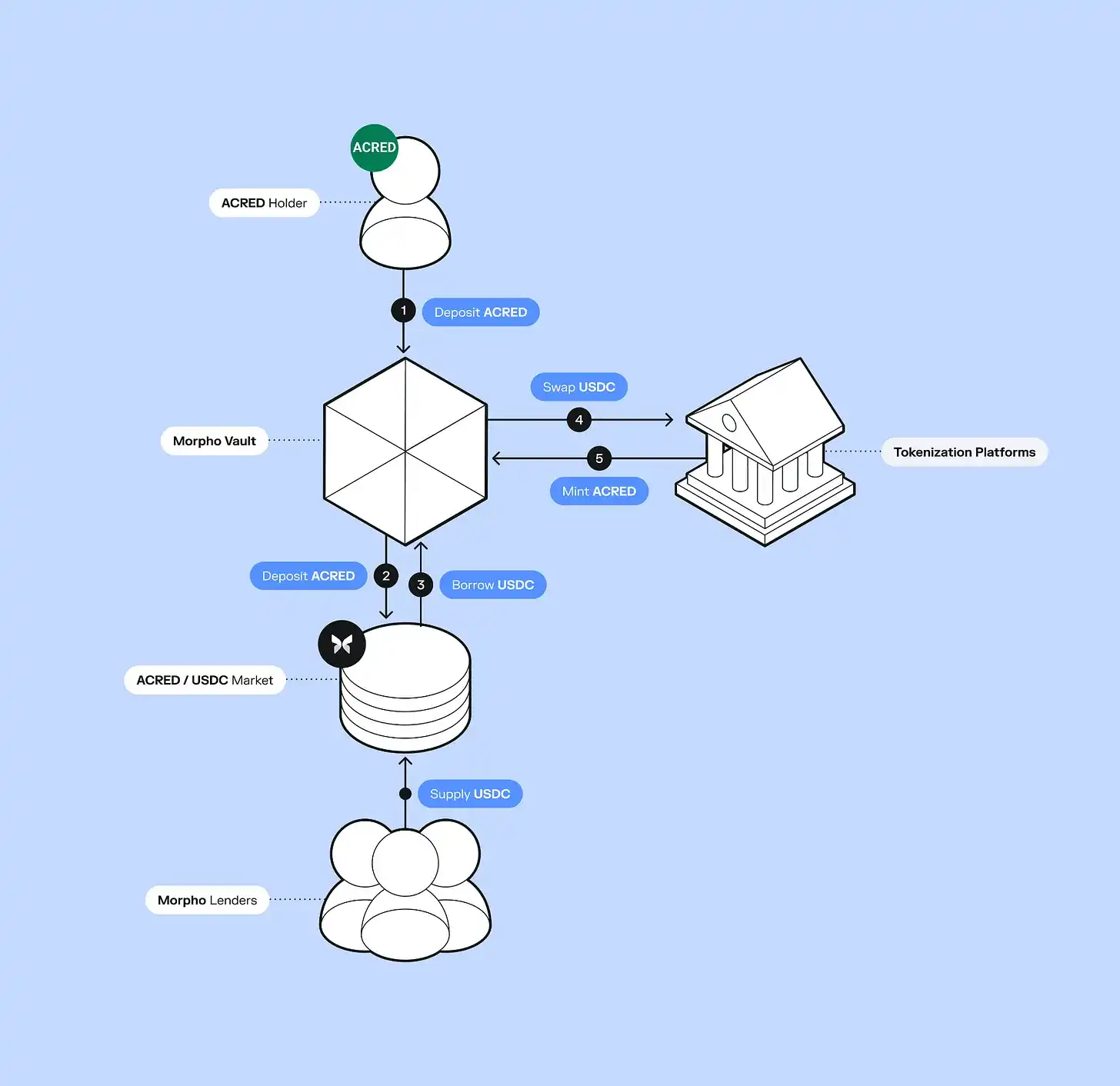
Figure has built an entire on-chain lending system, has issued $21 billion in loans, successfully listed on Nasdaq, and launched YLDS—a yield-bearing stablecoin with a circulating supply of $376 million. Other protocols, such as Pyse and Glow, go even further by tokenizing solar projects, allowing investors to fund solar installations in developing countries with a few hundred dollars and earn an annual percentage yield (APY) from monthly electricity fees.

This does not mean that the minimum investment requirement for the fund itself disappears. The ACRED fund still requires a direct investment of $5 million. However, once the fund is tokenized, its tokens can be traded on secondary markets with no minimum investment limit, and they can interoperate with DeFi (Decentralized Finance) systems in ways that traditional fund shares cannot match.

In traditional private credit, your funds are locked for years, with quarterly redemptions capped at 5%. On-chain, however, funds can be flexibly combined and are liquid 24/7. For companies like Apollo and Figure, this allows them to access a $315 billion pool of stablecoin capital actively pursuing yield. By tokenizing funds, they can directly tap into this capital pool, opening new distribution channels without having to build retail infrastructure from scratch.

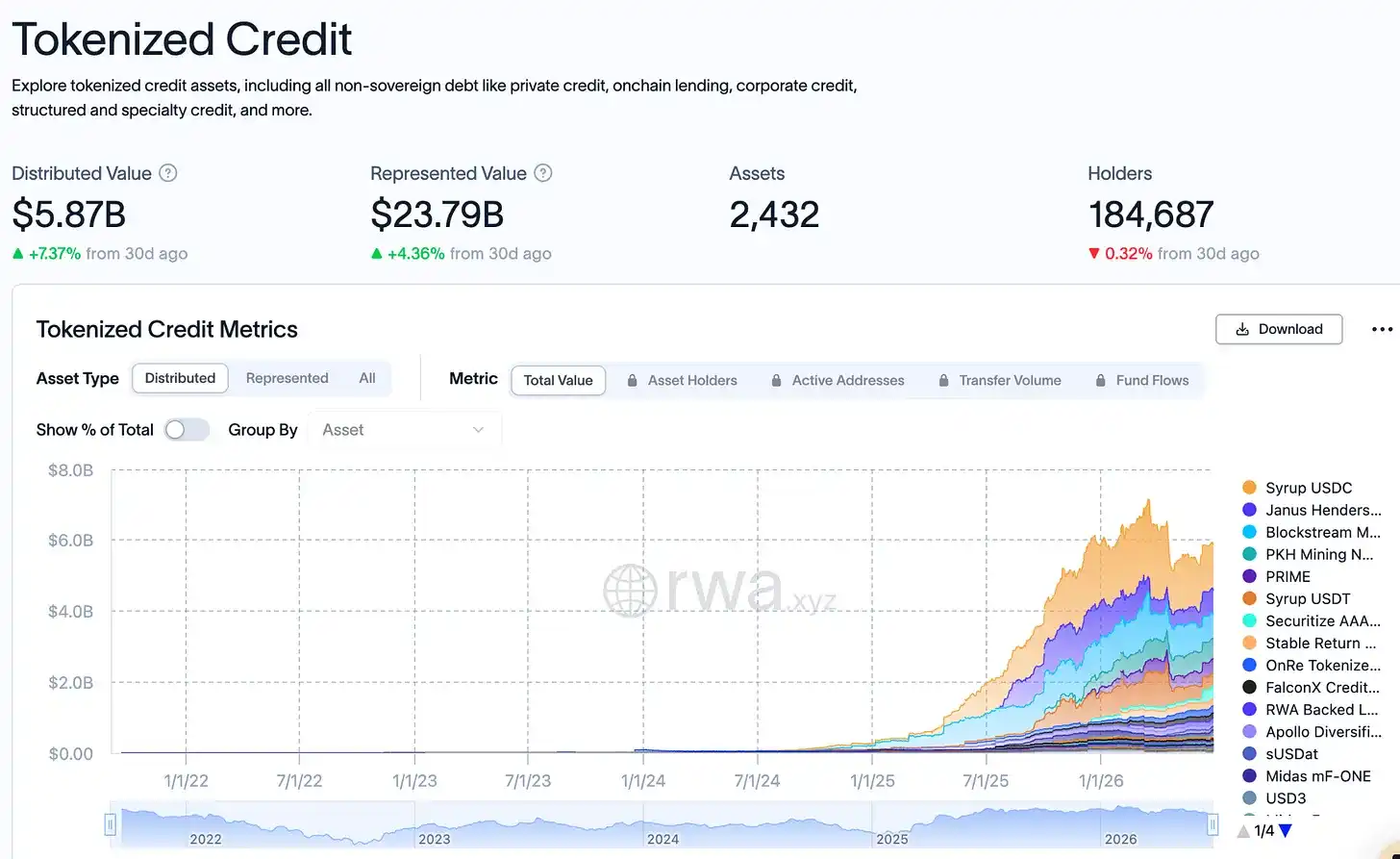
A year ago, the total on-chain private credit was just $400 million; today, it stands at $5.87 billion, a 15-fold increase in 12 months. However, this still represents only 0.30% of the $2 trillion global private credit market. Half of all new stablecoin supply in the first quarter of 2026 came from yield-bearing stablecoins, meaning most new stablecoin capital is now chasing active yield, not just a dollar peg.
Moreover, because every dollar of on-chain credit can be used as collateral and recycled through DeFi protocols, the actual financial activity it generates is a multiple of the dollar amount.

Take ACRED as an example. An investor deposits $10,000 on Morpho, borrows $7,000 in USDC using this deposit as collateral, then uses this USDC to purchase more ACRED and deposits it again as collateral. This way, a single deposit can generate over $17,000 in credit exposure. In contrast, traditional private credit: the same $10,000 would sit idle in a fund for 5 years, earning no yield. On-chain, this compounding effect occurs simultaneously across multiple layers, which is why the ACRED market is growing faster than its raw dollar size suggests. However, it also means that if the underlying loan defaults, losses propagate through every layer of the cycle.

Tokenization does not mean the underlying risks are reduced. Often, these risks are overlooked as capital continuously flows in, providing enough funds to cover redemptions. But as inflows slow, the gap between token promises and actual loan values begins to show. Investors try to exit, but liquidity is insufficient, or the token price becomes disconnected from its intrinsic value.

Something similar happened with Goldfinch; it was one of the first protocols to put private credit on-chain when launched in 2021, but recently had to shut down with $56 million of depositor funds stuck in Kenya and Nigeria.

What Went Wrong with Goldfinch?

Goldfinch raised $25 million from a16z in 2021 to channel cryptocurrency funds, which at the time were only yielding 2% to 3% in DeFi lending pools, to businesses across Africa and Southeast Asia. Borrowers in these regions had to pay interest rates of 15% to 25% because local banks were unwilling to serve them.

The concept was to allow anyone holding USDC to deposit into Goldfinch pools, and then smart contracts would allocate funds to respective borrower accounts within seconds. However, underwriting a loan for a motorcycle financing company in Nairobi meant someone had to understand the Kenyan transportation economy, personally verify the borrower's accounts, and potentially visit the borrower's office in person if repayments stopped.
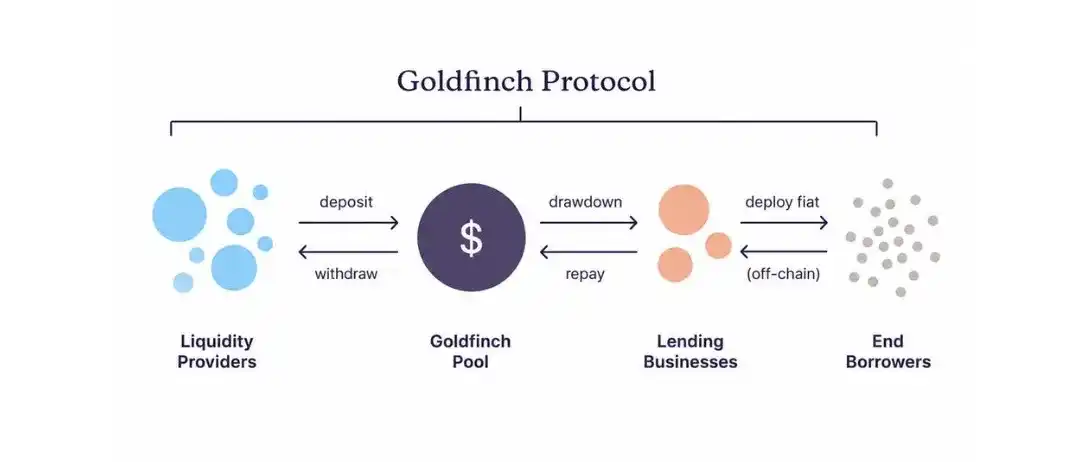
But on the blockchain, none of these things are possible. Once USDC is converted into Kenyan shillings and invested in a loan book, depositors have no way of knowing how their funds are being used, the financial status of the borrower, or even whether the loan terms are being honored. All critical information related to loan performance has left the blockchain and is in the hands of borrowers in countries most depositors have never visited.

This is why it took months for anyone to notice that Tugende Kenya, without authorization, transferred $1.9 million of its $5 million loan facility to Tugende Uganda in 2022. Nearly 40% of the loan was diverted to another legal entity in another country. Meanwhile, depositors continued to receive what they believed was 10% to 12% interest, completely unaware that the principal backing their yields had gone to a place never mentioned in the loan agreement.

If a traditional private credit firm discovered such a severe breach, it would recall the loan and force a restructuring within days. But Goldfinch depositors learned about this through posts on the company's governance forum, with their only option being to vote on a proposal that held neither legal authority to seize assets nor to audit the remaining assets.

By 2023, Tugende had completely defaulted and vanished. Over its $113.3 million lifespan, Goldfinch issued 24 asset pools, of which only 13 were fully repaid. The remaining 8 pools have $53.82 million in outstanding loans, and none are performing under the original terms. Most pools are undergoing restructuring, with repayments of less than $51,000 per month per pool, meaning recovering the full $53.82 million would take 8 to 15 years at this rate.

Goldfinch took on all the risks of emerging market currency volatility and limited credit history, yet possessed almost none of the infrastructure that traditional lenders spent decades building and managing to mitigate these risks. For example, banks offering loans in Kenya have local offices and regulatory relationships, giving them greater leverage when deals go wrong.

But Goldfinch funneled funds from anonymous global wallets to the same type of borrowers without any such supporting structures. This made the information gap between lenders and borrowers even larger than in traditional transactions and left depositors with almost no ability to intervene when things fell apart.

On-chain fund transfers constitute only about 10% of the processes required for lending. The remaining 90% is underwriting and fund recovery, which is highly localized and costly. Such underwriters need to establish a baseline of credibility for the entire asset class, which itself is still fighting for its right to exist. Every dollar lost in underwriting makes it harder for the next institutional partner to go on-chain and degrades the credibility of the entire asset class. The difficulty in credit has nothing to do with on-chain operations, and anyone building in this space without understanding this is essentially building the next 'Goldfinch.'


Related Questions

QAccording to the article, how do yield-bearing stablecoins function similarly to the first money market fund, and what market do they currently aim to access?

ASimilar to the first money market fund, which pooled small deposits to access large-denomination, high-yield U.S. Treasury bonds, yield-bearing stablecoins pool small deposits (in stablecoins) to access the private credit market, a sector that traditionally requires a minimum investment of $1 million or more. They open access to this high-yield asset class for smaller investors.

QWhat is the primary reason for the high minimum investment threshold in traditional private credit funds, and how does tokenization address this issue?

AThe primary reason for the high minimum investment threshold (e.g., $1 million) in traditional private credit is the high cost and complexity of managing loans, which involves due diligence, restructuring, and long-term monitoring. It is inefficient to manage thousands of small investors. Tokenization addresses this by allowing a fund (like Apollo's ACRED) to sell its tokenized shares on secondary markets with no minimum investment, enabling access for smaller investors while the fund itself still manages a consolidated pool of capital from institutional LPs.

QWhat are the key advantages of having private credit tokens on-chain, compared to traditional private credit fund shares?

AKey on-chain advantages include: 1) No minimum investment for token purchasers. 2) 24/7 liquidity and the ability to trade tokens, unlike traditional shares which have long lock-up periods (e.g., 5 years) and limited quarterly redemptions (e.g., 5%). 3) Composability with DeFi protocols, allowing tokens to be used as collateral for loans and generating leveraged returns, multiplying financial activity beyond the initial capital.

QWhat was the fundamental failure of the Goldfinch protocol according to the analysis, and what specific example illustrates this failure?

AThe fundamental failure of Goldfinch was that it handled the easy 10% of the lending process (on-chain fund transfer) but failed to manage the crucial 90% (off-chain loan underwriting, monitoring, and recovery), which is highly localized, costly, and requires specialized infrastructure. This is illustrated by the case of Tugende Kenya, which diverted $1.9 million of a $5 million loan to Tugende Uganda without authorization—a major breach that went unnoticed for months by remote depositors who lacked the legal authority or local presence to effectively intervene or recover the assets.

QWhat major risk is highlighted regarding the use of DeFi leverage with tokenized private credit assets like ACRED?

AThe major risk is the amplification of losses in case of a default in the underlying loans. For example, an investor could deposit $10,000 in ACRED as collateral, borrow $7,000 against it to buy more ACRED, and repeat the process. This creates over $17,000 of credit exposure from the initial $10,000. If the underlying loans default, the losses cascade through every layer of this leveraged cycle, affecting not just the initial capital but also the borrowed funds across the DeFi ecosystem.

Related Reads

7 Months After the Collapse of Huiwang, Southeast Asia's Escrow Platforms Undergo a Major Reshuffle

Following the collapse of Huione Pay—dubbed the "Alipay of Southeast Asia"—seven months ago, the region's underground financial guarantee platform sector is undergoing a significant reshuffle. This power vacuum has been swiftly filled by emerging platforms such as XinBi, Tiger/Navigator, JinBei (renamed JinBo), Dali/Tiancheng, and FullyLight. These platforms, operating largely via Telegram and offering services like escrow for illicit transactions, have absorbed the vast user base and markets left behind by Huione. While positioning themselves as "trust intermediaries," their primary clientele consists of networks involved in online scams, money laundering, illegal gambling, and even human trafficking. For instance, the Tiger/Navigator platform explicitly provides "escrow" services for kidnapping-for-ransom operations ("强押车交易"). Data underscores the immense scale: Huione alone processed over $103 billion in cryptocurrency payments and facilitated over $31 billion through its escrow market before its downfall, linking it to Cambodia's notorious Prince Group. Since its collapse, competitors have seen explosive growth. For example, the XinBi platform has accumulated over $1.6 billion in total USDT revenue, while platforms like NewPay, OkPay (under Dali), and FullyLight Wallet collectively processed over $4.8 billion in USDT in a single year. This ecosystem thrives in regions like Cambodia and Myanmar, where regulatory gaps allow these platforms to act as critical financial infrastructure for sprawling cybercrime industries, from scam compounds to online casinos. The article concludes that the moniker "Southeast Asian Alipay" is a misnomer, obscuring the platforms' fundamental role in enabling serious criminal enterprises rather than representing legitimate financial innovation.

Odaily星球日报15m ago

7 Months After the Collapse of Huiwang, Southeast Asia's Escrow Platforms Undergo a Major Reshuffle

Odaily星球日报15m ago

The Changing Landscape: What Are Crypto VCs Experiencing?

Title: The Shifting Landscape of Crypto Venture Capital The era of dedicated crypto venture capital funds is undergoing a significant transformation. Once essential for navigating the sector's complexity and high risk, these specialized funds are now facing an identity crisis as the market matures. This shift mirrors historical patterns in other specialized investment classes like cleantech and SPACs, where initial information advantages dissipate as technologies become mainstream and integrated into existing industry frameworks. The article argues that crypto is reaching a critical inflection point, transitioning from a "building phase" to an "integration phase." Major players like Stripe, BlackRock, and Visa now engage with crypto not for its novel mechanics but as a foundational financial infrastructure. Their needs—regulatory compliance, banking partnerships, distribution channels—align with traditional fintech, a domain easily understood by large, generalist funds like Sequoia and Founders Fund. This evolution creates a "barbell effect" within the VC landscape. On one end are massive, diversified platforms that can incorporate crypto as one vertical among many. On the other are small, nimble funds focused on niche, experimental projects. The middle ground—medium-sized dedicated crypto funds—is being squeezed out. Their typical fund size makes it impossible to generate sufficient returns solely from early-stage crypto bets, yet they cannot compete with giants for later-stage deals. Consequently, leading crypto-native firms like Paradigm and Framework Ventures are expanding into AI, robotics, and other sectors, driven partly by LP pressure for better returns amid a broader VC DPI crisis. Others, like Dragonfly and a16z, have narrowed their crypto focus predominantly to financial infrastructure like stablecoins, reframing the sector's core narrative. For crypto entrepreneurs, this consolidation presents challenges. While generalist funds offer larger checks and broader resources, crypto projects now compete fiercely with AI for attention and capital within these firms. Furthermore, the long-term, non-commercial foundational work that built the ecosystem—funded by dedicated crypto VCs—is less likely to attract generalist capital focused on direct returns. The conclusion is that "crypto investor" as a standalone category is becoming obsolete, akin to "internet investor." Crypto is becoming a baseline infrastructure layer. The future will see a barbell structure: large-scale growth financing handled by generalist funds, while pioneering, speculative projects are funded by small, specialized vehicles. The dedicated crypto funds of the 2017-2021 boom, which incubated core infrastructure, are giving way to this new, bifurcated reality.

Foresight News33m ago

The Changing Landscape: What Are Crypto VCs Experiencing?

Foresight News33m ago

As Consensus Accelerates, What Are Young Investors Betting On?

Title: As Consensus Forms Faster, What Are Young Investors Betting On? In the rapid evolution of tech investment, a new generation of young investors is navigating a landscape where AI, robotics, commercial aerospace, and quantum computing are advancing simultaneously. Traditional investment logic based on financial models is giving way to a need for deep technical understanding and the ability to act before industry consensus forms. An analysis of trends from the "WAIC FUTURE TECH" list of young investment leaders reveals key shifts in focus. The first major trend is the movement of AI from the digital screen into the physical world. Investment is shifting from large language models and chatbots towards embodied AI, robotics, AI hardware, and edge computing. While demonstrations generate excitement, the real challenge lies in achieving scalable, reliable, and cost-effective delivery in complex real-world environments like factories and logistics. Success depends not just on algorithms but on the integration of sensors, actuators, and control systems. Second, the competitive focus for large models is moving beyond raw capability toward building an "intelligence flywheel." The goal is to create self-reinforcing systems where user interaction generates data, improving the model, which in turn enhances the user experience and attracts more engagement. Companies that successfully embed AI into workflows to create these closed-loop systems can build lasting value that isn't easily erased by the next model upgrade. Third, facing a potential bottleneck in high-quality human-generated data, investors are looking at new underlying technologies. Reinforcement learning and self-play, as demonstrated by AlphaGo Zero, offer paths for AI to generate its own experience. Scientific foundation models, which aim to build general AI capabilities for fields like life sciences and materials discovery, represent a non-consensus direction that could unlock new frontiers of knowledge and data. Finally, in deep-tech areas like quantum computing, commercial aerospace, and space-based infrastructure, patient capital is essential. These fields have long, uncertain development and validation cycles involving complex engineering, supply chains, and regulations. Investment here requires a long-term view, focusing on foundational team capabilities and the eventual emergence of market demand, even if commercial returns are distant. Collectively, these trends illustrate how young investors are adapting to a new era. They are learning to make earlier, technically-informed judgments, balance hype with real-world viability, and provide the patient capital needed to build the deep-tech foundations of the future.

marsbit1h ago

As Consensus Accelerates, What Are Young Investors Betting On?

marsbit1h ago

Trading

Spot
活动图片