WEEX Labs Weekly Observation: The 'Power Restructuring' of AI Infrastructure and the 'Deep Dive Movement' into the Real Economy

marsbitPublished on 2026-07-19Last updated on 2026-07-19

Abstract

WEEX Labs Weekly Review: AI Infrastructure's "Power Restructuring" and the "Deep Dive" into the Real Economy Mid-July 2026 marks a pivotal shift in the global AI industry. The allocation of computing power is transferring from cloud giants to compute resource owners, while the core value of AI is solidifying around its penetration into physical industry, moving beyond the race for model parameters. The era of fragmented model development is over, replaced by a capital-intensive, integrated chain driven by hard tech. Key developments this week include Meta's planned entry into the cloud computing market with "MetaCompute." This move by social media giants with massive GPU clusters challenges traditional cloud providers like AWS, integrating compute, models, and data into one-stop services, which will squeeze smaller rental providers and shift enterprise focus towards underlying model ecosystems. Chinese foundational models like DeepSeek-V4 and Tencent's Hy-3 are pushing towards "utility" status through open-source releases and extreme cost reductions via MoE architectures. This lowers entry barriers for enterprises, allowing them to focus resources on private deployment and deep business integration. Embodied intelligence, particularly humanoid robots, is transitioning from lab demos to real-world factory applications, driven by policies promoting large-scale, practical deployment in logistics and manufacturing. The value focus is shifting from spectacle to stable industri...

In mid-July 2026, the global AI industry reached a subtle yet pivotal turning point: the allocation power of computing resources began shifting from "cloud giants" to "computing power owners," and the value anchor of AI officially settled from a "parameter race" to "penetration into the real industrial sector."

With the global governance consensus reached at the World Artificial Intelligence Conference (WAIC), and social media giants like Meta entering the cloud computing arena with their computing power, the AI industry has completely moved beyond the "cottage industry" style of model development and officially entered an era of "full-chain integration" driven by heavy assets and hardcore technology.

Seismic Shift in the Computing Power Landscape: Social Giants' "Dimensionality Reduction Strike"

The most critical commercial development this week was Meta's plan to launch its "MetaCompute" cloud business.

Logic Restructuring: This signifies that giants owning massive GPU clusters are no longer satisfied with merely providing model APIs, but are directly challenging traditional cloud computing vendors like AWS and Azure.

Impact Assessment: This integrated "computing power + model + data" one-stop service will significantly compress the living space for small and medium-sized computing power rental providers. For enterprise users, this means that when choosing a cloud computing platform in the future, criteria will extend beyond "storage and bandwidth" to also consider the "large model ecosystem" it is tied to.

Domestic Models' "Wall-Breaking" Action: The Extreme Squeeze of Open Source and Cost

The intensive launch and open-sourcing of domestic foundational large models (like DeepSeek-V4 and Tencent's Hunyuan Hy-3) this week revealed that competition among domestic large models has entered a stage of "public utility."

Strategic Signal: Model capabilities aligning with global top-tier standards have become the norm. The current core competitiveness lies in "extreme cost-effectiveness" and "scenario adaptability." Through Mixture-of-Experts (MoE) architecture optimization and time-based billing strategies, domestic vendors are systematically lowering the barrier to AI adoption for government & enterprise and education sectors.

Commercial Significance: As large models become cheaper, enterprises no longer need to train foundational models themselves, but can focus resources entirely on "private deployment" and "deep business integration," clearing the cost obstacle for the large-scale validation of native AI business models.

Embodied AI: From "Cool Videos" to "Factory Battlefield"

Driven by intensive policies, humanoid robots have left the lab and entered the "real-world training" phase.

Policy Lever: The so-called "ten-thousand-unit-scale deployment" and "adaptation for industrial AI computing centers" focus on directly connecting the AI "brain" to "limbs," requiring these limbs to perform industrial-grade tasks on real logistics, warehousing, and automotive manufacturing assembly lines.

Value Return: Capital's focus is shifting from "which robot has the best dance moves" to "who can provide the most stable industrial simulation data" and "whose robot can first complete a real factory hour bill."

Global Governance: From "Academic Debate" to "Operational Guidelines"

With the convening of WAIC and ITU summits, the global governance mechanism has evolved from hollow ethical appeals to practical frameworks for sovereign AI.

Sovereign Consensus: "Sovereign AI" is no longer a slogan, but the justification for nations to build data fortresses and localized computing centers. This implies that the global expansion of AI will face higher geopolitical compliance barriers.

Governance Pressure: For developers and enterprises, this means "compliance" has become a prerequisite for product release. Future AI models must, from the outset of design, integrate underlying architectures that are "auditable, governable, and data-sovereignty-friendly."

Summary of Key Variables This Week
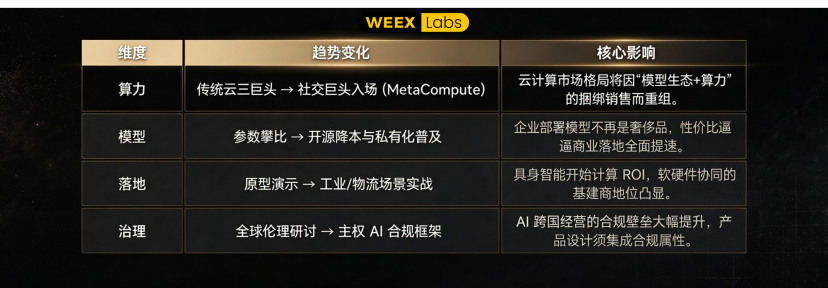
WEEX Labs Deep Insights

The industry shifts in July 2026 indicate: AI's prosperity is piercing through the screens of the virtual world, deeply embedding itself into the fabric of global manufacturing.

For current enterprise strategy, we propose three recommendations:

1. Embrace "Open Source Privatization": Leverage the current open-source benefits of domestic models like DeepSeek to prioritize building enterprise-specific knowledge bases in private environments. Avoid excessive data reliance on external APIs; this is the baseline for coping with future regulatory and cost fluctuations.

2. Beware of "Computing Power Lock-in": The entry of social platforms into the cloud market is a complex signal. When planning digital infrastructure, enterprises should maintain diversity among cloud providers to avoid losing future bargaining power due to model ecosystem lock-in.

Seek Opportunities in "Embodied Infrastructure": In the field of humanoid robots, the opportunity may lie not in making the robots themselves, but in being the "service provider" for data collection, industrial simulation software, or providing AI computing power adaptation solutions for factories.


Trending Cryptos

Related Questions

QWhat is the key shift happening in the AI industry's value focus as of mid-July 2026, according to the article?

AThe article states that the value anchor of AI has shifted from a 'parameter race' to a focus on 'penetration into the real-world industrial sector'.

QHow does Meta's reported plan to launch 'MetaCompute' impact the cloud computing landscape?

AMeta's move represents a 'power reshuffle' where major GPU cluster owners directly challenge traditional cloud providers like AWS. This consolidates 'computing power + model + data' into a one-stop service, squeezing smaller rental providers and forcing enterprise users to evaluate the underlying 'large model ecosystem' of a cloud platform.

QWhat strategic shift does the surge of open-source domestic foundational models in China indicate?

AIt indicates the domestic large model competition has entered a 'public utility' phase. Core competitiveness now lies in 'extreme cost-effectiveness' and 'scenario adaptability.' By lowering costs, enterprises can focus resources on private deployment and deep business integration, clearing cost barriers for scaling AI-native business models.

QAccording to the article, what is the new focus for capital in the field of embodied intelligence/robotics?

ACapital's focus is shifting from 'which robot dances the best' to 'who can provide the most stable industrial simulation data' and 'whose robot can first demonstrate real-world operational efficiency on a factory floor,' marking a transition from lab demos to industrial practicality.

QWhat are the three strategic recommendations WEEX Labs provides for enterprises based on the July 2026 industry shifts?

A1. Embrace 'Open-Source Privatization': Use open-source models like DeepSeek to build private enterprise knowledge bases to hedge against future regulatory and cost fluctuations. 2. Beware of 'Compute Lock-in': Maintain diversity in cloud suppliers to avoid losing future bargaining power due to model ecosystem binding. 3. Seek 'Embodied Infrastructure' Opportunities: Look for opportunities in data collection, industrial simulation software, or providing AI-compute adaptation solutions for factories, rather than just building the robots themselves.

Related Reads

Intern, Earning 120,000 Monthly

An article titled "Intern, Monthly Income of 120,000 RMB" discusses the intense competition for top AI talent in China, highlighted by a viral social media post. A Tsinghua University student from the prestigious Yao Class reportedly received a staggering internship offer from the AI company DeepSeek with a daily salary of 5,500 RMB (pre-tax), translating to over 120,000 RMB per month. This case exemplifies the fierce "talent war" raging among major tech firms. Companies like DeepSeek, Huawei, Tencent, and ByteDance are aggressively recruiting interns and fresh graduates with unprecedented compensation packages, high conversion rates to full-time positions, and even company stock options for top performers like those in Moonshot AI's "Time Travel Plan." The trend shows recruitment starting earlier, even targeting high school students. The driving force is the belief that a few exceptional individuals can be pivotal in the AI race. Salaries for elite AI researchers have skyrocketed from around one million RMB annually to tens of millions. Young, highly-educated talents from top schools, seen as adaptable "AI Natives," are being placed at the forefront of core projects. Examples include Tencent appointing a 27-year-old former OpenAI researcher as its Chief AI Scientist. In essence, the competition is shifting from just models and computing power to a battle for talent density. A new generation of young experts is rapidly rising to central roles, poised to reshape the future AI landscape.

marsbit3h ago

Intern, Earning 120,000 Monthly

marsbit3h ago

Trading

Spot

Hot Articles

Discussions

Welcome to the HTX Community. Here, you can stay informed about the latest platform developments and gain access to professional market insights. Users' opinions on the price of AI (AI) are presented below.

活动图片