Venice AI Raises $65 Million at a $1 Billion Valuation, Founder Declares "No Token Sales", Is $VVV Set for a New Catalyst?

marsbitPublished on 2026-07-02Last updated on 2026-07-02

Abstract

Privacy AI platform Venice AI raised $65 million in a Series A funding round at a $1 billion valuation, led by Dragonfly with participation from Coinbase Ventures and others. This marks the company's first external funding since its launch two years ago. Founder Erik Voorhees emphasized that the team has not sold any VVV tokens. The deal involves selling 8.98% equity, granting investors rights to 1.5 million VVV tokens, and warrants to purchase an additional 5 million VVV over eight years at a set price. If fully exercised, this could bring total funding to roughly $131.5 million. Voorhees estimates that post a one-year lockup, warrant exercises could introduce around 6,000 VVV tokens daily, approximately 0.2% of current daily trading volume. Venice AI, which claims over 3 million users, reported profitability in Q1 2026 with an annualized revenue run-rate exceeding $70 million. The platform positions itself as a private, uncensorable alternative to ChatGPT, offering access to over 200 AI models. The capital will be used to build proprietary computing infrastructure, including its first data center, to reduce reliance on leased GPUs. The company states it will continue using a portion of revenue to buy back and burn VVV tokens while gradually reducing token issuance.

Author: Claude, Deep Tide TechFlow

Deep Tide Introduction: Privacy AI platform Venice has completed its first external funding round of $65 million, reaching a $1 billion valuation and becoming a unicorn. The round was led by Dragonfly, with participation from Coinbase Ventures. For $VVV holders, the real story isn't the money, but this round's equity+token hybrid structure: Founder Erik Voorhees emphasized that the team has not sold a single token and will continue buyback-and-burns while reducing token issuance; however, investors hold warrants to purchase 5 million $VVV tokens over 8 years, exercisable starting one year from now, bringing approximately 6,000 new tokens into the market daily. $VVV rose on the news, with the market interpreting it as a positive catalyst.
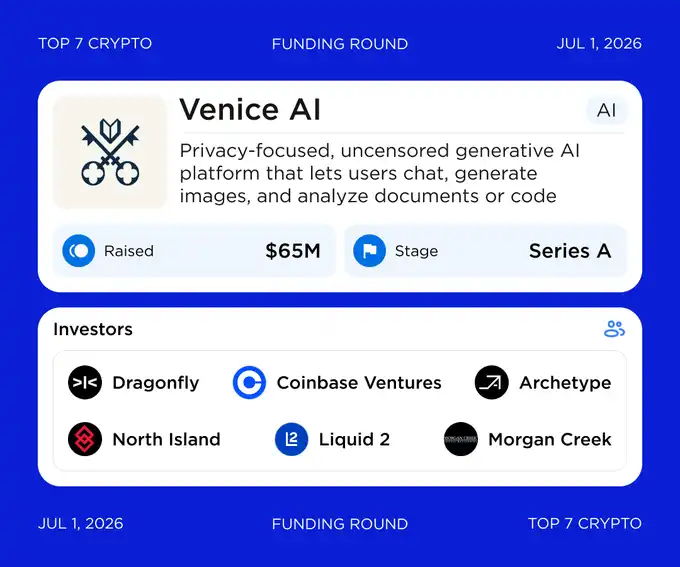
Erik Voorhees's Venice has secured its first external capital.

According to The Block, the privacy AI platform built by ShapeShift founder Voorhees, has closed a $65 million Series A funding round at a $1 billion valuation. The round was led by crypto venture firm Dragonfly, with participation from Coinbase Ventures, North Island Ventures, F-Prime, Archetype, Liquid2 Ventures, Morgan Creek, and others. This is Venice's first external capital raise since its launch two years ago. Previously, it had neither conducted a VC private sale nor monetized $VVV tokens from its treasury.
Equity+Token Two-Tier Structure: Investors Get Nearly 9% Equity Plus Two Batches of $VVV

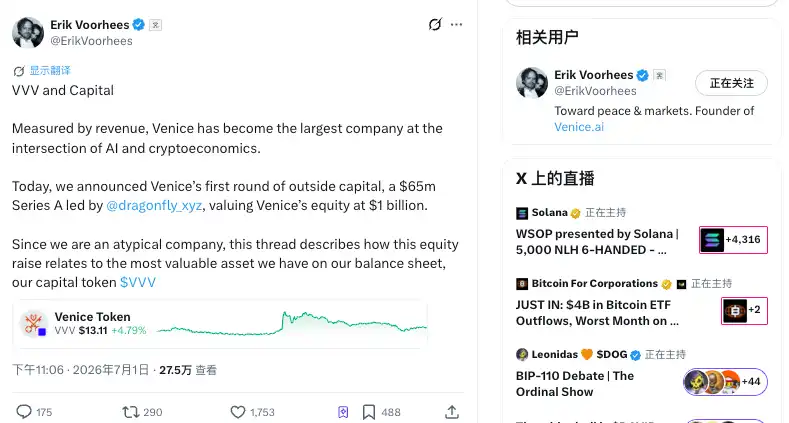
In a lengthy X post, Voorhees disclosed the full consideration for this round. The $65 million buys three things: 8.98% equity in Venice the company, vesting rights to 1.5 million $VVV tokens, and warrants giving the right to purchase an additional 5 million $VVV tokens over the next 8 years at an agreed price.

A warrant is a right to purchase tokens at a predetermined price at a future date. According to Voorhees's calculations, if investors fully exercise these 5 million warrants, they would pay approximately another $66.5 million to Venice, bringing the total potential raise from this round to roughly $131.5 million. Both the token vesting and the warrants have a one-year lock-up period, after which they unlock linearly over the following three years.

What investors receive now is equity plus an option to "buy tokens later at a set price," not immediately liquid tokens. This structure, bundling equity, token vesting, and token warrants together, is not common in crypto financing. Most projects opt for either pure equity or directly sell tokens to VCs.

Founder's Approach: "Build Product and Token First, Then Bring in VC," Reversing Industry Norms

Voorhees emphasized that Venice chose to sell equity rather than finance by selling tokens from its treasury. He stated that Venice remains the largest holder of $VVV, owning over 30 million of the current total supply exceeding 80 million tokens. Neither the company nor the team has sold a single $VVV token to date, despite the token rising over 700% this year.

Venice's funding cadence is the reverse of common industry practice. Most projects presell tokens to VCs under non-public terms first, promising to build the product and find users later. Venice launched its product and token first, generated users and revenue, and then brought in external investors.

This approach is backed by business metrics. According to company disclosures, Venice reached 3 million users in April, was profitable in Q1, and multiple media outlets cited Voorhees stating its annualized run-rate revenue already exceeds $70 million. It is unusual for an AI startup at the Series A stage to be profitable before raising funds.

Warrants Represent Future $VVV Selling Pressure, But Founder Calculates the Pace as "Negligible"

For token holders, those 5 million warrants are an unavoidable issue. They represent potential future issuance; once exercised, they become new circulating supply – selling pressure.

According to Voorhees's calculations, if investors fully exercise their warrants starting about a year from now, approximately 6,000 $VVV tokens would enter the market daily, equivalent to about 0.2% of current daily trading volume. This magnitude is relatively small compared to market depth. The portion of warrants not exercised corresponds to tokens that remain on Venice's balance sheet and do not enter circulation.

On the token strategy side, Venice states it remains unchanged: continuing to use a portion of revenue to buy back and burn $VVV while gradually reducing token issuance. Burns reduce the existing supply, while warrants increase potential supply—two forces moving in opposite directions. The direction of $VVV's net supply depends on whether the buyback-and-burn intensity can outweigh the warrant unlock and regular issuance. This is the core variable token holders need to watch next, more important than the funding news itself.

It's worth noting here that the figures "6,000 tokens daily, 0.2% of daily volume" come from Voorhees's own calculations, representing the funding party's self-reported numbers. Deep Tide currently lacks independent data for cross-verification; readers should treat this as a reference, not a definitive conclusion.

Capital to Be Used for In-House Compute, Targeting GPUs and First Data Center

According to the founder, this funding round will be used to build in-house compute infrastructure, including Venice's first data center, to reduce reliance on leased GPUs.

His stated logic is that owning compute capacity locks in production capability during the "impending resource crunch" and improves gross margins, thereby making "larger-scale $VVV burns possible."

In other words, owning compute lowers costs and increases profits, and profits are then used to buy back and burn $VVV. Besides compute, Venice also plans to use the funds to enter new markets, acquire "synergistic" businesses, hire, and expand its customer base.

On the product side, Venice positions itself as a privacy-focused, censorship-resistant alternative to ChatGPT, claiming not to store user prompts on its own systems, with requests encrypted and forwarded through external proxies, and paid subscriptions offering end-to-end encryption. The platform claims access to over 200 AI models, including both self-hosted open-source models and closed-source models like OpenAI and Anthropic accessed via anonymous API calls. Beyond $VVV, Venice has another token, DIEM: users stake $VVV to get sVVV, then lock a portion of sVVV to mint DIEM, with each DIEM token corresponding to $1 worth of non-expiring API credits on the platform.


Trending Cryptos

Related Questions

QWhat is the significance of the $650 million Series A funding round for Venice AI?

AThe $650 million Series A funding round, led by Dragonfly with participation from Coinbase Ventures and others, values Venice AI at $1 billion, making it a unicorn. It's the company's first external capital raise, notable because it was achieved by selling equity and future token warrants rather than selling existing VVV tokens from the treasury, which is contrary to typical industry practice.

QWhat is the structure of the deal for investors in Venice AI's funding round?

AThe deal grants investors 8.98% equity in Venice AI, immediate vesting rights to 1.5 million VVV tokens, and warrants giving them the right to purchase an additional 5 million VVV tokens over the next 8 years at a predetermined price. The tokens and warrants have a one-year lock-up period, followed by linear vesting over three years.

QAccording to the founder, what impact will the investor token warrants have on the VVV token supply?

AAccording to founder Erik Voorhees, if all warrants are exercised starting after one year, it would introduce approximately 6,000 new VVV tokens into the market daily, which he estimates would be about 0.2% of the current daily trading volume. He presents this as a manageable level of potential selling pressure.

QHow does Venice AI plan to use the funds raised from the Series A round?

AVenice AI plans to use the funds primarily to build its own computing infrastructure, including its first data center, to reduce reliance on leased GPUs. This aims to lock in capacity, improve gross margins, and enable larger-scale VVV token buybacks and burns. Funds will also go towards market expansion, strategic acquisitions, hiring, and growing the customer base.

QWhat is the core value proposition of the Venice AI platform as described in the article?

AVenice AI positions itself as a privacy-focused, anti-censorship alternative to platforms like ChatGPT. It claims not to store user prompts on its own systems, encrypts and routes requests through external proxies, and offers end-to-end encryption for paid subscriptions. The platform provides access to over 200 AI models, including both self-hosted open-source models and anonymously accessed proprietary models from providers like OpenAI and Anthropic.

Related Reads

What to Expect from Bitcoin's Price After Today's Sharp Surge? Only One Hurdle Left to Overcome!

Bitcoin ($BTC) surged sharply after the U.S. Treasury Department announced expanded liquidity support for the long-term bond market, triggering one of the largest short liquidations since October 2020. According to Michael Nagye, founder of The DeFi Report, the timing of Bitcoin's jump followed the Treasury's announcement of enhanced long-term bond buyback operations starting in September. Nagye views this as a second "moderate quantitative easing" measure implemented recently to alleviate pressure on long-term Treasury yields. He noted that gold reacted first to the macroeconomic shift, followed by Bitcoin. However, a significant portion of Bitcoin's move was attributed to short liquidations and market positioning changes rather than new, sustained spot demand. As Bitcoin approaches the $68,000-$69,000 range, key technical levels are back in focus: $68,500 (short-term holder cost basis), $68,800 (21-week moving average), and $69,100 (200-day moving average). The current price action is seen as crucial in determining whether the uptrend will continue. While the rally is notable given the Treasury's actions, Nagye emphasized it remains largely liquidation-driven at this stage. The key question now is whether sustainable market demand will emerge to support further gains. If Bitcoin can break through and convert the $68,500-$69,100 resistance zone into support, it could pave the way for a new bullish rally.

cryptonews.ru41m ago

What to Expect from Bitcoin's Price After Today's Sharp Surge? Only One Hurdle Left to Overcome!

cryptonews.ru41m ago

LATEST NEWS: Long-awaited Fed meeting minutes released! Here's what you absolutely need to read

The Federal Reserve has released the highly anticipated minutes from its Federal Open Market Committee (FOMC) meeting held on July 28-29. The minutes revealed that while most Fed officials supported holding the federal funds rate steady at 3.50-3.75%, a minority advocated for a 25-basis-point increase. A key consensus was that interest rates may need to remain high for longer, and further hikes could be necessary if inflation does not continue to decline. Inflation concerns were central to the discussion. Officials broadly agreed that risks to inflation remain elevated, with some noting that current financial conditions might not be sufficiently restrictive to bring inflation back to the Fed's 2% target. They observed that price increases have been broad-based across many categories of goods and services. The minutes noted that financial conditions had tightened between meetings, partly driven by market expectations of tighter Fed policy. Some officials viewed this market-driven tightening as having already done some of the Fed's work. Staff economic forecasts saw little change in inflation outlook but a slightly downgraded growth forecast. Other points included assessments of financial stability, with some officials flagging a potential sharp correction in AI-related stocks as a risk. The minutes also covered operational topics, such as the effective handling of a payment system glitch and a proposal—though not adopted—to reduce the number of annual policy meetings. The committee affirmed its commitment to maintaining the phrase "will ensure price stability" in its policy statement.

cryptonews.ru1h ago

LATEST NEWS: Long-awaited Fed meeting minutes released! Here's what you absolutely need to read

cryptonews.ru1h ago

Trading

Spot

Hot Articles

Discussions

Welcome to the HTX Community. Here, you can stay informed about the latest platform developments and gain access to professional market insights. Users' opinions on the price of AI (AI) are presented below.

活动图片