The Safest Middleman in the Chip Industry Is Taking the Most Dangerous Path

marsbitPublished on 2026-03-25Last updated on 2026-03-25

Abstract

Arm, the semiconductor IP licensing giant, is embarking on a high-risk strategic shift by developing its own data center CPU, the Neoverse V3-based AGI CPU. This move, its first in-house chip in 35 years, aims to catapult the company's annual revenue from $4 billion to a targeted $15 billion for its chip business by 2031. This ambitious goal requires creating a new business line nearly the size of Intel's entire data center division. The core driver is the threat from its largest customers. Major cloud providers like AWS, Google, and Microsoft are increasingly designing and deploying their own powerful Arm-based server chips (Graviton, Axion, Cobalt), capturing the chip profits while Arm earns only licensing fees and royalties. This trend places a visible ceiling on Arm's traditional revenue growth from the data center sector. By building its own chip, Arm is now competing directly with its own licensees. While its first customer, Meta, lacks a mature in-house chip program, the strategy risks alienating key partners like Amazon and Google. Arm's bet is that the explosive growth of AI-driven data center demand, particularly for CPU-based AI inference tasks, is large enough to support both its new chip business and its ongoing IP licensing model. The success of this unprecedented dual-role strategy hinges on navigating this inherent conflict.

Between $4 billion and $15 billion lies not a growth curve, but a self-disruption of a business model.

On March 24, Arm unveiled the first self-developed data center CPU in its 35-year history in San Francisco. This chip, named the AGI CPU, features 136 Neoverse V3 cores, is built on TSMC's 3nm process, has a 300W TDP, with Meta as its first customer, and is set for large-scale deployment within the year. Simultaneously announced collaborations include OpenAI, Cerebras, Cloudflare, SAP, and SK Telecom.

At the launch event, Arm CEO Rene Haas presented a set of target figures, stating that the chip business aims to achieve $15 billion in annual revenue by 2031, with total company revenue reaching $25 billion and earnings per share of $9.

What do these numbers signify? Arm's total company revenue for FY2025 (ending March 2025) is $4.007 billion. According to Arm's annual report data, this includes $1.839 billion in licensing revenue and $2.168 billion in royalty revenue, with a gross margin of 97%. In other words, a company with $4 billion in annual revenue aims to build a new business nearly the size of Intel's entire data center division within five years. According to Intel's Q4 2024 earnings report, Intel's DCAI (Data Center and AI) division generated $12.8 billion in revenue for the full year 2024.
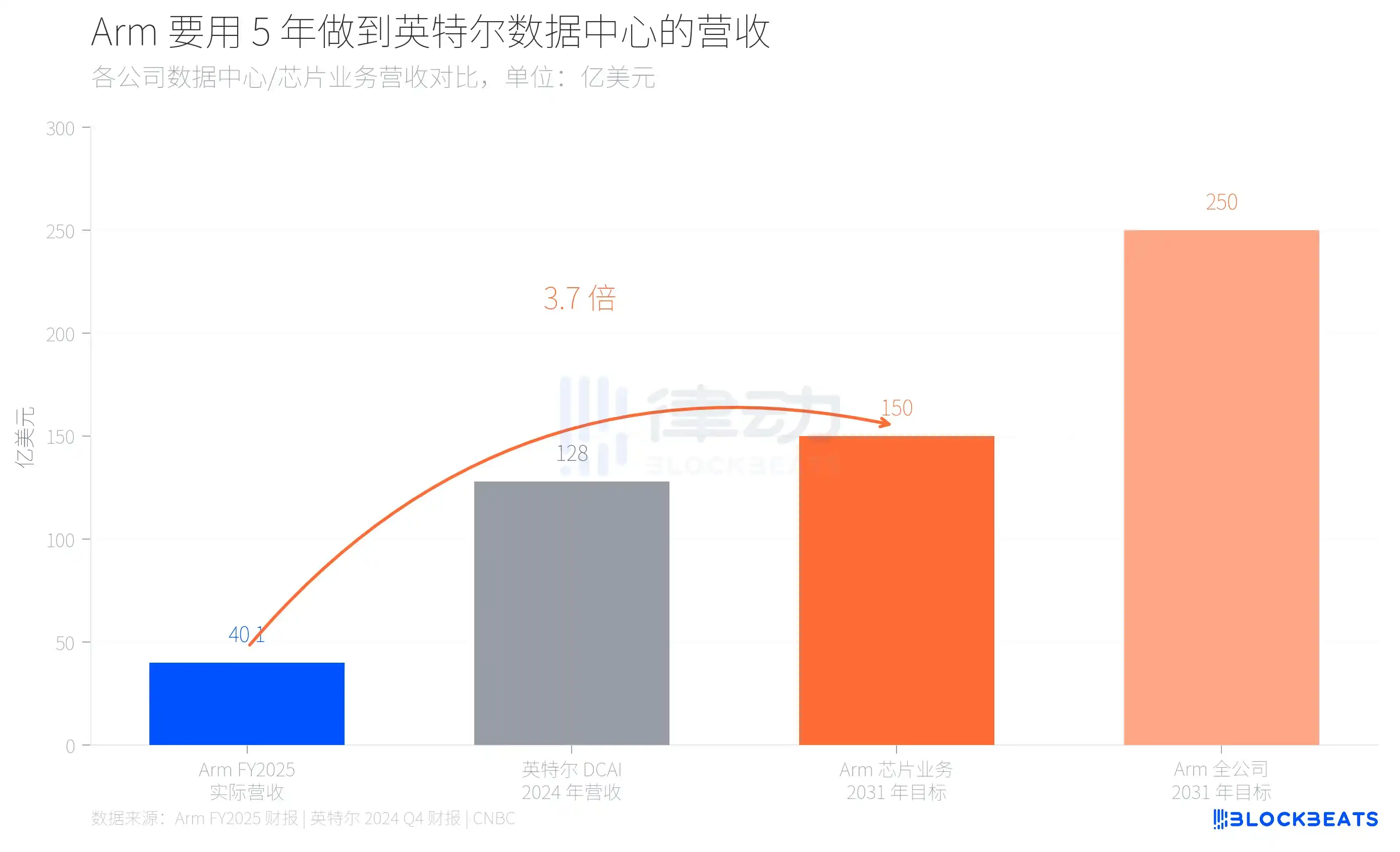
Behind the 3.7-fold leap from $4 billion to $15 billion is Arm's attempt to transform from a pure IP licensing company into a hybrid that sells both design blueprints and finished products. There is no precedent for this in the chip industry.

Why is Arm taking this risk? The answer lies in its customer list.

Over the past three years, Arm's largest data center customers have all been doing the same thing. According to AWS public data, Amazon has migrated over 50% of its EC2 computing power to its self-developed Graviton chips, with the latest Graviton5 reaching 192 cores. As disclosed by Google Cloud, Google's Axion chip has already facilitated the migration of over 30,000 internal applications, improving energy efficiency by 80%. Microsoft's Cobalt 200 is also based on the Arm Neoverse architecture, built on TSMC's 3nm process, with 132 cores.
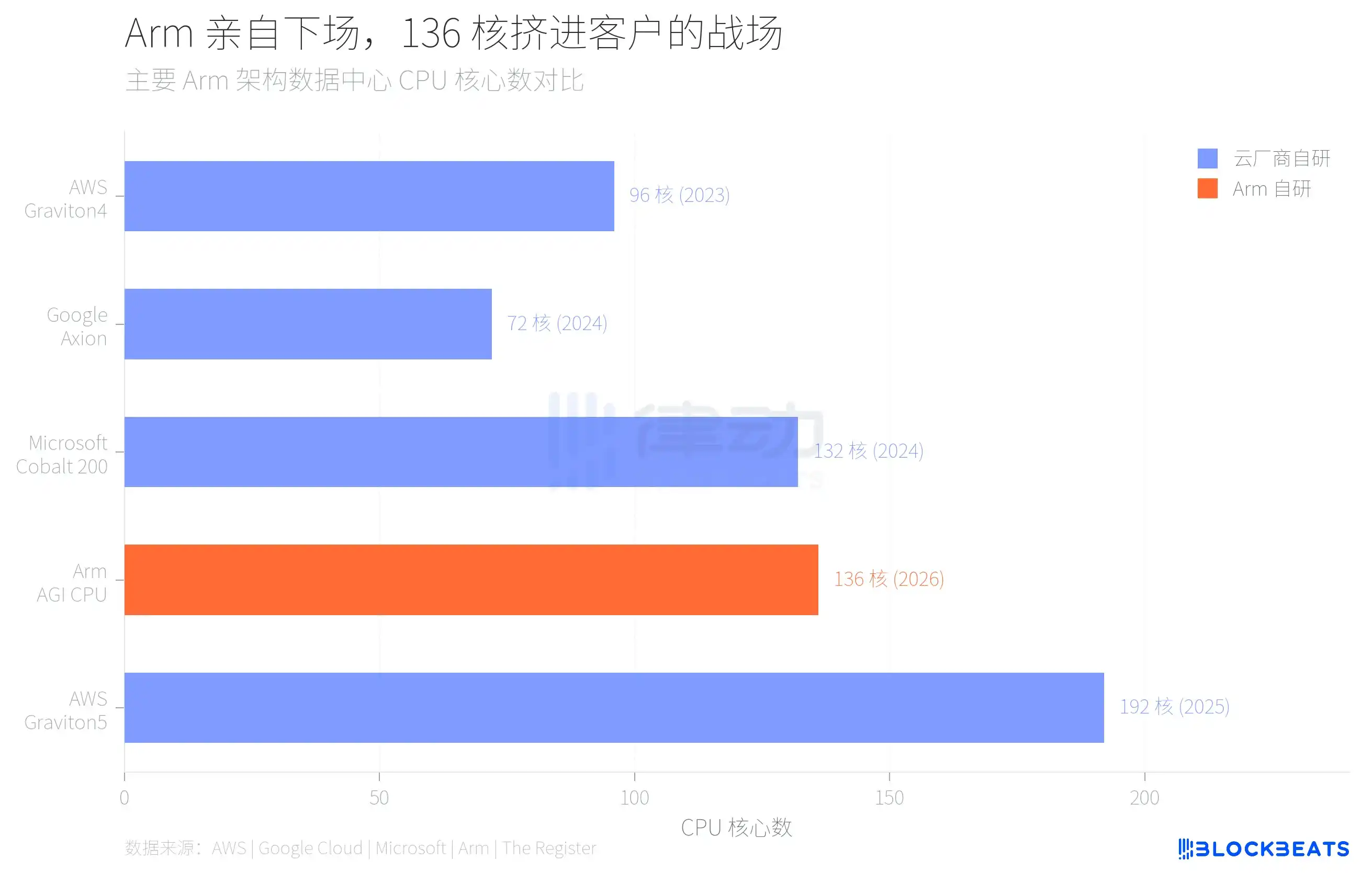
These cloud providers all use Arm's architectural license, but they design, tape out, and deploy the chips themselves. Arm earns licensing fees and royalties from this, not the profits from the chips. As more computing demands are absorbed by these self-developed chips, the revenue ceiling for Arm in the data center becomes increasingly clear.

Examining Arm's revenue structure over the past four years reveals this ceiling more concretely. According to Arm's financial reports from FY2022 to FY2025, total company revenue grew from $2.7 billion to $4.0 billion, with an average annual growth of about 14%. Within this, royalty revenue increased from $1.562 billion to $2.168 billion, while licensing revenue grew from $1.141 billion to $1.839 billion. Royalty growth has already slowed to around 20% in recent years, and much of this 20% growth comes from the upgrade cycle to the Armv9 architecture in mobile, not the data center.
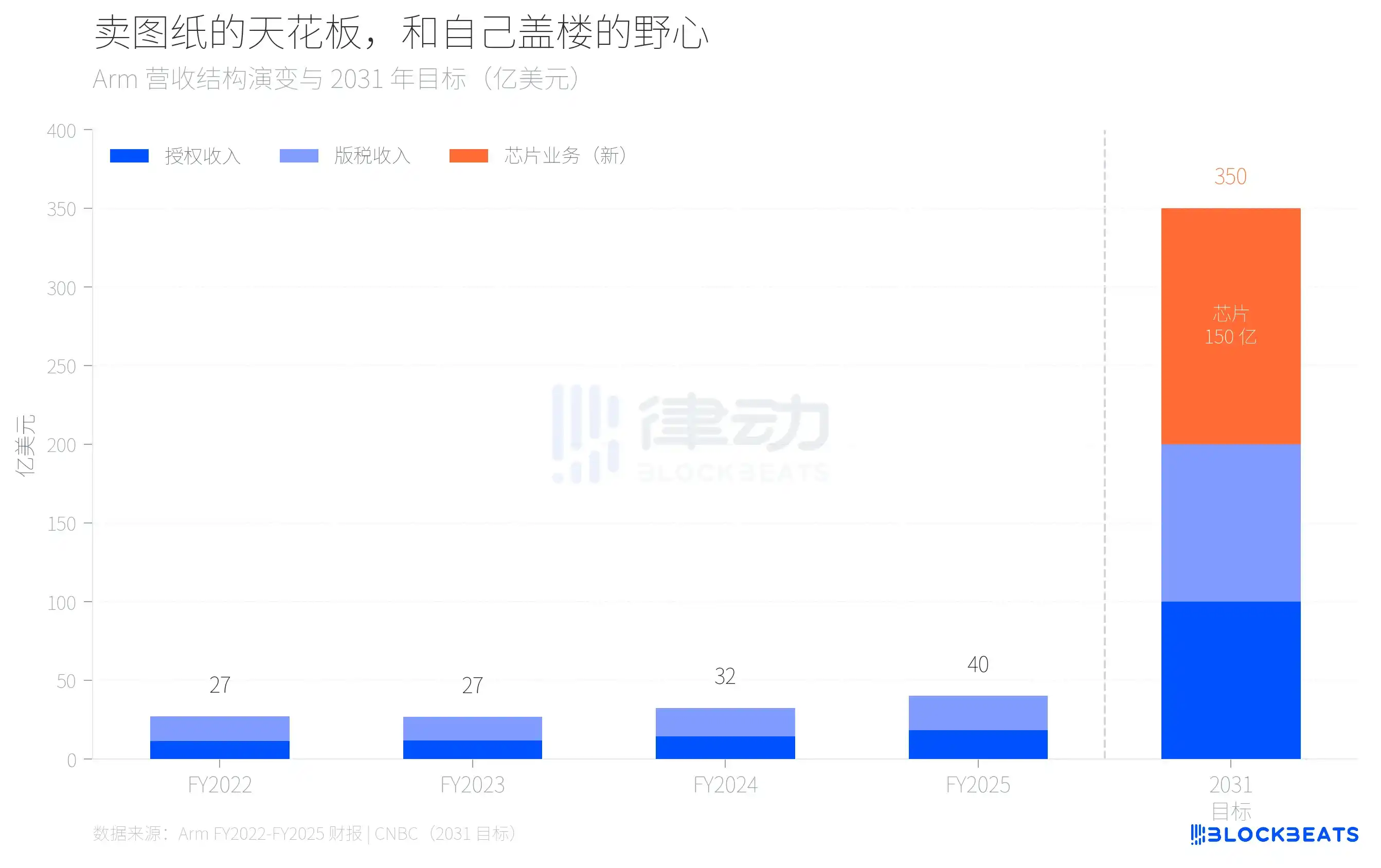
Extrapolating at this growth rate, even if both licensing and royalty revenues maintain around 20% annual growth, they would only reach approximately $10 billion by 2031. The remaining $5 billion to reach the $15 billion target must come from a business that does not exist today. This is the arithmetic logic behind Arm's decision to build its own chips.

By choosing to manufacture its own chips, Arm is essentially competing with its own customers. A company that sells architectural blueprints has started building houses itself, while its blueprint buyers have been building for several years.

This is the true backdrop of the 136-core AGI CPU. According to The Register, this chip has a base frequency of 3.2 GHz, boosting to 3.7 GHz, 12-channel DDR5 memory, 6 GB/s bandwidth per core, 96 PCIe 6.0 lanes, and supports CXL 3.0. Arm positions it as the "computing foundation for the agentic AI cloud era," specializing in CPU-side task scheduling and data flow management for AI inference, rather than directly competing with GPUs.

The pace of market share change is also telling. According to Omdia estimates, Arm architecture servers will account for about 21% of global shipments in 2025, with a growth rate of 70%. However, within hyperscale data centers, this proportion is already close to 50%. The 40-year monopoly of x86 is not collapsing; it's being replaced chip by chip.

The risk for Arm's self-developed chips lies not in technology, but in relationships. Meta's willingness to be the first customer is partly because Meta does not have a mature self-developed chip project like Amazon or Google. But how will Amazon, Google, and Microsoft view this? If a supplier starts competing for your business, would you still entrust it with your most critical architectural licenses?

Arm's bet is that the total data center market will grow faster than customer relationships deteriorate. Rene Haas evidently believes that the incremental demand for CPUs in the AI era is large enough for self-developed chips and architectural licensing to coexist. The $15 billion target is the price tag on this judgment.

After 35 years of selling blueprints, it's building its first house. The blueprints are still for sale, and the house is also being built. The question is whether there's enough room on the same plot of land for both.


Trending Cryptos

Related Questions

QWhat is the significance of Arm's first self-developed data center CPU, the AGI CPU, and who is its first major customer?

AThe AGI CPU is Arm's first self-developed data center CPU, marking a significant shift from its traditional IP licensing model to also manufacturing and selling finished chips. It is built on TSMC's 3nm process, features 136 Neoverse V3 cores, and has a 300W TDP. Meta is the first major customer and plans to deploy it at scale within the year.

QWhat are Arm's ambitious financial targets for its chip business by 2031, and how do they compare to its current revenue?

AArm aims for its chip business to achieve $15 billion in annual revenue by 2031, with total company revenue reaching $25 billion and earnings per share of $9. This is a massive increase from its FY2025 total revenue of approximately $4 billion, meaning the new chip business alone would need to grow to nearly the size of Intel's entire Data Center and AI division, which had $12.8 billion in revenue in 2024.

QWhy is Arm taking the risk of manufacturing its own chips, a strategy that puts it in competition with its own customers?

AArm is taking this risk because its largest data center customers, like Amazon (Graviton), Google (Axion), and Microsoft (Cobalt), are increasingly designing their own chips based on Arm's architecture licenses. While Arm earns licensing fees and royalties from these designs, it misses out on the larger profits from the actual chips. This trend places a clear ceiling on Arm's future revenue growth from its traditional business model, forcing it to seek new revenue streams by selling finished products.

QWhat is the potential conflict or risk for Arm in its new strategy of selling both IP licenses and finished chips?

AThe primary risk is damaging its relationships with its major architecture licensees, such as Amazon, Google, and Microsoft. By becoming a direct supplier of finished chips, Arm is now competing with its own customers. These companies may become reluctant to share their most critical architectural plans and designs with a supplier that is also a competitor, potentially jeopardizing Arm's core licensing business.

QHow does Arm justify its new strategy and what market trend is it betting on for success?

AArm is betting that the total market demand for data center CPUs, particularly driven by the agentic AI era, is growing fast enough to accommodate both its traditional licensing business and its new chip manufacturing venture. CEO Rene Haas believes the AI-driven demand for CPU-based tasks like AI inference scheduling and data flow management will be so substantial that the potential revenue from selling chips outweighs the risk of alienating some licensing customers.

Related Reads

Must-Watch Events Next Week|CLARITY Act Could Face Senate Vote; SpaceX, Circle to Report Earnings (8.3-8.9)

**Summary: Key Events and Developments to Watch (August 3-9)** The upcoming week is marked by significant financial disclosures, key legislative deadlines, and notable product updates. **Major Financial Events:** Several companies are scheduled to release their Q2 2026 earnings. American Bitcoin (ABTC) will report on August 3, followed by SpaceX and Hut 8 Mining Corp. on August 4, and Circle on August 5. Notably, a significant portion of SpaceX shares (up to 12% of total shares) will be unlocked on August 6 following their earnings release. **Key Legislative Deadline:** The U.S. Senate faces an August 7 deadline to secure 60 votes for the CLARITY Act, a bipartisan bill aiming to establish a federal regulatory framework for cryptocurrencies. The Senate may hold a full vote on the bill during the week. **Economic Data:** The U.S. July Non-Farm Payrolls report will be released on August 7, providing crucial labor market data. **Technology & Product Updates:** * **Shutdowns:** DeFi portfolio tracker Zapper and wallet app Ctrl Wallet will cease operations on August 3. * **Upgrades:** LayerZero will deprecate its v1 relayers on August 3. XRP Ledger's new version 3.3.0, featuring five new functions, is expected next week. * **AI:** Elon Musk announced that the advanced Grok 4.6 AI model is set for release around August 7. * **Bitcoin:** The BIP-110 forced signaling for a potential Bitcoin network change is scheduled to begin around August 8. **Other Notable Events:** Chinese robotics firm Unitree Tech has set its preliminary price inquiry for its IPO for August 5. South Korean exchange Upbit will delist AQT and AERGO tokens on August 3.

marsbit23m ago

Must-Watch Events Next Week|CLARITY Act Could Face Senate Vote; SpaceX, Circle to Report Earnings (8.3-8.9)

marsbit23m ago

Stocks Are Plummeting More Sharply Than Cryptocurrencies. Where Has the Money Gone?

Stock Markets Plunge Deeper Than Cryptocurrencies: Where Did the Money Go? In late July, Seoul's Kospi index triggered circuit breakers for two consecutive days, plummeting over 40% from its June high. The collapse was led by heavyweight stocks like SK Hynix, whose record profits still disappointed investors, and devastating leveraged ETFs, with one major product losing over 83% of its value. This signaled a global, forced deleveraging targeting the most crowded trades. Interestingly, while stocks exhibited extreme volatility akin to crypto markets, Bitcoin rose nearly 15% in July after a prior steep drop. Analysis shows the money fleeing equities did not flow into Bitcoin. Instead, Bitcoin had already absorbed its sell-off in May-June, when U.S. spot Bitcoin ETFs saw historic outflows. The true safe-haven beneficiary was gold, whose price rose over 20% year-on-year, highlighting a decoupling between Bitcoin and gold as "digital gold." The sell-off was a targeted unwinding of leveraged positions in tech and semiconductors, accelerated by broker-dealer risk management and shifts in the AI narrative, including new competition from Chinese memory chipmakers. The retreat path was clear: from high-valuation tech stocks to cash and U.S. Treasuries, then to gold. For Bitcoin to attract sustained institutional inflows, conditions like eased global liquidity pressure, a "soft-landing" Fed rate cut, and U.S. regulatory clarity via legislation like the stalled CLARITY Act are needed. Currently, Bitcoin is not a safe haven but an already-cleared asset. Its low correlation with tech stocks, however, makes it a potential diversification play for institutional portfolios once the storm passes. The money isn't here yet, but the positioning is underway.

marsbit23m ago

Stocks Are Plummeting More Sharply Than Cryptocurrencies. Where Has the Money Gone?

marsbit23m ago

In Conversation with Ray Dalio: We Are Currently in an AI Bubble, with 1% of My Portfolio in Bitcoin

Ray Dalio, founder of Bridgewater Associates, warns in an interview that the current AI boom shows classic bubble characteristics, which could lead to significant economic downturns as seen in past cycles like 1929 or 2000. He explains that speculative enthusiasm, fueled by debt and overvaluation, often precedes a crash when rising rates or taxation force asset sales, causing widespread losses and recession. Dalio also outlines his "Big Cycle" theory, describing an approximate 80-year pattern where widening wealth gaps, massive government deficits, and shifting geopolitical power (like China's rise) create internal conflict and global instability. He emphasizes that we are in a late-cycle, transitional phase where traditional powers like the US and UK face decline. For personal wealth protection, Dalio advises diversification beyond cash into assets like stocks, bonds, real estate, and particularly gold, which he prefers over Bitcoin. While he holds about 1% of his portfolio in Bitcoin as a non-printable hard asset, he views gold as more secure from technological or governmental threats. Regarding AI's impact, Dalio believes it will disproportionately benefit capital owners, worsening inequality by replacing both physical and cognitive labor. He suggests that human intuition and emotional intelligence, combined with AI, will be key for future workers. On taxation, Dalio argues that wealth taxes are impractical and risk triggering asset sell-offs, reducing productive investment. He points to the UK as a cautionary example of debt, low productivity, and political strife. Geopolitically, Dalio foresees a more regionalized world, with the US showing weakness in prolonged conflicts like with Iran, akin to past imperial declines. The ideal outcome, he suggests, is coexisting powerful blocs (e.g., Americas, China-Asia Pacific) without major war.

marsbit4h ago

In Conversation with Ray Dalio: We Are Currently in an AI Bubble, with 1% of My Portfolio in Bitcoin

marsbit4h ago

Daily 7.2 Trillion KRW: Foreign Capital's Record Net Buying on Friday! Wall Street Says Headwinds for Korean Stock Fund Flows Have Subsided

South Korean stock market sees a dramatic shift in fund flows. On July 31, foreign investors made a record net purchase of approximately KRW 7.2 trillion in KOSPI stocks, marking a fundamental reversal from the persistent large-scale net outflows seen in previous months. This contributed to a significant narrowing of foreign net selling in July to KRW 9.8 trillion, down sharply from KRW 48.4 trillion in June and KRW 44.5 trillion in May. Simultaneously, domestic institutional pressure eased. South Korean pension funds and asset managers turned to a net buying position in July, purchasing KRW 1.0 trillion worth of KOSPI shares, contrasting with net sales in May and June. Market volatility is expected to be dampened by new financial regulations. Effective July 31, the Financial Services Commission tightened access for retail investors to single-stock leveraged ETFs by raising the minimum cash deposit requirement. Trading volumes for these products subsequently dropped to about 50% of their monthly average. Citigroup Research maintains its year-end KOSPI target of 10,000 points. The firm cites several supportive factors: the substantial easing of headwinds from capital outflows, a robust fundamental outlook for the semiconductor sector, historically low market valuations, strong economic fundamentals, and the potential for policy support from financial authorities if needed.

marsbit4h ago

Daily 7.2 Trillion KRW: Foreign Capital's Record Net Buying on Friday! Wall Street Says Headwinds for Korean Stock Fund Flows Have Subsided

marsbit4h ago

Trading

Spot

Hot Articles

How to Buy 4

Welcome to HTX.com! We've made purchasing 4 (4) simple and convenient. Follow our step-by-step guide to embark on your crypto journey.Step 1: Create Your HTX AccountUse your email or phone number to sign up for a free account on HTX. Experience a hassle-free registration journey and unlock all features.Get My AccountStep 2: Go to Buy Crypto and Choose Your Payment MethodCredit/Debit Card: Use your Visa or Mastercard to buy 4 (4) instantly.Balance: Use funds from your HTX account balance to trade seamlessly.Third Parties: We've added popular payment methods such as Google Pay and Apple Pay to enhance convenience.P2P: Trade directly with other users on HTX.Over-the-Counter (OTC): We offer tailor-made services and competitive exchange rates for traders.Step 3: Store Your 4 (4)After purchasing your 4 (4), store it in your HTX account. Alternatively, you can send it elsewhere via blockchain transfer or use it to trade other cryptocurrencies.Step 4: Trade 4 (4)Easily trade 4 (4) on HTX's spot market. Simply access your account, select your trading pair, execute your trades, and monitor in real-time. We offer a user-friendly experience for both beginners and seasoned traders.

5.0k Total ViewsPublished 2025.10.20Updated 2026.06.02

How to Buy 4

Discussions

Welcome to the HTX Community. Here, you can stay informed about the latest platform developments and gain access to professional market insights. Users' opinions on the price of 4 (4) are presented below.

活动图片