The answer could be revealed as soon as today; the entire internet is awaiting the 'AI stock god'’s playbook.

marsbitPublished on 2026-05-18Last updated on 2026-05-18

Abstract

The article discusses the highly anticipated Q1 2026 13F filing from 24-year-old "AI stock guru" Leopold Aschenbrenner's fund, Situational Awareness LP. The fund gained fame after its publicly disclosed holdings skyrocketed from $225 million in Q4 2024 to $5.5 billion in Q4 2025. The market is eagerly awaiting the fund's latest portfolio, seen as a key indicator for AI investment trends. The filing was due by May 15 but has not yet been published. Three potential reasons are explored: 1) A late Friday submission causing an SEC processing delay, with the filing expected imminently. 2) The fund requested confidential treatment from the SEC, suggesting it is building a large, sensitive position. 3) The unlikely scenario that the fund's holdings dropped below the $100 million reporting threshold. The outcome is expected within days. If the filing is released, it will be analyzed for portfolio shifts. If confidential treatment was requested, it will intensify speculation about what major asset Aschenbrenner is accumulating.

Original | Odaily Planet Daily(@OdailyChina)

Author | Azuma(@azuma_eth)

Remember Leopold Aschenbrenner? The 24-year-old “New AI Stock God” we introduced in our article “SBF's Underling Turns $225 Million into $5.5 Billion in One Year”.

Leopold Aschenbrenner worked at FTX's Future Fund in 2022 and remained with the team until FTX's collapse. In 2024, Leopold Aschenbrenner wrote a 165-page super-paper titled “Situational Awareness: The Decade Ahead” and founded a fund of the same name, Situational Awareness LP, the same year, where he serves as Chief Investment Officer.

Situational Awareness LP focuses on investment opportunities in the AI industry chain. The fund's publicly disclosed holdings were “only” $225 million in Q4 2024, but by the Q4 2025 holdings disclosure released this February, that number had skyrocketed to $5.5 billion. This explosive investment performance has greatly boosted the reputation of Leopold Aschenbrenner and Situational Awareness LP, making it one of the most closely watched AI investment trends online.
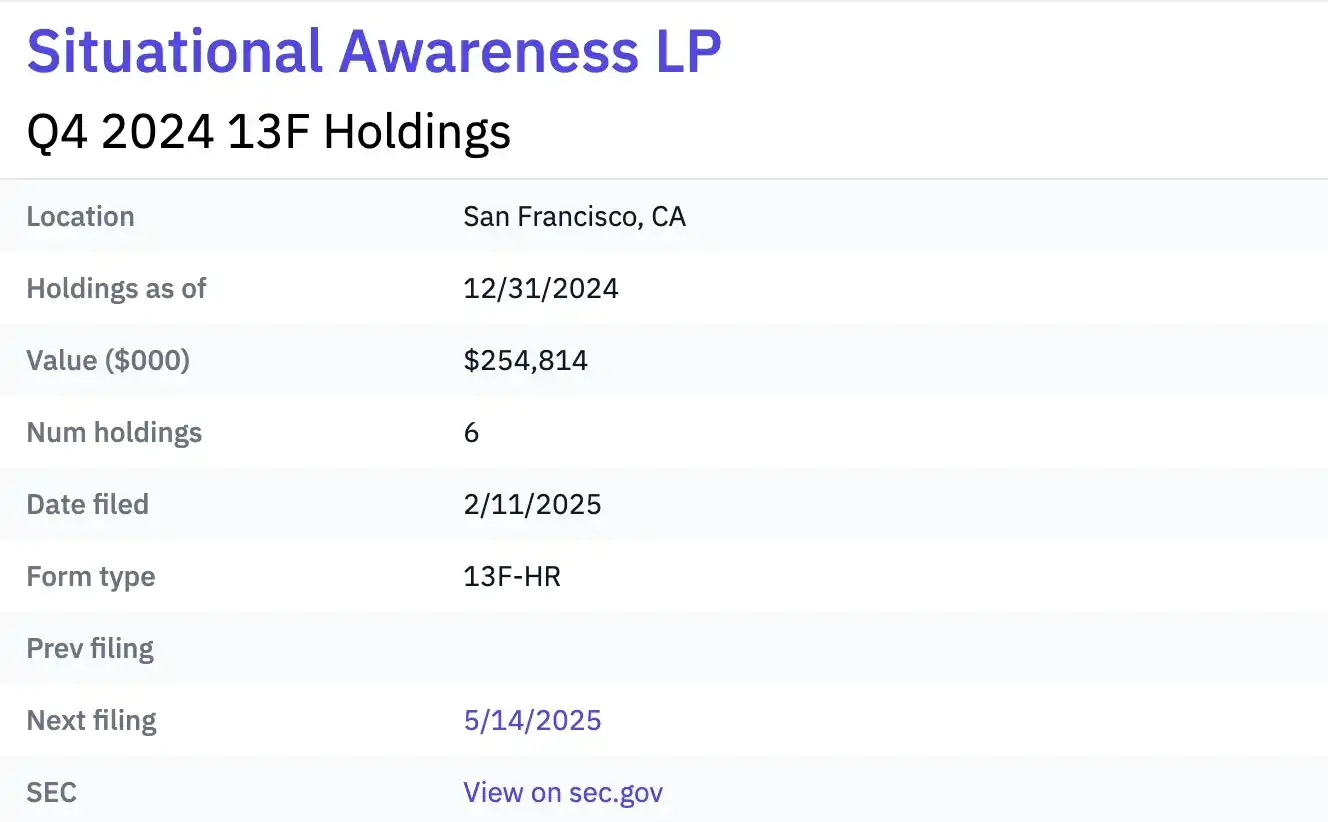
Now, it's once again the critical window for Situational Awareness LP to disclose its holdings (13F). Starting last week, the entire internet has been eagerly waiting for the fund to reveal the current AI investment playbook, but as of publishing, the disclosure from Situational Awareness LP is still awaited.

The so-called 13F is a quarterly disclosure document required by the U.S. Securities and Exchange Commission (SEC) from funds with assets under management exceeding $100 million. The SEC mandates that funds meeting the disclosure requirements must submit this document within 45 days after the end of each calendar quarter. The fund is required to disclose its holdings of U.S. listed stocks, call/put options, convertible bonds, and specific ETF positions as of the end of the previous quarter.

Today is May 18th, three days past the Q1 2026 disclosure deadline of May 15th. Over the past few days, numerous sovereign wealth funds, university endowment funds, and traditional financial institutions have already disclosed their Q1 13F holdings reports, but the market is still waiting for Situational Awareness LP's disclosure.

Based on various market analyses, the following three scenarios may have affected Situational Awareness LP's 13F disclosure progress.

The first possibility is that Situational Awareness LP may have submitted the document to the SEC after 5:30 PM on May 15th. Since that day was a Friday, the SEC may not have had time to process it, so the document would need to be published on the SEC website the following Monday, after which the public could see it.

This is the mainstream market view. If this is the case, we can expect to see Situational Awareness LP's 13F file later today (or tomorrow at the latest).

The second possibility is that Situational Awareness LP has applied to the SEC for confidential treatment. This is a legal mechanism provided by the SEC that allows large funds to delay public disclosure of their holdings information while they are still actively building positions, with delays of up to one year.

Generally, the only reason a fund applies for confidential treatment is that they are building a position large enough that if the market were to learn about it prematurely, it would move the price against them before they finish building. If this is the case, it would mean Leopold Aschenbrenner is quietly accumulating a significant asset and temporarily does not want the market to know. This would undoubtedly warrant even closer market attention.

The third scenario is highly unlikely: Situational Awareness LP significantly reduced its holdings in the past quarter, bringing its portfolio size below the 13F disclosure threshold ($100 million). Considering the fund held $5.5 billion last quarter, the probability of this is extremely low.

In short, we only need to wait another 1 to 2 days to know the real reason for Situational Awareness LP's disclosure delay this time.

If it's the first scenario, we will bring you an analysis of the portfolio changes as soon as the 13F is released. If it's the second reason, the entire internet will truly be on edge—what exactly is Leopold Aschenbrenner hoarding? That would be the moment for internet investigators to shine.


Related Questions

QWhat is the name of the 24-year-old AI investment prodigy featured in the article and his fund?

AThe 24-year-old AI investment prodigy is Leopold Aschenbrenner. The fund he founded and serves as the Chief Investment Officer for is called Situational Awareness LP.

QWhat is a 13F filing according to the U.S. SEC, as explained in the article?

AA 13F filing is a quarterly report mandated by the U.S. Securities and Exchange Commission (SEC) for investment funds managing over $100 million in assets. It requires the fund to disclose its holdings of U.S. exchange-traded stocks, options, convertible bonds, and certain ETFs at the end of the quarter.

QWhat was the extraordinary growth in Situational Awareness LP's publicly disclosed portfolio value between Q4 2024 and Q4 2025?

ASituational Awareness LP's publicly disclosed portfolio value grew from $225 million in Q4 2024 to $5.5 billion in Q4 2025.

QWhat are the three possible reasons suggested in the article for Situational Awareness LP's delayed 13F filing for Q1 2026?

A1. The fund submitted the filing after 5:30 PM on the May 15th deadline (a Friday), and the SEC simply hasn't processed and published it yet. 2. The fund requested confidential treatment from the SEC to delay public disclosure, possibly because it is building a large position and wants to avoid price impact. 3. It's highly improbable, but the fund's holdings may have fallen below the $100 million reporting threshold.

QWhat significant action did Leopold Aschenbrenner take in 2024 besides founding his investment fund?

AIn 2024, besides founding Situational Awareness LP, Leopold Aschenbrenner wrote a 165-page paper titled 'Situational Awareness: The Decade Ahead,' which shares its name with his fund.

Related Reads

The Rally That Wasn't

The article analyzes Bitcoin's sharp decline amid a shift in macroeconomic expectations, with strong US job data leading markets to price out Fed rate cuts. Bitcoin fell 13% to around $67,000, triggering significant outflows from US spot ETFs and indicating institutional de-risking. On-chain data confirms a bearish structure. Price has dropped back into the "bear market range," with the Short-Term Holder Cost Basis falling below a key mean level—a pattern last seen in early 2022. The profitability bias has collapsed, with loss realization now dominating, mirroring a panic wave from February. Recent buyers who accumulated near the $82k top are under pressure, and loss realization is accelerating across both short-term and long-term holder cohorts. Off-chain, the rally failed at the aggregate US ETF cost basis near $83k, turning it into resistance. Spot market demand has deteriorated sharply, with sellers dominating order books. While a major long liquidation event cleared over $400M in leverage, spot buyers have not returned to absorb supply. Options markets show sustained demand for downside protection (elevated put premiums) but not panic, with volatility premiums near three-month highs. The conclusion is that the market remains fragile, with overhead supply from trapped ETF investors, weak spot demand, and accelerating losses. Without a return of spot buying and a reclaim of key cost bases, Bitcoin is vulnerable to further downside within the prevailing bear market structure.

insights.glassnode4h ago

The Rally That Wasn't

insights.glassnode4h ago

Trading

Spot
Futures

Hot Articles

Discussions

Welcome to the HTX Community. Here, you can stay informed about the latest platform developments and gain access to professional market insights. Users' opinions on the price of AI (AI) are presented below.

活动图片