BREAKING: Mastercard Just Opened Its Global Payment Network To Crypto — Which Altcoins Made The Cut?

bitcoinistPublished on 2026-06-03Last updated on 2026-06-03

Abstract

Mastercard announced the expansion of its global settlement infrastructure to support on-chain settlement using regulated stablecoins. This enables card transactions to settle 24/7, eliminating delays from traditional banking hours. The initial rollout supports six stablecoins—USDC, PYUSD, USDG, USDP, RLUSD, and SoFiUSD—across eight blockchains, including Ethereum, Solana, and the XRP Ledger. The service is launching with partners in the U.S. and Latin America. This is a back-end settlement upgrade, not a consumer-facing change, allowing network partners to optionally use blockchain rails while traditional fiat settlement remains available.

Mastercard announced on June 3 that it will expand its global settlement infrastructure to support on-chain settlement using crypto via regulated stablecoins — enabling card transactions to settle 24 hours a day, seven days a week, across weekends and holidays for the first time in the network’s history, per the company’s official press release.

Six regulated crypto and stable coins are supported in the initial rollout: Circle’s USDC, PayPal’s PYUSD, Paxos-issued USDG and USDP, Ripple’s RLUSD, and SoFi’s SoFiUSD. Settlement will operate across eight blockchain networks — Ethereum, Solana, Polygon, Base, Arbitrum, the XRP Ledger, Canton, and Tempo — per the official announcement.

ARQ (formerly DolarApp), CBW Bank, Cross River, Lead Bank, and Nuvei are among the first partners to support stablecoin settlement optionality, with the initial rollout targeting the United States and Latin America before broader expansion through 2026.
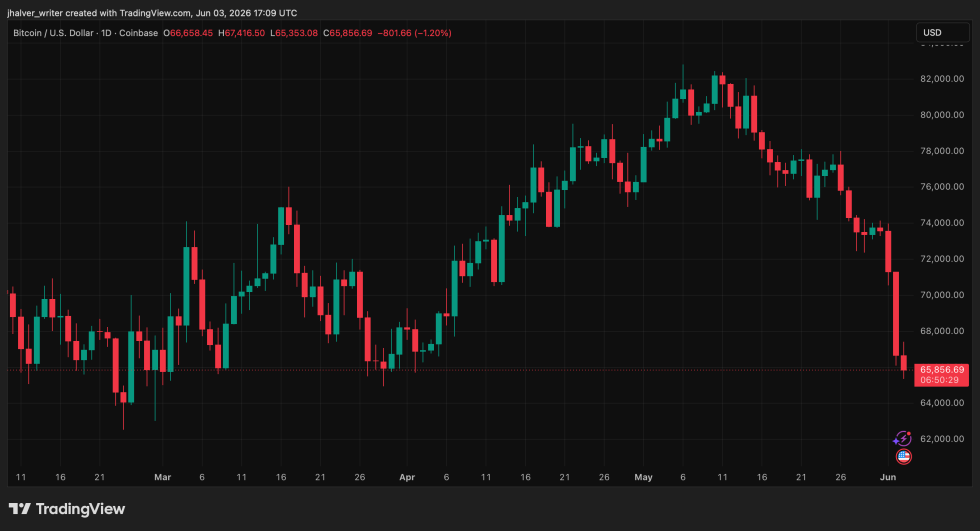
BTC's price trends to the downside on the daily chart. Source: BTCUSD on Tradingview

What Changes For Crypto — And What Doesn’t

The announcement is a settlement-layer development, not a consumer-facing product shift. Issuers and acquirers on Mastercard’s network can now choose to settle card-based transactions using regulated stablecoins on-chain rather than through traditional banking rails — or continue using existing fiat processes. Both options run in parallel. No cardholder needs to change how they pay.

What changes is the back-end infrastructure that clears and finalizes transactions between merchants, banks, and payment processors. That infrastructure can now operate on blockchain networks around the clock — removing the dead zones created by banking hours, weekend closures, and public holidays that have been a structural friction point in global payments for decades, per Mastercard’s press release.

Raj Dhamodharan, Mastercard’s Executive Vice President for Blockchain and Digital Assets, described the enhancement as expanding how partners manage liquidity while operating in an always-on digital economy, per the announcement. Ripple SVP Jack McDonald called it a landmark validation that blockchain technology is ready for the world’s most critical payment infrastructure, per Benzinga’s reporting of his statement.

This development marks a pivotal and historic moment for the nascent sector. The world’s second-largest card network opening its global settlement rails to six regulated stablecoins across eight blockchains — not as a pilot, not as a proof of concept, but as a live network-level enhancement — is the clearest institutional validation the stablecoin economy has received to date.

Cover image from Grok, BTCUSD chart from Tradingview

Related Questions

QWhat major announcement did Mastercard make on June 3 regarding its payment network?

AMastercard announced it is expanding its global settlement infrastructure to support on-chain settlement using regulated stablecoins, enabling card transactions to be settled 24/7 for the first time in the network's history.

QWhich six regulated stablecoins are supported in the initial rollout of Mastercard's new settlement system?

AThe six supported stablecoins are Circle's USDC, PayPal's PYUSD, Paxos-issued USDG and USDP, Ripple's RLUSD, and SoFi's SoFiUSD.

QHow many and which blockchain networks will this settlement system operate across according to the announcement?

ASettlement will operate across eight blockchain networks: Ethereum, Solana, Polygon, Base, Arbitrum, the XRP Ledger, Canton, and Tempo.

QWho are among the first partners to support stablecoin settlement optionality with Mastercard?

AThe first partners include ARQ (formerly DolarApp), CBW Bank, Cross River, Lead Bank, and Nuvei.

QWhat is the key difference this announcement makes for crypto transactions on Mastercard's network?

AThe announcement is a settlement-layer development, not a consumer-facing change. Issuers and acquirers can now choose to settle card transactions using regulated stablecoins on-chain, operating 24/7, instead of or alongside traditional banking rails. Cardholders' payment methods do not change.

Related Reads

WWDC26 Ultimate Preview: The All-New Siri is the Main Course, iOS 27 is Another Year of Refinements

Apple has confirmed WWDC26 will begin on June 8, with the keynote at 10 AM PT (1 AM Beijing Time, June 9). This year's focus is expected to shift significantly from routine OS updates to Apple's progress in AI, particularly a major overhaul of Siri. Reports indicate the highlight will be a new Siri, reportedly powered by Google's Gemini technology. This upgraded assistant is expected to appear as a lightweight bubble from the Dynamic Island and be accessible via a unified "Search or Ask" system-wide entry point. It aims to deeply integrate with iOS 27, iPadOS 27, and macOS 27, accessing personal data like messages, photos, and documents, with a potential standalone Siri app also in development. For iOS 27, leaks suggest incremental improvements rather than major redesigns. Key updates may include a redesigned, more customizable Camera app, enhanced photo editing tools within the Photos app, and potential early system optimizations for a future foldable iPhone. The update is also rumored to prioritize bug fixes, stability, and performance optimization. iPadOS 27 is anticipated to focus on improving productivity features like window management, file systems, and external display support to better utilize the iPad's hardware. macOS 27 is seen as a core platform for Apple Intelligence, likely receiving an optimized Siri, new AI features, and continued refinement of the "Liquid Glass" design language. Notably, macOS 27 may finally drop support for Intel-based Macs. The overarching theme for WWDC26 is whether Apple can effectively integrate AI across its ecosystem. The success of the new Siri and Apple Intelligence will be judged on their ability to move beyond standalone features and become a cohesive, context-aware system layer that understands user workflows across iPhone, iPad, Mac, and other devices, while maintaining Apple's emphasis on privacy and stability. The conference represents Apple's critical attempt to catch up and redefine the AI assistant experience after a perceived slow start in the generative AI era.

marsbit15m ago

WWDC26 Ultimate Preview: The All-New Siri is the Main Course, iOS 27 is Another Year of Refinements

marsbit15m ago

The Rally That Wasn't

The article analyzes Bitcoin's sharp decline amid a shift in macroeconomic expectations, with strong US job data leading markets to price out Fed rate cuts. Bitcoin fell 13% to around $67,000, triggering significant outflows from US spot ETFs and indicating institutional de-risking. On-chain data confirms a bearish structure. Price has dropped back into the "bear market range," with the Short-Term Holder Cost Basis falling below a key mean level—a pattern last seen in early 2022. The profitability bias has collapsed, with loss realization now dominating, mirroring a panic wave from February. Recent buyers who accumulated near the $82k top are under pressure, and loss realization is accelerating across both short-term and long-term holder cohorts. Off-chain, the rally failed at the aggregate US ETF cost basis near $83k, turning it into resistance. Spot market demand has deteriorated sharply, with sellers dominating order books. While a major long liquidation event cleared over $400M in leverage, spot buyers have not returned to absorb supply. Options markets show sustained demand for downside protection (elevated put premiums) but not panic, with volatility premiums near three-month highs. The conclusion is that the market remains fragile, with overhead supply from trapped ETF investors, weak spot demand, and accelerating losses. Without a return of spot buying and a reclaim of key cost bases, Bitcoin is vulnerable to further downside within the prevailing bear market structure.

insights.glassnode6h ago

The Rally That Wasn't

insights.glassnode6h ago

Trading

Spot
Futures
活动图片





