SpaceX IPO Rush: A Capital Feast That Could Reshape the Landscape of AI and Crypto

marsbitPublished on 2026-05-20Last updated on 2026-05-20

Abstract

SpaceX's potential IPO is emerging as a pivotal event that could reshape the landscape for both AI and Crypto markets. Far more than a traditional aerospace offering, SpaceX represents the core of Musk's future-tech ecosystem, with its Starlink satellite network positioning it as a global digital infrastructure company. This shift could redefine the foundational layers of the internet, communication, and data flow. Historically, major tech capital market movements, like AI booms or Bitcoin ETF approvals, have profoundly influenced crypto cycles. The SpaceX IPO could trigger a similar "super-narrative" fusion, boosting investor sentiment toward future digital infrastructure. This is particularly relevant for Crypto, which aims to build decentralized versions of such global systems. Key crypto sectors likely to benefit include: * **DePIN (Decentralized Physical Infrastructure Networks):** Projects like Render, Filecoin, and Helium, which incentivize real-world infrastructure for compute, storage, and connectivity. * **AI Crypto:** Platforms such as Bittensor and Fetch.ai, which leverage blockchain for decentralized AI computation, data markets, and agent economies. * **On-chain Payments & SocialFi:** Ecosystems like Solana and Ton, which could gain traction if Musk's X platform integrates digital payments and stablecoins. Ultimately, the IPO symbolizes a broader capital re-evaluation of core digital-age assets—networks, AI, data, and decentralized systems—aligning clos...

Author: Climber, CryptoPulse Labs

Over the past few years, the crypto market has witnessed numerous cycles of trending themes. From DeFi, NFTs, and GameFi to AI, Memes, RWA, and modular public chains, market sentiment has been shifting at an increasingly rapid pace. However, the major events truly capable of altering the global flow of risk assets have consistently originated from the U.S. technology capital markets.

Recently, news of SpaceX's impending IPO has kept global capital markets abuzz with excitement. This is because the company heading for an Initial Public Offering is not merely a traditional aerospace firm; it's a core asset within Elon Musk's entire future technology universe.

Once SpaceX officially goes public, it is likely to become a landmark event for global capital to reprice the infrastructure of the future. And the crypto market might emerge as one of the biggest beneficiaries of this shift.

I. The Essence of the SpaceX IPO: Global Capital Betting on Future Digital Infrastructure

Many ordinary people still understand SpaceX primarily as a rocket launch company, but today's SpaceX is increasingly resembling a global-scale digital infrastructure enterprise.

Its true value no longer lies solely in its space launch business but increasingly in the underlying Starlink satellite internet system, global communication capabilities, military contracts, data transmission capacity, and its potential for integration with future AI and robotics ecosystems.
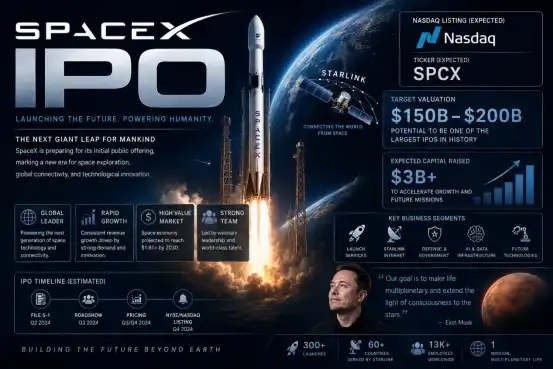
Starlink, in particular, is gradually constructing a global satellite network system. While the core competition of the past internet era was over who controlled terrestrial communication networks, the future of the global internet may evolve towards satellite-based connectivity. This implies that the foundational gateways for networks, data, communication, and AI could be redefined.

The connection between this development and the crypto industry runs deeper than many realize. The Web3 world has long emphasized globalization and decentralization, yet one of its biggest limitations has been the heavy reliance on traditional internet infrastructure for underlying physical networks.

The emergence of Starlink is essentially about rebuilding the way the world connects to the internet.

For regions traditionally difficult for ground-based networks to cover, satellite internet could even become the primary point of internet access in the future. Once global connectivity capabilities are further enhanced, on-chain payments, decentralized identity, AI Agents, on-chain social networks, and distributed node systems could all experience significantly greater growth potential.

More critically, the significance of the SpaceX IPO extends beyond fundraising; it represents the moment when global capital will formally begin reassessing the value of future digital civilization infrastructure.

In recent years, AI has been the most sought-after theme in the U.S. stock market. However, the market may gradually come to realize that AI, communication, data, and computing power are all inseparable from the underlying network infrastructure.

Crypto, coincidentally, also revolves around these elements. In a sense, SpaceX is building a centralized version of global infrastructure, while the crypto world is attempting to construct a decentralized counterpart.

This logical resonance might lead increasingly more traditional capital to refocus on the long-term value of Web3.

II. Narrative Upgrade: The SpaceX IPO Could Catalyze the Next Crypto Bull Run

Reviewing past bull cycles reveals that shifts in the U.S. technology capital market have often profoundly influenced the crypto market.

For instance, the global liquidity easing and surge in U.S. tech stocks in 2020 preceded Bitcoin's super bull run. The AI boom in 2023 saw the AI Crypto sector double rapidly. Following the approval of spot Bitcoin ETFs, the entire crypto industry entered a new phase of institutionalization.
Therefore, what's truly worth paying attention to this time with the SpaceX IPO is not just its valuation, but the potential super-narrative convergence it might bring about.

Elon Musk today no longer controls just a single company but is gradually forming a complete technological ecosystem. SpaceX handles aerospace and satellite networks, Starlink manages global communications, the X platform is transforming into a payments and social super-app, xAI is positioning itself in artificial intelligence, and Tesla controls robotics and energy systems.

If these businesses become increasingly integrated in the future, it essentially means the formation of a super-ecosystem encompassing AI, social media, communications, payments, robotics, and data.

The crypto market's inherent sensitivity lies in its natural aptitude for providing the financial settlement layer for such globalized digital ecosystems.

Consequently, the SpaceX IPO is likely to usher in a new market sentiment, where global capital begins to believe once again in the vast growth potential of the future tech world.

Whenever this sentiment emerges, the crypto market often becomes a gathering point for capital with the highest risk appetite. Sectors like AI Crypto, on-chain payments, decentralized social networks (DeSoc), DePIN (Decentralized Physical Infrastructure Networks), and computing power are highly likely to become focal points for speculative capital once again.

The most noteworthy among these is arguably DePIN, as its core logic involves using token incentives to build real-world infrastructure, including networks, communications, GPU computing power, wireless nodes, and data collection.

The rise of Starlink is actually helping the global market understand one thing: the most important future assets may not be traditional internet platforms, but the underlying infrastructure itself.

When the market starts revaluing networks, communications, computing power, and data, the long-term logic of infrastructure-related projects in the Crypto world will be reinforced.

Simultaneously, the SpaceX IPO could further strengthen market expectations for global payments and stablecoins. Musk has long expressed his desire for the X platform to evolve into a super-app akin to WeChat, Alipay, or an AI-powered equivalent.

If the X platform were to integrate stablecoins or even an on-chain payment system in the future, the valuation logic for the entire Crypto payments industry could undergo a dramatic change.

In other words, what the market is speculating on now is no longer just a pure space exploration concept, but a bet that the future global internet, AI, and financial systems will gradually migrate on-chain.

III. Potential Beneficiaries in the Crypto Space from the SpaceX IPO

If the SpaceX IPO successfully ignites sentiment among global technology investors, the most promising directions in the future crypto market will likely concentrate on two core narratives: infrastructure and AI.
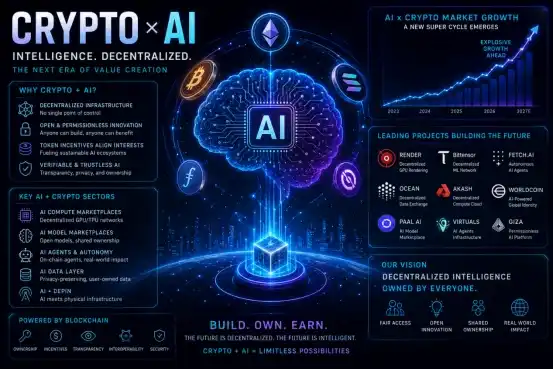
The first and most direct beneficiaries would remain in the DePIN sector.

This is because this track is essentially an "on-chain infrastructure revolution." Projects like Render, Akash Network, Filecoin, Helium, and Arweave represent core players in the "networks, storage, computing, communications" direction. While the market has previously favored short-term meme hype, future capital might return to infrastructure sectors that possess genuine long-term value.

Secondly, AI Crypto is highly likely to regain market spotlight. As competition intensifies among AI giants like xAI, OpenAI, and Google DeepMind, the market is increasingly realizing that the endgame of AI is, in fact, computing power, data, and energy.

Blockchain technology can play a role in distributed GPU networks, AI data marketplaces, and payment systems for AI Agents.

Therefore, AI Crypto projects like Bittensor, Fetch.ai, Virtuals Protocol, and io.net are likely to attract renewed capital attention. The direction of AI Agents, in particular, could very well become the strongest new narrative combining AI and Crypto.

Beyond that, on-chain payments and SocialFi (Decentralized Social Finance) are also worth close attention. If the X platform gradually integrates payments, stablecoins, and digital identity systems in the future, the entire logic of Web3 social finance could be rebooted.

Projects and ecosystems focused on consumer-facing applications, payments, and high performance, such as Toncoin, Solana, Internet Computer, and Aptos, could all receive heightened attention.

From a broader perspective, the greatest significance of the SpaceX IPO for the crypto market is not a short-term speculative wave, but its potential indication that global capital is repricing the core assets of the future digital civilization.

These core assets fundamentally revolve around several key themes: networks, AI, communications, data, payments, and decentralized systems.

Coincidentally, these are precisely the problems the crypto industry has been trying to solve for over a decade.

Thus, the SpaceX IPO might not just be another super U.S. stock market listing; it could potentially become a major turning point for the flow of technology capital back into the Crypto world in the coming years.

Conclusion

If the SpaceX IPO does materialize, its significance may already transcend the listing of a single company, instead serving as a signal for a shift in the next wave of technology narratives. As aerospace, AI, communications, social media, and payments gradually merge within one ecosystem, capital markets will simultaneously search for new anchors. And the crypto market has consistently been the most sensitive component during such narrative migrations.

Future uncertainties remain, but one thing is certain: when global technology begins retelling the story of integrated infrastructure, AI, and finance, the crypto market will never be absent.


Trending Cryptos

Related Questions

QWhat is the core argument of the article regarding the significance of SpaceX's potential IPO for the crypto market?

AThe article argues that a SpaceX IPO is more than just a company listing; it represents a global capital event that could re-price future digital infrastructure. This could benefit the crypto market by shifting capital and narrative focus towards decentralized versions of the infrastructure (like networks, AI, data, and payments) that SpaceX is building in a centralized manner, potentially catalyzing the next crypto bull cycle.

QAccording to the article, how does Starlink relate to the development of Web3 and crypto?

AStarlink, as a global satellite internet system, is redefining the underlying physical network for internet connectivity. For Web3 and crypto, which emphasize global and decentralized access, Starlink's infrastructure could overcome limitations posed by traditional ground-based networks, especially in remote areas. This enhanced global connectivity could unlock greater growth potential for on-chain payments, decentralized identity, AI agents, and distributed node systems.

QWhich specific crypto sectors or narratives does the article identify as potential beneficiaries of a SpaceX IPO-driven market shift?

AThe article identifies several crypto sectors as potential beneficiaries: 1) DePIN (Decentralized Physical Infrastructure Networks) for network, storage, and compute (e.g., Render, Filecoin). 2) AI Crypto projects focused on distributed computing, data, and AI agents (e.g., Bittensor, Fetch.ai). 3) On-chain payment and SocialFi ecosystems, particularly if Elon Musk's X platform integrates crypto payments (benefiting chains like Solana, Ton). 4) Broader infrastructure and high-performance blockchain projects.

QWhat historical pattern does the article reference to support its prediction about the impact of U.S. tech capital markets on crypto?

AThe article references the pattern where major shifts in U.S. tech capital markets have historically influenced crypto bull cycles. Examples given include the 2020 liquidity-driven tech stock rally preceding Bitcoin's bull run, the 2023 AI stock boom sparking an AI Crypto rally, and the approval of Bitcoin ETFs accelerating institutional adoption in crypto.

QWhat is the broader thematic connection the article draws between Elon Musk's ecosystem (SpaceX, xAI, X, Tesla) and the crypto industry?

AThe article suggests that Elon Musk is building an integrated super-ecosystem spanning space, AI, social media, payments, robotics, and energy. Crypto, with its strengths in providing a global financial settlement layer and decentralized systems, is 'naturally adept' at serving as the financial infrastructure for such a future digital ecosystem. The potential fusion of these narratives could drive capital and innovation towards crypto.

Related Reads

From South Korea to the United States: Blue-Collar Jobs Are Becoming Increasingly Popular, Thanks to AI

AI is reshaping the labor market's value proposition. The traditional four-year college degree is losing its appeal as a guaranteed career path, while skilled blue-collar trades like electricians, welders, and plumbers are experiencing historic demand and wage premiums. This shift is driven by dual pressures: AI's displacement of certain white-collar roles and a booming need for physical infrastructure and data center construction. Data confirms the trend. In the U.S., vocational school revenue surged, and a significant portion of recent layoffs are AI-related. Surveys show a majority of Gen Z adults plan to pursue blue-collar work, citing better job security against AI automation. Vocational education interest has exploded recently. Experts cite a psychological shift as younger generations seek tangible, AI-resistant careers and avoid high student debt. In many cases, salaries for skilled trades now match or exceed those requiring a bachelor's degree. In South Korea, semiconductor vocational high schools boast near-total employment, with graduates securing high-paying roles at companies like Samsung. The shortage is structural, exacerbated by a retiring baby boomer workforce and massive infrastructure projects. Companies like JPMorgan Chase, Meta, and Lowe's are investing heavily in training programs. However, overcoming historical stigma and a "perception gap" around trade careers remains a key challenge to closing the talent gap.

marsbit1h ago

From South Korea to the United States: Blue-Collar Jobs Are Becoming Increasingly Popular, Thanks to AI

marsbit1h ago

Qualcomm: AI Hype Subsides, When Will Smartphones Emerge from the Gloom?

Qualcomm reported its Q3 FY2026 results (ending June 2026), with revenue of $9.95B, down 4% YoY but above expectations. Gross margin declined to 53.1%, pressured by rising costs across manufacturing and memory. Key business segments showed mixed performance: Handset revenue fell 19.6% YoY to $5.09B, dragged by an 11% decline in non-Apple Android shipments and weaker high-end mix. Conversely, Automotive revenue surged 61% to $1.59B, and IoT grew 9% to $1.83B. Core operating profit dropped 41% YoY due to margin compression and higher expenses. Management's Q4 FY2026 guidance projects revenue of $9.7B-$10.5B, in line with consensus, but Non-GAAP EPS guidance of $2.05-$2.25 fell short of expectations. Amidst persistent weakness in its core handset market, Qualcomm is pursuing growth in AI, focusing on Edge AI (smartphones, PCs, automotive) and Data Center AI. Its data center strategy includes four pillars: AI accelerators (e.g., AI200), commercial CPUs (Dragonfly C1000), custom silicon, and connectivity solutions. While these initiatives initially boosted its stock, concerns over AI capital expenditure sustainability have since erased those gains. The company targets $5B in data center revenue for FY2027 and $15B for FY2029. The report concludes that with the traditional handset business still under pressure, the data center opportunity is currently viewed as a longer-term option, and a more conservative valuation based on core operations may be warranted until AI contributions materialize.

marsbit1h ago

Qualcomm: AI Hype Subsides, When Will Smartphones Emerge from the Gloom?

marsbit1h ago

From TPU to Self-Evolving Agents: How Jeff Dean Predicts the Next Step in AI

At the 2026 YC Startup School, Jeff Dean outlined his vision for AI's next phase, shifting focus from simply scaling models to building intelligent, autonomous systems. He believes AI's progress is no longer just about creating smarter models, but about integrating them into systems capable of long-term, iterative work, automated experimentation, and continuous learning. This evolution moves the competition from "who has the bigger model" to "who can best organize intelligence." Dean suggests AI capabilities are now comparable to a junior engineer, enabling the automation of complex workflows. However, the true challenge and opportunity lie in managing these AI "workers" at scale. He emphasizes the importance of **context engineering**—structuring tools, memory, and feedback loops—over raw model power. For startups, this means building deep expertise in niche domains where general models currently fail (near 0-1% success rates), leveraging proprietary data, specialized tools, and domain-specific evaluators. A recurring theme is re-examining fundamental constraints. Dean's past work, like moving Google's search index to memory or creating the TPU, stemmed from questioning outdated assumptions about hardware and cost. He sees similar inflection points today, particularly in **specialized inference hardware** to drastically reduce latency and energy consumption for real-time Agent operation. Notably, he points out that in modern AI systems, the dominant cost is often not computation but **data movement**. Reliable, long-running Agents require robust system design, borrowing concepts from distributed computing like checkpointing, state management, and parallel exploration to handle failures and maintain progress over days or weeks. As AI automates execution, the scarcest human skills will shift to **defining clear specifications**, **judging what problems are worth solving** (taste), and designing effective feedback loops. Ultimately, Dean's framework prioritizes understanding the problem deeply, identifying the true bottlenecks, and systematically building closed-loop systems where AI can not only perform tasks but also improve AI itself.

marsbit1h ago

From TPU to Self-Evolving Agents: How Jeff Dean Predicts the Next Step in AI

marsbit1h ago

Trading

Spot

Hot Articles

Discussions

Welcome to the HTX Community. Here, you can stay informed about the latest platform developments and gain access to professional market insights. Users' opinions on the price of AI (AI) are presented below.

活动图片














