San Francisco now has humanoid robots to help with household chores.
Great, another significant step towards entering homes, after all...
This dude can wash his own hands!!!
Amazing, squeezing soap, turning off the faucet... and even knows to wipe his hands with a towel at the end.
It just looks a bit weird, with a Wi-Fi router on its head—like a Teletubby, right?
Doesn't affect its work, though. This mopping demo is quite interesting; while mopping, it sees trash on the floor, bends down to pick it up, turns around, walks a few steps, and throws it into the trash bin.
Could this be what mom calls "having an eye for work"? (just kidding).
But, and I have to say but.
Scrolling to the comments section, I found out that all of the above was remote-controlled. Pure·Manual·Intelligence.
Honestly, when I saw that line, my heart sank halfway...
But thinking about it calmly, there are still things worth praising.
All the videos above are at 1x speed.
You have to know, most home demos of robots on the market start at 2x speed as a baseline, some even crank it up to 4x speed just to look passable.
Maybe at this stage, it's still too difficult for humanoid robots to both work and be aesthetically pleasing. Remote control is a clever workaround, I suppose.
This is the debut of the US robotics company Tau Robotics.
Yes, the τ of Embodied AI (just kidding).
The "Wi-Fi Router" Doing Housework
Tau Robotics is an American robotics startup founded in 2024, headquartered in the San Francisco Bay Area. It's very small, less than 10 people, quite early-stage.
Their approach is quite interesting.
Instead of jumping straight into autonomous AI, they "cheat" via remote control to bridge the gap, aiming to kickstart the data flywheel once real-world home deployment is achieved.
They raised about $3 million in Pre-seed funding in September 2024 and then went quiet. Now they've finally presented their work—
A humanoid robot cleaning service.
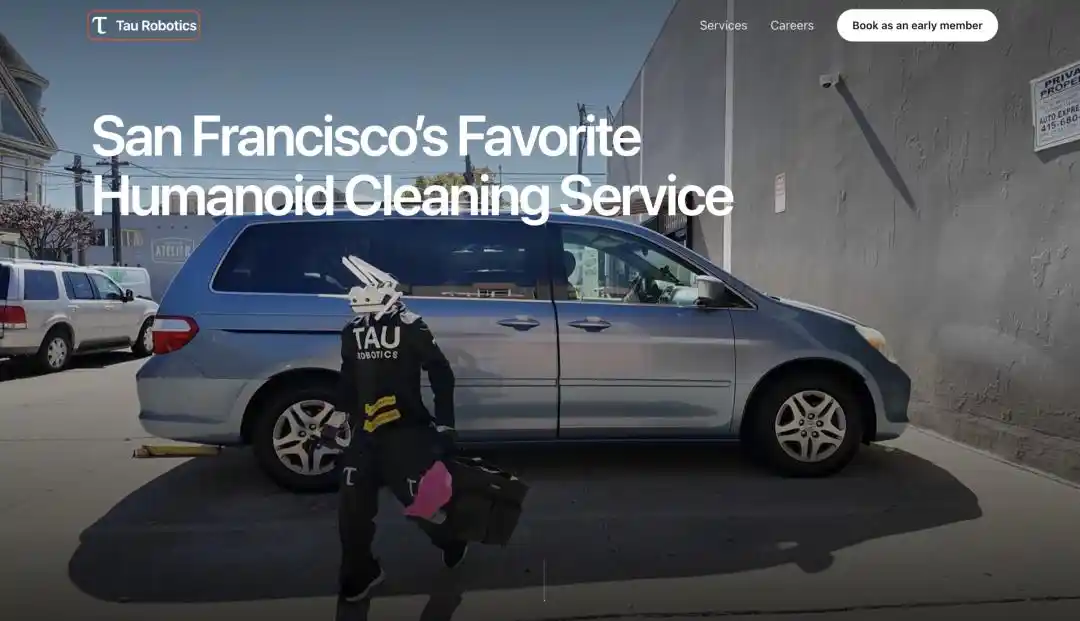
Honestly, at first glance, I was wondering where the robot was.
After all, this guy is dressed in dark work clothes, getting out of a van looking quite human-like—
Until I saw that Wi-Fi router on its head...
The founder specifically explained, saying it does look a bit funny, but there's no choice, it's the best spot to place the antenna for the humanoid robot.

Bro, the key is I didn't know it was remote-controlled at first. Seeing that antenna suddenly gave me goosebumps, has Embodied AI already developed to this level??
You can tell the official team is more than a little satisfied with this demo. The website background loops this getting-out-of-the-van video endlessly...
Once inside the home, it starts working officially.
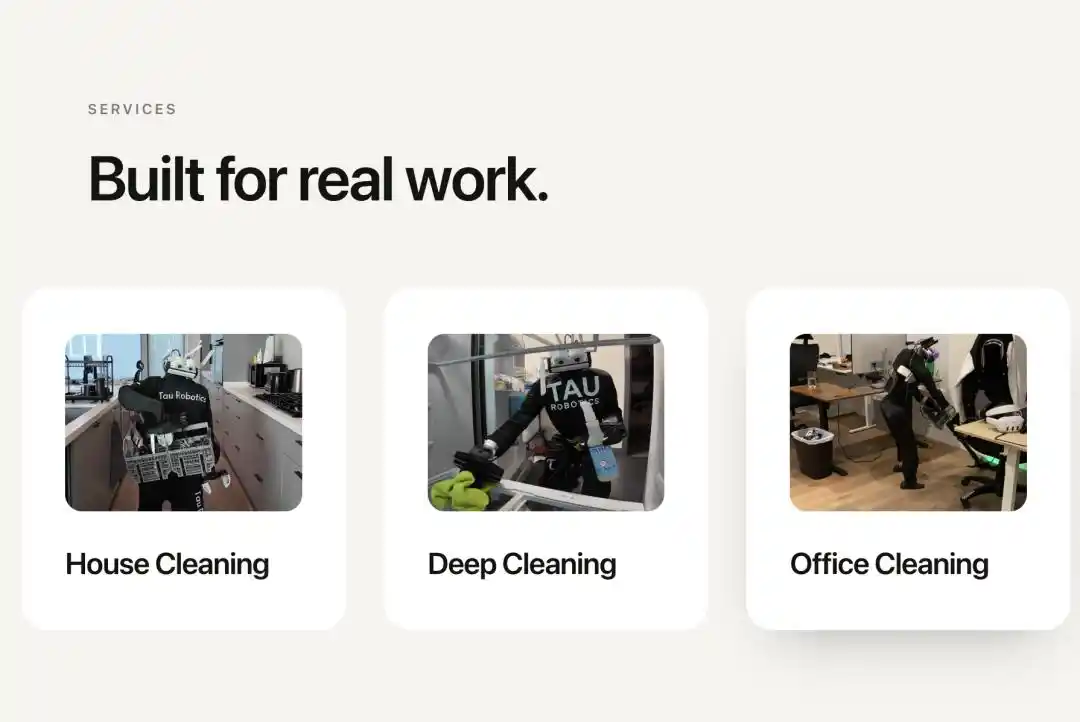
Tau has three "employees".
The first one, Chelsea.
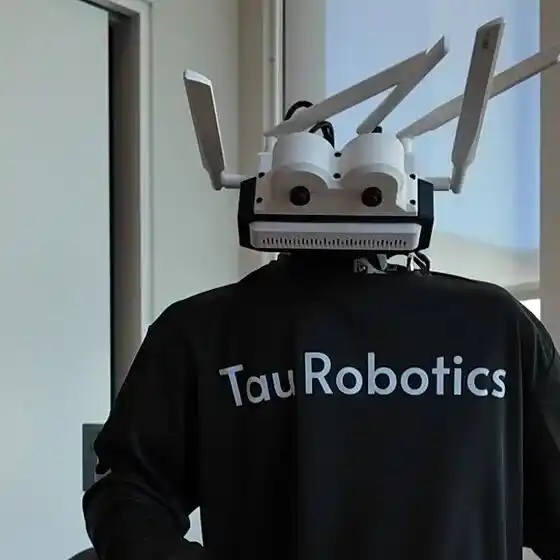
That's the guy who got out of the van. The kitchen and bathroom are its strengths—sink, countertops, mirrors, tiles, floors...
The second one, Elon.
That name, little Musk, huh?
Elon handles regular weekly visits. After a few sessions, it can remember where things are in your home and put everything back in its place after cleaning.
The third one, Tony.
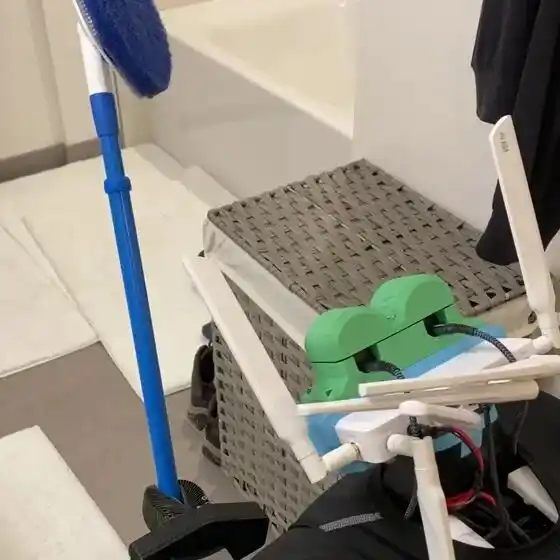
Tony specializes in deep cleaning—baseboards, grout lines, window tracks, under the fridge, behind the washer—targeting years of built-up grime.
But, I really have to complain.
Tau, for your first public debut, couldn't you spend some money to hire a photographer for proper portrait shots??I honestly couldn't find where Tony was in the picture...
No need to go into detail about the demos, as they are remote-controlled and theoretically can do anything a human can.
Wiping tables.

Mopping floors.

Taking out the trash.

Finally, the question everyone cares about most—how much does it cost?
Not bad, $30 per hour (approx. 200 RMB).
Honestly, that's quite affordable in the US. Hiring a real human cleaner can easily cost fifty or sixty dollars per hour.
Humanoid Robots Entering Homes
Last week, I attended WAIC and chatted with several friends working in Embodied AI. A common observation was that getting humanoid robots into homes is indeed extremely, extremely difficult.
It's not like China hasn't made any attempts either, but it's still in the early stages. For example, Ziliang's recent collaboration with 58.com to launch smart cleaning is a good case of entering households.
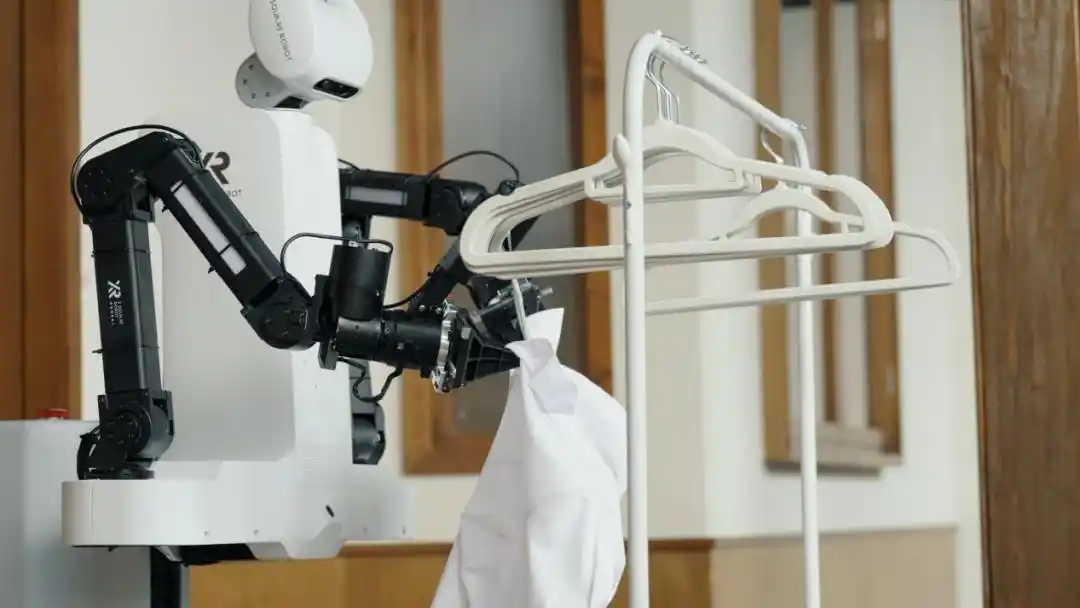
However, many netizens also criticized it, wondering what's the point of having a human cleaner specifically watching over the robot while it works.

Sigh, you can only say there's really no other way. Embodied AI has such a tough starting point; they have to enter the scene first, otherwise they can't collect data at all.
But currently, the main focus domestically is prioritizing industrial applications, where the environment is relatively controllable, and it can provide direction for gradual optimization and enable a closed data loop.
The logic in the US is somewhat different. The demand for manufacturing isn't as strong as in China, which has instead spurred some companies to start from the home scene. For example, 1X Neo, which gained some popularity last year, also promoted the concept of entering homes via teleoperation.
After all, the gap is indeed huge, and remote control is a relatively smart method, somewhat similar to the shadow mode in autonomous driving, ensuring work efficiency while collecting data.
But whether consumers are willing to pay $30 an hour to have a remotely-controlled robot with built-in monitoring working in their homes is another story...
It's been 9 months since the announcement, and 1X Neo still hasn't officially launched on a large scale. It's hard to judge how the market will react.
So let's return to the technology itself.
Some netizens expressed confusion: Why insist on humanoid form for entering homes?

The narrative about bipedal forms being better suited for non-standardized environments has, honestly, been told to death. Robotic vacuum cleaners basically move around homes unimpeded. Aren't wheels great?
I discussed this topic with SuDu half a month ago. Their perspective was that the root cause must be found from the data side—
If a person were to remotely operate a wheeled base and perform complex mobile manipulation tasks, the difficulty would be extremely high. For humanoids, operators can map their own body intuition onto the robot, lowering the barrier significantly.
Looking at it this way, Tau and 1X's insistence on humanoid form is likely largely due to considerations for remote control.
It's quite a first-principles choice.
Of course, another point that cannot be ignored.
This humanoid thing, well, it truly is top-tier in providing emotional value.
A human-shaped machine walking around your home, wiping tables, mopping floors, taking out trash, while you sit on the sofa watching... how to put it? Spending $30 to experience life as an Athenian citizen isn't a bad deal either (doge).

Currently, Tau's "Teletubby" is operating on an invitation basis. Friends in San Francisco can go to the official website to sign up for a try (doge).
"Athenian Citizen" Experience Address: https://www.tau-robotics.com/
References:
[1]https://x.com/alexkoch_ai/status/2082135074615763251
This article is from the WeChat public account "QbitAI" (ID: QbitAI), author: Focus on Frontier Technology






