Robinhood enters AI crypto trading: ‘World is flat’ presentation reveals US expansion

ambcryptoPublished on 2026-07-11Last updated on 2026-07-11

Abstract

Robinhood is expanding its crypto offerings by introducing AI-powered trading agents for eligible U.S. customers, as revealed in its 'World is flat' presentation. These agents will execute crypto trades on a user's behalf, provide real-time profit and loss tracking, and send push notifications, allowing users to set specific strategies without constant monitoring. Robinhood positions this as a major step toward giving retail traders advantages previously held by institutions. The company, which previously launched equities and options trading in the U.S., plans to expand the AI agent service to the UK soon. This move follows similar initiatives by other exchanges like Kraken and Coinbase, which launched AI agentic trading in 2026. However, current usage of such AI trading protocols remains relatively low, with transaction volumes and activity suggesting the market has yet to fully embrace the technology. Robinhood's entry could potentially broaden the adoption of AI-driven crypto trading.

Robinhood expanded its crypto ambitions by introducing AI-powered crypto trading agents for eligible U.S. customers.

The launch builds on the company’s broader push into digital assets and Real World Asset (RWA) tokenization.

In May 2026, Robinhood launched equities and options trading for U.S. markets, attracting more than 70,000 accounts.

The company is now bringing that expansion to crypto.

What are Robinhood’s AI trading agents?

In the latest presentation, titled ‘World is flat’, Robinhood said eligible US customers will soon be able to connect AI agents to make crypto trades.

These agents will conduct trades on behalf of a connected user. Using the same agentic trading, the trades will show real-time P&L tracking and push notifications.

With the agentic accounts, users can coordinate with the AI agents and establish a specific strategy. This eliminates the need for traders to constantly keep monitoring their accounts, as agents invest and reinvest accordingly.

Robinhood sees this step as a major win for retail traders, positing that

This is another step towards giving retail traders every advantage that institutional investors have enjoyed for decades.

After announcing the upcoming launch in the United States, the executive said it will also launch in the UK soon.

How widely are AI trading agents used?

Robinhood follows in the footsteps of other exchanges that have adopted agentic accounts. For example, in July 2026, Kraken unveiled a plan to launch AI-powered agentic trading.

The agents are expected to monitor markets, identify opportunities, and execute trades in line with predefined goals.

In addition to Kraken, Coinbase sits as their earliest exchange to adopt agentic trading. Coinbase’s X402 AI payment protocol launched agentic trading in April 2026.

The platform was presented as a channel for discovering and comparing services, while also offering access to apps and websites that AI agents can use.
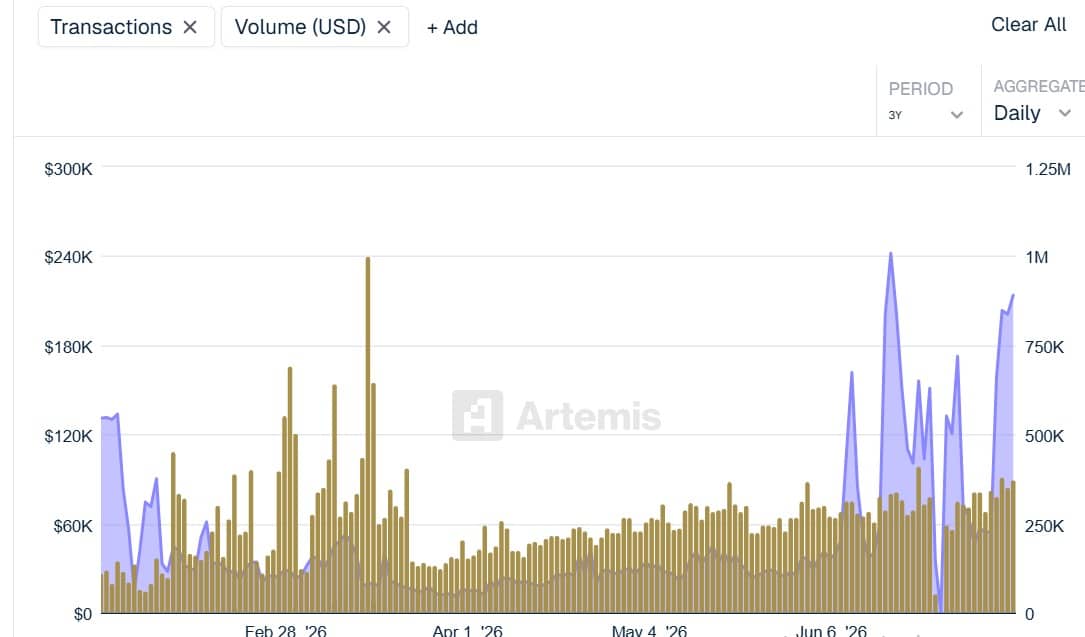
Source: Artemis

Although these major platforms have all embraced and integrated AI agents, their reach remains relatively low. In fact, X402 transactions peaked at 3 million in 2025 and, in June, recorded only 1 million.

On a daily average, volume facilitated through the protocol has barely crossed the $100k mark in 2026. Such low volume and transaction activity suggest that usage remains low and that the market has yet to fully embrace it.

Therefore, Robinhood’s entry could broaden the scope or further stretch the service’s limited demand.


Final Summary

  • Robinhood said eligible US customers will soon be able to connect AI agents to make crypto trades.
  • These agents will conduct trades on behalf of a connected user, thus showing real-time P&L tracking and push notifications.


Trending Cryptos

Related Questions

QWhat new service did Robinhood announce for eligible U.S. customers in its 'World is flat' presentation?

ARobinhood announced that eligible U.S. customers will soon be able to connect AI-powered trading agents to make cryptocurrency trades on their behalf.

QAccording to the article, how does Robinhood's introduction of AI trading agents benefit retail traders?

ARobinhood posits that giving retail traders AI agents is a step towards providing them with the same advantages that institutional investors have enjoyed for decades, such as automated trading based on specific strategies without the need for constant monitoring.

QWhich other major cryptocurrency exchanges have already adopted or announced plans for AI agentic trading, as mentioned in the article?

AThe article mentions that Kraken unveiled a plan to launch AI-powered agentic trading in July 2026, and Coinbase launched agentic trading earlier in April 2026 through its X402 AI payment protocol.

QWhat does the article indicate about the current market adoption and usage volume of AI agentic trading protocols like Coinbase's X402?

AThe article indicates that current usage and adoption are relatively low. For example, X402 transactions peaked at 3 million in 2025 but recorded only 1 million in June 2026, with daily average volume barely crossing $100k in 2026.

QBeyond the United States, which other country did Robinhood executives mention for the upcoming launch of its AI crypto trading agents?

AAfter announcing the launch in the United States, Robinhood executives said the service will also launch in the UK soon.

Related Reads

Pantera Capital: As Perpetual Contracts Move Towards the Financial Center, Hyperliquid Aims to Be All-Encompassing

Perpetual futures ("perps"), once a crypto-native phenomenon, are becoming a dominant global financial instrument, evolving into a fundamental market structure shift that traditional finance can no longer ignore. This article outlines the advantages of perpetual contracts over traditional futures, highlighting their simplicity (no expiry/rollover), easier risk management, and native 24/7 operation. While the concept is not new, digital assets provided the ideal environment for its explosive growth. Initially dominated by centralized exchanges (CEX), perps have recently migrated significantly to decentralized exchanges (DEX), with Hyperliquid emerging as the leading DEX for perps, capturing ~40% of the on-chain volume. Hyperliquid, built on its own purpose-built L1 blockchain, has successfully expanded beyond crypto into traditional assets like stocks, commodities, and indices, driven by its permissionless listing framework (HIP-3) and 24/7 availability. It has become a crucial price discovery venue during off-hours and for pre-IPO companies, attracting attention from traditional hedge funds and major exchanges like ICE, which now views it as serious competition. The investment thesis for Hyperliquid's token, HYPE, rests on its large and growing total addressable market (TAM) across all finance, strong execution, superior user experience, and direct value accrual via aggressive token buybacks using 99% of protocol revenue. Key risks remain, primarily regulatory uncertainty in the U.S., though recent CFTC actions approving certain regulated crypto perp contracts signal a potential shift toward broader acceptance. The core question is no longer if perpetuals matter beyond crypto, but whether blockchain-based infrastructure like Hyperliquid can become the primary venue for pricing, trading, and discovering risk across all financial domains.

marsbit2h ago

Pantera Capital: As Perpetual Contracts Move Towards the Financial Center, Hyperliquid Aims to Be All-Encompassing

marsbit2h ago

Tiger Research: Zuckerberg Begins Betting on Prediction Markets, While Asian Nations Still View Them as Gambling

This article examines the rise of prediction markets, contrasting their growing institutional acceptance in the West with their restrictive regulation in Asia. It details how prediction markets, which originated from informal political betting and academic experiments like the Iowa Electronic Market, aggregate crowd wisdom into probabilistic prices through binary contracts. Their growth accelerated around 2020, reaching over $14 billion in monthly volume. A key driver is the "skin in the game" principle, where users risk their own capital, leading to high accuracy in predicting events like Fed rate decisions and elections, as demonstrated by platforms like Polymarket. Meta's entry, with Mark Zuckerberg reportedly leading the development of the Arena app, signals the market's maturation. In the U.S., court rulings have distinguished prediction markets from gambling, facilitating entry by traditional financial institutions. However, most Asian jurisdictions still classify them as gambling, focusing on social control rather than financial innovation. The article argues this stance creates three problems for Asia: 1) regulatory arbitrage pushes users to riskier offshore platforms, 2) loss of sovereign information infrastructure as valuable social sentiment data accumulates abroad, and 3) abandonment of user protection. It concludes that Asia needs a policy shift from prohibition to constructive regulation, integrating these markets into the formal system to harness their data as a national asset, as initiatives like Limitless Research are beginning to do.

marsbit5h ago

Tiger Research: Zuckerberg Begins Betting on Prediction Markets, While Asian Nations Still View Them as Gambling

marsbit5h ago

Trading

Spot

Hot Articles

Discussions

Welcome to the HTX Community. Here, you can stay informed about the latest platform developments and gain access to professional market insights. Users' opinions on the price of AI (AI) are presented below.

活动图片