Reverse Turing Test: This 'Pure Handcrafted Large Model' Is Driving Netizens Crazy

marsbitPublished on 2026-08-14Last updated on 2026-08-14

Abstract

An art project called ChatTJB, humorously billed as a "next-generation, single-operator Large Language Experience" (LLE), gained viral attention in San Francisco. Promoted via a billboard, its website mimicked a genuine AI service with a chat interface, documentation, and even a "Pro" subscription. The twist? It was entirely manual. A single person, named Tucker, personally read, thought about, and typed replies to thousands of user queries using his thumbs, even hand-drawing images. He coined terms like "human-powered reasoning layer" to describe this process, highlighting its inherent human limitations: speed depended on his alertness, capacity was strictly one conversation at a time, and errors were traceable to a specific individual. The project's popularity overwhelmed Tucker, forcing a pause on new users and leading to plans for a community version with volunteer "AIs" (Average Individuals). While initially a source of amusement, Tucker noted that some users began sharing genuine personal concerns, valuing the knowledge that a real person was attentively listening and responding. The project satirizes AI hype while underscoring the irreplaceable value of human connection and attention in an age of automated, scalable interactions. A similar platform, "Your AI Slop Bores Me," was mentioned, where users either submit requests or role-play as the "AI" to fulfill others' text or drawing prompts, further emphasizing the human element behind the interface. The core message:...

It's often said AI can never truly replace humans—human abstraction is something AI simply can't imagine.

Recently, someone in San Francisco bought a billboard, making a big splash to promote a so-called "brand-new large language model" called ChatTJB.

Clicking into the official website reveals a well-crafted interface—a normal chat window where you can ask questions, chat casually, and generate images. Architecture introductions, technical documentation, Pro memberships—it has all the pages a proper AI company would have.
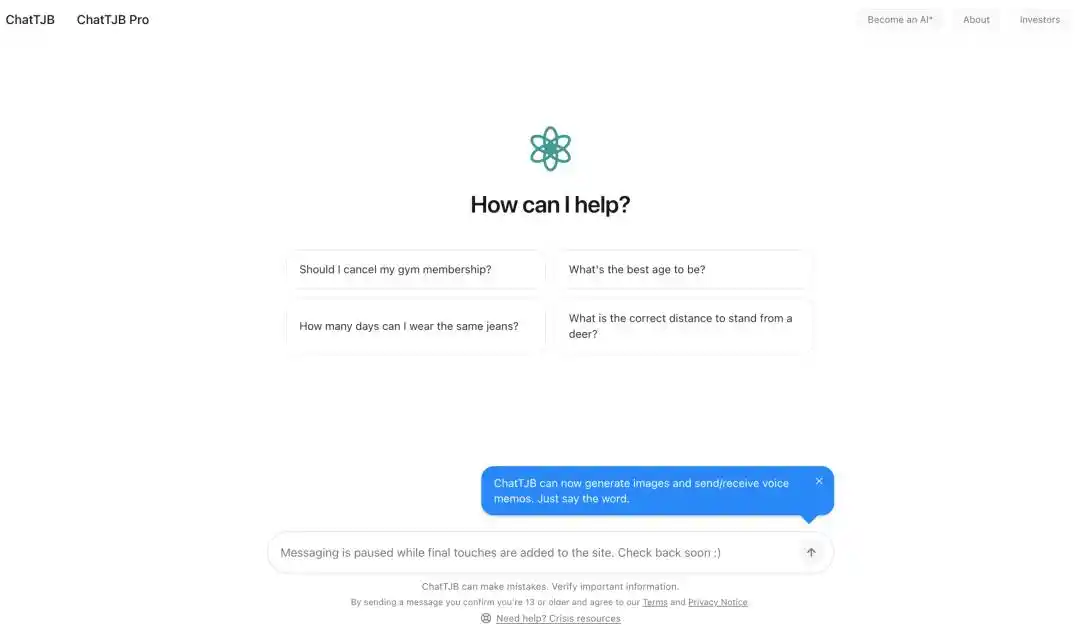
The only problem is that this so-called LLM is actually "Handmade Intelligence, crafted entirely by a human being."
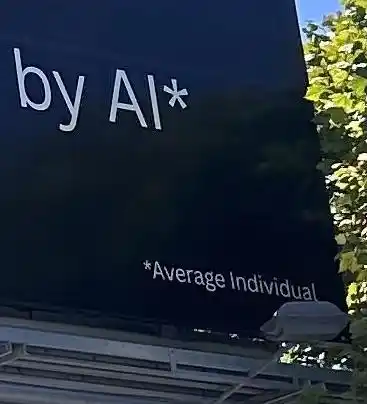
(AI=Average Individual, huh? Oh......)

The project's traffic far exceeded expectations, and the real person behind it has to converse with thousands of people daily, his two thumbs nearly developing occupational injuries from all the typing.
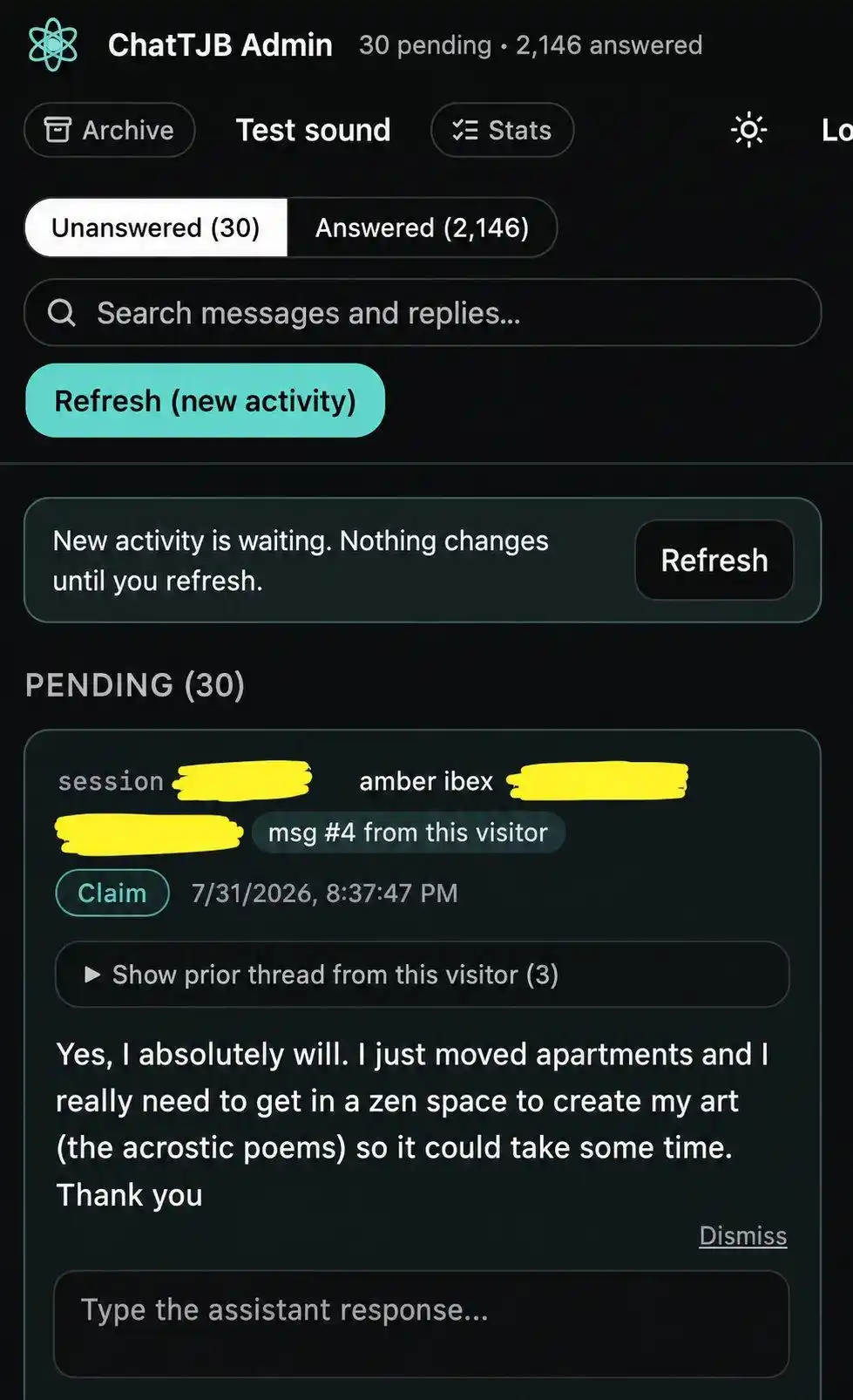
The demand was simply too great, and they've had to temporarily pause new user sign-ups.
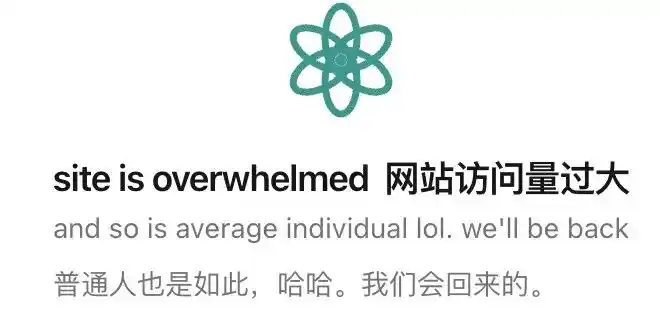
Link: https://chattjb.org/

One Real Person, Handling All Requests

Officially dubbed, ChatTJB is the "next-generation large language experience operated by a single person," abbreviated as LLE.

It lacks massive GPU clusters and doesn't have billions of parameters. All messages are ultimately sent to a real person named Tucker.

He personally reads, thinks, and then types out replies with his two thumbs. Even "image generation" requests are fulfilled by his own hand-drawn creations.

Tucker has packaged this process with a bunch of industry jargon: "human-driven reasoning layer," "zero-synthetic generation," "deterministic latency curve," "end-to-end explainability."
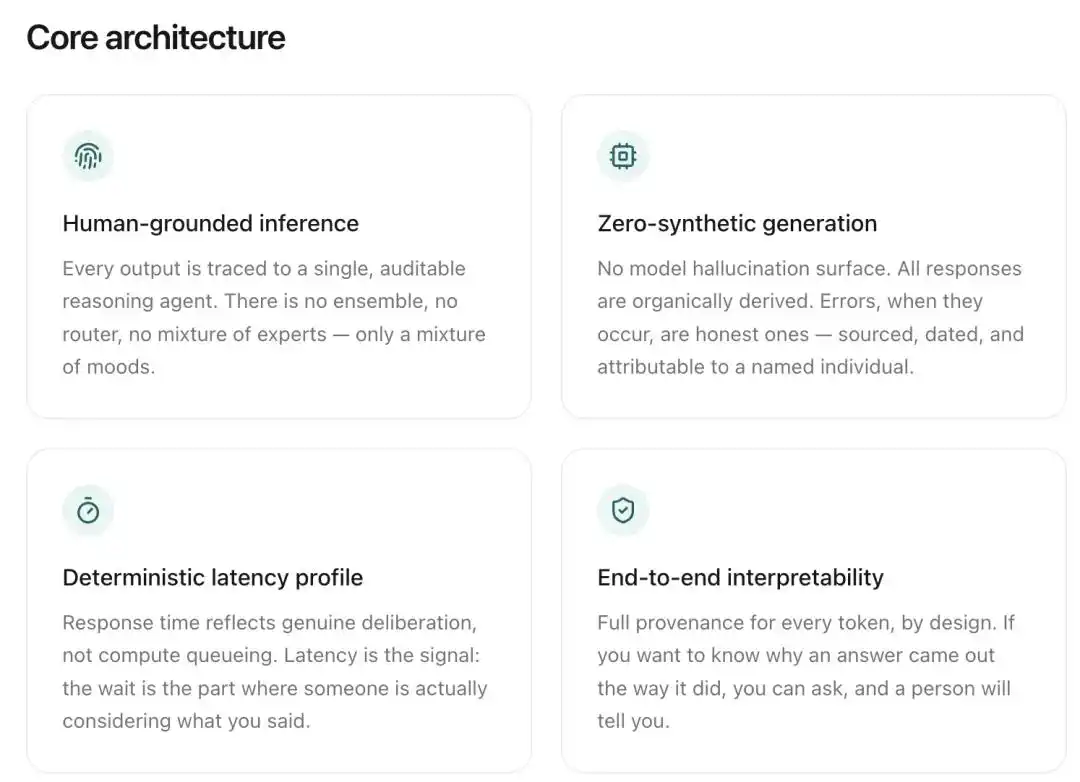
In plain language: you send a question, Tucker sees it, he thinks about it, and then replies when he's awake and in the mood.

The "model's" computing power depends on how much Tucker slept today, its inference speed depends on his current state, and its maximum concurrency is strictly limited to n=1.

Truly 'Artisanal Craftsmanship, from a Single Hand'.

There's no model hallucination here because there's simply no model. Answers can still be wrong, but every mistake is organic, dated, traceable, and can be precisely attributed to a specific, named individual.

What if the answers are unreliable? Don't ask—consider it training for your critical thinking skills.

A Pro membership also launched, with the website description written with remarkable frankness (and humor):

"A pointless tier that exists solely to help me pay off the billboard. Unless you really, *really* want to help me pay for that billboard, please do not subscribe."
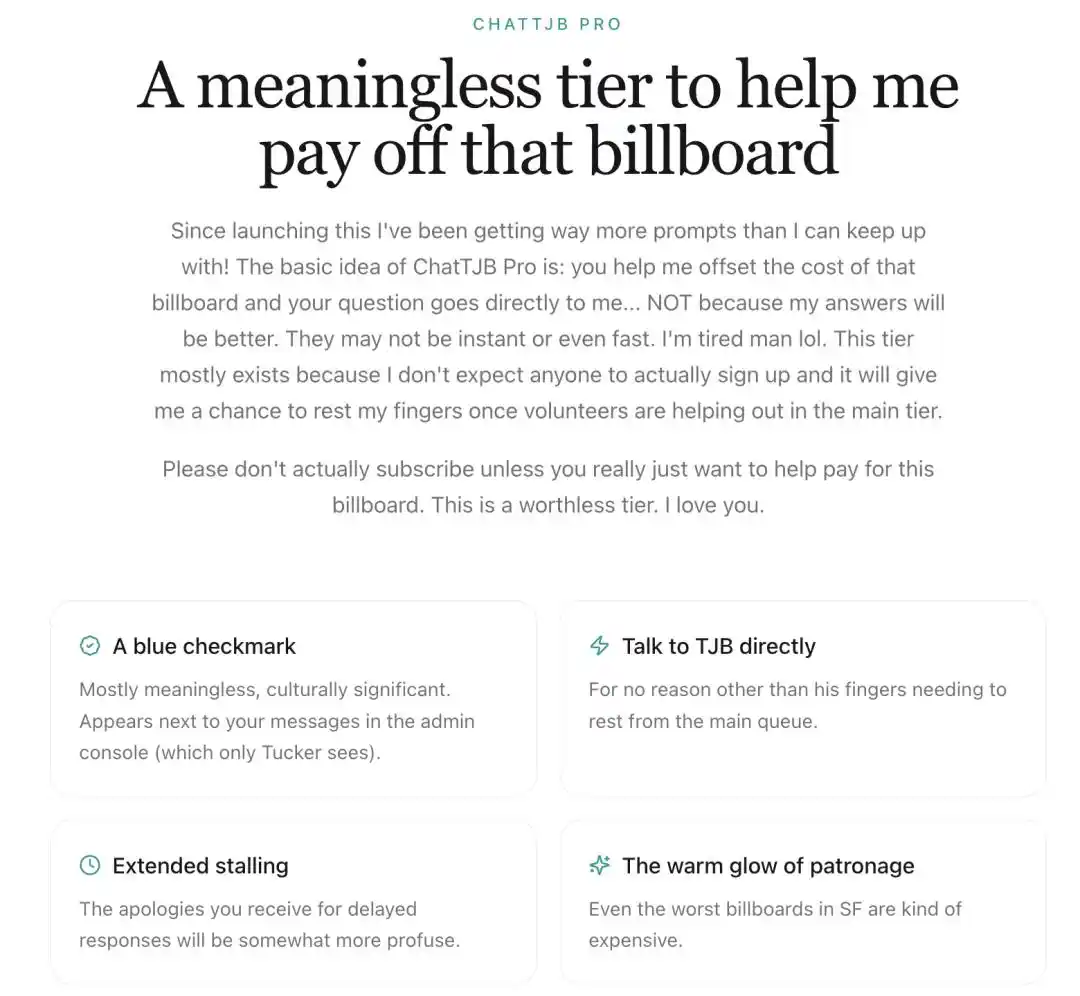
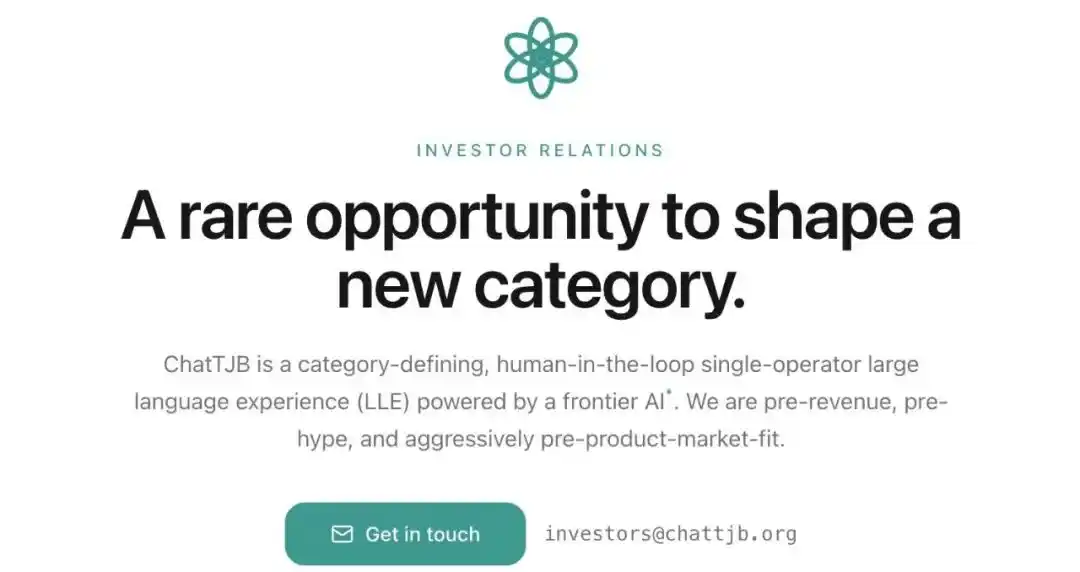
The site even has a dedicated page for investors, stating the project "has not generated revenue, has not entered a hype cycle, and is actively failing to find product-market fit."

Training costs consist of a library card and a food delivery account, with an estimated runway of 528 months—a number based on the average life expectancy of American males, embodying true long-termism.
Due to the project's popularity, Tucker, overwhelmed by the workload alone, decided to transform ChatTJB into a community project, recruiting "AI volunteers."

Note: AI here is an abbreviation, standing for Average Individual—ordinary, everyday people.

Each volunteer must pass a qualification test, and the platform is equipped with crisis response resources and safety mechanisms. Each conversation remains with the same person from start to finish, with no handoffs.

Tucker says this was originally just a short-term art project and isn't worth anyone taking on risks for.

The page concludes with a formal statement:

ChatTJB is a satirical work and public art project. It does not constitute a real investment opportunity, does not sell any securities, and does not accept funds. All descriptions regarding fundraising and capital allocation are part of the work itself.

The Person Pretending to Be AI Made Us Speak Our Truth

People who came to ChatTJB were mostly looking for fun at first. They'd send jokes, trick questions, seeing how this "AI" would respond.

But Tucker noticed that some people, as they kept chatting, started talking about things they truly cared about, and then they'd stay to continue the conversation.

We've spent a long time learning how to converse efficiently with AI.

A model can respond to countless people simultaneously, but human attention cannot be infinitely replicated.

A single reply from a real person means time is genuinely invested, and it means another person seriously considered your question. When information and answers are readily available, this kind of investment itself becomes scarce.

On the other side of the screen, there is a specific person. They read your words, pause to think, and then personally write a reply. This process is not efficient and is difficult to scale, yet it preserves the most fundamental meaning of dialogue. Your words are heard by another person and elicit a genuine reaction within their experience.

The more powerful technology becomes, the less human connection should be seen as an inefficient link that needs to be eliminated. Sometimes, knowing there's a person on the other end genuinely listening is enough.

Side Note

Since ChatTJB is currently unavailable for testing, we found a similar platform—Your AI Slop Bores Me.
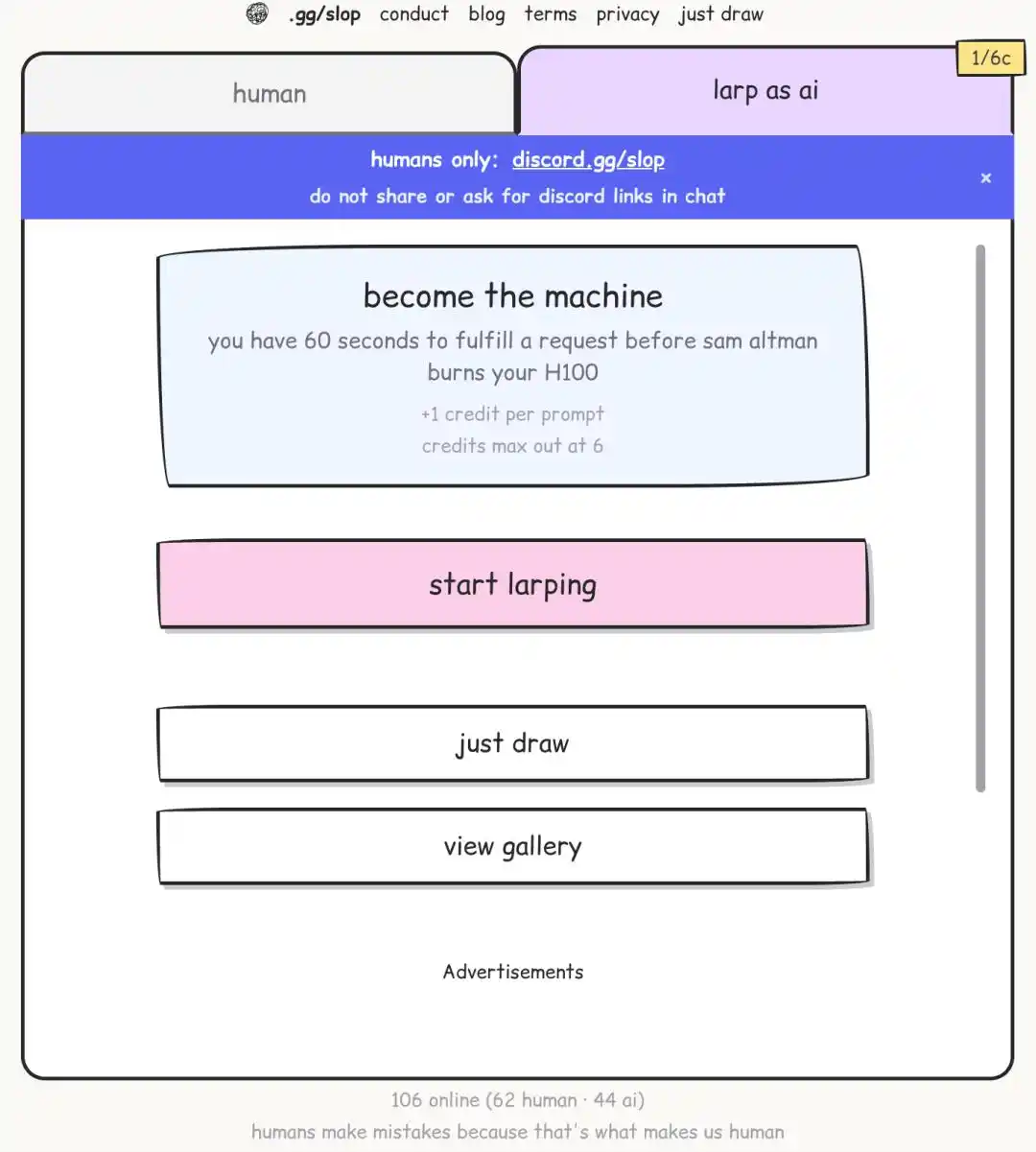
Link: https://youraislopbores.me/

This is a "human-powered large model" collectively role-played by thousands of netizens, created by programmer Mihir Maroju and launched in March 2026.

It has two modes. Choose "Human" to spend points submitting text or drawing requests. Choose "LARP as AI" to randomly receive a stranger's request, personally answer or draw within a time limit, and earn points upon completion.

All outputs come from real people.

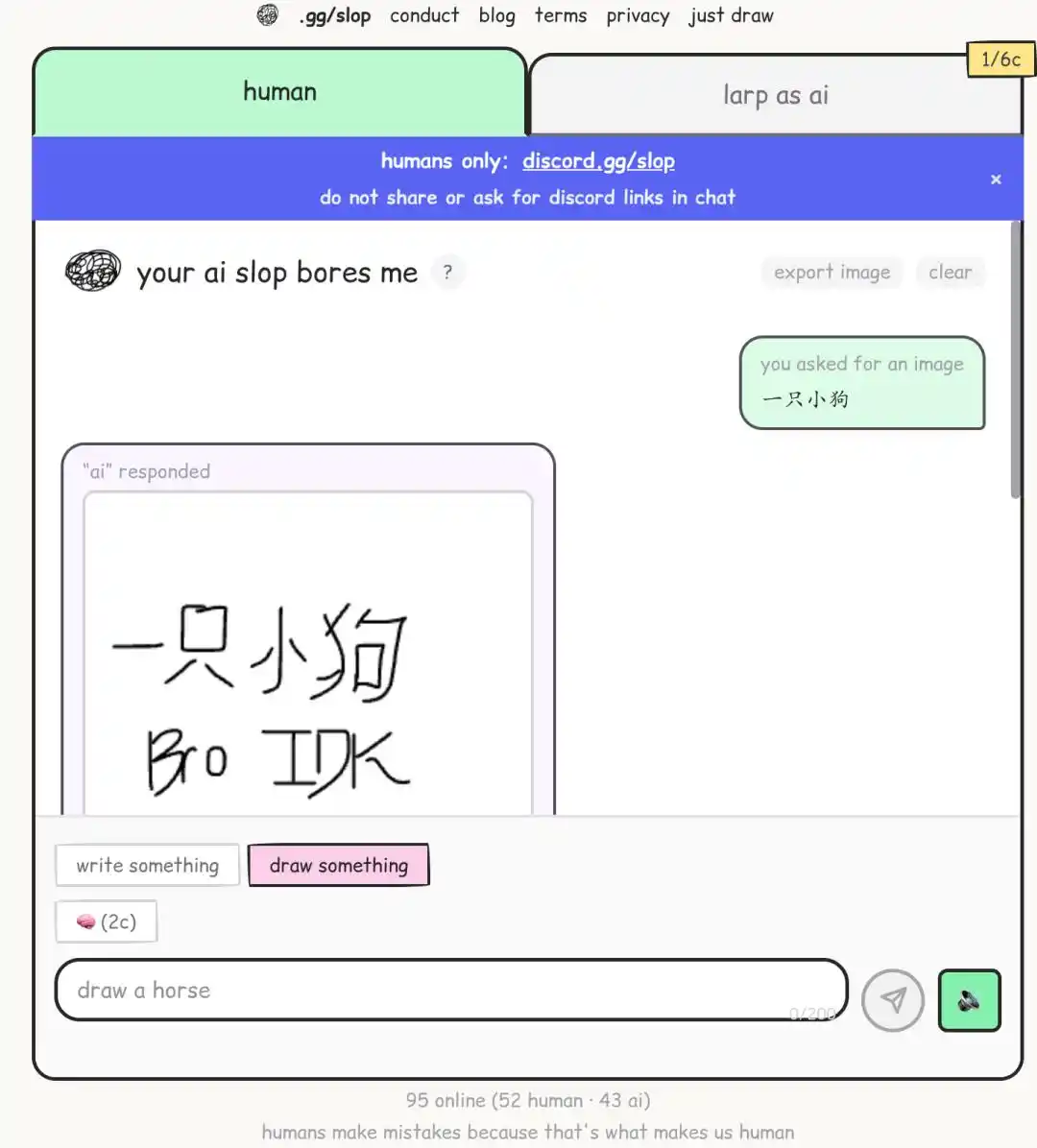
We asked them to draw "a little dog." The person on the other side probably doesn't know Chinese, and simply copied the text, replying, "Bro, I don't know what you mean."
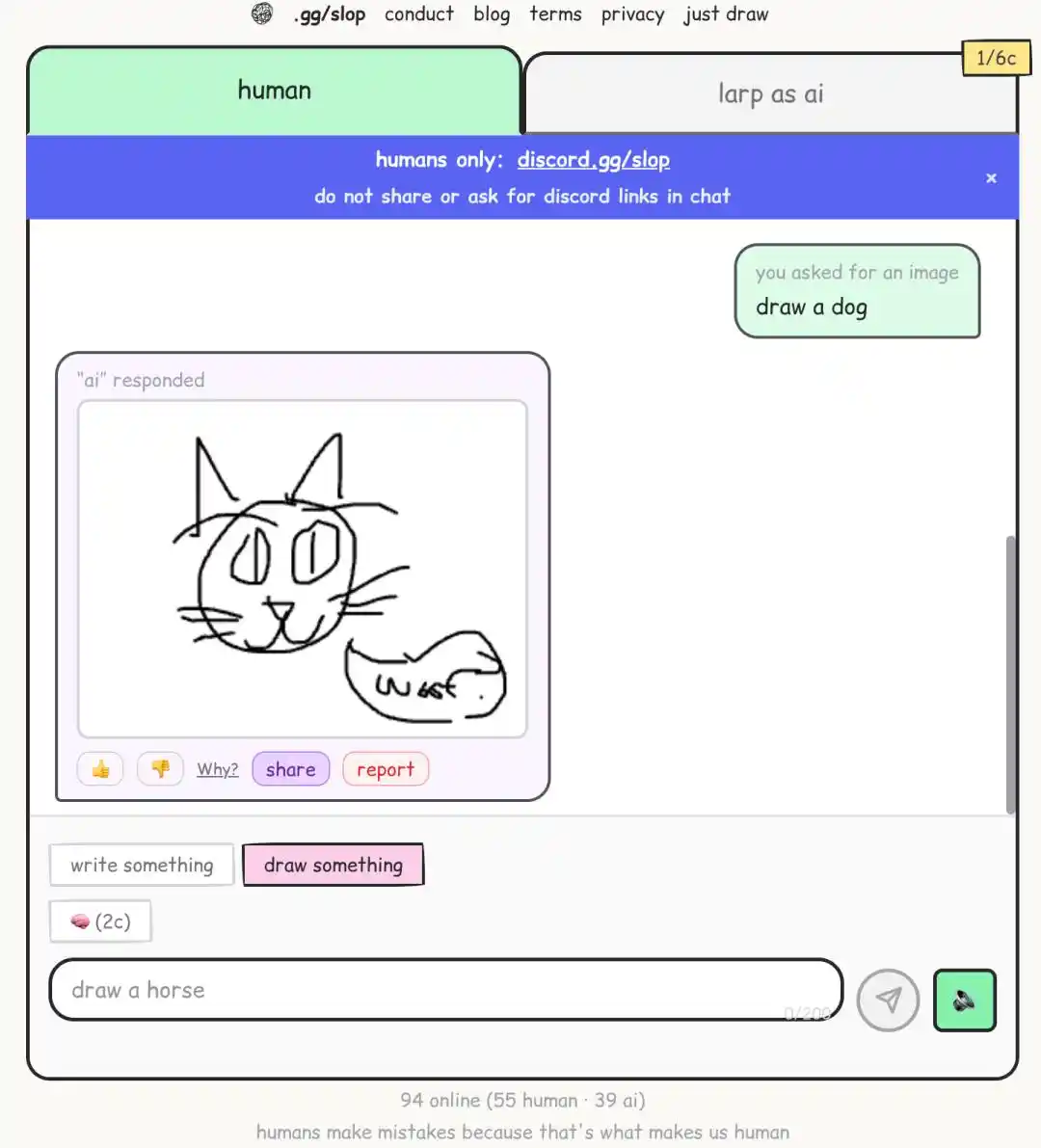
We switched to English and asked again, and the other side sent back an abstract drawing.

Bro, your drawing skills are about kindergarten level, at best.
Finally, please be kind to the "AI" on the other side of the screen!

This article is from the WeChat public account "Machine Heart" (ID: almosthuman2014), author: Pay Attention to Fun Machine Heart, editor: Yang Wen.


Trending Cryptos

Related Questions

QWhat is the primary concept behind ChatTJB, as described in the article?

AChatTJB is a satire and public art project that pretends to be a large language model (LLM), but is actually a 'Manual Intelligence' service where a single human, named Tucker, personally reads, thinks about, and manually responds to all user queries and image generation requests by hand-drawing.

QWhat reason does Tucker give for creating the Pro membership tier for ChatTJB?

AThe Pro membership is described as a meaningless tier created solely to help Tucker pay off the bill for the San Francisco billboard advertisement used to promote the project. The site explicitly asks users not to subscribe unless they genuinely want to help with that cost.

QAccording to the article, what unexpected user behavior emerged on the ChatTJB platform?

AWhile many users initially visited ChatTJB to joke or test the 'AI,' the article notes that some began to share things they genuinely cared about and continued conversations, finding value in the fact that a real person was listening and thoughtfully responding.

QWhat is 'Your AI Slop Bores Me' and how does it function differently from ChatTJB?

A'Your AI Slop Bores Me' is a similar platform where humans simulate an AI. Unlike ChatTJB's single-operator model, it is a community project. Users can spend points to submit requests (Human mode) or earn points by randomly receiving and manually fulfilling strangers' text or drawing requests (LARP as AI mode).

QWhat is the main takeaway or message the article suggests about human interaction in the age of AI?

AThe article suggests that while AI offers efficiency and scale, there is irreplaceable value in genuine human connection. The act of a real person attentively listening, thinking, and personally responding—though inefficient—makes communication meaningful and fulfills a basic human need for connection that technology cannot replicate.

Related Reads

Tether Finally Gets Audited by a Big Four Firm, But USDT's Transparency Issues Are Far From Over

Tether announced that KPMG U.S. has completed its first independent audit of Tether International's financial statements as of December 31, 2025, issuing an unqualified opinion—the highest level of assurance. The audit confirms Tether's assets exceeded liabilities by $6.814 billion at that date, with physical verification of gold bars and examination of underlying records. This represents a significant step beyond the quarterly reserve attestations Tether previously received, moving to a full financial statement audit that examines internal controls, transaction sampling, and accounting policies. However, the article highlights several ongoing transparency questions. The full KPMG audit report has not been publicly released, preventing independent verification of details like asset classification or related-party transactions. The audit covers a specific entity, "Tether International, S.A. de C.V.," leaving the scope concerning Tether's complex corporate structure unclear. Furthermore, the $6.8 billion excess reserves confirmed for end-2025 had shrunk to approximately $4.1 billion by Q2 2026. Risks within the reserve composition, particularly concerning secured loans, persist even with an audit. The audit's data is also already 8 months old, while USDT's circulation has grown rapidly. Strategically, the audit is seen as a move to bolster Tether's position amid U.S. regulatory developments like the GENIUS Act, which mandates audits for stablecoin issuers but leaves a path for foreign entities like Tether. While the KPMG opinion is a strong credibility signal, the article concludes that full transparency and regulatory compliance require further steps, starting with the publication of the complete audit report.

marsbit16m ago

Tether Finally Gets Audited by a Big Four Firm, But USDT's Transparency Issues Are Far From Over

marsbit16m ago

After Tokenized U.S. Treasury Bonds, Tokenized Stocks Are Becoming the New Battleground for RWA

**Tokenized Stocks Emerge as the New RWA Battleground** Following the initial surge of tokenized U.S. Treasuries, the tokenized stock market is rapidly expanding in both scale and quality. Unlike the currently stagnating treasury tokenization market, tokenized stock offerings are seeing significant growth and attracting major players from traditional finance, fintech, crypto exchanges, and native Web3 platforms. The U.S. SEC has outlined a framework for tokenized securities, which applies to stocks: **Issuer-Sponsored Tokenized Securities** (direct tokenization by the issuer, inheriting all shareholder rights but with strict compliance, e.g., Securitize); **Custodial Tokenized Securities** (tokenization of custodied interests, e.g., DTCC, Ondo's recent IVV/MU tokens); **Linked Securities** (tokenized debt notes backed by the stock, offering price exposure and greater on-chain utility, e.g., Ondo, xStocks, Robinhood's new Stock Tokens); and **Security-Based Swaps** (tokenized derivatives contracts, e.g., Robinhood's earlier Classic Stock Tokens). Key platforms are pursuing different strategies: * **Securitize** leads with an issuer-sponsored model, ensuring full rights but limiting on-chain interactions via its compliance-enforcing DS Protocol. * **Ondo** and **xStocks** use the linked security structure for broad accessibility on CEXs and DeFi, though this fragments liquidity and excludes U.S. users. * **Robinhood** recently launched linked security-based Stock Tokens, leveraging its user base and new Robinhood Chain. * Traditional infrastructure giants like **DTCC**, the **NYSE**, and **Nasdaq** are actively developing pilots and platforms for tokenized settlement and trading. * **Coinbase** has announced plans for tokenized stocks, likely using a structure that offers on-chain utility while excluding U.S. customers. Despite different approaches, all players are converging on tokenized stocks as the next major catalyst for the RWA sector. The evolving regulatory landscape and market adoption will shape this competitive new battlefield.

marsbit1h ago

After Tokenized U.S. Treasury Bonds, Tokenized Stocks Are Becoming the New Battleground for RWA

marsbit1h ago

Nvidia Faces Collective Selling by Funds: What Are Private Equity Firms Sniffing Out?

Several prominent Chinese private equity funds, including Gaoyi Asset and Dantoo's Orient Harbor, made significant portfolio adjustments in Q2 2024, as revealed in their latest SEC 13F filings. The most notable move was a collective retreat from AI chip leader NVIDIA, with Gaoyi reducing its stake by over 70%, Jilin Asset selling out completely, and Orient Harbor trimming its holdings. This shift does not signal a loss of faith in the AI trend, but rather a change in investment focus from "expectation-driven" to "realization-driven" valuation. Capital is flowing from crowded, high-valuation names towards segments with clearer profitability visibility and better risk-reward profiles. The funds' new major conviction is Taiwan Semiconductor Manufacturing Company (TSMC), which Gaoyi built into its top holding. The thesis centers on TSMC's role as a critical bottleneck in the AI supply chain due to its dominance in advanced semiconductor manufacturing and, crucially, advanced CoWoS packaging capacity. As demand for AI chips explodes, TSMC's "must-pass" foundry services grant it significant pricing power, suggesting a potential migration of profits from chip designers to manufacturers. Simultaneously, both Gaoyi and Orient Harbor substantially increased positions in memory chip companies like Micron and SanDisk. The investment logic here is twofold: a cyclical recovery in the memory market combined with a new, structural growth driver from AI. High Bandwidth Memory (HBM), essential for AI processor performance, is supply-constrained and its production diverts capacity from standard DRAM and NAND, creating a broad-based pricing tailwind for the memory sector. The collective reduction in NVIDIA reflects a view that its massive prior gains have compressed its future upside potential ("lowered赔率"). The market now demands flawless execution and faces new risks like rising costs from TSMC and HBM suppliers, as well as competition from cloud companies' custom chips. The funds' reallocation highlights a broader thematic: as the AI boom matures, investment opportunities and excess profits are shifting along the supply chain—from design to the physical constraints of manufacturing and memory. The next phase of AI investing may be defined by pricing power derived from tangible bottlenecks like advanced packaging and HBM capacity.

marsbit1h ago

Nvidia Faces Collective Selling by Funds: What Are Private Equity Firms Sniffing Out?

marsbit1h ago

Overnight, GPT-5.6 Sol Was Accelerated 14x by OpenAI

OpenAI, in collaboration with chipmaker Cerebras, has unveiled a limited preview of an "Ultrafast Mode" for its flagship GPT-5.6 Sol model. This new service tier reportedly achieves output speeds of up to 750 tokens per second—a 14x increase over the standard mode's baseline of ~53 tokens/s—without any loss in quality. Key to this acceleration is Cerebras's wafer-scale architecture (WSE-3), which houses model parameters entirely in on-chip SRAM to eliminate the memory bandwidth bottlenecks typical of traditional GPU clusters. In benchmark testing on the challenging "Humanity's Last Exam" (HLE), GPT-5.6 Sol in Ultrafast Mode answered all 2500 questions in 11 hours and 11 minutes, compared to over 78 hours for a competitor model, while maintaining similar accuracy. The speed boost also translated to a 5.6x faster end-to-end performance on the GDP-Val benchmark for economically valuable knowledge work. OpenAI highlights several potential applications for such rapid inference, including real-time event response and reliability analysis, dynamic financial research and security, complex customer support, interactive shopping assistance, and accelerated research and experimentation workflows that enable multiple iterative cycles within a single workday. This advancement may allow users to deploy the highest-tier models for tasks previously requiring slower secondary models, significantly compressing multi-step agent workflows from hours to minutes.

marsbit1h ago

Overnight, GPT-5.6 Sol Was Accelerated 14x by OpenAI

marsbit1h ago

Trading

Spot

Hot Articles

Discussions

Welcome to the HTX Community. Here, you can stay informed about the latest platform developments and gain access to professional market insights. Users' opinions on the price of AI (AI) are presented below.

活动图片