Reddit's Viral Image Suggests Your Laptop Could Run Fable 5 in 2 Years

marsbitPublished on 2026-07-07Last updated on 2026-07-07

Abstract

Reddit's r/LocalLLaMA community sparked widespread discussion with a chart predicting that "Mythos-class" AI capabilities (referring to models like Fable 5) could run locally on high-end consumer laptops by approximately July 2028. The projection is based on analyzing the historical timeframe for cutting-edge AI capabilities, from initial cloud release to becoming practically runnable on local hardware. This lag averaged about 24.8 months across four generations: GPT-3 (37 months), GPT-3.5 (17 months), GPT-4 (~24 months), and Claude 3.5 Sonnet/GPT-4o (21 months). The trend suggests the democratization of AI, shifting from centralized cloud control to decentralized, private local operation. Key drivers include advancements in model efficiency (MoE architecture, quantization), rapid open-source replication of frontier capabilities, and evolving hardware. The post highlights that while current geopolitical dynamics may control *access* to the most powerful models, they cannot halt the *proliferation* of equivalent capability to local devices over time. This implies a future where privacy, offline workflows, and reduced costs become standard, challenging the current subscription-based cloud AI paradigm.

【Introduction】A chart from the r/LocalLLaMA community went viral across the AI circle: Fable 5-level AI expected to run locally on laptops in about 2 years.

In two years, a Fable 5-level AI might just be sitting in your laptop.

Just yesterday, a chart posted in r/LocalLLaMA, the world's largest community for local large models, flooded the entire AI sphere—

The title was simple and blunt: If trends hold, Mythos-class capability may run on high-end consumer hardware in about 2 years.
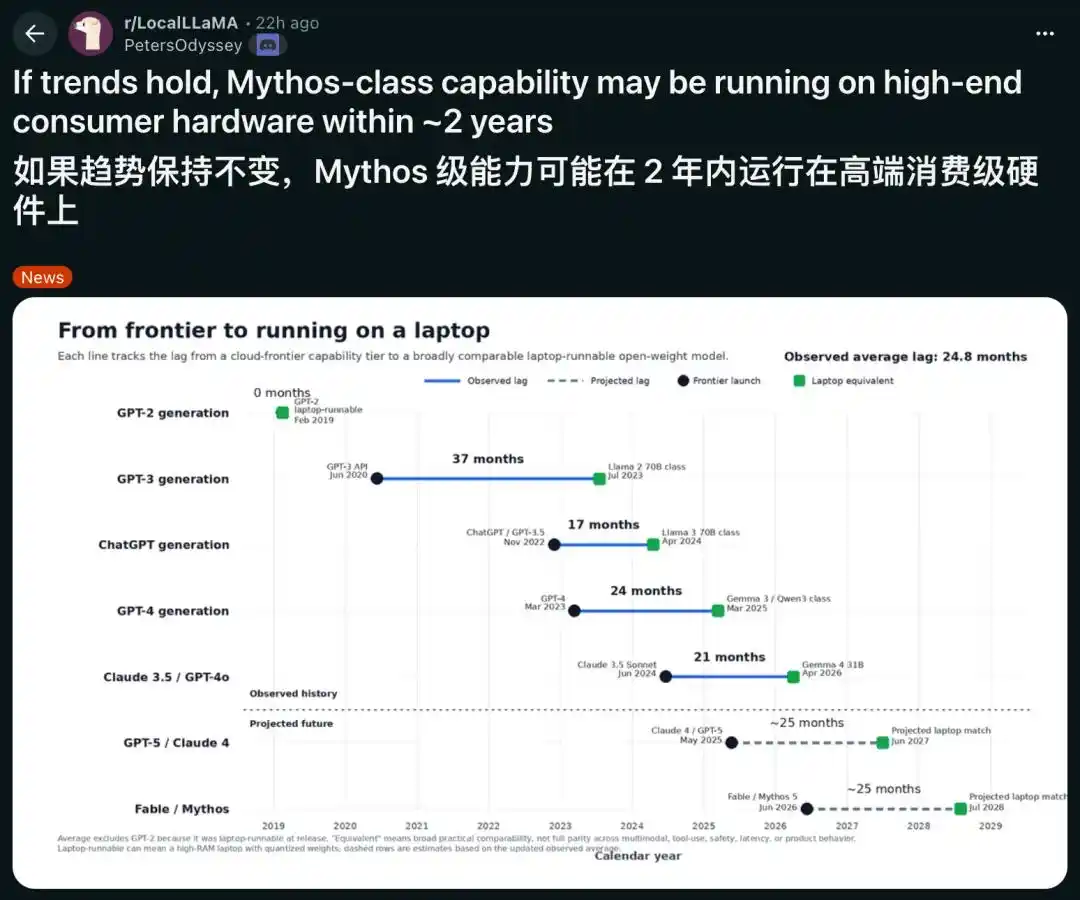
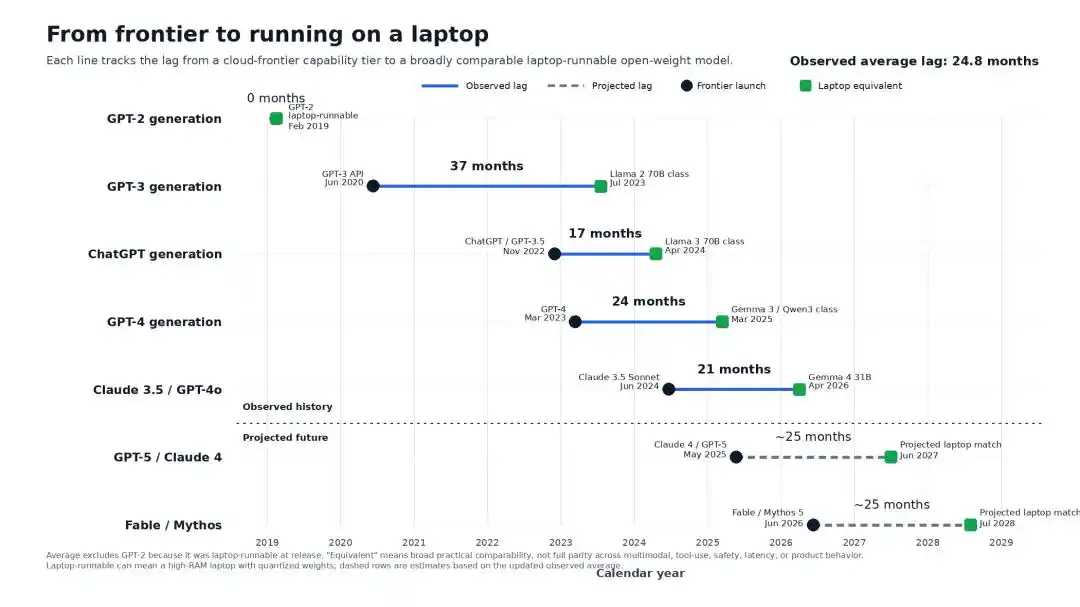
The chart's logic is straightforward: it marks out the time gap between each generation of frontier models being released in the cloud and their capabilities being matched by open-source models running on local hardware—

GPT-3-level capability took 37 months. GPT-3.5-level, 17 months. GPT-4-level, about 24 months. Claude 3.5 Sonnet / GPT-4o-level, 21 months.

Averaging across the four generations gives roughly 24.8 months—almost exactly two years.

Then, the poster extrapolated this trend line forward, and the landing point is startling: The frontier capability of Fable / Mythos 5-level will likely be practically usable on a high-end laptop locally around July 2028.
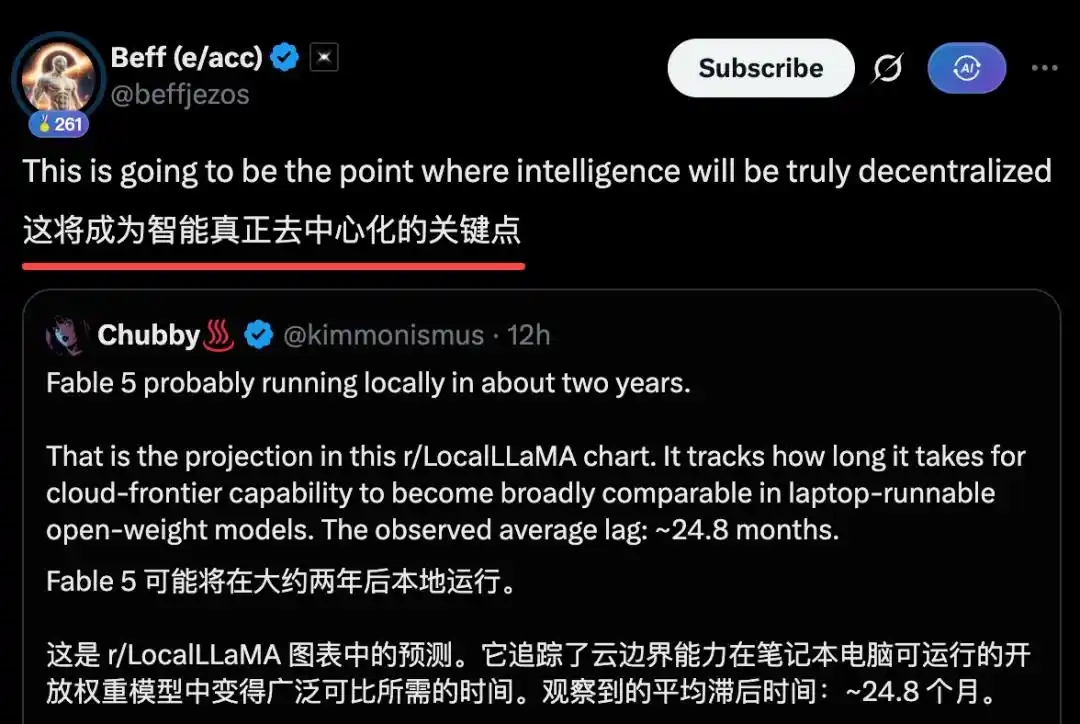
A major X influencer reposted the chart with one sentence that ignited the internet: "This will be the moment intelligence truly decentralizes."
Influencer @GaryMarcus went further to question what would become of Anthropic, OpenAI, and others if this holds true.
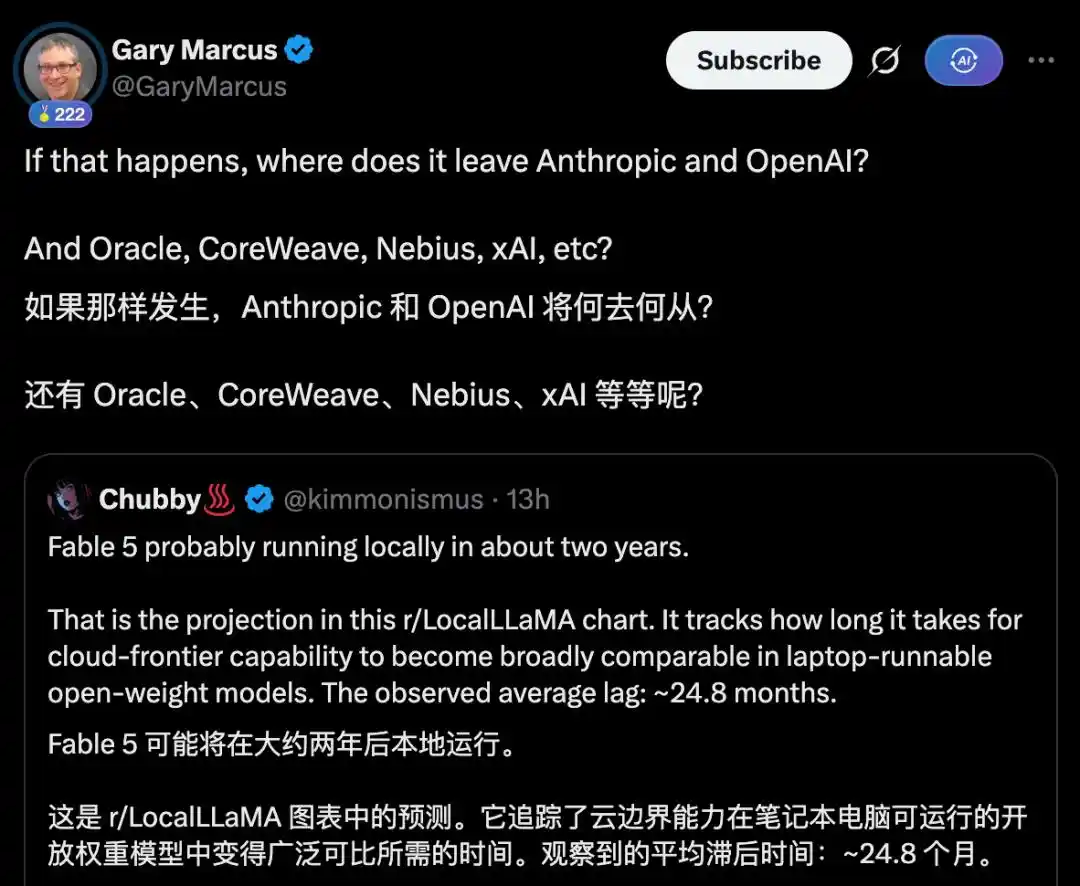
What does local execution mean?

No internet connection, no queuing, no worries about subscription quotas, not a single byte of your data leaves your machine.

The intelligence you cautiously rent from the cloud today, billed by the token, could be a one-time hardware purchase two years from now.

Two Hard Trends Supporting the 24-Month Timeline

This projection is supported by two hard trends.

On the model side, MoE architecture, Q4/Q8 quantization, better RL and data recipes continue to drive down the compute required for equivalent capabilities.

The open-source community's catch-up cycle for frontier capabilities generally falls between 12 to 25 months, and the distilled, efficient versions will only accelerate their migration to consumer hardware.

The latest data point on the chart is proof: It took 21 months from Claude 3.5 Sonnet's release in June 2024 to Google's release of Gemma 4 31B in April 2026—a 31-billion-parameter open-source model that now matches Claude Sonnet 4.5 on the Arena AI leaderboard and even leads on GPQA.

The untouchable cloud king from two years ago now fits on a consumer-grade graphics card.

In reality, Gemma 4 31B has reached Claude 3.5 Sonnet's, even early Opus's, level in coding, reasoning, and tool-calling.

And GPT-4—the frontier benchmark from two years ago—was caught up by Gemma 3 and Qwen3 in March to April 2025, exactly 24 months later.
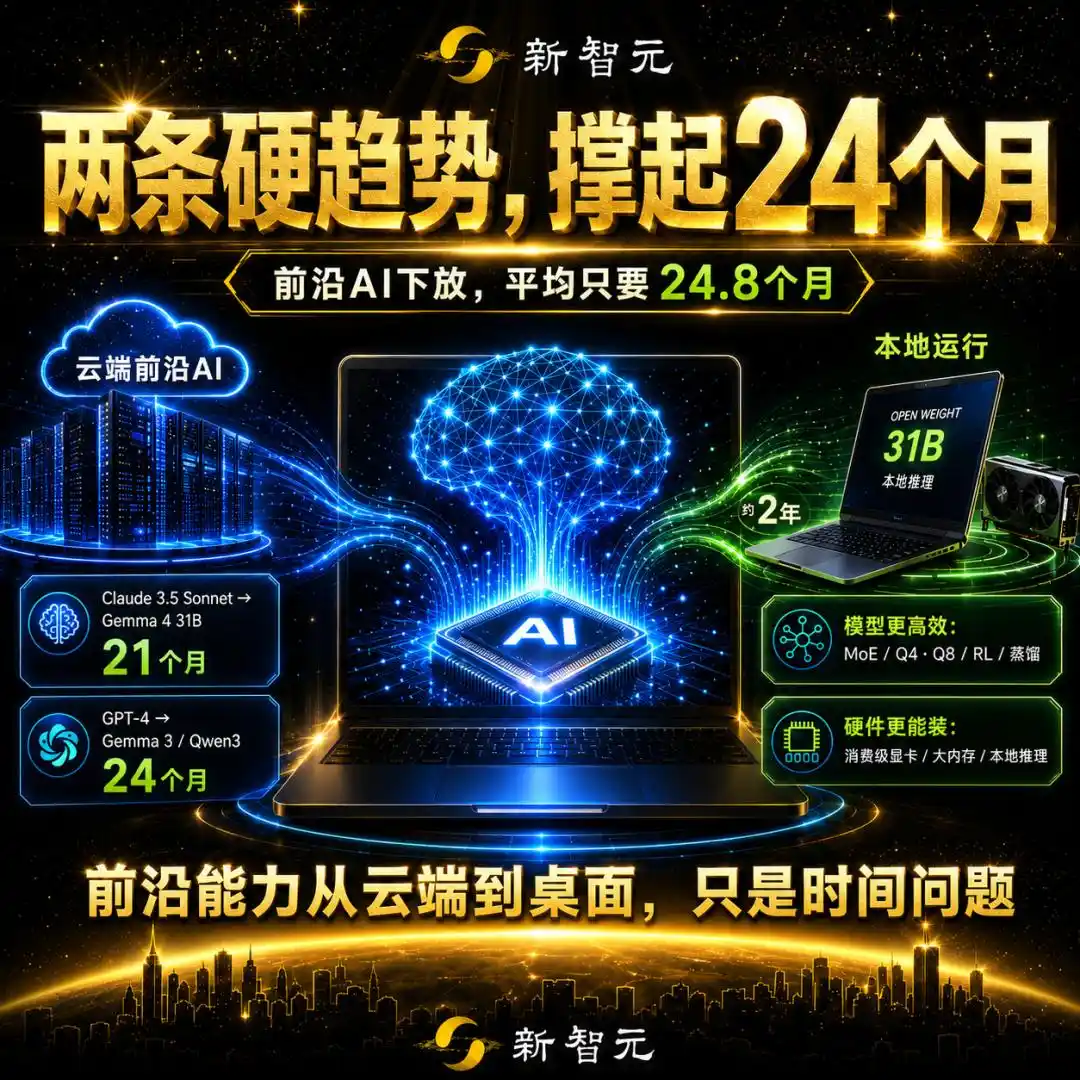
It's only a matter of time before frontier capability moves from the cloud to the desktop, and that timeframe is steadily converging to around two years.

Some are looking to China: GLM 5.2, a 753B parameter MoE architecture with an MIT open-source license and a 1M token context window, closely trails Claude Opus 4.8 on SWE-bench Pro.

In other words, even if Anthropic locks its doors, other contenders will bring equivalent capability to your desktop via a different path.

Blockades Can Restrict Access, But Not Time

This chart truly strikes the most sensitive nerve of the moment.

The past month witnessed the AI industry's first-ever "model recall": release, block, negotiation, unblock—every step of the Fable 5 saga emphasized two words: scarcity and control.

Who gets to use the strongest model has, for the first time, become a question answered with a passport.

This chart offers another perspective: From GPT-3 to today, no generation of frontier capability has successfully remained exclusively in the cloud for more than three years.

Distillation proliferates, open source catches up. Regulation can decide who uses Fable 5 today, but it cannot decide whose laptop runs a Fable 5-level model two years from now.

For developers, this means local agents, privacy-preserving computation, and offline workflows are worth investing in now; for hardware vendors, an arms race around large memory and high bandwidth has already begun; for the entire industry, this means the exclusive window for frontier models may be just 24 months—AI is transitioning from cloud monopoly to desktop democratization.

This might be the most ironic and optimistic aspect of that chart: Washington answers "Who deserves the strongest AI?" with a piece of paper; Redditors answer with four historical data points—In two years, everyone.

Remember July 2028. On that day, today's myth might just be your everyday tool.

Reference: https://www.reddit.com/r/LocalLLaMA/comments/1uoij3s/if_trends_hold_mythosclass_capability_may_be/

This article is from the WeChat public account "AI Era (新智元)", author: ASI启示录; editor: 所罗门

Trending Cryptos

Related Questions

QWhat is the core claim made by the Reddit post in r/LocalLLaMA that went viral?

AThe post claims that if current trends hold, 'Mythos'-class or Fable 5-level AI capabilities could be running practically on high-end consumer laptops in approximately 24 months, around July 2028.

QWhat historical data trend does the analysis in the article rely on to support its prediction?

AThe analysis tracks the time lag between the release of frontier models (GPT-3, GPT-3.5, GPT-4, Claude 3.5 Sonnet/GPT-4o) and the availability of open-source models with comparable performance on consumer hardware. The average lag across these four generations is about 24.8 months.

QAccording to the article, what are the two main trends driving this capability to local devices?

AThe two main trends are: 1) Model-side advancements like MoE architectures, quantization (Q4/Q8), and better RL/data recipes reducing computational requirements. 2) The real-world proof of open-source models (e.g., Gemma 4 31B) achieving performance parity with recent frontier models (e.g., Claude 3.5 Sonnet) within the predicted timeframe.

QWhat broader implication for the AI industry does the article suggest based on this trend?

AThe article suggests the trend indicates AI is moving from cloud-based monopoly to 'desktop democratization.' It implies the exclusive window for frontier models may shrink to about 24 months, enabling local, private, and offline workflows and reducing dependency on centralized cloud services and access controls.

QHow does the article contrast the current geopolitical controls on AI access with the predicted future?

AThe article contrasts current geopolitical access controls, which use 'passports' to determine who can use the strongest AI, with the predicted future where, in about two years, Fable 5-level capability could be available locally to 'everyone,' making today's restricted technology a common commodity.

Related Reads

IOSG: Q-Day Countdown, Will Quantum Computing End Cryptocurrency?

IOSG: The Q-Day Countdown – Will Quantum Computing End Cryptocurrency? This analysis explores the looming threat quantum computing poses to blockchain technology. Quantum computers, leveraging Shor's algorithm, could theoretically break the elliptic curve cryptography (ECC) underpinning cryptocurrencies like Bitcoin and Ethereum. The article outlines a hypothetical "Q-Day" scenario where exposed public keys from dormant assets are compromised, leading to fund theft and a deep governance crisis. The core risk is not the complete erasure of blockchains but a systemic reset of public-key cryptography. Bitcoin faces significant challenges due to its "code-is-law" ethos and the immense social consensus required for migration. Its primary vulnerability lies in legacy UTXOs with publicly exposed keys. Ethereum's path involves a more complex, full-stack cryptographic agility upgrade across execution, consensus, and data layers. The industry has a limited "engineering comfort window" of 5-8 years to coordinate a migration to post-quantum cryptography (PQC), such as lattice-based or hash-based signatures. While the existential threat is often overstated, the real bottleneck is the immense coordination required across protocol developers, node operators, wallet providers, exchanges, and custodians. Market repricing of crypto assets may occur well before an actual Q-Day if quantum hardware roadmaps accelerate or regulatory pressure mounts. The article concludes that quantum computing is not a doomsday weapon but a severe stress test for blockchain's foundational security model and governance structures.

marsbit5m ago

IOSG: Q-Day Countdown, Will Quantum Computing End Cryptocurrency?

marsbit5m ago

Why 2026 could redefine Ethereum, Solana, Base and Avalanche

Blockchain infrastructure is undergoing a major coordinated transformation, driven by institutional demand for reliability, compliance, and predictable settlement. Over $30 billion in Real-World Assets (RWA) on-chain has exposed network weaknesses. Major blockchains are responding with foundational upgrades, moving beyond incremental speed improvements. Ethereum's "Glamsterdam" upgrade, planned for H1 2026, will significantly increase gas limits and introduce features like PBS (pre-blocked state) for enhanced settlement and parallel execution. Solana's "Alpenglow," targeting a mainnet launch in H2 2026, focuses on reducing finality time dramatically and freeing network resources to improve reliability. Beyond speed, compliance is critical. Base's "Beryl" upgrade in Q3 2026 will introduce a standardized, regulatory-compliant token framework (B20). Avalanche's "Octane" upgrade aims to boost transaction processing and reduce costs for enterprise applications. Even Bitcoin is evolving with the potential activation of OP_CAT by late 2026/early 2027. The competition is shifting. While technical upgrades are widespread, institutions will ultimately allocate capital based on proven execution, operational resilience, and regulatory compatibility during market stress. Ethereum currently leads in tokenized assets, while networks like Base and Solana are strengthening their institutional offerings. The blockchain that best delivers reliable, compliant, and uninterrupted service is poised to attract the greatest share of future institutional capital.

ambcrypto42m ago

Why 2026 could redefine Ethereum, Solana, Base and Avalanche

ambcrypto42m ago

Tiger Research: Take RWA Tokenization Overseas First

This article discusses the strategic choices facing financial institutions in jurisdictions lacking mature regulatory frameworks for Real-World Asset (RWA) tokenization. With the market growing rapidly, institutions must choose between waiting for local legislation, using regulatory sandboxes, or—the recommended priority—expanding into overseas markets to gain early experience. Successfully launching cross-border RWA tokenization requires meticulous preparation across six key areas: establishing an overseas base (e.g., Hong Kong, Singapore, the U.S.), securing necessary licenses, defining the tokenized asset (with bonds being simpler than non-standard assets), defining the target investor scope, deciding on settlement currencies/payment flows, and designing operational requirements like custody and on-chain governance. The article outlines two primary strategic paths: a direct "onshore" path and a "native on-chain" path. The direct path involves setting up a legal entity and obtaining licenses in a mature jurisdiction like Hong Kong, Singapore, or the U.S., leveraging existing platforms (e.g., DigiFT, Securitize) for efficiency. The alternative native on-chain path involves partnering with compliant, decentralized platforms (e.g., Ondo, Plume Nest) that use structures like offshore SPVs to facilitate tokenization and access DeFi liquidity, offering speed and broader reach but with greater structural complexity. The core argument is that institutions should not wait for perfect domestic regulation. A detailed hypothetical case study illustrates the multi-step, 6-12 month process of launching an overseas tokenized bond. The key takeaway is that the essence of a tokenization business lies not in the technology but in successfully executing the entire sales and operational process. The market is moving forward, and the time to act is now.

marsbit53m ago

Tiger Research: Take RWA Tokenization Overseas First

marsbit53m ago

Trading

Spot

Hot Articles

Discussions

Welcome to the HTX Community. Here, you can stay informed about the latest platform developments and gain access to professional market insights. Users' opinions on the price of AI (AI) are presented below.

活动图片