Trump Proclaims Himself a 'Super Fan of Cryptocurrency,' Bitcoin May Be Included in 'Trump Account'?

Foresight NewsPublished on 2026-07-07Last updated on 2026-07-07

Abstract

Former President Donald Trump, declaring himself a "big fan of cryptocurrency," has signaled the potential inclusion of Bitcoin in the newly launched "Trump Account" savings program. Speaking at the plan's White House launch event, Trump explained his pro-crypto stance is driven by a desire for U.S. dominance in the digital asset space, stating, "if we don't take it, China will." He acknowledged an initial lack of understanding but was swayed by strong public interest and significant capital flowing into Bitcoin. The "Trump Account," established under the 2025 GREAT Act, is a tax-advantaged account for children, with the government providing an initial $1,000 deposit. Funds are locked until the child turns 18. While Trump offered no specific timeline for adding Bitcoin, his remarks align with his administration's crypto-friendly policies. These include a 2025 executive order creating a U.S. strategic Bitcoin reserve, the passage of the GENIUS Act to regulate payment stablecoins, and a relaxed enforcement posture toward the industry. This latest endorsement reinforces the administration's commitment to positioning the U.S. as a leader in the global cryptocurrency competition.


Written by: Micah Zimmerman

Compiled by: AididiaoJP, Foresight News


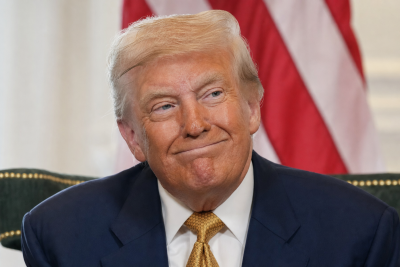
U.S. President Donald Trump recently indicated that Bitcoin could potentially be included in the newly launched "Trump Account" savings plan in the future. Publicly calling himself a "super fan of cryptocurrency," this statement once again demonstrates his positive stance towards the digital asset industry.


Trump made these remarks during the launch ceremony for the "Trump Account" held in the White House Oval Office on Monday. On this occasion, he not only personally rang the opening bells for both the New York Stock Exchange and Nasdaq—the first time in White House history that the opening bells for both major exchanges were rung simultaneously—but also witnessed this significant moment alongside several key figures. Attendees included Treasury Secretary Scott Bessent, Securities and Exchange Commission Chairman Paul Atkins, leaders from the NYSE and Nasdaq, as well as tech industry figures Michael Dell and his wife, who pledged over $6 billion to support this children's savings plan.
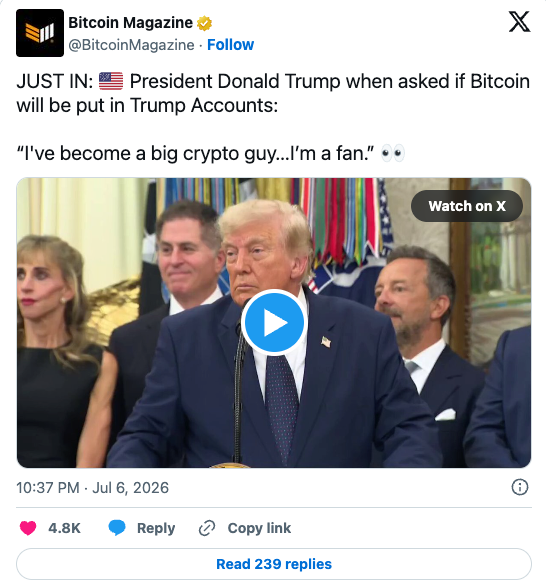


When asked whether the "Trump Account" would include Bitcoin, Trump did not provide a specific timeline but clearly signaled openness. "Yes, it is possible that something happens," he replied, taking the opportunity to elaborate on his evolving stance on cryptocurrency.


Trump stated directly: "I am now a super fan of cryptocurrency. I became a firm supporter of cryptocurrency for one reason only—if we don't seize it, China will take it first. They really want to dominate this space. But now they are not trying as hard because we already dominate cryptocurrency. I am a fan of it."


He also reflected on his journey: "Initially, I didn't understand this space. In the first half of my first term, I wasn't very involved, just following it occasionally. But later I found that a massive number of people really love cryptocurrency. As a businessman, I also saw a huge amount of money flowing into the Bitcoin market."
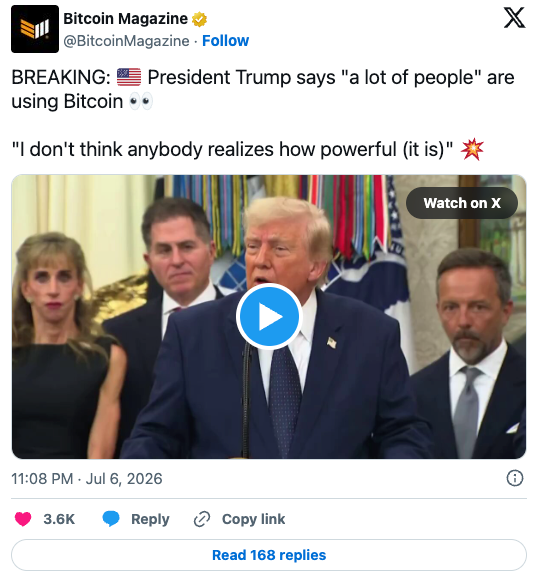


Trump emphasized that the scale of Bitcoin usage has reached a level "that nobody really fully understands." He repeatedly linked the issue to U.S.-China competition, arguing that the U.S. must maintain leadership in the digital asset space or risk falling behind its rivals.


During the same event, Trump also addressed other topics. He stated that the U.S. is leading China in the field of artificial intelligence, crediting his policies on easing energy permits for data centers, while criticizing renewable energy forms like wind power. Additionally, he confirmed that he had spoken with FIFA President Gianni Infantino regarding the red card suspension of U.S. player Folarin Balogun, which resulted in FIFA's independent committee lifting the ban, a decision that sparked objections from countries including Belgium.


What is the "Trump Account"?


The "Trump Account" is a tax-advantaged investment account established under the "One Great Act" signed by Trump in 2025, also known as the 530A account. The plan officially launched on July 4, 2026. Each account is set up for a child, with the government depositing a one-time $1,000 seed amount for eligible children. U.S. citizen children born between January 1, 2025, and December 31, 2028, are eligible for federal funding, with families allowed to contribute an additional maximum of $5,000 per year. Funds are locked until the child turns 18, at which point the account automatically converts into a traditional Individual Retirement Account.


This plan aims to help the younger generation accumulate wealth while injecting long-term capital into U.S. financial markets. Significant donations from tech figures like Michael Dell and his wife further highlight the appeal of this initiative.


Continuation of Trump's Cryptocurrency Policies


Trump's latest remarks are consistent with his crypto-friendly policies since the beginning of his second term. In March 2025, he signed an executive order formally establishing the U.S. Strategic Bitcoin Reserve and Digital Asset Reserve, mandating that Bitcoin held by the government through means such as seizure would no longer be sold. At that time, the U.S. government held over 207,000 Bitcoins, valued at nearly $17 billion.


In July 2025, he signed the "Genius Act," the first major federal cryptocurrency legislation in the U.S., creating a regulatory framework for payment stablecoins. Furthermore, his administration relaxed enforcement efforts at the Department of Justice and the Securities and Exchange Commission from the previous administration and removed some restrictions on banks' participation in crypto activities. Currently, the broader market structure bill, the "Clarity Act," is still under congressional review.


Trump's public endorsement of Bitcoin's inclusion in children's savings accounts not only further boosts market confidence but also clearly signals the U.S. determination to dominate the global cryptocurrency space. Against the backdrop of U.S.-China technological competition, this signal holds significant meaning for the entire industry. Going forward, whether Bitcoin is truly incorporated into the "Trump Account" and the speed of related policy implementation will remain key focal points for market attention.

Trending Cryptos

Related Questions

QWhat is the 'Trump Account' and what are its key features?

AThe 'Trump Account' is a tax-advantaged investment account established under the 'One Great Act' signed by former President Donald Trump in 2025, also known as a 530A account. Launched on July 4, 2026, it is a savings plan for children. The government deposits a one-time seed funding of $1,000 for eligible children. U.S. citizen children born between January 1, 2025, and December 31, 2028, qualify for federal funding. Families can contribute up to an additional $5,000 per year. Funds are locked until the child turns 18, at which point the account automatically converts to a traditional IRA. The plan aims to help the younger generation build wealth and inject long-term capital into U.S. markets.

QWhat did Donald Trump say about possibly including Bitcoin in the 'Trump Account'?

AWhen asked if Bitcoin could be included in the 'Trump Account', Donald Trump did not provide a specific timeline but expressed openness to the idea. He stated, 'Yes, something could happen.' He further elaborated on his changed stance, declaring himself a 'superfan of cryptocurrency' and a 'strong believer.' His primary reason for supporting it was to prevent China from dominating the field, claiming the U.S. now leads in cryptocurrency.

QHow has Trump's administration approached cryptocurrency policy during his second term?

ADuring his second term, Trump's administration has pursued crypto-friendly policies. In March 2025, he signed an executive order to establish a U.S. Strategic Bitcoin Reserve and Digital Asset Reserve, mandating that bitcoin held by the government (over 207,000 BTC at the time) not be sold. In July 2025, he signed the 'Genius Act,' the first major federal cryptocurrency legislation, which created a regulatory framework for payment stablecoins. His administration also relaxed enforcement at the DOJ and SEC and removed certain restrictions on banks engaging in crypto activities.

QWhat was the significance of the 'Trump Account' launch event at the White House?

AThe 'Trump Account' launch event was significant as it marked the first time in White House history that the opening bells for both the New York Stock Exchange and Nasdaq were rung simultaneously, which Trump did himself. The event was attended by prominent figures including Treasury Secretary Scott Bessent, SEC Chairman Paul Atkins, leaders from the NYSE and Nasdaq, and tech magnate Michael Dell and his wife, who committed over $6 billion to support the children's savings plan.

QAccording to Trump, what was his initial view on cryptocurrency and what caused his change in perspective?

ATrump stated that initially he 'didn't know much about the space' and wasn't very involved during the first half of his first term, only paying occasional attention. His perspective changed for two main reasons: first, he realized a significant number of people 'really love cryptocurrency,' and second, as a businessman, he observed 'a lot of money' flowing into the Bitcoin market. His current support is also heavily framed within the context of U.S.-China competition, aiming to ensure American dominance in the digital asset sector.

Related Reads

Examining the Open USD Partner Lineup: Follow Who's Joining to See Where the Money Flows

**Title: Deciphering the Open USD Partner Roster: Following the Money** The launch of Open USD is notable less for the stablecoin itself and more for its expansive list of over 140 founding partners, which reads like a "who's who" of global finance and tech. This coalition, including asset managers like BlackRock, card networks Visa and Mastercard, banks (BNY Mellon, Standard Chartered, etc.), tech giants (Google, IBM), merchants (Shopify), and crypto firms (Coinbase, Ripple, Aave, MetaMask), signals a strategic shift. The diverse membership reveals that stablecoins are increasingly viewed not as products to compete over, but as shared infrastructure too critical to be left to any single entity. Each partner category has distinct motives. Asset managers like BlackRock seek to manage the large, sticky cash reserves, a lucrative fee-generating opportunity. Merchants like Shopify aim for lower-cost settlement and potential yield on balances. Banks join defensively to retain custody and settlement roles, fearing deposit outflows to stablecoins. Tech companies bet on programmable money for future machine-to-machine commerce. Crypto firms gain mainstream legitimacy and distribution channels. Remarkably, the consortium includes direct competitors (Visa vs. Mastercard, Coinbase vs. Ripple), indicating that the fear of exclusion from this emerging financial layer outweighs competitive rivalries. However, this shared governance could also lead to slow decision-making. The roster's composition is the real message: it represents a collective bet that a widely accepted, consortium-owned stablecoin is preferable to proprietary versions or having none at all. For incumbents like Circle and Tether, this alliance poses a significant threat, as potential clients have collectively chosen to build their own alternative. The absence of major U.S. retail banks (busy with their own tokenized deposit networks) is equally telling. In essence, the partner list maps where the industry believes value and risk will flow in a tokenized dollar future, marking stablecoin's evolution from a product to a utility.

Foresight News11m ago

Examining the Open USD Partner Lineup: Follow Who's Joining to See Where the Money Flows

Foresight News11m ago

IOSG: Q-Day Countdown, Will Quantum Computing End Cryptocurrency?

IOSG: The Q-Day Countdown – Will Quantum Computing End Cryptocurrency? This analysis explores the looming threat quantum computing poses to blockchain technology. Quantum computers, leveraging Shor's algorithm, could theoretically break the elliptic curve cryptography (ECC) underpinning cryptocurrencies like Bitcoin and Ethereum. The article outlines a hypothetical "Q-Day" scenario where exposed public keys from dormant assets are compromised, leading to fund theft and a deep governance crisis. The core risk is not the complete erasure of blockchains but a systemic reset of public-key cryptography. Bitcoin faces significant challenges due to its "code-is-law" ethos and the immense social consensus required for migration. Its primary vulnerability lies in legacy UTXOs with publicly exposed keys. Ethereum's path involves a more complex, full-stack cryptographic agility upgrade across execution, consensus, and data layers. The industry has a limited "engineering comfort window" of 5-8 years to coordinate a migration to post-quantum cryptography (PQC), such as lattice-based or hash-based signatures. While the existential threat is often overstated, the real bottleneck is the immense coordination required across protocol developers, node operators, wallet providers, exchanges, and custodians. Market repricing of crypto assets may occur well before an actual Q-Day if quantum hardware roadmaps accelerate or regulatory pressure mounts. The article concludes that quantum computing is not a doomsday weapon but a severe stress test for blockchain's foundational security model and governance structures.

marsbit41m ago

IOSG: Q-Day Countdown, Will Quantum Computing End Cryptocurrency?

marsbit41m ago

Why 2026 could redefine Ethereum, Solana, Base and Avalanche

Blockchain infrastructure is undergoing a major coordinated transformation, driven by institutional demand for reliability, compliance, and predictable settlement. Over $30 billion in Real-World Assets (RWA) on-chain has exposed network weaknesses. Major blockchains are responding with foundational upgrades, moving beyond incremental speed improvements. Ethereum's "Glamsterdam" upgrade, planned for H1 2026, will significantly increase gas limits and introduce features like PBS (pre-blocked state) for enhanced settlement and parallel execution. Solana's "Alpenglow," targeting a mainnet launch in H2 2026, focuses on reducing finality time dramatically and freeing network resources to improve reliability. Beyond speed, compliance is critical. Base's "Beryl" upgrade in Q3 2026 will introduce a standardized, regulatory-compliant token framework (B20). Avalanche's "Octane" upgrade aims to boost transaction processing and reduce costs for enterprise applications. Even Bitcoin is evolving with the potential activation of OP_CAT by late 2026/early 2027. The competition is shifting. While technical upgrades are widespread, institutions will ultimately allocate capital based on proven execution, operational resilience, and regulatory compatibility during market stress. Ethereum currently leads in tokenized assets, while networks like Base and Solana are strengthening their institutional offerings. The blockchain that best delivers reliable, compliant, and uninterrupted service is poised to attract the greatest share of future institutional capital.

ambcrypto1h ago

Why 2026 could redefine Ethereum, Solana, Base and Avalanche

ambcrypto1h ago

Tiger Research: Take RWA Tokenization Overseas First

This article discusses the strategic choices facing financial institutions in jurisdictions lacking mature regulatory frameworks for Real-World Asset (RWA) tokenization. With the market growing rapidly, institutions must choose between waiting for local legislation, using regulatory sandboxes, or—the recommended priority—expanding into overseas markets to gain early experience. Successfully launching cross-border RWA tokenization requires meticulous preparation across six key areas: establishing an overseas base (e.g., Hong Kong, Singapore, the U.S.), securing necessary licenses, defining the tokenized asset (with bonds being simpler than non-standard assets), defining the target investor scope, deciding on settlement currencies/payment flows, and designing operational requirements like custody and on-chain governance. The article outlines two primary strategic paths: a direct "onshore" path and a "native on-chain" path. The direct path involves setting up a legal entity and obtaining licenses in a mature jurisdiction like Hong Kong, Singapore, or the U.S., leveraging existing platforms (e.g., DigiFT, Securitize) for efficiency. The alternative native on-chain path involves partnering with compliant, decentralized platforms (e.g., Ondo, Plume Nest) that use structures like offshore SPVs to facilitate tokenization and access DeFi liquidity, offering speed and broader reach but with greater structural complexity. The core argument is that institutions should not wait for perfect domestic regulation. A detailed hypothetical case study illustrates the multi-step, 6-12 month process of launching an overseas tokenized bond. The key takeaway is that the essence of a tokenization business lies not in the technology but in successfully executing the entire sales and operational process. The market is moving forward, and the time to act is now.

marsbit1h ago

Tiger Research: Take RWA Tokenization Overseas First

marsbit1h ago

Trading

Spot

Hot Articles

What is $BITCOIN

DIGITAL GOLD ($BITCOIN): A Comprehensive Analysis Introduction to DIGITAL GOLD ($BITCOIN) DIGITAL GOLD ($BITCOIN) is a blockchain-based project operating on the Solana network, which aims to combine the characteristics of traditional precious metals with the innovation of decentralized technologies. While it shares a name with Bitcoin, often referred to as “digital gold” due to its perception as a store of value, DIGITAL GOLD is a separate token designed to create a unique ecosystem within the Web3 landscape. Its goal is to position itself as a viable alternative digital asset, although specifics regarding its applications and functionalities are still developing. What is DIGITAL GOLD ($BITCOIN)? DIGITAL GOLD ($BITCOIN) is a cryptocurrency token explicitly designed for use on the Solana blockchain. In contrast to Bitcoin, which provides a widely recognized value storage role, this token appears to focus on broader applications and characteristics. Notable aspects include: Blockchain Infrastructure: The token is built on the Solana blockchain, known for its capacity to handle high-speed and low-cost transactions. Supply Dynamics: DIGITAL GOLD has a maximum supply capped at 100 quadrillion tokens (100P $BITCOIN), although details regarding its circulating supply are currently undisclosed. Utility: While precise functionalities are not explicitly outlined, there are indications that the token could be utilized for various applications, potentially involving decentralized applications (dApps) or asset tokenization strategies. Who is the Creator of DIGITAL GOLD ($BITCOIN)? At present, the identity of the creators and development team behind DIGITAL GOLD ($BITCOIN) remains unknown. This situation is typical among many innovative projects within the blockchain space, particularly those aligning with decentralized finance and meme coin phenomena. While such anonymity may foster a community-driven culture, it intensifies concerns about governance and accountability. Who are the Investors of DIGITAL GOLD ($BITCOIN)? The available information indicates that DIGITAL GOLD ($BITCOIN) does not have any known institutional backers or prominent venture capital investments. The project seems to operate on a peer-to-peer model focused on community support and adoption rather than traditional funding routes. Its activity and liquidity are primarily situated on decentralized exchanges (DEXs), such as PumpSwap, rather than established centralized trading platforms, further highlighting its grassroots approach. How DIGITAL GOLD ($BITCOIN) Works The operational mechanics of DIGITAL GOLD ($BITCOIN) can be elaborated on based on its blockchain design and network attributes: Consensus Mechanism: By leveraging Solana’s unique proof-of-history (PoH) combined with a proof-of-stake (PoS) model, the project ensures efficient transaction validation contributing to the network's high performance. Tokenomics: While specific deflationary mechanisms have not been extensively detailed, the vast maximum token supply implies that it may cater to microtransactions or niche use cases that are still to be defined. Interoperability: There exists the potential for integration with Solana’s broader ecosystem, including various decentralized finance (DeFi) platforms. However, the details regarding specific integrations remain unspecified. Timeline of Key Events Here is a timeline that highlights significant milestones concerning DIGITAL GOLD ($BITCOIN): 2023: The initial deployment of the token occurs on the Solana blockchain, marked by its contract address. 2024: DIGITAL GOLD gains visibility as it becomes available for trading on decentralized exchanges like PumpSwap, allowing users to trade it against SOL. 2025: The project witnesses sporadic trading activity and potential interest in community-led engagements, although no noteworthy partnerships or technical advancements have been documented as of yet. Critical Analysis Strengths Scalability: The underlying Solana infrastructure supports high transaction volumes, which could enhance the utility of $BITCOIN in various transaction scenarios. Accessibility: The potential low trading price per token could attract retail investors, facilitating wider participation due to fractional ownership opportunities. Risks Lack of Transparency: The absence of publicly known backers, developers, or an audit process may yield skepticism regarding the project's sustainability and trustworthiness. Market Volatility: The trading activity is heavily reliant on speculative behavior, which can result in significant price volatility and uncertainty for investors. Conclusion DIGITAL GOLD ($BITCOIN) emerges as an intriguing yet ambiguous project within the rapidly evolving Solana ecosystem. While it attempts to leverage the “digital gold” narrative, its departure from Bitcoin's established role as a store of value underscores the need for a clearer differentiation of its intended utility and governance structure. Future acceptance and adoption will likely depend on addressing the current opacity and defining its operational and economic strategies more explicitly. Note: This report encompasses synthesised information available as of October 2023, and developments may have transpired beyond the research period.

656 Total ViewsPublished 2025.05.13Updated 2025.05.13

What is $BITCOIN

Discussions

Welcome to the HTX Community. Here, you can stay informed about the latest platform developments and gain access to professional market insights. Users' opinions on the price of BTC (BTC) are presented below.

活动图片