Machines Pay, Humans Reap: Coinbase, Stripe, Google, Visa's AI Payments Land Grab

marsbitPublished on 2026-05-22Last updated on 2026-05-22

Abstract

One year after being a concept, machine-to-machine payments are now a battleground. Four competing architectures are already deployed by Coinbase (x402 protocol), Stripe/Tempo (MPP standard), Google (AP2 authorization layer), and Visa (tokenized credentials). AI Agents have already settled over $73 million across 176 million transactions, with a median value between $0.01 and $0.10. A key barrier is the ~$0.30 minimum fee of traditional card rails, making them unviable for micro-payments. In contrast, Layer 2 stablecoin settlement costs $0.0001, with USDC dominating 98.6% of all transactions. The dynamic is less about a single winning protocol and more about vertical integration within a new payment stack. Companies like Coinbase and Stripe control multiple layers (settlement, wallet, routing, protocol, governance), driving over $8 billion in recent acquisitions to solidify their positions. The shift from extractive bot activity to productive Agent commerce is underway, with AI Agents accounting for 37% of all Gnosis Chain Safe transactions. The pace of adoption will be set not by available technology but by the development of trust and safety infrastructure for autonomous transactions. While a fully permissionless vision is appealing, supervised access remains crucial until AI reliability improves. Regulatory frameworks like MiCA and the EU AI Act, due in mid-2026, currently lag behind this rapidly evolving reality. The foundational argument is clear: crypto rails have alr...

Author:Ben Harvey

Compilation: TechFlow

TechFlow Introduction: A year ago, machine-to-machine payments were just a concept. Now, Coinbase, Stripe, Google, and Visa have deployed four competing architectures. AI Agents have already completed 176 million transactions and settled $73 million. Traditional giants have spent over $8 billion on acquisitions to secure their position. This is not a future narrative but an ongoing restructuring of payment infrastructure—whoever controls the most layers will capture the most value.

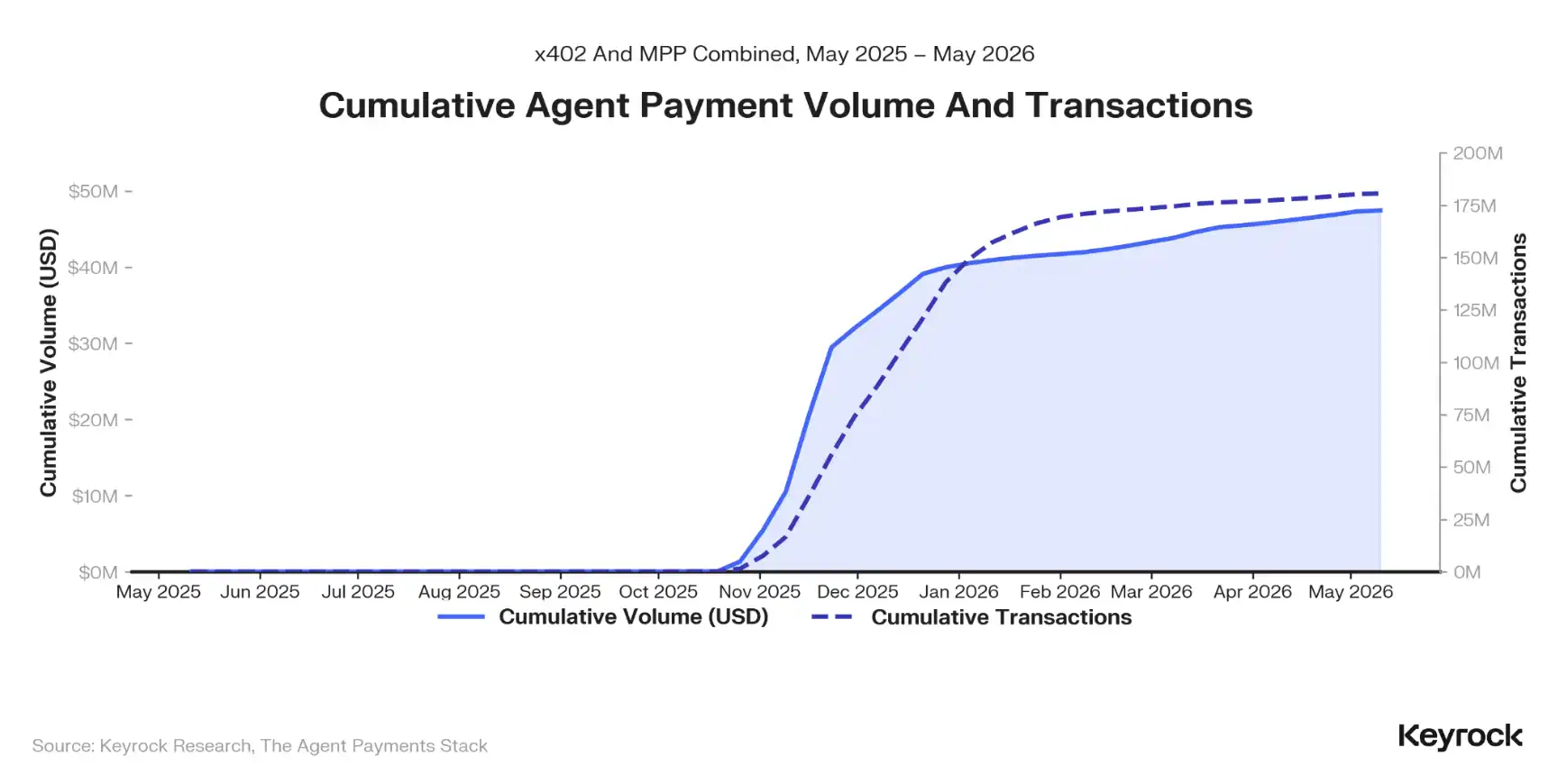
A year ago, machine-to-machine payments were just a concept. Now four competing payment architectures are live, backed by Coinbase, Stripe, Google, Visa, and American Express. AI Agents have settled over $73 million across 176 million transactions. Traditional giants have invested over $8 billion in acquisitions to stake their claim in this new payment stack.

This report, produced in collaboration with Keyrock, Coinbase, and Tempo, examines how this payment stack is being assembled, whether the economic model works, and the obstacles it faces.
Protocols Aren't Competing, They're Stacking

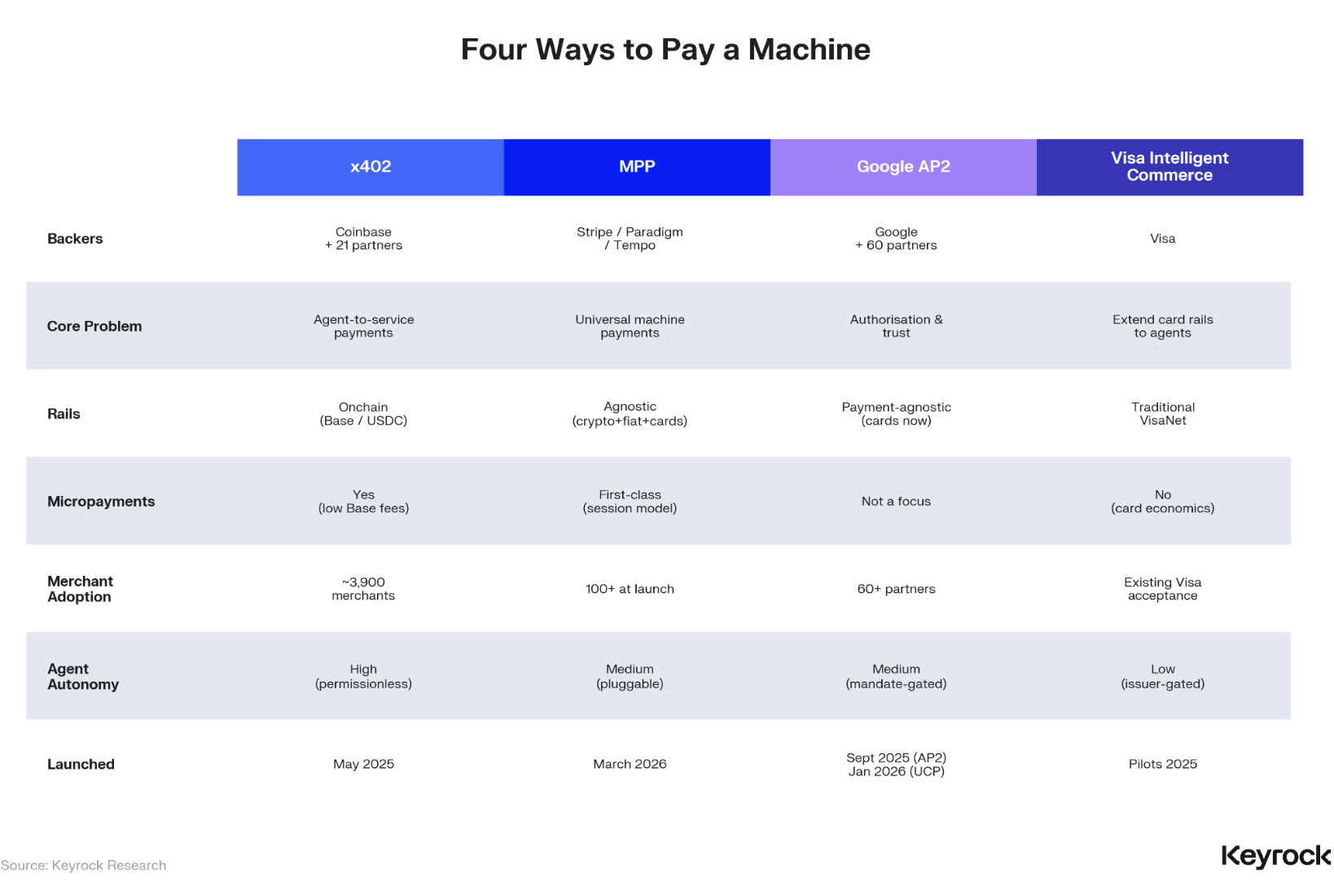
In September 2024, if you wanted an AI Agent to pay for something, there was essentially one insecure option. Twelve months later, four architectures exist, backed by some of tech's biggest companies.

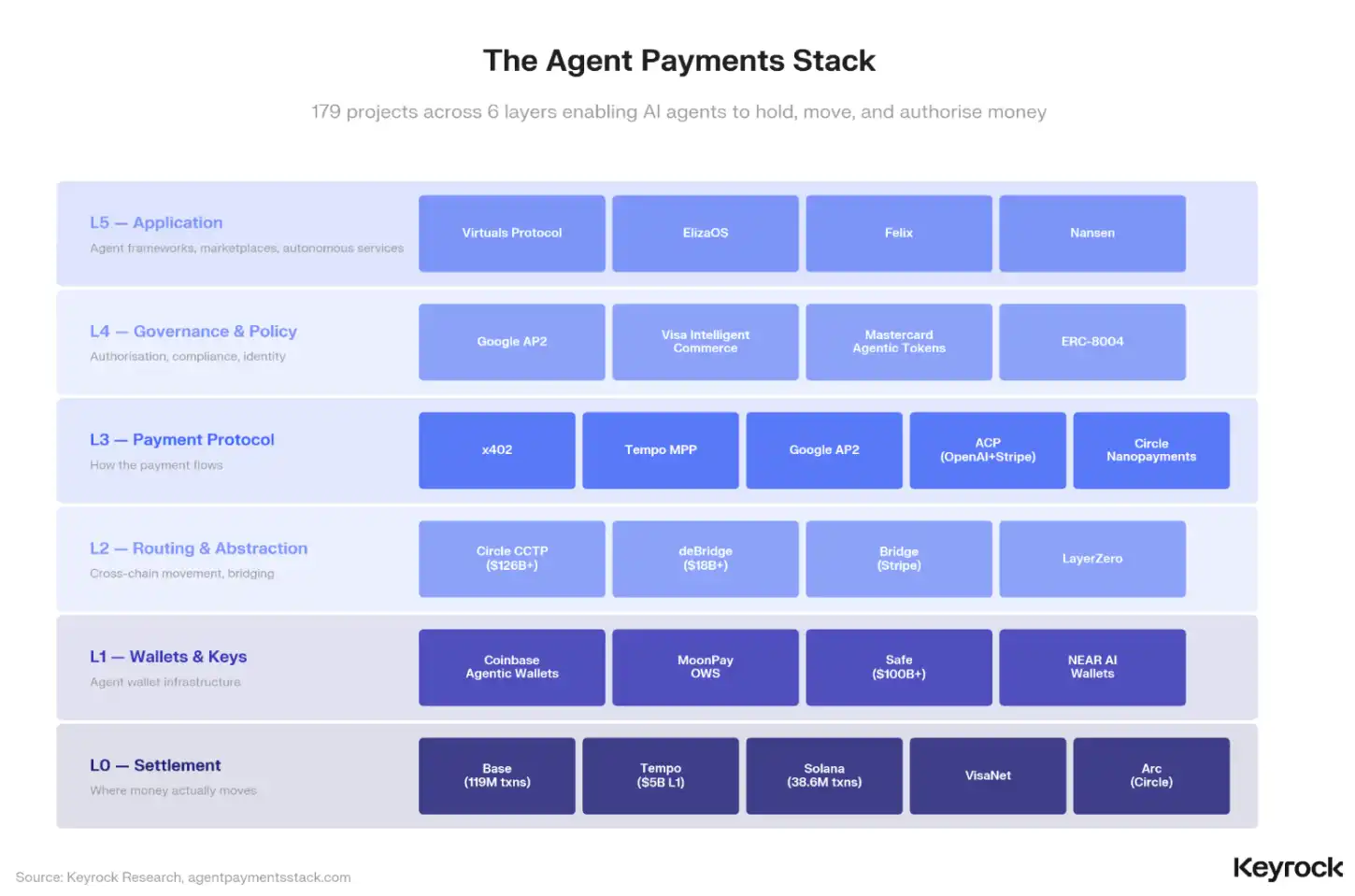
Coinbase built x402, a crypto-native protocol that turns stablecoin wallets into a universal API key. Stripe and Tempo launched MPP, a payment-method-agnostic standard handling bank cards, cryptocurrency, and Lightning through a single HTTP flow. Google assembled AP2, an authorization layer allowing users to delegate payment permissions to Agents via cryptographic signatures. Visa expanded its existing card rails to provide AI-ready tokenized credentials.

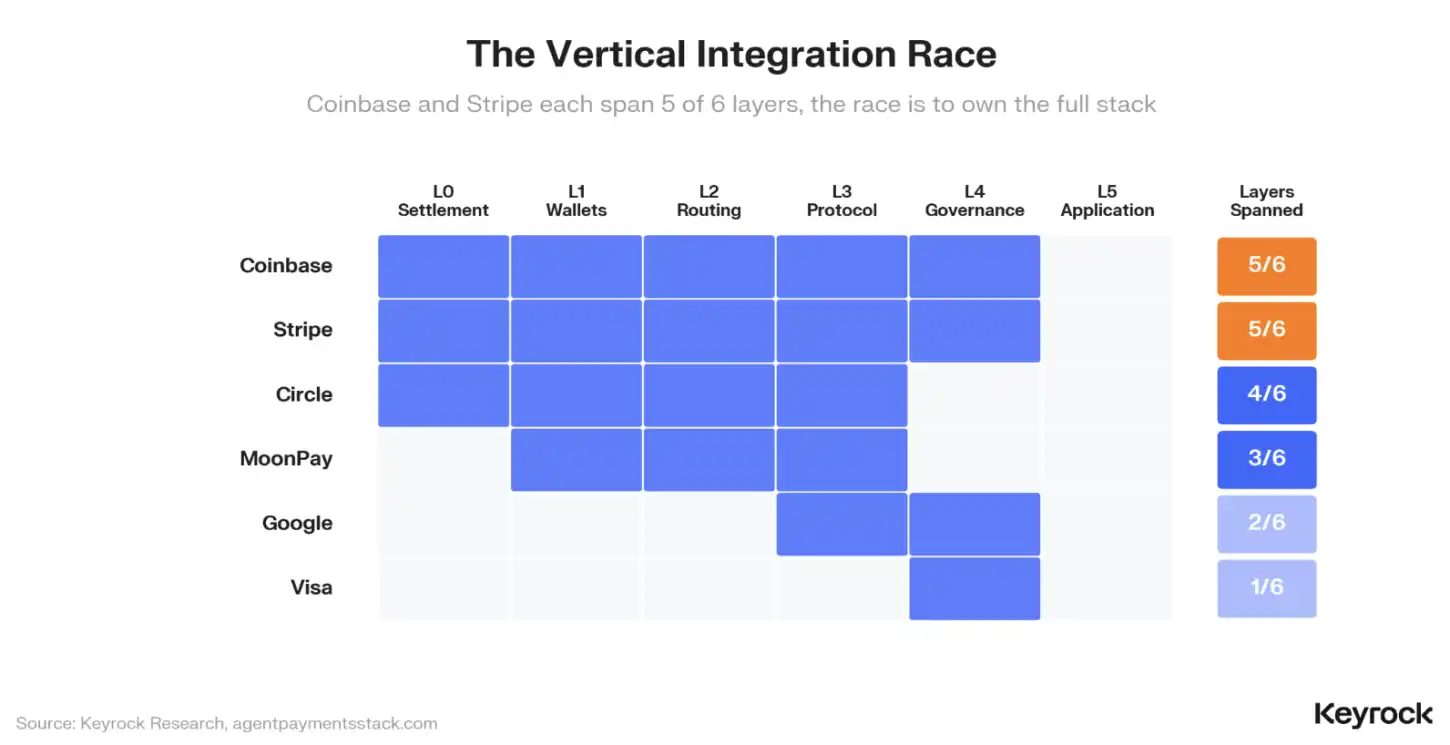
What most coverage misses is that these four proposals are not purely competitive. Protocol layers do overlap, but the more important dynamic is that they are assembling into a payment stack. The right question isn't "which protocol will win?" but "which companies control the most layers and thus capture the most value?"
The $0.30 Wall

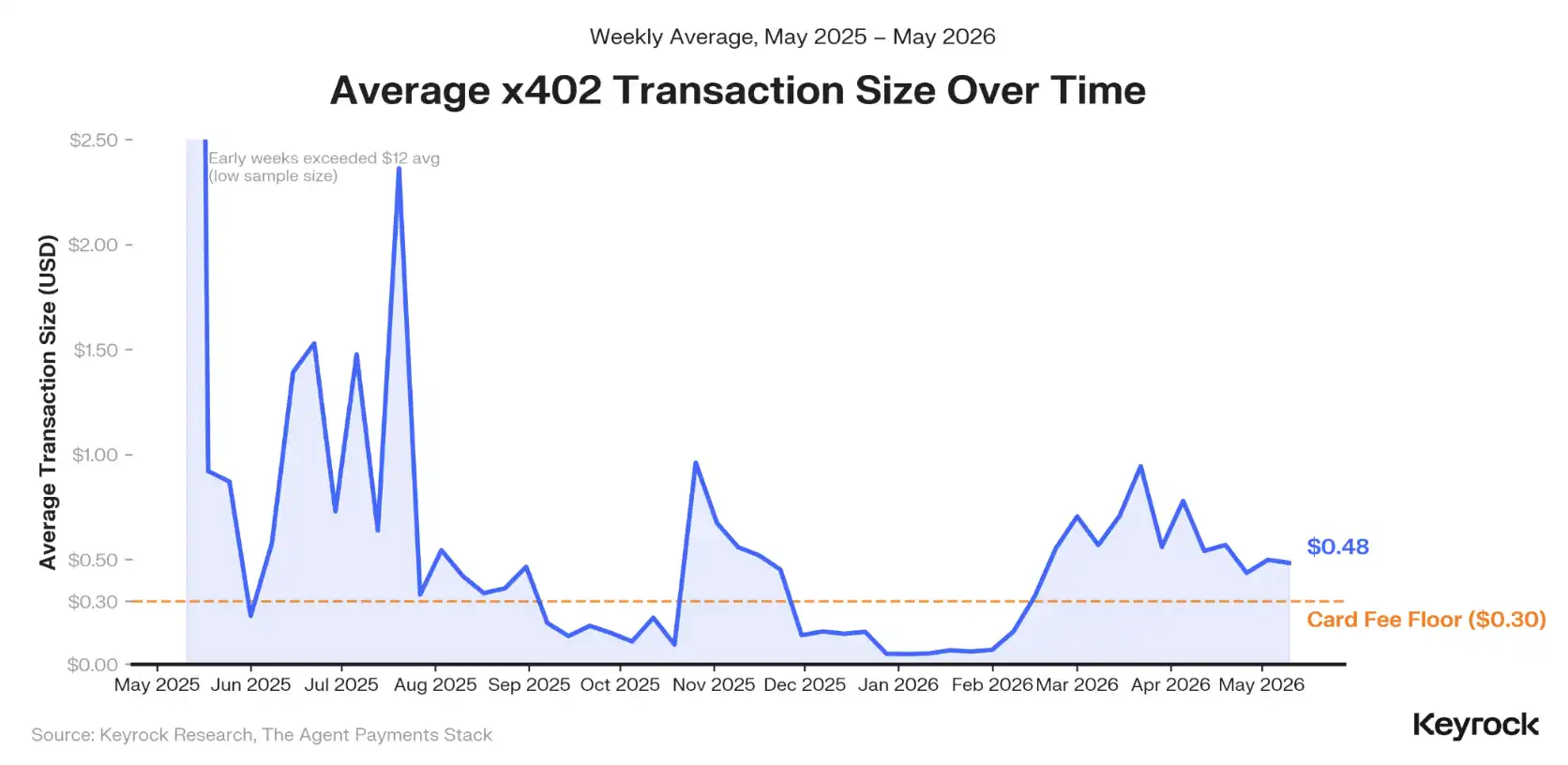
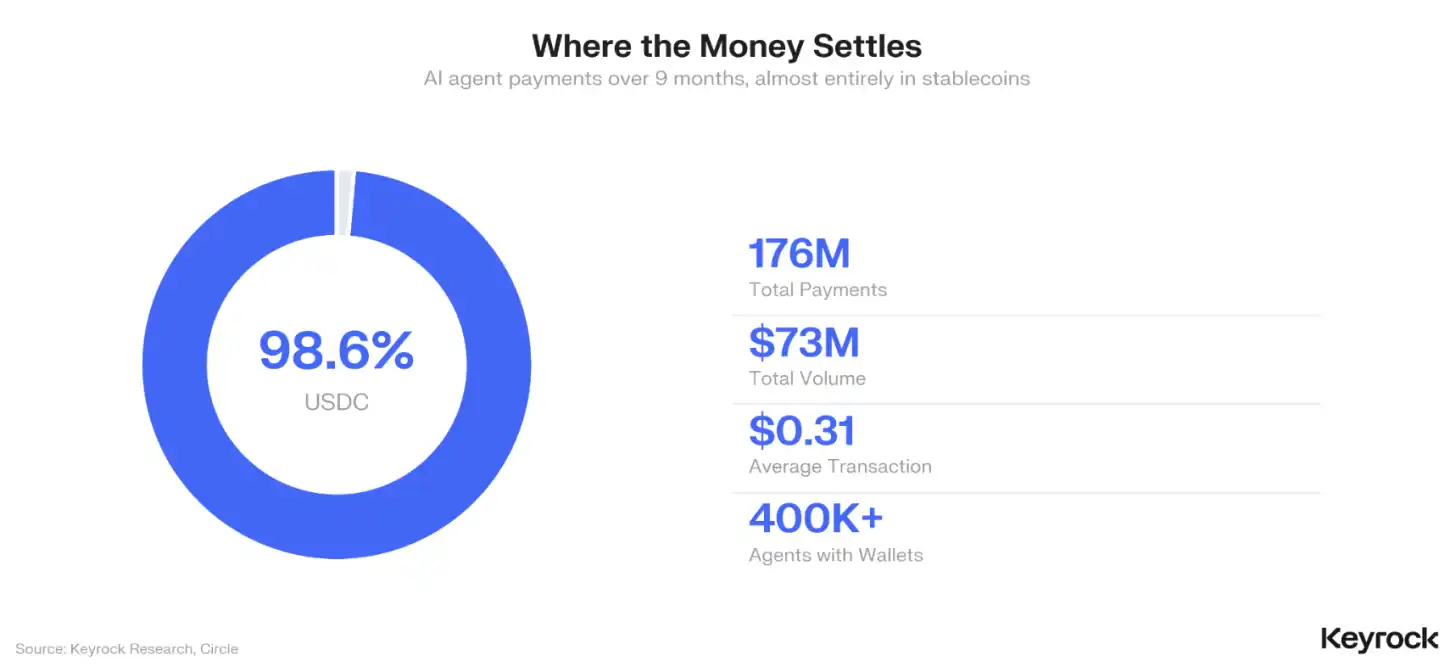
Among the 176 million x402 payments processed so far, the median transaction amount falls between $0.01 and $0.10. 76% of the activity is below the $0.30 baseline card processing fee. This figure almost single-handedly explains why traditional payment rails cannot serve this market. A fixed processing fee of approximately $0.30 per transaction renders micropayments unprofitable. An Agent cannot route a 3-cent payment for a weather API call through Visa.

Layer 2 stablecoin settlement costs $0.0001. For Agents, this means blockchain rails are a necessity.
Single Stablecoin Dominance

Of those 176 million payments, 98.6% were settled in USDC. Stablecoins have all but defaulted to winning the settlement layer for machine commerce; they are the only instruments that can process small-value transactions without the economic model collapsing.

This concentration is both validation and a vulnerability. It validates Circle's position as the default settlement asset, but it also means the entire Agent payments ecosystem depends on a single stablecoin issuer's reserve management, regulatory standing, and technical infrastructure. No one in the industry is discussing this publicly. We think they should.
The Race for Vertical Integration

Coinbase and Stripe each cover five of the six layers in the emerging payment stack. Coinbase controls the settlement layer (Base), wallets (Agentic Wallets), routing (internal infrastructure), the payment protocol (x402), and governance (as an AP2 collaborator). Stripe forms a mirror image through Tempo (settlement), Privy (wallets), Bridge (routing, acquired for $1.1 billion), MPP (protocol), and its compliance infrastructure.

Over the past 12 months, traditional giants have spent over $8 billion on acquisitions to fill gaps in their stack coverage. Capital One acquired Brex for $5.15 billion, Mastercard spent $1.8 billion on BVNK, and Stripe bought Bridge. These are infrastructure consolidation moves by companies that see machine payments as a natural expansion of their core business.
From Bot Activity to Agent Commerce

The machine economy has arrived. It just hasn't started doing commerce yet. But the signals are clear: AI Agents account for 37% of all Safe transactions on Gnosis Chain, peaking over 75%. Coinbase has deployed tens of thousands of fenced Agents. Over 104,000 Agents are registered across 15 or more directories and registries.

The shift from extractive bot activity to productive Agent commerce is underway. The payment infrastructure studied in this report is what makes this possible.
Regulation as a Constraint

MiCA, the GENIUS Act, and the EU AI Act will all reach enforcement stages within weeks of each other in mid-2026. None of them address autonomous machine-to-machine transactions. This is not a future problem; it's a current one, playing out on a real-time timeline with real capital at stake.

What Happens Next

The market is moving towards greater Agent autonomy, but we believe the pace will not be set by technology—that's largely ready. The pace will be set by the trust infrastructure that makes it safe. The fully permissionless vision is attractive in theory, but it assumes a level of AI reliability that doesn't exist yet. Until Agents stop hallucinating, they probably shouldn't have unsupervised access to user funds.

We find the bottom-up argument the most compelling framework for what happens next. Crypto rails have already default-won for micropayments. As transaction volumes grow and trust infrastructure matures, increasingly larger transaction amounts will migrate on-chain. The question isn't whether machine-native payments can scale, but how quickly the trust layer can catch up with the settlement layer.

This article is a summary of the report's core findings. The full report delves deeper into the data, including analysis of protocol architectures, insights from interviews with Coinbase and Tempo, economic modeling of transactions, and the regulatory landscape.


Related Questions

QWhat are the key competing payment architectures for AI Agents mentioned in the article, and which companies back them?

AThe article mentions four key competing payment architectures for AI Agents: Coinbase's x402 (a crypto-native protocol), Stripe and Tempo's MPP (a payment-method-agnostic standard), Google's AP2 (an authorization layer), and Visa's extension of its existing card rails to provide AI-ready tokenized credentials.

QWhy are traditional payment rails like Visa considered unsuitable for AI Agent micro-payments according to the report?

ATraditional payment rails like Visa have a fixed processing fee of around $0.30 per transaction. Since the median transaction value for AI Agent payments is between $0.01 and $0.10, with 76% of activity below $0.30, these fees make micro-payments economically unviable. In contrast, Layer 2 stablecoin settlement costs are as low as $0.0001.

QWhich stablecoin dominates the settlement layer for machine-to-machine payments, and what concern does this raise?

AUSDC dominates the settlement layer, accounting for 98.6% of the 176 million payments analyzed. While this validates Circle's position, it also introduces fragility, as the entire AI Agent payment ecosystem depends on the reserve management, regulatory status, and technical infrastructure of a single stablecoin issuer, creating a central point of risk.

QHow are companies like Coinbase and Stripe positioning themselves in the new AI payment stack through vertical integration?

ABoth Coinbase and Stripe are pursuing vertical integration to control multiple layers of the payment stack. Coinbase controls the settlement layer (Base), wallets, routing, payment protocol (x402), and governance. Stripe has a mirroring strategy through Tempo (settlement), Privy (wallets), Bridge (routing, acquired for $1.1B), MPP (protocol), and its compliance infrastructure. This allows them to capture more value from the ecosystem.

QWhat does the article identify as the primary constraint on the pace of adoption for fully autonomous AI Agent payments?

AThe article identifies trust infrastructure, not technology, as the primary constraint. While the technical capability for autonomous payments exists, the pace of adoption will be set by the development of security and reliability measures. Until AI Agents can operate without 'hallucinations' or errors, they should not have unsupervised access to user funds, limiting full autonomy.

Related Reads

AI PC Battle: Bet on the Toll Booth, Not the Camp

**Title:** The AI PC Battle: Don't Bet on Sides, Bet on the Tollbooth **Summary:** The AI PC competition is moving beyond simple "x86 vs. Arm" narratives. The core investment thesis should focus on identifying which players can sustain margins, cash flow, and pricing power throughout the upgrade cycle, rather than backing a particular architecture. The opportunity is analyzed in three layers: 1. **The Advanced Foundry Tollbooth:** TSMC is positioned to collect "tolls" regardless of which chip designer wins, due to its dominant ~70% share in advanced semiconductor manufacturing, which is essential for high-end AI PC chips. 2. **Compute & Platform Spillover:** AMD represents an offensive in the x86 CPU+GPU space, while NVIDIA leverages its GPU and CUDA software stack dominance. Both benefit from the demand for increased local AI compute. 3. **Architecture Diffusion & Turnaround Plays:** ARM and Intel offer potential for significant upside (elasticity), but investments here require stricter discipline due to higher execution risks and competitive challenges. The industry is transitioning from concept to shipment validation. While short-term forecasts for AI PC adoption have been revised down slightly due to tariffs and procurement delays, the long-term trend towards AI becoming a standard PC feature remains intact. The key driver for upgrade cycles will be whether compelling enterprise applications (e.g., privacy-sensitive computing, low-latency inference) emerge beyond consumer-focused features like meeting summarization. Investment strategy should prioritize companies with platform-level advantages and recurring revenue streams. TSMC offers high certainty as the foundational tollbooth. AMD presents a strong offensive play within the established ecosystem. ARM and Intel are higher-risk, higher-potential-reward turnaround bets. The report cautions against chasing short-term hype and emphasizes a disciplined, long-term approach focused on buying ecosystem strength and cash-flow certainty after market enthusiasm subsides. **Key Risks:** Underwhelming AI PC applications slowing upgrade cycles; slow improvement in Windows on Arm compatibility; macro/tariff impacts on PC demand; potential advanced node supply-demand mismatches affecting TSMC; high overall AI sector valuations making stocks vulnerable to a risk-off shift in markets.

marsbit11m ago

AI PC Battle: Bet on the Toll Booth, Not the Camp

marsbit11m ago

Ten-Thousand-Word Analysis: From $10 to $290, MRVL Wins the Entire AI Era by 'Not Making GPUs'

Marvell Technology's stock price surged from under $10 in 2016 to a record $290 in June 2026, fueled not by making GPUs, but by dominating AI infrastructure connectivity. This analysis argues the market misvalues MRVL as merely a smaller Broadcom in custom AI chips, overlooking its true, unique position. Marvell's core strength lies in enabling high-speed data flow for AI clusters through three interconnected businesses. First, it holds a commanding ~70% market share in high-speed optical DSPs (essential for data center light modules), a deep-moat business with accelerating growth. Second, its custom AI chip design business serves hyperscalers like AWS, Microsoft, and Google, with a significant revenue pipeline despite lower margins. Third, stable cash flows come from Ethernet switch chips and enterprise storage controllers. Together, they form a full-stack "AI data movement" platform. CEO Matt Murphy's transformative leadership since 2016, involving strategic divestments, key acquisitions (like Inphi for optical DSPs), and securing long-term agreements with major cloud providers, repositioned the company. A pivotal $2 billion strategic investment from NVIDIA in 2026 underscored Marvell's critical role in the AI ecosystem, particularly through collaborations like NVLink Fusion. While Marvell faces risks—including client concentration (losing the Amazon Trainium3 design), lower-margin business mix, competitive threats, insider selling, and complex supply chains—its fundamentals remain strong. The optical interconnect moat is widening with the acquisition of Celestial AI (photonics fabric), and financial metrics show accelerating revenue growth and operating leverage. With a PEG ratio suggesting undervaluation relative to its growth, the thesis is that the market undervalues Marvell's monopolistic position in AI "plumbing" while overemphasizing its competitive custom chip segment. The story transcends investing, symbolizing how in any complex system—from the internet to AI—the value of "connection" ultimately surpasses that of individual "nodes."

marsbit40m ago

Ten-Thousand-Word Analysis: From $10 to $290, MRVL Wins the Entire AI Era by 'Not Making GPUs'

marsbit40m ago

AI Relay Stations Spark Heated Debate on Zhihu: Behind Cheap Tokens, What Are Users Really Worried About?

A discussion on Zhihu about "AI relay stations" shifted the niche developer topic of "cheap tokens" into broader user awareness. Users moved beyond simply questioning the legitimacy of these services to focus on practical concerns: Where do cheap tokens truly come from? Is the model being accessed the real one? Can relay stations see prompts, code, and API keys? For occasional users, are the risks worth it? The core debate centered less on price and more on trust. A primary worry is model authenticity—the risk of "model swapping," where users paying for a premium model might be routed to a cheaper one, creating an information asymmetry. Others argued that cost comparisons matter; while cheaper than official pay-as-you-go APIs, relay stations may not be the lowest-cost option versus subscriptions, domestic models, or free tiers, making user needs assessment crucial. Speculation about token sources ranged from legitimate bulk discounts to gray-area methods like account sharing or exploiting regional pricing. This opacity makes risk assessment difficult for users. Data security emerged as a critical concern, especially for enterprise use. When processing sensitive information like code, contracts, or client data, the inability to verify a relay station's data handling, retention, or access policies poses significant compliance and confidentiality risks. The evolving consensus suggests relay stations can be used cautiously for low-sensitivity, disposable tasks (e.g., summarizing public info, simple translation). However, they should not be the default for sensitive, professional, or production workflows involving proprietary data, Agents, or automated systems. Recommendations include avoiding large prepayments, not relying on a single service, using test prompts to monitor quality, anonymizing data where possible, and keeping official channels as backups. Ultimately, the discussion framed tokens not just as a billing unit but as a measure of real cost encompassing price, model integrity, data security, and service stability. The popularity of relay stations highlights user demand for affordable access, but the debate underscores a key trade-off: the savings from cheap tokens may come at the price of trust, transparency, and control over one's data and AI experience.

marsbit1h ago

AI Relay Stations Spark Heated Debate on Zhihu: Behind Cheap Tokens, What Are Users Really Worried About?

marsbit1h ago

In-Depth Research Report on TradFi: The Convergence Wave of Crypto and Traditional Finance

In 2026, the crypto industry is undergoing a profound infrastructure-level transformation—TradFi assets are migrating on-chain at an unprecedented pace. According to CoinGecko's Q1 2026 report, the total value locked (TVL) of tokenized real-world assets (RWA) has surpassed $31 billion, a nearly 4x increase from $7.8 billion at the beginning of 2025, with the sector’s aggregate market capitalization reaching $19.3 billion. Among these, the market cap of tokenized stocks surged from $2 million to $486 million, with Q1 spot trading volume reaching $15.1 billion—a single quarter already surpassing the entire second half of 2025. RWA perpetual contract Q1 trading volume reached a staggering $524.8 billion, far exceeding the $313 billion for all of 2025. Meanwhile, BlackRock's BUIDL fund has reached $2.3 billion in scale and has filed for two new tokenized funds, signaling that the world's largest asset manager's tokenization strategy is evolving from pilot to product suite expansion. HTX, as a core participant in the crypto exchange sector, officially launched TradFi perpetual futures products including NVDA, AAPL, MSFT, META, and SPY in 2026, enabling crypto users to gain 24/7 trading access to core U.S. equities. Boston Consulting Group predicts that global tokenized asset scale could reach $16 trillion by 2030, while McKinsey offers a conservative estimate of approximately $2 trillion. The on-chain migration of TradFi assets is no longer a "future narrative" but a structural transformation unfolding in real time, as crypto exchanges evolve from single crypto asset trading platforms toward "multi-asset-class trading infrastructure."

HTX Learn1h ago

In-Depth Research Report on TradFi: The Convergence Wave of Crypto and Traditional Finance

HTX Learn1h ago

Trading

Spot
Futures

Hot Articles

Discussions

Welcome to the HTX Community. Here, you can stay informed about the latest platform developments and gain access to professional market insights. Users' opinions on the price of AI (AI) are presented below.

活动图片