How Can a Single Missile Take Down Global AI Giants Instantly?

比推Published on 2026-03-03Last updated on 2026-03-03

Abstract

An Iranian missile strike on a data center in the UAE, operated by Amazon Web Services, caused a significant outage of cloud services, including the AI system Claude. The incident occurred shortly after the US and Israel conducted airstrikes in Iran, reportedly aided by Claude for intelligence analysis. This marks the first time a commercial data center has been physically destroyed in a military conflict, highlighting the vulnerability of global AI infrastructure. The event underscores how AI, despite its digital nature, relies on physical infrastructure located in geopolitically unstable regions. Major tech companies, including Amazon, Microsoft, and OpenAI, have heavily invested in data centers across the Middle East due to favorable policies and resources. However, these facilities are now exposed to physical threats in times of conflict. The attack raises critical questions about the classification of data centers as civilian or military assets when they support both commercial and defense operations. It also exposes the lack of international legal frameworks and physical security measures for protecting such infrastructure. The incident shifts the focus from fears of AI replacing humans to the fragility of AI itself in the face of real-world threats.

Author: David, Deep Tide TechFlow

Original Title: AI Within the Range of Artillery


On March 1, Iranian missiles and drones struck the Gulf region, with one landing on an Amazon data center in the UAE.

The data center caught fire, lost power, and approximately 60 cloud services were disrupted.

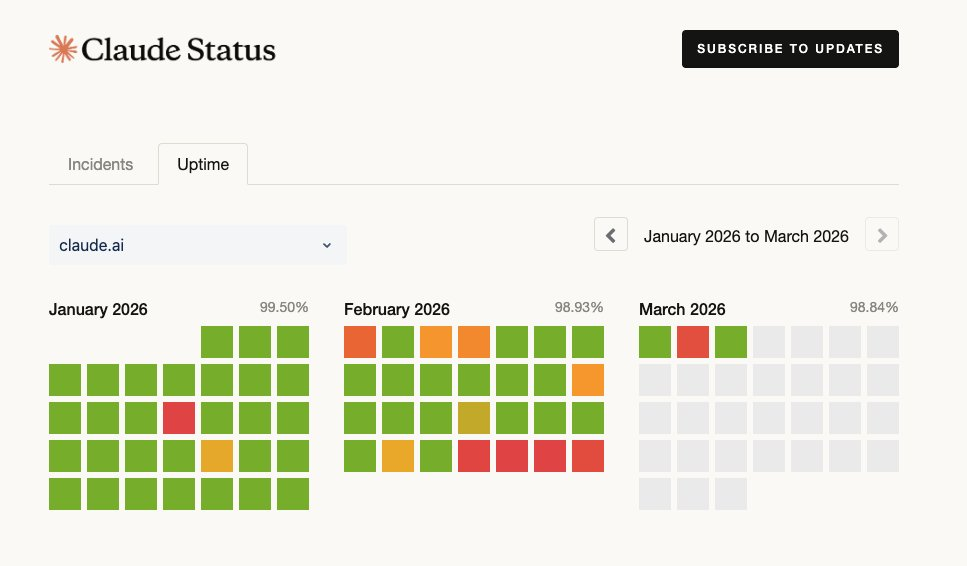
Claude, one of the world's most widely used AIs, runs on Amazon's cloud. On the same day, Claude experienced a global outage.

Anthropic's official explanation was a surge in users overwhelming the servers.

As of the time of writing, complaints about Claude's service being unavailable still persist on social media; the renowned prediction market Polymarket has already launched a prediction topic: "How many more times will Claude go down in March?"
If it is confirmed that Iran was responsible, this would be the first time in human history:

A commercial data center was physically destroyed in a war.

But why would a civilian data center be targeted?

Rewind two days. On February 28, the U.S. and Israel jointly launched an airstrike on Iran, killing Supreme Leader Khamenei and a number of senior officials.

A significant portion of the intelligence analysis, target identification, and battlefield simulation for this airstrike was assisted by Claude. Through collaboration between the military and data analytics company Palantir, Claude had long been integrated into the U.S. military's intelligence system.

Ironically, just hours before the airstrike, Trump ordered a comprehensive ban on Anthropic because the company refused to provide unrestricted access to its AI for the Pentagon. But despite the ban, the operation proceeded.

Publicly, it was stated that removing Claude from the military system would take at least six months.

So, before the ink on the ban was dry, the U.S. military used Claude to strike Iran. Iran then retaliated, and a missile landed on the data center running Claude AI.

Source: Bloomberg

The data center was likely not the intended target, merely collateral damage. But regardless of whether the missile was aimed at the data center, one thing is certain:

Truth lies within the range of artillery, and so does AI. Both the side firing the artillery and the side being hit by it are affected.

AI's Grand Infrastructure, Built on the Middle East Powder Keg

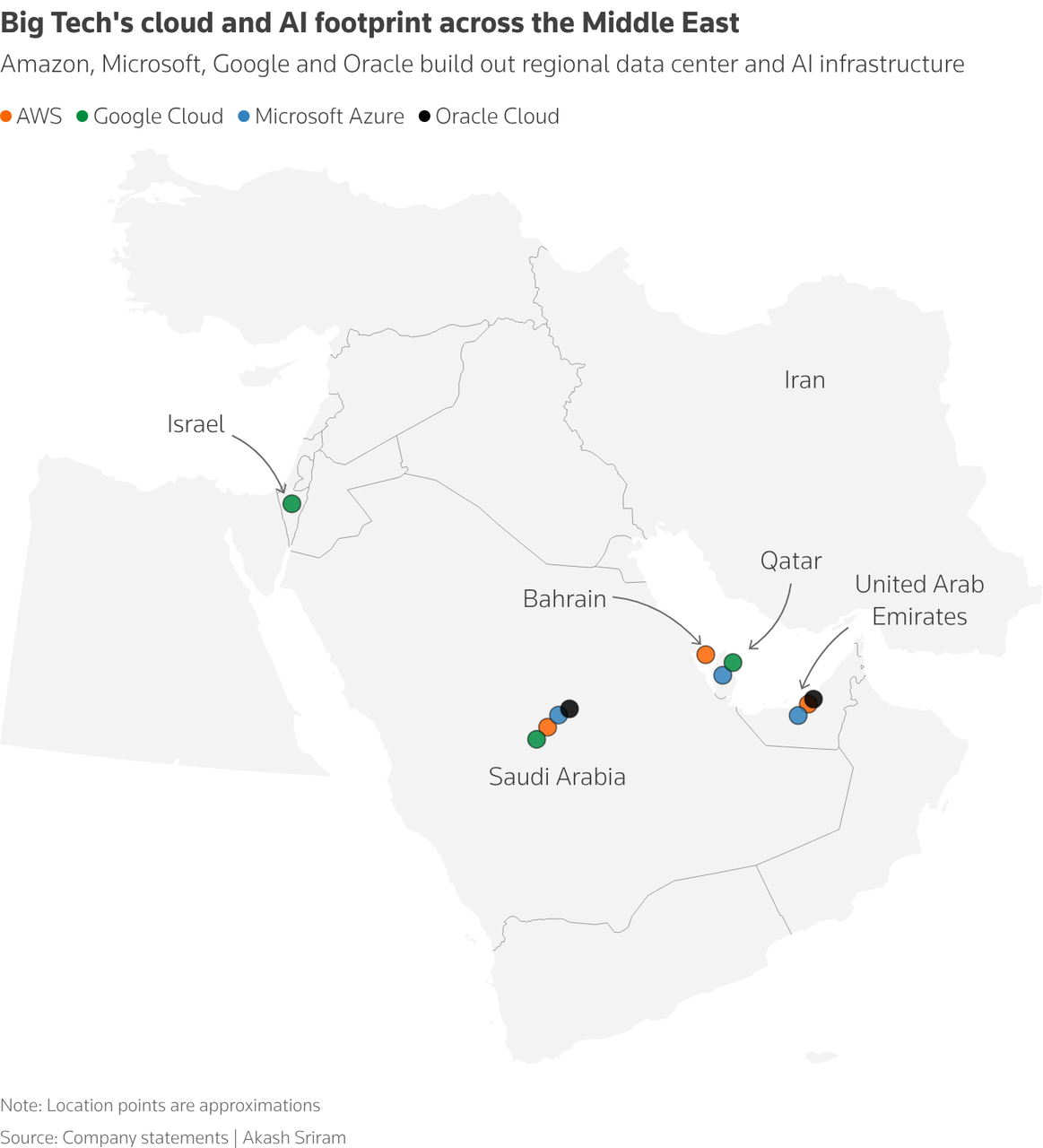
Over the past three years, Silicon Valley has relocated half of the AI industry to the Middle East Gulf.

The reason is simple. The UAE and Saudi Arabia have the world's wealthiest sovereign funds, cheap electricity, and one key regulation:

If you want to serve my customers, your data must be stored on my territory.

So Amazon opened data centers in the UAE and Bahrain, and invested $5.3 billion to build another in Saudi Arabia; Microsoft has nodes in the UAE and Qatar, with one in Saudi Arabia already completed.

OpenAI, in partnership with NVIDIA and SoftBank, is building a $30 billion AI park in the UAE, touted as the largest computing base outside the U.S.
In January of this year, the U.S. signed an agreement with the UAE and Qatar called "Pax Silica." Translated as "Silicon Peace," it sounds ideal.

The core of the agreement is to control the flow of chips, ensuring advanced chips do not fall into China's hands.

In exchange, the UAE secured permission to import hundreds of thousands of NVIDIA's most advanced processors annually. Abu Dhabi's G42 cut ties with Huawei, and Saudi AI companies pledged not to purchase Huawei equipment...

The entire Gulf's AI infrastructure, from chips to data centers to models, has fully aligned with the U.S.

These agreements considered everything: chip export controls, data sovereignty, investment reciprocity, and technology leakage risks.

But not one considered the possibility of someone bombing a data center with a missile.

An international security scholar at Qatar University made a fitting remark after the Amazon data center fire:

"These security frameworks were designed for supply chain control and political alignment. Physical security was never on the agenda."

Cloud computing has preached elasticity, redundancy, and decentralization for a decade. But data centers are physical buildings with walls, roofs, and coordinates. No matter how advanced your chips are, if the data center is bombed, it's bombed.

"Cloud" is a metaphor; data centers are not.

AI may seem virtual, running on code, floating in the cloud. But code runs on chips, chips are installed in data centers, and data centers are built on Earth.

Who Protects AI?

This time, Amazon's data center may have been collateral damage, or optimistically, mistakenly hit.

But what about next time?

In an era of escalating global geopolitical conflicts, if your data center runs AI models that help opponents with target identification, there is no reason for them not to treat your data center as a military facility.

International law has no answer to this question.

Current laws of war have provisions for "dual-use facilities," but those clauses were written for factories and bridges. No one considered data centers.

A data center that processes bank transactions by day and military intelligence analysis by night—is it civilian or military?

In peacetime, data center选址 considers latency, electricity costs, policy incentives... In war, none of that matters. What matters is how far your data center is from the nearest military base.

So, this bombing has shifted everyone's focus.

Previously, everyone was discussing the same anxiety: will AI replace my job? But no one discussed another question:

Before AI replaces you, how fragile is it itself?

A regional conflict brought down the Middle East node of the world's largest cloud service provider for an entire day; and this was just one data center.

There are nearly 1,300 hyperscale data centers worldwide today, with another 770 under construction. These centers consume increasing amounts of electricity, water, and money, and they承载 more and more—your savings, your medical records, your food delivery orders, even a country's military intelligence...

But the solutions protecting these data centers, to this day, likely still consist of fire suppression systems and backup generators.

When AI becomes a nation's infrastructure, its security is no longer just a company's concern. Who protects AI? Cloud providers? The Pentagon? Or the UAE's air defense system?

This question was theoretical three days ago. Not anymore.

AI is within the range of artillery. In fact, isn't everything in this era within the range of artillery?


Twitter:https://twitter.com/BitpushNewsCN

Bitpush TG Discussion Group:https://t.me/BitPushCommunity

Bitpush TG Subscription: https://t.me/bitpush

Original link:https://www.bitpush.news/articles/7616277

Trending Cryptos

Related Questions

QWhat event on March 1st led to the global outage of Claude AI?

AA missile and drone attack by Iran on the Gulf region struck an Amazon data center in the UAE, causing a fire, power outage, and disruption of approximately 60 cloud services, which led to the global outage of Claude AI.

QWhy was the Amazon data center in the UAE targeted or affected by the missile strike?

AThe data center was likely not directly targeted but was affected because Claude AI, which was hosted on Amazon's cloud, had been used by the U.S. military and Palantir for intelligence analysis, target identification, and battlefield simulation in a joint U.S.-Israel airstrike on Iran just two days prior.

QWhat is the 'Pax Silica' agreement signed between the U.S., UAE, and Qatar?

AThe 'Pax Silica' agreement, signed in January, focuses on controlling the flow of advanced chips to prevent them from reaching China. In exchange, the UAE received permits to import hundreds of thousands of Nvidia's most advanced processors annually, and Gulf AI companies committed to cutting ties with Huawei and avoiding its equipment.

QHow does the article highlight the vulnerability of AI infrastructure in the context of geopolitical conflicts?

AThe article emphasizes that AI infrastructure, such as data centers, is physically vulnerable to attacks during conflicts. Despite being critical infrastructure, data centers are often protected only by basic systems like fire suppression and backup generators, and their physical security is not adequately considered in geopolitical or military planning.

QWhat broader implication does the incident have for the future of AI and cloud services in conflict zones?

AThe incident underscores that AI and cloud services, often seen as virtual and decentralized, are grounded in physical infrastructure that can be targeted in warfare. This raises unresolved questions about whether data centers hosting dual-use (civilian and military) AI should be considered military targets and who is responsible for protecting them—cloud providers, national militaries, or host countries.

Related Reads

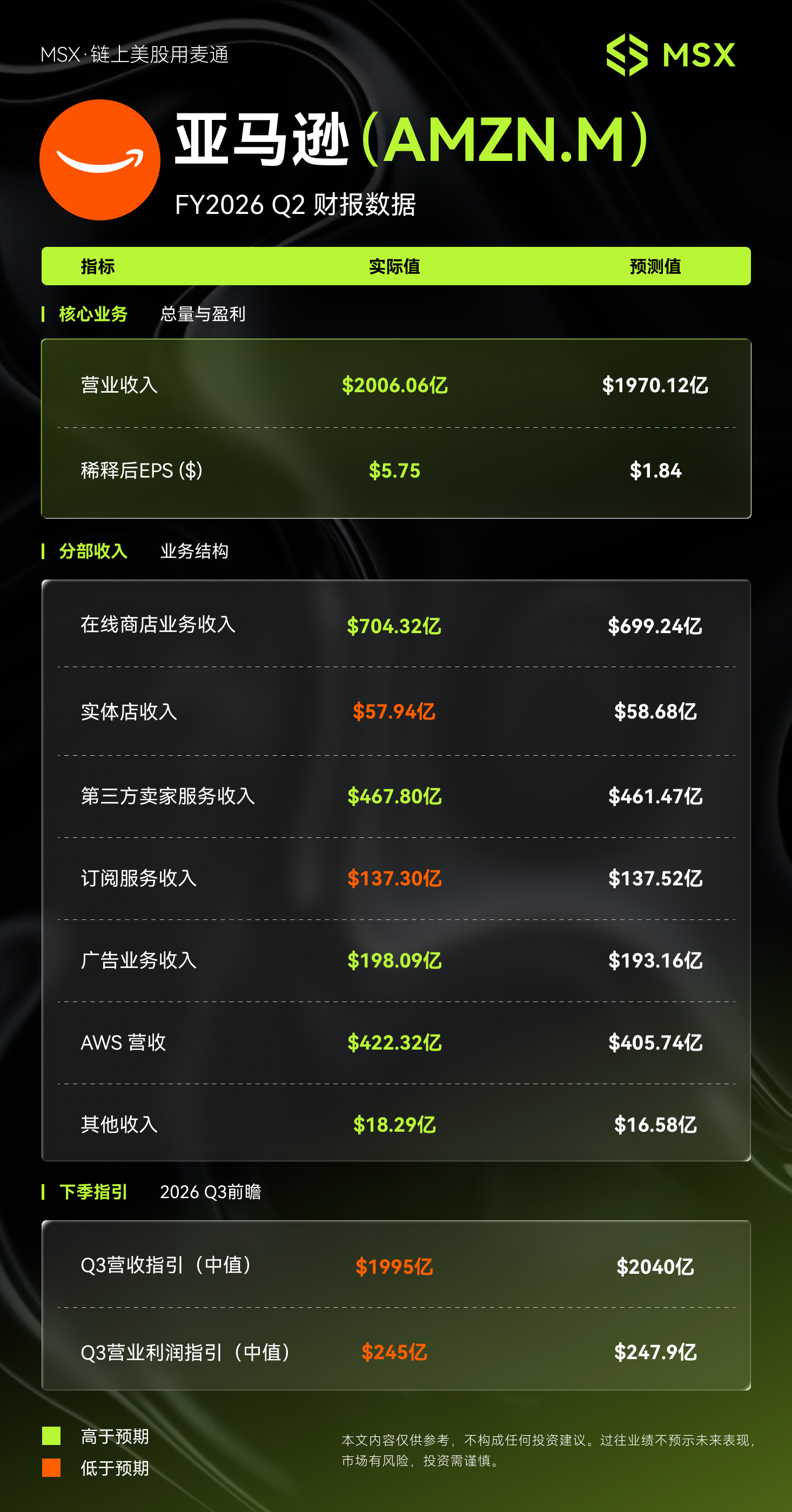
MSX US Stock Daily Insight: Amazon 2026 Q2 Earnings: AWS Records Fastest Growth in Five Years

**MSX Daily US Stock Observation: Amazon's Q2 2026 Earnings: AWS Achieves Fastest Growth in Five Years** Amazon's latest quarterly results exceeded expectations, driven by a strong performance from its cloud computing unit. The company reported revenue of $200.66 billion, surpassing estimates of approximately $197 billion. The key highlight was Amazon Web Services (AWS), which generated $42.232 billion in revenue, surging 37% year-over-year. This marked the segment's fastest growth pace in 18 quarters, indicating robust demand for cloud services. Reported Earnings Per Share (EPS) of $5.75 significantly exceeded the $1.84 forecast. However, this figure included a substantial one-time, non-operating gain of $53.4 billion, primarily from the revaluation of Amazon's investment in AI company Anthropic. Excluding this item, core operating profit was $27.461 billion, a strong increase of 43% compared to the same period last year. Despite the positive results, Amazon provided guidance for the upcoming third quarter that fell short of market expectations. The company's revenue guidance midpoint is $199.5 billion, below the consensus estimate of around $204 billion. Operating profit guidance of $24.5 billion also slightly missed expectations of approximately $247.9 billion. Furthermore, Amazon raised its forecast for full-year capital expenditures to $220 billion, citing rising memory chip costs, which weighed on investor sentiment regarding future profitability. In summary, Amazon's quarter showcased accelerating momentum in its core AWS business. The underlying operational profit growth remains solid. However, cautious forward guidance and increased investment spending present key areas for monitoring in the coming quarters, as the market assesses whether the current growth phase will translate into sustained profit margin expansion.

Odaily星球日报8m ago

MSX US Stock Daily Insight: Amazon 2026 Q2 Earnings: AWS Records Fastest Growth in Five Years

Odaily星球日报8m ago

Cyclical Stock or Growth Stock? Coinbase's Q2 Earnings Report Reveals 'Valuation Disagreement'

Coinbase's Q2 2026 financial results revealed a mixed performance, reigniting debate over whether the company should be valued as a cyclical stock tied to crypto markets or a growth stock with future potential. Total revenue missed expectations at $1.22 billion, down 19% year-over-year. Transaction revenue fell to $599 million, with retail crypto spot trading revenue dropping 30% to $452 million, back to 2023 levels. The company reported a net loss of $359 million, marking its third consecutive quarterly loss. Despite CEO Brian Armstrong's positive commentary on metrics like a 10.3% overall crypto trading market share and 106% growth in prediction markets, the market reacted negatively, with shares dropping over 5% after-hours. A key issue is the decline in core retail trading. While Coinbase touted record market share, this figure includes derivatives and new products. Its traditional crypto spot trading share is likely shrinking. New ventures like prediction markets, while growing, contributed less than $30 million, insufficient to offset the core revenue decline. The valuation debate hinges on perspective. As a cyclical stock, Coinbase remains deeply tied to the crypto bear market, with user attrition and competitive pressures justifying a lower valuation. The company's strategy appears focused on surviving until the next bull cycle. Viewed as a growth stock, however, Coinbase shows promising diversification. Subscription and service revenue reached $555 million, nearly matching transaction revenue. Stablecoin revenue, its second-largest source at $292 million, remains strong through its partnership with Circle. Critically, Coinbase is positioning itself as a leader in the emerging on-chain "agent economy." Over 90% of agent-based stablecoin transactions occur on its Base network, which it believes could handle trillions in future agent transactions. The recent acquisition of Deribit also aims to boost its international derivatives offering. In summary, Coinbase's present struggles are clear, but its future hinges on whether its investments in revenue diversification, stablecoins, and the agent economy can ultimately transform its business model and justify a growth premium.

Odaily星球日报28m ago

Cyclical Stock or Growth Stock? Coinbase's Q2 Earnings Report Reveals 'Valuation Disagreement'

Odaily星球日报28m ago

Global Market Share Survey: Japanese Firms Lead in Semiconductor Materials

Global Market Share Survey: Japanese Firms Lead in Semiconductor Materials According to the 2025 "Major Goods and Services Market Share Survey" by Nikkei, Japanese companies maintain strong positions in semiconductor-related materials. In silicon wafers, Shin-Etsu Chemical ranks first with a 26.3% share, followed by SUMCO at 17.8%. Together, they hold 44.1% of the market, widening their lead over competitors from Taiwan, Germany, and South Korea. In photoresists, Tokyo Ohka Kogyo, JSR, and Shin-Etsu Chemical occupy the top three spots, with a combined share of 60.5%. Despite their strength in materials, Japanese firms have a weaker presence in core semiconductor segments like DRAM and NAND flash memory, where South Korean and U.S. companies dominate. For instance, SK Hynix and Samsung lead in DRAM, while China’s CXMT doubled its share to 6% in 2025. The semiconductor market is projected to grow rapidly, with WSTS forecasting a 90% increase to $1.5112 trillion by 2026. Major players like Samsung, SK Hynix, and Micron are making massive investments to expand capacity. To maintain their edge in materials, Japanese companies must similarly commit to large-scale, risk-taking investments. In contrast, Japan’s automotive sector shows stagnation. Toyota remains the global leader but with only a slight share increase to 12.3%, while Japanese brands are absent from the top five in the EV market. In shipbuilding, Imabari Shipbuilding rose to third place globally with a 7.2% share, benefiting from large container ship deliveries. However, Chinese and South Korean firms dominate the sector, holding the top two positions. Japan aims to revitalize its shipbuilding industry through government and corporate efforts, targeting a near doubling of output by 2035. Addressing labor shortages and adopting advanced technologies like physical AI will be critical for competitiveness.

marsbit53m ago

Global Market Share Survey: Japanese Firms Lead in Semiconductor Materials

marsbit53m ago

Trading

Spot

Hot Articles

Discussions

Welcome to the HTX Community. Here, you can stay informed about the latest platform developments and gain access to professional market insights. Users' opinions on the price of AI (AI) are presented below.

活动图片