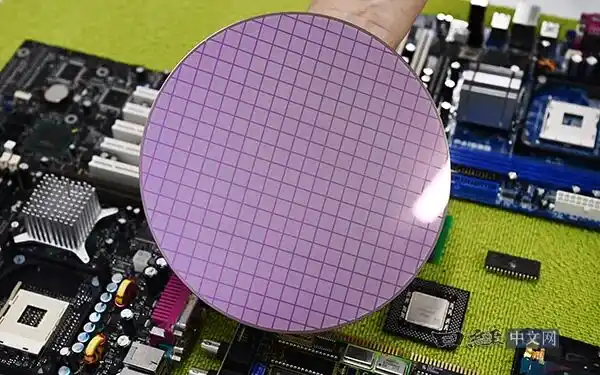
Japanese companies maintain a high market share in silicon wafers
In the silicon wafer field, Shin-Etsu Chemical holds the top share; in the photoresist field, Japanese firms occupy the top three positions. In 2025, Japanese companies performed robustly in the semiconductor materials sector, but stagnated in the pillar automotive industry...
The 2025 "Major Goods and Services Market Share Survey" by Nikkei shows that Japanese companies maintained high market shares in semiconductor-related materials. With the spread of artificial intelligence (AI), memory and GPU manufacturers are making massive investments. Whether Japanese material companies can keep pace through their own investments will be a focal point.
In the silicon wafer sector, fundamental to semiconductors, Shin-Etsu Chemical ranks first with a 26.3% share, up 1 percentage point from the previous year. SUMCO ranks second with a 17.8% share, up 1.8 percentage points. The combined share of the two companies increased by 2.8 percentage points to 44.1%, further widening the gap with the 3rd to 5th place companies. The latter are mainly from Taiwan, Germany, and South Korea, with their combined market share dropping 0.7 percentage points to 31.9%.
Furthermore, in the photoresist field, three Japanese companies—Tokyo Ohka Kogyo (TOK), JSR, and Shin-Etsu Chemical—swept the top three positions. Their combined share reached 60.5%, up 0.3 percentage points from 2024.
In the semiconductor manufacturing equipment sector, Tokyo Electron holds a 10.4% share, ranking 4th for the second consecutive year since 2024.
While Japanese firms maintain an edge in semiconductor materials, their presence remains weak in the core memory and GPU segments of the semiconductor market.
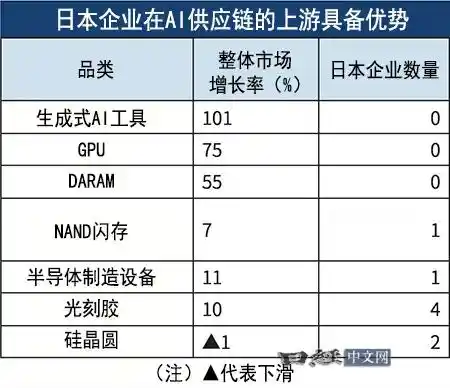
In the DRAM memory field, South Korea's SK Hynix holds a 34% share, up 1 percentage point from 2024, moving up one rank to tie for first place with Samsung Electronics. Micron Technology of the US ranks third. The top three companies combined hold a 92% market share.
The 2025 survey shows that ChangXin Memory Technologies (CXMT) achieved a 6% share, doubling from 2024 (3%). CXMT's parent company was listed on the Shanghai Stock Exchange on July 27 and is expected to further increase production capacity.
In the NAND flash memory field, SK Hynix and Samsung rank first and second, with a combined share of 50%. Kioxia Holdings, which once became the Japanese stock market's highest-valued company, ranks third, but its global share fell by 1 percentage point to 15% compared to 2024.
The World Semiconductor Trade Statistics (WSTS) organization, composed of major semiconductor manufacturers, predicts the global semiconductor market will reach $1.5112 trillion in 2026, a 90% increase from 2025. To avoid losing market share in this rapidly expanding market, semiconductor manufacturers are pushing ahead with astronomical levels of investment.
Samsung Electronics and SK Hynix announced plans to invest a total of 800 trillion won to build four new semiconductor plants in South Korea. US-based Micron Technology announced it will invest over $250 billion in US domestic memory production and R&D by 2035.
For Japanese companies to defend their market share in the semiconductor materials field where they still hold an advantage, the key, as for semiconductor manufacturers, is whether they can dare to take risks and continue making large-scale investments.
Japanese companies performed robustly in semiconductor materials but stagnated in the pillar automotive industry. Toyota maintained its top industry position, but its market share only slightly increased to 12.3%. In the pure electric vehicle (EV) field, China's BYD and the US's Tesla are strong, with Japanese companies absent from the top five.
In the two-wheeler (motorcycle) field, Honda maintained the top spot with a 36.3% share, although its market share fell by 1.2 percentage points from the previous year. India's TVS Motor (4th) and China's Yadea (5th) are growing, meaning Honda's lead is not unassailable.
In the shipbuilding sector, Imabari Shipbuilding climbed from 6th place in 2024 to 3rd. Its market share increased by 2.7 percentage points to 7.2%.
The increase in market share was driven by the completion of large container ships. Imabari has a solid order backlog and, in January 2026, made Japan Marine United (JMU), Japan's second-largest domestic player, a subsidiary. Imabari aims to leverage economies of scale to advance large-scale investments and next-generation ship R&D.
From an economic security perspective, the Japanese government seeks to revitalize the domestic shipbuilding industry, designating it as one of 17 strategic sectors. The government's goal is to nearly double construction output by 2035 compared to 2024, reaching 18 million gross tons. It plans for government and industry to collaborate on 700 billion yen in equipment investment over the next decade.
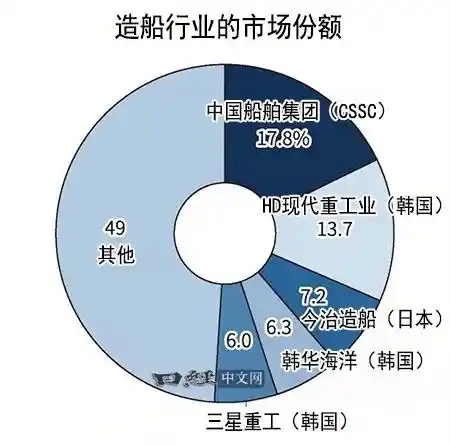
China State Shipbuilding Corporation (CSSC) ranks first in the global shipbuilding market share at 17.8%. South Korea's HD Hyundai Heavy Industries ranks second at 13.7%. Chinese and Korean firms, relying on massive investments, seized advantage from the formerly leading Japanese companies and have now left them far behind.
For Japan to steadily increase shipbuilding volume, it needs not only to expand investment but also to tackle the labor shortage challenge. Actively attracting talent while introducing physical AI capable of autonomously operating machinery and robots is also crucial.
This article is from the WeChat public account "Nikkei Chinese Website" (ID: rijingzhongwenwang), author: Nikkei Chinese Website






