Global AI Revenue Leader: This Company Has Surpassed OpenAI?

marsbitPublished on 2026-04-08Last updated on 2026-04-08

Abstract

The article discusses how Anthropic has surpassed OpenAI to become the world's highest-revenue independent large language model company, with an annualized revenue (ARR) of $300 billion compared to OpenAI's $250 billion. While OpenAI gained widespread recognition with ChatGPT, Anthropic strategically focused on the enterprise market from the beginning, prioritizing API stability, context window expansion, and its Claude model. This enterprise-first approach, emphasizing productivity tools over consumer-facing chatbots, allowed Anthropic to capture significant revenue from business clients in sectors like finance, law, and tech. A key driver of Anthropic's success is its dominance in the AI coding assistance sector, particularly with Claude Code, which saw explosive growth—reaching $2.5 billion in ARR and capturing 54% of the enterprise coding market, far ahead of OpenAI’s 21%. The piece also highlights how Chinese companies, such as ByteDance and Zhipu, are similarly shifting toward enterprise AI solutions, offering tailored models and deployment options to meet business demand. The central conclusion is that in the AI market, superior model capabilities alone are no longer enough; delivering measurable productivity gains and integrating into high-frequency workflows are now critical to commercial success.

Over the past three years, OpenAI has almost defined the public's first impression of large models: 400 million weekly active users, an $852 billion valuation, and ChatGPT, the AI entry point for the masses.

In public perception, it should have been the first company to achieve commercial success.

However, market data has brought an unexpected reversal:

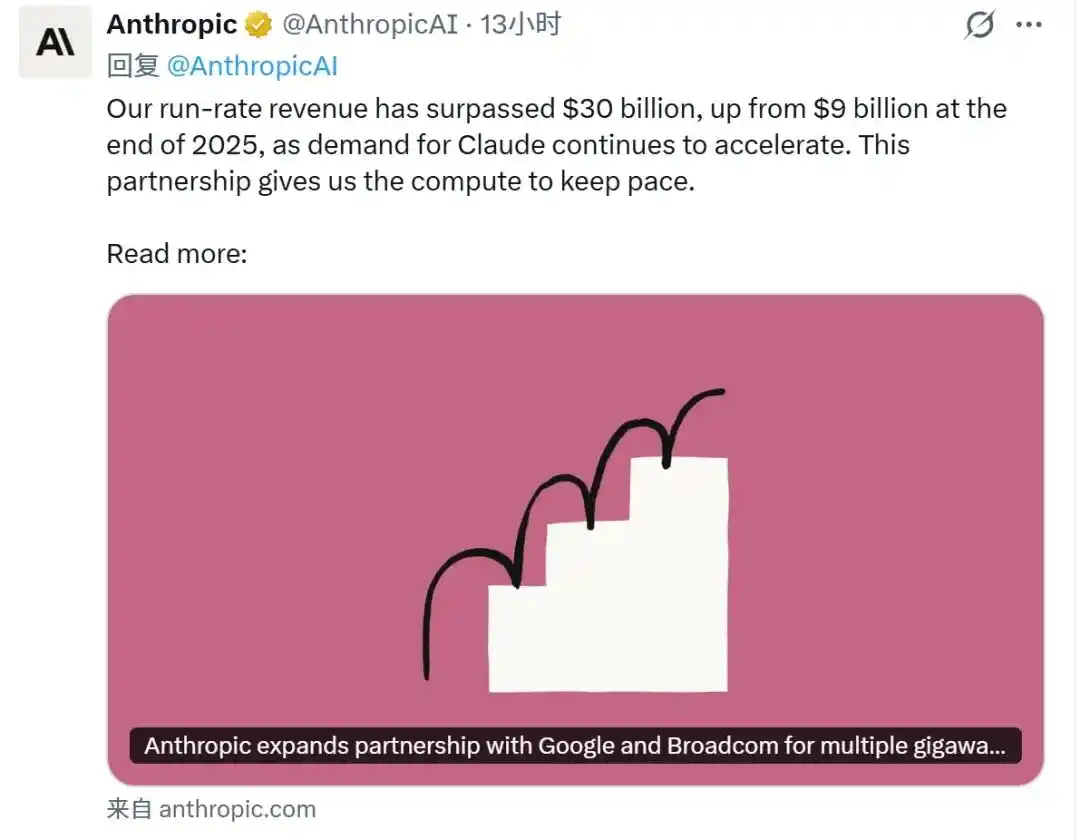
On April 7, the American large model company Anthropic announced that its annualized revenue (ARR) has reached $30 billion.

This amount surpasses OpenAI's $25 billion (as of the end of February 2026), making Anthropic the independent large model company with the highest global revenue.

Why can a company without a ChatGPT entry point and without the platform scale of OpenAI run faster in revenue than OpenAI?
What Did Anthropic Bet On?

To understand Anthropic's surpassing, one must first understand its fundamental divergence from OpenAI.

Around 2022, after ChatGPT went viral, the entire industry was replicating chatbots, but Anthropic invested resources in seemingly boring infrastructure—API stability, context window expansion, and a model named Claude.

Anthropic's positioning from day one was not a better chat tool, but an engine embedded to enhance enterprise productivity.

This positioning restraint seemed conservative, even backward, during 2023 to 2024.

At that time, ChatGPT's daily active numbers were dozens of times that of Anthropic, and OpenAI's valuation was far ahead.

But when enterprise AI spending truly exploded in 2025, Anthropic's early layout began to pay off.

Its client list included professional information service providers like Thomson Reuters, tech unicorns in Silicon Valley, and a large number of leading institutions in finance, law, and healthcare. These clients are paying for productivity improvements.

Financial data shows that about 80% of Anthropic's revenue comes from enterprise clients, and many of these clients are billed based on usage. Once an enterprise scenario starts to be used frequently, revenue is quickly driven up.

In contrast, OpenAI's revenue structure is more diverse, currently still dominated by ChatGPT subscription revenue, with API and licensing business accounting for about 15%-20%.

While OpenAI tilted resources towards consumer features like ChatGPT's voice conversation and image generation, Anthropic continued to focus on enterprise capabilities.

Claude Code, launched by Anthropic in 2025, was hailed as a coding神器 (divine tool) by the developer community, becoming a productivity pillar for enterprise engineering teams.

Not only that, the difference in their pricing strategies is equally intriguing.

OpenAI's ChatGPT Plus caps revenue at $20, whether the user uses it once or a thousand times.

Anthropic adopts tiered pricing, ranging from $20 to $200, paying per Token consumption. The deeper the usage, the higher the revenue.

Behind this is enterprise clients' recognition of the value of productivity tools, far exceeding individual consumers' willingness to pay for chat entertainment.

An observation from a Silicon Valley venture capitalist hits the mark:

OpenAI is building a Disney facing consumers, while Anthropic is building a toll road to enterprise core systems. The former requires continuous innovation and marketing investment, while the latter, once built, has extremely low maintenance costs and tolls can be raised year after year.

The Gap-Widening Coding

Anthropic surpassed OpenAI with its enterprise strategy, but a question随之浮现 (subsequently emerges):

In its vast enterprise revenue landscape, what exactly supports the $30 billion volume?

The answer points to a seemingly vertical but actually extremely lethal track: Coding (programming assistance).

In Anthropic's enterprise business, Coding is not the only source of income.

Scenarios like document analysis, customer service automation, and legal review are all contributing revenue, but coding is undoubtedly the category with the strongest certainty, the fastest growth, and the best reflection of enterprise willingness to invest.

This certainty was extremely verified in the commercial performance of Claude Code.

In April 2025, the annualized revenue of this AI programming assistant for developers was only $17 million;

By November, this number soared to $1 billion, setting the fastest growth record in enterprise software history.

By February 2026, Claude Code's ARR had exceeded $2.5 billion, accounting for over 18% of Anthropic's total revenue.

More critical is the health of its revenue structure. Enterprise subscriptions account for more than half and have quadrupled since the beginning of the year.

This means that Claude Code not only contributes a large amount of revenue but has also become a super category for Anthropic to penetrate the enterprise business.

In contrast, OpenAI's response in the Coding field seemed slow and passive.

In OpenAI's revenue structure, Coding-related revenue was almost zero for a long time.

Data shows that until early 2026, the commercial contribution of OpenAI's specialized code products was still minimal.

When OpenAI realized the strategic value of the Coding track and turned to internally develop Codex, finally launching it in the form of a macOS application in February 2026, the market格局已定 (pattern was already set).

In terms of enterprise coding market share, according to Menlo Ventures estimates, OpenAI only holds 21%, far lower than Anthropic's 54%.

Although OpenAI's model capabilities have always been powerful, in the to B market, technological leadership is just an entry ticket.

Finding a strongly confirmed scenario like Coding and packaging the technology into productivity infrastructure that enterprises are willing to pay for continuously is the real moat.

And in China, this AI war concerning the enterprise level is unfolding in another form.

Domestic Manufacturers Seize the Enterprise Track

Anthropic used enterprise workflows to grow its revenue, OpenAI was forced to make up for lessons, a signal that manufacturers in China have certainly also seen.

Whether it's leading large factories or startups, they are competing for this first-mover commercialized battlefield with different entry methods.

For example, a more representative large factory like ByteDance is currently connecting underlying cloud and models, as well as upper-level applications like office and coding, to the same enterprise AI base.

According to IDC data, in the first half of 2025, Volcano Engine's MaaS market share reached 49.2%, ranking first.

Doubao large model call volume is even globally leading. As of April 2026, the number of enterprise customers with cumulative token usage exceeding 1 trillion has increased from 100 at the end of last year to 140.

This indicates that ByteDance is turning model calls into an infrastructure business that enterprise customers continuously consume.

Feishu is no longer just a collaboration tool but packages AI directly into enterprise packages.

Feishu official documents from April 2026 show that enterprises can directly purchase multi-level AI solutions like AI Basic, AI Business, AI Business Plus, and AI Enterprise.

And Trae, as ByteDance's coding entry point, launched an enterprise version in December 2025, bringing the developer workflow into this enterprise network.

Looking at startup large model companies, Zhipu's enterprise route is more obvious.

Financial reports show that Zhipu's full-year revenue for 2025 was 724 million yuan, of which localized deployment revenue accounted for 73.7%, a year-on-year increase of over 100%. Meanwhile, the API platform ARR grew 60 times in the past 12 months.

This indicates that Zhipu's revenue does not come solely from model hype but from two most typical types of enterprise payments: one is localized deployment, and the other is cloud API calls.

In the first quarter of 2026, after an 83% API price increase, Token call volume still increased by 400%. This pricing power, daring to raise prices without losing users, is unique among domestic manufacturers.

Zhipu is proving that even without a complete ecosystem like large factories, it is possible to initially get revenue through enterprise deployment and calls.

In fact, Anthropic's surpassing and the collective turn of domestic manufacturers point to a common conclusion:

In the enterprise AI market, having the strongest model capability is no longer the first priority; high-frequency workflows and quantifiable productivity improvements are the primary factors for enterprises choosing AI products.

In the second half of AI, the real competition has just begun.

This article is from the WeChat public account "World Model Factory", author: World Model Factory


Trending Cryptos

Related Questions

QWhich company has the highest AI revenue globally according to the article, and what is its annualized revenue?

AAnthropic has the highest AI revenue globally with an annualized revenue (ARR) of $300 billion.

QWhat is the main reason for Anthropic's higher revenue compared to OpenAI?

AAnthropic's revenue is higher because it focuses on enterprise-level AI solutions, particularly in coding and productivity tools, with a pay-per-use pricing model, while OpenAI relies more on consumer subscriptions like ChatGPT.

QWhat specific product contributed significantly to Anthropic's revenue growth in the coding sector?

AClaude Code, Anthropic's AI programming assistant, contributed significantly to its revenue growth, reaching an ARR of $25 billion by February 2026 and capturing 54% of the enterprise coding market share.

QHow did domestic Chinese companies, like ByteDance and Zhipu, respond to the enterprise AI market trend?

AChinese companies like ByteDance integrated AI into enterprise services through platforms like Volcano Engine and Feishu, while Zhipu focused on localized deployment and API calls, achieving substantial revenue growth from enterprise clients.

QWhat key factor determines enterprise adoption of AI products, as highlighted in the article?

AThe key factor is not just model capability but high-frequency workflows and quantifiable productivity improvements, which drive their choice of AI products.

Related Reads

From South Korea to the United States: Blue-Collar Jobs Are Becoming Increasingly Popular, Thanks to AI

AI is reshaping the labor market's value proposition. The traditional four-year college degree is losing its appeal as a guaranteed career path, while skilled blue-collar trades like electricians, welders, and plumbers are experiencing historic demand and wage premiums. This shift is driven by dual pressures: AI's displacement of certain white-collar roles and a booming need for physical infrastructure and data center construction. Data confirms the trend. In the U.S., vocational school revenue surged, and a significant portion of recent layoffs are AI-related. Surveys show a majority of Gen Z adults plan to pursue blue-collar work, citing better job security against AI automation. Vocational education interest has exploded recently. Experts cite a psychological shift as younger generations seek tangible, AI-resistant careers and avoid high student debt. In many cases, salaries for skilled trades now match or exceed those requiring a bachelor's degree. In South Korea, semiconductor vocational high schools boast near-total employment, with graduates securing high-paying roles at companies like Samsung. The shortage is structural, exacerbated by a retiring baby boomer workforce and massive infrastructure projects. Companies like JPMorgan Chase, Meta, and Lowe's are investing heavily in training programs. However, overcoming historical stigma and a "perception gap" around trade careers remains a key challenge to closing the talent gap.

marsbit1h ago

From South Korea to the United States: Blue-Collar Jobs Are Becoming Increasingly Popular, Thanks to AI

marsbit1h ago

Qualcomm: AI Hype Subsides, When Will Smartphones Emerge from the Gloom?

Qualcomm reported its Q3 FY2026 results (ending June 2026), with revenue of $9.95B, down 4% YoY but above expectations. Gross margin declined to 53.1%, pressured by rising costs across manufacturing and memory. Key business segments showed mixed performance: Handset revenue fell 19.6% YoY to $5.09B, dragged by an 11% decline in non-Apple Android shipments and weaker high-end mix. Conversely, Automotive revenue surged 61% to $1.59B, and IoT grew 9% to $1.83B. Core operating profit dropped 41% YoY due to margin compression and higher expenses. Management's Q4 FY2026 guidance projects revenue of $9.7B-$10.5B, in line with consensus, but Non-GAAP EPS guidance of $2.05-$2.25 fell short of expectations. Amidst persistent weakness in its core handset market, Qualcomm is pursuing growth in AI, focusing on Edge AI (smartphones, PCs, automotive) and Data Center AI. Its data center strategy includes four pillars: AI accelerators (e.g., AI200), commercial CPUs (Dragonfly C1000), custom silicon, and connectivity solutions. While these initiatives initially boosted its stock, concerns over AI capital expenditure sustainability have since erased those gains. The company targets $5B in data center revenue for FY2027 and $15B for FY2029. The report concludes that with the traditional handset business still under pressure, the data center opportunity is currently viewed as a longer-term option, and a more conservative valuation based on core operations may be warranted until AI contributions materialize.

marsbit1h ago

Qualcomm: AI Hype Subsides, When Will Smartphones Emerge from the Gloom?

marsbit1h ago

From TPU to Self-Evolving Agents: How Jeff Dean Predicts the Next Step in AI

At the 2026 YC Startup School, Jeff Dean outlined his vision for AI's next phase, shifting focus from simply scaling models to building intelligent, autonomous systems. He believes AI's progress is no longer just about creating smarter models, but about integrating them into systems capable of long-term, iterative work, automated experimentation, and continuous learning. This evolution moves the competition from "who has the bigger model" to "who can best organize intelligence." Dean suggests AI capabilities are now comparable to a junior engineer, enabling the automation of complex workflows. However, the true challenge and opportunity lie in managing these AI "workers" at scale. He emphasizes the importance of **context engineering**—structuring tools, memory, and feedback loops—over raw model power. For startups, this means building deep expertise in niche domains where general models currently fail (near 0-1% success rates), leveraging proprietary data, specialized tools, and domain-specific evaluators. A recurring theme is re-examining fundamental constraints. Dean's past work, like moving Google's search index to memory or creating the TPU, stemmed from questioning outdated assumptions about hardware and cost. He sees similar inflection points today, particularly in **specialized inference hardware** to drastically reduce latency and energy consumption for real-time Agent operation. Notably, he points out that in modern AI systems, the dominant cost is often not computation but **data movement**. Reliable, long-running Agents require robust system design, borrowing concepts from distributed computing like checkpointing, state management, and parallel exploration to handle failures and maintain progress over days or weeks. As AI automates execution, the scarcest human skills will shift to **defining clear specifications**, **judging what problems are worth solving** (taste), and designing effective feedback loops. Ultimately, Dean's framework prioritizes understanding the problem deeply, identifying the true bottlenecks, and systematically building closed-loop systems where AI can not only perform tasks but also improve AI itself.

marsbit1h ago

From TPU to Self-Evolving Agents: How Jeff Dean Predicts the Next Step in AI

marsbit1h ago

Trading

Spot

Hot Articles

Discussions

Welcome to the HTX Community. Here, you can stay informed about the latest platform developments and gain access to professional market insights. Users' opinions on the price of AI (AI) are presented below.

活动图片














