From Tencent and Circle: Looking at the Easy and Hard Questions of Investment

marsbitPublished on 2026-03-21Last updated on 2026-03-21

Abstract

The article contrasts the investment prospects of Tencent and Circle in the AI era, framing the decision as a choice between "easy" and "hard" problems, inspired by Charlie Munger's philosophy. Tencent's stock has declined despite strong earnings, as the market shifted from fearing insufficient AI investment to worrying about excessive spending. The author argues this pessimism is overdone. WeChat's nascent AI agent, Yuanbao, is seen as a prototype for a future, more powerful system-native agent. Crucially, this agent would have system-level permissions to seamlessly interact with the massive Mini Program ecosystem (housing apps like Meituan, Didi, etc.), making it a practical, usable product for billions. The author believes the high-probability success of this inevitable development makes investing in Tencent an "easy" decision that the market is currently overlooking. Conversely, Circle's recent rise is fueled by the AI narrative, specifically the belief that AI agents will require blockchain-based stablecoins for settlement, with USDC as the leading compliant option. The author deconstructs this bullish thesis, identifying high uncertainties in its core assumptions: whether AI transactions will *necessarily* use stablecoins (vs. other protocols like Google's UCP), USDC's ability to maintain its lead against competitors like Tether or PayPal, and whether stablecoins even possess strong network effects in an agent-dominated world where cost and friction are paramount. The...

Author: Alex Xu

The AI narrative continues to unfold, yet the recent performance of related stocks has been a tale of two extremes: some are in the heat of summer, while others are in the depths of winter.

The former is represented by Circle, the issuer of the largest compliant stablecoin, USDC, while the latter is represented by Tencent.

There are many reasons for Circle's rise, such as its deep correction from 300 to 49, which built up momentum for a rebound. Additionally, the scale of USDC has recently seen a resurgence, hitting new highs again.

But the biggest driver might be the震撼 (shock) after the explosion of openclaw, where people were awed by the wave of Agents. This concrete impact has popularized stablecoins, which are considered highly suitable for Agent settlements, and Circle is currently the only pure-play stablecoin标的 (target) among globally listed companies.

The reason for Tencent's fall is more intriguing. Previously criticized for being slow in the AI era, it has been in a sustained correction from its high of 680. After a strong earnings report and statements about "reducing buybacks and increasing AI investment" during the earnings call, it反而 (instead) fell instead of rising. Market concerns about its AI investments have shifted from "insufficient" to "excessive."

So, in the AI era, who has more certainty, Tencent or Circle?

Charlie Munger once said that investing shouldn't involve tackling hard problems. His exact words were:

“One of our secrets is that we don't try to know too much... I constantly put things into the 'too hard' category. Occasionally, an easy decision comes along, and I make it. That's my system: most things go into 'too hard,' and only a few obvious, simple decisions get handled immediately.”

So, right now, which is the easy question on our investment desk, and which is the hard one, Tencent or Circle?

Let's start with Tencent.

Currently, Yuanbao AI within WeChat actually serves as an experimental form of WeChat's future native Agent:
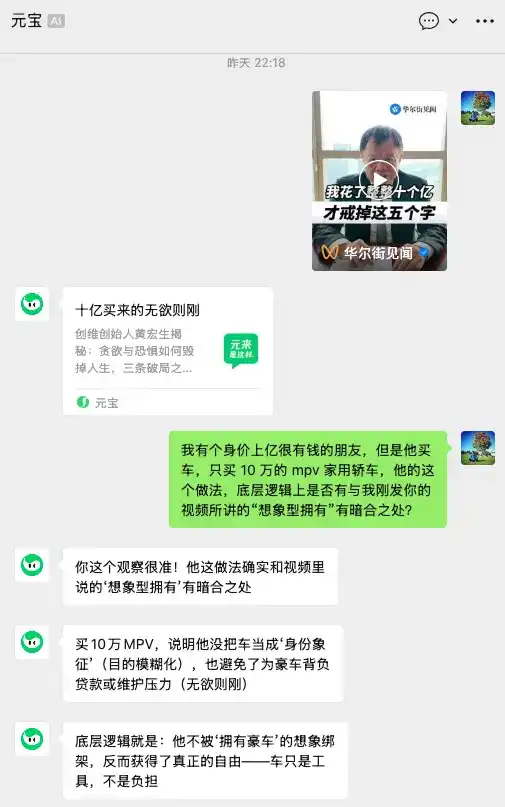
It can already handle most of the highest-frequency tasks that ordinary people use AI for: queries and Q&A.

However, currently, Yuanbao can only interact with content-based information within WeChat, such as text and image messages, Video Channel content, and WeChat Official Accounts. At this stage, it cannot directly interact with Mini Programs.

But predicting the general form of WeChat's own native agent isn't difficult: through natural language对话 (dialogue), we can directly instruct WeChat's Agent to call upon Mini Programs to perform various tasks, including ordering food delivery, booking hotels, summarizing videos and recordings, reminding us of schedules, and reporting on work.

Mini Programs themselves constitute a huge application ecosystem; most of the commonly used apps have Mini Program versions: DiDi Chuxing, Meituan, Pinduoduo, McDonald's, Huolala, WPS, and even Alibaba's Xianyu and Ele.me.

More importantly, WeChat's agent's relationship with Mini Programs is similar to (or stronger than) Apple's relationship with iOS ecosystem software—it has extremely strong system-level permissions. Mini Program development must follow WeChat's specifications. WeChat's agent certainly won't be directly blocked by major apps like Douban's Phone Assistant, kept outside the walled garden. Instead, it will interact system-level with various Mini Programs, and major Mini Program apps will inevitably embrace WeChat's official agent to provide better services to users.

Compared to the currently hot but折磨 (tormenting) for most early adopters and causing many ordinary users to give up from the start openclaw, a WeChat Agent面向 (aimed at) 1.4 billion users will必然 (inevitably) have better usability and practicality. Then it will be the true "nationwide Agent promotion." This form might not be as geeky or cool, but it's the product usable by 90% of the masses.

The launch of this Agent product form at some future point is highly certain. It's just that before it happens and people see it, against the backdrop of Tencent's continuously falling price, Mr. Market is吝啬地 (stingily) not pricing it in.

But for value investors, Mr. Market is someone we use.

We want to invest in things that have a high probability, even near certainty, of happening, but haven't happened yet.

Facing the highly uncertain AI era, is Tencent's operational certainty really that low? I think it's actually quite good.

Is buying/holding Tencent at this time an easy or a hard question?

I think it's much easier than market sentiment suggests.

Now, let's talk about Circle:

Some things, when viewed over the long term, actually have rather模糊 (blurry) certainty.

Will Circle's future business scale smoothly grow to several trillion, or even tens of trillions?

Optimistic bullish voices believe so. Their logic is:

1. AI is the future. In the future, agents will be the main users of the internet and will dominate huge online transaction volumes.

2. AI transactions will require stablecoins based on blockchain settlement.

3. USDC is currently the largest compliant stablecoin. AI's settlement needs will directly drive the growth of USDC's scale.

4. Stablecoins have strong network effects; scaling amplifies and reinforces itself.

5. USDC's scale will grow同步 (synchronously) with AI's transaction volume to several trillion or more.

This chain of reasoning seems tight, but several key links have significant uncertainties:

1. In the future, will agents be the main users of the internet and dominate huge transaction volumes?

Long-term, this has high certainty. Pass.

2. Will AI transactions use stablecoins?

Not necessarily. Everyone sees point 1, but existing payment infrastructure providers, internet giants, and AI giants that control users are also pushing their own standards, many not based on blockchain, like Google's promoted UCP protocol for agentic commerce.

3. Is USDC the largest compliant stablecoin?

Currently, yes. But Tether also has significant influence, is trying to become compliant, and has considerable political resources. There are also more eager tradfi financial groups and payment providers like Paypal.

4. Do stablecoins have strong network effects?

In the face of ruthless agents, the differentiation between stablecoins will be compressed. As long as they can all be used for payment, agents will choose the one with the lowest friction and fees. Whether it's USD1, USDT, USDC, or some bank-issued stablecoin? It doesn't matter. You say USDC currently has more merchant-side resources? Payment通道商 (channel providers) like Visa and Stripe have far larger merchant networks and channels than Circle and can similarly help other stablecoins gain access. As long as settlement is convenient and friction is low, merchants don't care which stablecoin they receive. The network effects of stablecoins might not be that strong in an agent-dominated payment era.

5. Will USDC's scale grow同步 (synchronously) with AI's transaction volume to several trillion?

When assumptions 2-4 all have high uncertainty, combining them to reach conclusion 5 makes the overall uncertainty模糊 (blurry).

Facing the highly uncertain AI era, is Circle's operational certainty really that high? I think it's just okay.

Is buying/holding Circle at this time an easy or a hard question?

I think it's much harder than market sentiment reflects.

Just my personal opinion, for reference only.

Trending Cryptos

Related Questions

QAccording to the article, why is Circle's stock price increase considered a 'simple problem' for investment?

AThe article suggests that Circle's recent price surge is driven by concrete factors like a deep correction from its high, a rebound in USDC's market cap, and its unique position as the only pure-play stablecoin company publicly traded, making its AI-driven growth narrative appear more straightforward and less uncertain compared to others.

QWhat is the main reason the author believes Tencent's current stock decline presents an investment 'simple problem'?

AThe author argues that Tencent's decline is an overreaction by the market, ignoring the high certainty of its future AI agent integration within WeChat, which will leverage its massive mini-program ecosystem to create a practical, widely-adopted agent service, making it a predictable long-term value opportunity.

QHow does the WeChat Agent, as described, differ from current AI agents like OpenClaw in terms of usability?

AThe WeChat Agent is expected to be system-level integrated with mini-programs, offering better usability and practicality for the general public (1.4 billion users), unlike OpenClaw, which is seen as complex and less accessible to non-technical users, leading to high abandonment rates.

QWhat are the key uncertainties the author highlights about Circle's growth tied to AI agent adoption?

AThe author points out uncertainties such as whether AI transactions will necessarily use stablecoins (competing standards exist), USDC's ability to maintain its lead amid competition (e.g., Tether, PayPal), and the strength of network effects for stablecoins in an agent-dominated payment landscape where cost and friction may outweigh brand loyalty.

QWhat investment philosophy does the author reference to justify focusing on 'simple problems' like Tencent over 'hard problems' like Circle?

AThe author references Charlie Munger's philosophy of avoiding 'too hard' problems and instead investing in obvious, high-probability opportunities where future outcomes are predictable but not yet priced in, using market pessimism to one's advantage.

Related Reads

Must-Watch Events Next Week|CLARITY Act Could Face Senate Vote; SpaceX, Circle to Report Earnings (8.3-8.9)

**Summary: Key Events and Developments to Watch (August 3-9)** The upcoming week is marked by significant financial disclosures, key legislative deadlines, and notable product updates. **Major Financial Events:** Several companies are scheduled to release their Q2 2026 earnings. American Bitcoin (ABTC) will report on August 3, followed by SpaceX and Hut 8 Mining Corp. on August 4, and Circle on August 5. Notably, a significant portion of SpaceX shares (up to 12% of total shares) will be unlocked on August 6 following their earnings release. **Key Legislative Deadline:** The U.S. Senate faces an August 7 deadline to secure 60 votes for the CLARITY Act, a bipartisan bill aiming to establish a federal regulatory framework for cryptocurrencies. The Senate may hold a full vote on the bill during the week. **Economic Data:** The U.S. July Non-Farm Payrolls report will be released on August 7, providing crucial labor market data. **Technology & Product Updates:** * **Shutdowns:** DeFi portfolio tracker Zapper and wallet app Ctrl Wallet will cease operations on August 3. * **Upgrades:** LayerZero will deprecate its v1 relayers on August 3. XRP Ledger's new version 3.3.0, featuring five new functions, is expected next week. * **AI:** Elon Musk announced that the advanced Grok 4.6 AI model is set for release around August 7. * **Bitcoin:** The BIP-110 forced signaling for a potential Bitcoin network change is scheduled to begin around August 8. **Other Notable Events:** Chinese robotics firm Unitree Tech has set its preliminary price inquiry for its IPO for August 5. South Korean exchange Upbit will delist AQT and AERGO tokens on August 3.

marsbit1h ago

Must-Watch Events Next Week|CLARITY Act Could Face Senate Vote; SpaceX, Circle to Report Earnings (8.3-8.9)

marsbit1h ago

Stocks Are Plummeting More Sharply Than Cryptocurrencies. Where Has the Money Gone?

Stock Markets Plunge Deeper Than Cryptocurrencies: Where Did the Money Go? In late July, Seoul's Kospi index triggered circuit breakers for two consecutive days, plummeting over 40% from its June high. The collapse was led by heavyweight stocks like SK Hynix, whose record profits still disappointed investors, and devastating leveraged ETFs, with one major product losing over 83% of its value. This signaled a global, forced deleveraging targeting the most crowded trades. Interestingly, while stocks exhibited extreme volatility akin to crypto markets, Bitcoin rose nearly 15% in July after a prior steep drop. Analysis shows the money fleeing equities did not flow into Bitcoin. Instead, Bitcoin had already absorbed its sell-off in May-June, when U.S. spot Bitcoin ETFs saw historic outflows. The true safe-haven beneficiary was gold, whose price rose over 20% year-on-year, highlighting a decoupling between Bitcoin and gold as "digital gold." The sell-off was a targeted unwinding of leveraged positions in tech and semiconductors, accelerated by broker-dealer risk management and shifts in the AI narrative, including new competition from Chinese memory chipmakers. The retreat path was clear: from high-valuation tech stocks to cash and U.S. Treasuries, then to gold. For Bitcoin to attract sustained institutional inflows, conditions like eased global liquidity pressure, a "soft-landing" Fed rate cut, and U.S. regulatory clarity via legislation like the stalled CLARITY Act are needed. Currently, Bitcoin is not a safe haven but an already-cleared asset. Its low correlation with tech stocks, however, makes it a potential diversification play for institutional portfolios once the storm passes. The money isn't here yet, but the positioning is underway.

marsbit1h ago

Stocks Are Plummeting More Sharply Than Cryptocurrencies. Where Has the Money Gone?

marsbit1h ago

In Conversation with Ray Dalio: We Are Currently in an AI Bubble, with 1% of My Portfolio in Bitcoin

Ray Dalio, founder of Bridgewater Associates, warns in an interview that the current AI boom shows classic bubble characteristics, which could lead to significant economic downturns as seen in past cycles like 1929 or 2000. He explains that speculative enthusiasm, fueled by debt and overvaluation, often precedes a crash when rising rates or taxation force asset sales, causing widespread losses and recession. Dalio also outlines his "Big Cycle" theory, describing an approximate 80-year pattern where widening wealth gaps, massive government deficits, and shifting geopolitical power (like China's rise) create internal conflict and global instability. He emphasizes that we are in a late-cycle, transitional phase where traditional powers like the US and UK face decline. For personal wealth protection, Dalio advises diversification beyond cash into assets like stocks, bonds, real estate, and particularly gold, which he prefers over Bitcoin. While he holds about 1% of his portfolio in Bitcoin as a non-printable hard asset, he views gold as more secure from technological or governmental threats. Regarding AI's impact, Dalio believes it will disproportionately benefit capital owners, worsening inequality by replacing both physical and cognitive labor. He suggests that human intuition and emotional intelligence, combined with AI, will be key for future workers. On taxation, Dalio argues that wealth taxes are impractical and risk triggering asset sell-offs, reducing productive investment. He points to the UK as a cautionary example of debt, low productivity, and political strife. Geopolitically, Dalio foresees a more regionalized world, with the US showing weakness in prolonged conflicts like with Iran, akin to past imperial declines. The ideal outcome, he suggests, is coexisting powerful blocs (e.g., Americas, China-Asia Pacific) without major war.

marsbit5h ago

In Conversation with Ray Dalio: We Are Currently in an AI Bubble, with 1% of My Portfolio in Bitcoin

marsbit5h ago

Trading

Spot

Hot Articles

Discussions

Welcome to the HTX Community. Here, you can stay informed about the latest platform developments and gain access to professional market insights. Users' opinions on the price of AI (AI) are presented below.

活动图片















