From Speculation to Utility: Why AI and Stablecoins Remain Unfazed by the Bear Market?

marsbitPublished on 2026-03-27Last updated on 2026-03-27

Abstract

Despite the overall downturn in the cryptocurrency market in 2026, the AI and stablecoin sectors have outperformed, showing resilience and continued adoption. While Bitcoin price dropped by 18.5% and the total crypto market cap fell to $2.42 trillion, these two areas recorded significant growth in usage and market activity. Key data highlights include: - The AI token sector declined by only 14% in Q1 2026, the smallest drop among major categories. - Stablecoin total market cap reached a record $3.2 trillion, with monthly trading volume hitting $1.8 trillion in February 2026, also a historic high. USDC supply grew by 220% since November 2023, reaching $78 billion, while ChatGPT’s weekly active users increased tenfold to 900 million during the same period. Tether’s USDT remains the leading stablecoin with a $184 billion market cap. The convergence of AI and stablecoins is driven by structural trends: AI requires fast, low-cost payment systems, and stablecoins serve as ideal “internet money.” Both sectors benefit from real-world utility beyond speculation—AI enhances productivity and security, while stablecoins provide efficient global dollar distribution and settlement infrastructure. This shift reflects a broader market transition from speculation to practical, infrastructure-focused applications, positioning AI and stablecoins for sustained growth.

Written by: Cointelegraph

Compiled by: AididiaoJP, Foresight News

Despite the overall downturn in the cryptocurrency market in 2026, the performance of the artificial intelligence (AI) and stablecoin sectors has outperformed the broader market. Relevant data shows that while the prices of other assets continue to fall, usage in these two sectors continues to grow.

Key Takeaways

  • The AI sector recorded the smallest decline in Q1 2026, at just 14%.
  • The total market capitalization of stablecoins reached a new all-time high of $3.2 trillion, with monthly trading volume hitting $1.8 trillion, also a record high.

AI and Stablecoin Sectors Defy the Downtrend

In 2026, Bitcoin's price fell by 18.5%, and the total cryptocurrency market capitalization dropped to $2.42 trillion, with most altcoins underperforming. The market was affected by concerns and uncertainties related to the US and Israel-Iran conflict, while the Federal Reserve maintained a hawkish stance, leading to a generally cautious sentiment.

In contrast, businesses related to AI and stablecoins continued to grow against the trend, showing strong fundamentals and significant expansion, reflecting a market shift in focus from speculative behavior to infrastructure construction.

Taking USDC, issued by Circle, as an example, data from Token Terminal shows its supply has reached $78 billion, a 220% increase since November 2023.

Meanwhile, the number of weekly active users of ChatGPT grew from 85 million in November 2023 to 900 million in March 2026, an approximately 10-fold increase during the same period.
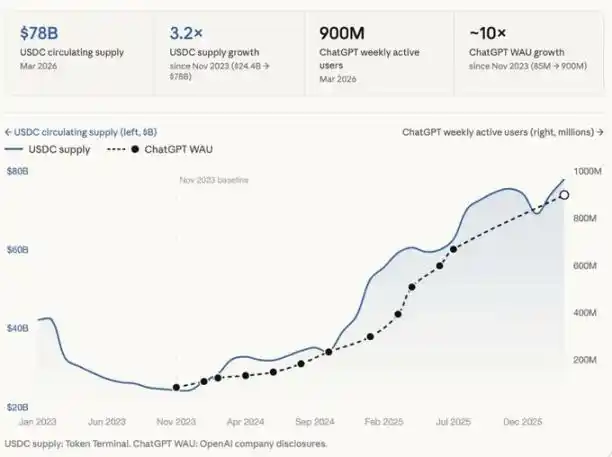
(Chart: USDC Supply vs. ChatGPT Weekly Active Users; Source: Token Terminal)

A Q1 2026 report from Grayscale also confirmed this trend. The report pointed out that the AI sector had the smallest decline in the first quarter, at 14%, while the Consumer & Culture sector fell 31%, the Smart Contract Platforms sector fell 21%, and the Currency sector fell 21% during the same period.

The digital asset management company stated that this indicates "investor preference has shifted away from momentum-driven, more speculative sectors." The report further stated:

"Although overall market sentiment remains low, capital has begun to concentrate in projects with stronger fundamentals that align with key themes such as AI and tokenization."
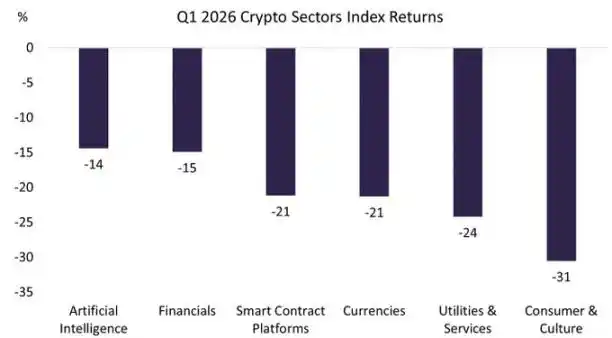
(Chart: Negative Returns Across All Sectors in Q1 2026; Source: Grayscale)

Currently, the total market capitalization of AI tokens is approximately $17.4 billion, up 30% in the past 30 days. Among them, Bittensor and NEAR Protocol (NEAR) led the gains, with prices rising 75% and 30% respectively during the same period.
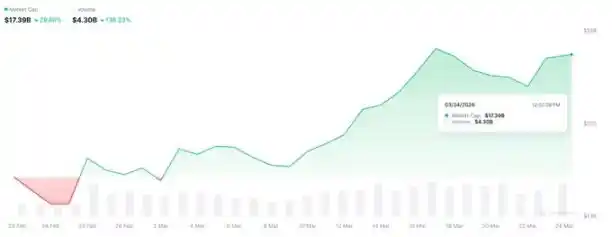
(Chart: Market Capitalization of Major AI & Big Data Tokens; Source: CoinMarketCap)

Regarding stablecoins, their market size continues to expand. As of March 23rd, the total market capitalization of stablecoins reached a record $3.2 trillion. USDt, issued by Tether, continues to dominate with a market capitalization of approximately $1.84 trillion, accounting for 57% of the total stablecoin supply.

In February 2026, the monthly trading volume of stablecoins reached $1.8 trillion, a historical high, now comparable to traditional payment systems. USDC stood out in terms of supply growth, increasing 80% month-on-month, with last month's trading volume reaching a historical high of $1.26 trillion.
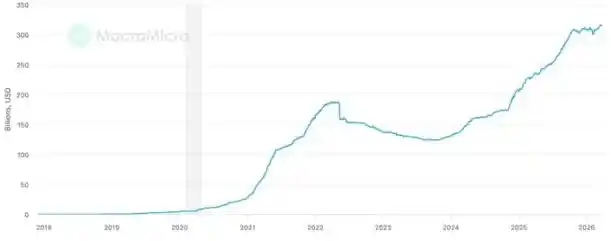
(Chart: Total Stablecoin Market Capitalization; Source: MacroMicro.me)

Stablecoins are a type of cryptocurrency designed to maintain a stable value, typically pegged to fiat currencies like the US dollar, and can operate on multiple blockchains.

In a bear market environment, stablecoins serve as a store of purchasing power and a settlement channel, widely used in trading pairs, tokenized real-world assets, and yield-generating products. The transfer volume of stablecoins on Ethereum and other blockchains remains high, and institutional-grade products launched by banks and fintech companies are gradually integrating stablecoins for yield management and fund operations. Even as speculative assets perform poorly, the role of stablecoins as infrastructure remains solid.

"Structural Tailwinds" Drive Convergent Growth in Both Sectors

The reason the AI and stablecoin sectors can thrive is that they continue to provide tangible value even after the speculative frenzy subsides.

Token Terminal pointed out: "AI labs and stablecoin issuers are among the companies with the strongest structural tailwinds in the 2020s."

The crypto data service provider further stated that these two fields are at the "convergence of technological, financial, and geopolitical forces," and each force independently brings demand to these two sectors. The report added:

"AI drives improvements in productivity and defense capabilities, while stablecoins provide the financial infrastructure for the global distribution of the US dollar."

Cryptocurrency trader Mando CT stated in a post on platform X on March 24th that AI and stablecoins are two of the four dominant sectors in 2026.

Explaining the convergence trend of the two sectors, the trader noted that AI requires instant, low-fee payment systems to support its operation, and stablecoins are the "internet money" that achieves this.

Mando CT said: "These trends are interconnected," adding:

"2026 is not just another cycle rotation, but a transformative year moving from speculation to infrastructure."

As reported by Cointelegraph, stablecoins are expected to benefit from AI-driven payment scenarios, facilitating convenient, automated, rule-based transactions between entities, further driving the long-term growth of both fields.


Related Questions

QWhy did the AI and stablecoin sectors outperform the broader cryptocurrency market in 2026 despite the bear market?

AThe AI and stablecoin sectors showed strong fundamentals and significant expansion, reflecting a market shift from speculation to infrastructure. AI tokens had the smallest decline (14%) in Q1 2026, while stablecoin market cap hit a record $3.2 trillion with monthly trading volume reaching $1.8 trillion.

QWhat was the USDC supply growth and ChatGPT user growth from November 2023 to March 2026?

AUSDC supply grew by 220% from November 2023, reaching $78 billion. ChatGPT's weekly active users grew approximately 10 times, from 85 million in November 2023 to 900 million in March 2026.

QWhich AI tokens performed well in the 30 days leading up to the article, and what were their gains?

ABittensor and NEAR Protocol (NEAR) were top performers. Bittensor's price increased by 75%, and NEAR's price increased by 30% in the past 30 days.

QWhat role do stablecoins play in a bear market environment according to the article?

AIn a bear market, stablecoins act as a store of purchasing power and a settlement channel. They are widely used in trading pairs, tokenized real-world assets, and yield-bearing products, maintaining their role as infrastructure even when speculative assets perform poorly.

QHow are the growth trends of AI and stablecoin sectors interconnected, as explained by trader Mando CT?

AMando CT stated that AI requires instant, low-fee payment systems to support its operations, and stablecoins serve as 'internet money' to achieve this. These trends are interconnected, representing a transition from speculation to infrastructure in 2026.

Related Reads

Cryptocurrency & Stock Market Indicator丨SpaceX Discloses Holding 18,712 Bitcoins Worth $1.18 Billion; Strategy Spends $100 Million Two Weeks in a Row to Scoop Up BTC at Low Levels (June 16)

"Coin-Stock Barometer: SpaceX discloses holding 18,712 Bitcoin worth $1.18B; Strategy spends another $100M accumulating BTC (June 16) SpaceX has officially disclosed holding 18,712 Bitcoin in its S-1 filing, valued at ~$1.18B, becoming the 8th largest public company Bitcoin holder. Its average cost is ~$35,000 per BTC. In weekly BTC treasury news, Strategy (formerly MicroStrategy) purchased another 1,587 BTC (~$100M) last week, increasing its total to 846,842 BTC. Mara Holdings added 1,000 BTC. However, Metaplanet and others made no purchases. Nakamoto sold ~600 BTC to repay ~$45M in debt. Global public companies (excluding miners) now hold 1,121,341 BTC. In other crypto treasury developments: - Metaplanet acquired Siiibo Securities to build a Bitcoin-focused financial ecosystem in Japan. - Bitmine increased its ETH holdings by 76,881 last week. - SharpLink's cumulative ETH staking rewards surpassed 21,119 ETH. - Forward Industries' acquisition offers for two SOL treasury companies, including Brera Holdings (holding 2.1M SOL), were rejected. - Tron Inc.'s TRX holdings surpassed 700 million. - Avalanche Treasury Co. (AVAT) begins trading on Nasdaq. - AIFC detailed plans to use WLFI tokens for collateral/loans. Market perspectives on U.S. stocks vary. 'White-Haired Stock God' Serenity sees the current cycle as retail-to-institution transfers, where negative reports may signal institutional accumulation. Morgan Stanley suggests a rotation from tech to cyclical stocks could occur. Citrini believes the U.S. stock market hasn't peaked but expects frequent 10-15% pullbacks in the coming months."

marsbit5m ago

Cryptocurrency & Stock Market Indicator丨SpaceX Discloses Holding 18,712 Bitcoins Worth $1.18 Billion; Strategy Spends $100 Million Two Weeks in a Row to Scoop Up BTC at Low Levels (June 16)

marsbit5m ago

Do Robots Also Need Encrypted Wallets? Stablecoin Giant Tether Bets on German Company NEURA Robotics

Do Robots Need Crypto Wallets? Stablecoin Giant Tether Bets on German Firm NEURA Robotics German robotics company NEURA Robotics has secured up to $1.4 billion in what is claimed to be the largest-ever funding round in the full-stack robotics industry, valuing the company at $7 billion. The Series C round attracted major investors like Tether, Qualcomm, Amazon, NVIDIA, Bosch, and the European Investment Bank. NEURA, founded in 2019, initially focused on AI-powered collaborative robots (cobots) for industrial automation, later expanding to autonomous mobile robots, service robots, and humanoid robots. Its core strategy is evolving from a hardware manufacturer to the operator of "Neuraverse," a platform designed to enable different robots to share learned experiences and data, creating network effects. A key, crypto-focused aspect of this investment is Tether's involvement. Tether plans to integrate its open-source Wallet Development Kit (WDK) into NEURA's robot platforms. This would embed self-custody wallet functionality, allowing robots to autonomously handle payments and settlements for tasks under pre-set rules—envisioning use cases in logistics or Robotics-as-a-Service (RaaS) models. This move could position stablecoins and crypto wallets as potential "machine payment infrastructure." Additionally, the partnership will see Tether's QVAC (QuantumVerse Automatic Computer) edge-AI framework tested and deployed within Neuraverse. This aims to enable low-latency, offline-capable AI decision-making directly on robots, reducing reliance on cloud computing for critical, time-sensitive operations. The investment underscores Tether's broader ambition to expand beyond being just a stablecoin issuer into AI, energy, and digital infrastructure, with NEURA's robotics network serving as a testbed for merging crypto-based financial layers with edge-based intelligence for the future of automation.

marsbit23m ago

Do Robots Also Need Encrypted Wallets? Stablecoin Giant Tether Bets on German Company NEURA Robotics

marsbit23m ago

AMD Launches Compact AI Host, Directly Challenging NVIDIA DGX Spark

In June 2026, AMD announced the Ryzen AI Halo, a compact AI developer desktop to rival NVIDIA's DGX Spark. Both feature 128GB unified memory for running 200B+ parameter models locally. Priced from $2,949 to $3,999, AMD undercuts NVIDIA's $3,999+ DGX Spark. The core divergence lies in architecture and philosophy. Ryzen AI Halo uses an x86-based Ryzen AI Max+ 395 APU (CPU+GPU+NPU), runs standard Windows/Linux, and emphasizes general-purpose PC flexibility. DGX Spark uses an ARM-based Grace Blackwell Superchip, runs a custom DGX OS, and includes a high-speed ConnectX-7 NIC for cluster prototyping, anchoring it to NVIDIA's full-stack CUDA ecosystem. AMD's ROCm software has improved, with simpler installation and support for major frameworks, but still lags behind CUDA's 17-year maturity in community support and cutting-edge library availability. AMD's broader strategy focuses on becoming a viable second-source supplier. Key moves include acquiring design capabilities via ZT Systems (while outsourcing manufacturing) and securing two major 6GW GPU supply deals with OpenAI and Meta in late 2025/early 2026. These contracts validate AMD's role in diversifying the AI supply chain, rather than outright beating NVIDIA. NVIDIA counters with a tightly integrated stack from desktop (DGX Spark) to data center, emphasizing seamless scalability and enterprise software subscriptions (AI Enterprise). In summary, Ryzen AI Halo represents AMD's pragmatic path: offering a cost-effective, open-ecosystem alternative for developers wary of vendor lock-in, while its large data center contracts aim to capture share from customers seeking a second GPU supplier. The choice boils down to a familiar, flexible PC environment with potential software gaps (AMD) versus a premium, optimized, but locked-in ecosystem (NVIDIA).

marsbit23m ago

AMD Launches Compact AI Host, Directly Challenging NVIDIA DGX Spark

marsbit23m ago

Sharplink CEO: One Million Ethereum Developers, Who Can Compete?

Etherean Ecosystem: One Million Developers and a Formidable Moat The Ethereum network has surpassed a significant milestone: over one million unique lifetime developers, with approximately 232,000 active in the past year. This vast and growing talent pool is Ethereum's core advantage, far more critical than transient metrics like speed or transaction fees. The central question is not which blockchain is fastest, but where the best builders choose to build long-term. Ethereum's answer lies in a decade-long accumulation of infrastructure, standards, tools, liquidity, and collaborative culture that is exceptionally difficult to replicate. It has become the default operating system for programmable finance. This massive developer base is actively working on complex, high-risk challenges that deepen Ethereum's strategic moat: * **Glamsterdam Upgrade (2026):** Focused on core protocol scalability (ePBS, parallel execution) while preserving core values like credible neutrality. * **Synchronous Composability:** Aims to make numerous Rollups interoperate like a single chain, directly addressing fragmentation concerns. * **Quantum Resistance:** Ethereum leads mainstream ecosystems in coordinated preparation for post-quantum cryptography, with a targeted migration plan around 2029. This developer advantage is self-reinforcing, fueled by: * **Deep Composability:** Applications interact like interoperable financial Lego bricks via shared standards (e.g., EVM, Solidity). * **Credible Neutrality:** Secured by over 900,000 validators, making it trusted by major institutions. * **Modularity:** Rollups (Base, Arbitrium, etc.) expand, rather than fracture, the ecosystem into a tightly connected modular internet economy. * **Culture:** Attracts top-tier researchers and standard-setters who guide the entire industry. In essence, while other chains generate activity, Ethereum is consolidating as the trusted, long-term coordination layer for internet-native finance. Its future is being built now by the architects of the next-generation financial infrastructure.

Odaily星球日报1h ago

Sharplink CEO: One Million Ethereum Developers, Who Can Compete?

Odaily星球日报1h ago

Trading

Spot
Futures

Hot Articles

Discussions

Welcome to the HTX Community. Here, you can stay informed about the latest platform developments and gain access to professional market insights. Users' opinions on the price of AI (AI) are presented below.

活动图片














