Company Bitfarms, successor to Bitfarms, suspends all its mining operations in the US, as $141 million loss is directed to fund AI development

cryptonews.ruPublished on 2026-08-10Last updated on 2026-08-10

Abstract

Bitcoin mining company Keel Infrastructure, formerly known as Bitfarms, has shut down all its U.S. mining sites and sold 1,085 BTC for $75 million. The company, which rebranded after acquiring Bitfarms in April, is repurposing these sites into data centers for artificial intelligence. In its Q2 report, Keel posted a $141 million operating loss, partly due to depreciation. Revenue from continuing operations was $30 million, half of the previous year's figure, attributed to lower Bitcoin prices and the shutdown of a major mining site. Despite the loss, the company holds $819 million in liquidity, boosted by a recent convertible note offering. This shift is part of a broader industry trend where public miners are pivoting assets toward AI and high-performance computing deals.

Keel Infrastructure, formerly known as Bitfarms, has powered down all its bitcoin mining sites in the U.S. and sold 1085 $BTC for $75 million.

The company disclosed both details on Monday in its second-quarter earnings report as it retrofits those facilities into artificial intelligence data centers.

Bitfarms transforms into Keel, and on-chain bitcoin supply decreases

According to the results released on August 10, Keel reported the completion of decommissioning its U.S. mining fleet to construct high-performance computing facilities.

The 1085 $BTC sold between April 1 and August 7 were sold for $75 million. Thus, as of August 7, 1861 $BTC remained on the balance sheet, valued at approximately $121 million in unencumbered coins.

In April, Keel acquired Bitfarms and rebranded shortly after. The company's shares trade on the Nasdaq and TSX under the ticker KEEL. The company positions itself as a North American digital infrastructure and energy company, with a development project portfolio of 2.2 gigawatts in Pennsylvania, Washington state, and Quebec.

Keel reported $30 million in revenue from its ongoing operations. This figure is half of last year's figure and is explained by the decline in the bitcoin price and the closure of the Moses Lake mining station in April.

In Q2 2025, Keel's operating income from ongoing operations was $11 million, but an operating loss of $141 million was recorded this year. This amount included $84 million in cash depreciation.

The loss from ongoing operations was $64 million, or 11 cents per share, while adjusted EBITDA turned negative at $24 million. General and administrative expenses increased to $31 million from $19 million the previous year, which the company explained by hiring highly qualified staff to build the new facility. KEEL shares fell more than 11% on Monday.

"Power is the limiting factor. Everything else depends on it," CEO Ben Gagnon stated in the earnings report.

He stated that Keel began working on this idea 18 months ago, and now all three priority sites have nearly full permits, with tenants in negotiations for each.

The company "is negotiating from a position of strength," said Gagnon, citing $819 million in liquidity and uncontracted capacity for 2027 in the PJM grid and in Washington.

Keel joins the mass exodus of mining representatives from the mining industry

CFO Jonathan Meer stated that Keel "has the best capitalization level today that we've ever had in our company's history."

This liquidity amount includes about $698 million in unrestricted cash and $121 million in bitcoin, facilitated by the placement of $458 million in convertible bonds during the quarter.

Keel also reported obtaining zoning permits for its Panther Creek and Sharon sites, appointing Ganesh Iyer as president, receiving the first Vertiv modules at Moses Lake, and an agreement to transfer 96 MW of power for a data center in Sherbrooke, Quebec.

As previously reported by Cryptopolitan, the cash cost of one bitcoin in Q4 2025 was about $79,995, while the price ranged between $68,000 and $70,000. Miners were losing about $19,000 on each coin mined. Since peaking the value of their treasury bonds, public miners have sold over 15,000 $BTC.

In the listed mining sector, contracts worth over $70 billion have been announced in AI and high-performance computing. Bitdeer reduced its assets to zero in February. Empery Digital sold 1400 $BTC in July. MARA Holdings, IREN, Cipher Digital, and DMG Blockchain have repurposed power capacity or equipment for AI-using clients.

MARA agreed to acquire a 505 MW gas power plant in Ohio for $1.5 billion, and IREN entered into a five-year, $3.4 billion agreement with Nvidia to provide cloud services, including Blackwell GPUs.

end-content

Trending Cryptos

Related Questions

QWhat actions did Keel Infrastructure (formerly Bitfarms) take regarding its US bitcoin mining operations and assets?

AKeel Infrastructure shut down all its US bitcoin mining sites and sold 1,085 BTC for $75 million.

QWhat was Keel Infrastructure's reported operational loss for the year, and what major expense contributed to it?

AKeel Infrastructure reported an operational loss of $141 million for the year, which included $84 million in cash depreciation.

QWhat is Keel Infrastructure's new business focus after shutting down its US mining operations?

AKeel Infrastructure is repurposing its former mining facilities into data centers for high-performance computing and artificial intelligence (AI).

QWhat reason does CEO Ben Gagnon give for the company's strategic shift, and what does he cite as its current advantage?

ACEO Ben Gagnon states that power capacity is the limiting factor, and the company is negotiating from a position of strength, citing $819 million in liquidity and uncontracted power capacity for 2027.

QHow are other public mining companies mentioned in the article diversifying their business?

AOther public mining companies are shifting into AI and high-performance computing. Examples include Bitdeer, MARA Holdings acquiring a power plant, and IREN signing a cloud services deal with Nvidia.

Related Reads

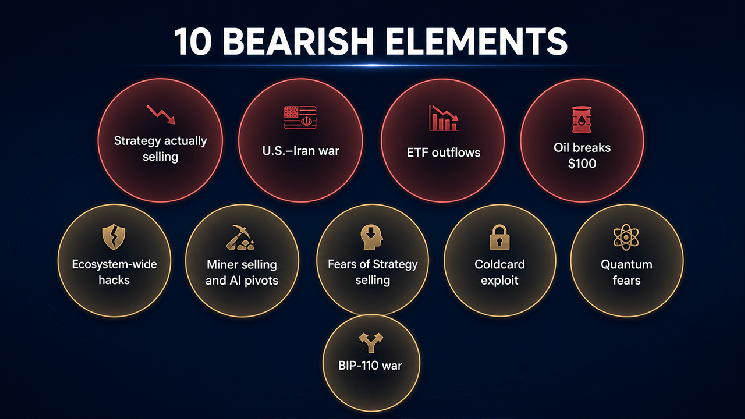
Bitcoin Withstood 10 Bearish Blows in 2026, Yet Experienced Its Mildest Bear Market

Bitcoin, the leading cryptocurrency by market cap, peaked above $126,000 in early October before entering a prolonged decline. By August, it was mainly trading between $63,000 and $65,400, inflicting losses on late buyers but resulting in what is, historically for Bitcoin, an unusually shallow bear market—down about 49% from its peak, compared to typical 75-80% plunges. Throughout 2026, Bitcoin faced multiple headwinds yet demonstrated notable resilience. Geopolitical tensions in the Middle East and volatile oil prices revived inflation concerns but failed to trigger the panic-driven sell-offs seen in prior cycles. A significant psychological blow came from corporate seller MicroStrategy, a longtime accumulator, which began strategic sales to bolster its cash position, reducing its holdings. U.S. spot Bitcoin ETFs also faced sustained outflows, though a late-week inflow hinted at potential relief. Pressure also came from within the ecosystem. A contentious blockchain proposal, BIP-110, failed after a minority chain stalled. Miners, facing tighter economics, sold reserves and pivoted infrastructure toward AI. A major security breach involving Coldcard hardware wallets saw an estimated 2,000 BTC stolen, shaking confidence in self-custody. Long-term threats like quantum computing resurfaced in discussions. Despite this confluence of corporate selling, ETF outflows, miner capitulation, geopolitical shocks, internal conflict, and security issues—any one of which could historically cause sharp declines—Bitcoin stubbornly held above a key $60,000 support level. Deeper market liquidity, regulated products, and long-term holders appear to be absorbing selling pressure that once would have caused deeper crashes. This resilience suggests a maturing market structure, though risks remain. Another shock could still push Bitcoin toward $50,000. For now, its 49% decline, severe for most assets, is relatively moderate by Bitcoin's own volatile standards. The remaining months of 2026 will test whether $60,000 is a durable floor or merely the next major line of defense.

cryptonews.ru31m ago

Bitcoin Withstood 10 Bearish Blows in 2026, Yet Experienced Its Mildest Bear Market

cryptonews.ru31m ago

Korean Financial Supervisory Service to Revise Compensation System for Phishing Losses Involving Crypto Transfer

The South Korean Financial Supervisory Service (FSS) is overhauling its system for reimbursing victims of voice phishing scams. Starting in October, the new system will be able to calculate and compensate losses held in cryptocurrency, not just in Korean won. Previously, the reimbursement system assumed stolen funds were in won, failing to fully compensate victims whose money was converted into digital assets. The upgraded software will apply a recovery ratio to determine the specific type and quantity of tokens owed to each victim, based on the token's value at the time the payment was frozen. It will also better track cases where fraud proceeds are split across multiple accounts and later consolidated. These changes follow March 31st amendments to the Act on Reimbursement of Losses from Telecommunications Fraud, which now classify virtual assets as both damaged and recoverable property. Major Korean crypto exchanges like Upbit and Bithumb must now comply with the same anti-phishing obligations as banks, including verifying transaction purposes and tracking suspicious funds. The revised law takes effect October 1st, with the FSS allocating a three-month period and a budget of 118.53 million won for system implementation and troubleshooting. The update addresses schemes where stolen money is intentionally laundered through cryptocurrency for overseas transfer. Notably, telecom fraud losses in South Korea rose 14.1% to 433.8 billion won in 2025, a five-year high.

cryptonews.ru42m ago

Korean Financial Supervisory Service to Revise Compensation System for Phishing Losses Involving Crypto Transfer

cryptonews.ru42m ago

Trading

Spot

Hot Articles

Discussions

Welcome to the HTX Community. Here, you can stay informed about the latest platform developments and gain access to professional market insights. Users' opinions on the price of AI (AI) are presented below.

活动图片