CFTC pulls ‘actual delivery’ crypto guidance, giving flexibility to exchanges

cointelegraphPublished on 2025-12-12Last updated on 2025-12-12

Abstract

Acting CFTC Chairman Caroline Pham has withdrawn the 2020 guidance on "actual delivery" of cryptocurrencies, a move praised for offering exchanges greater operational flexibility. The guidance, which previously required crypto to be delivered within 28 days for margin or leveraged trading, was deemed outdated and stifling to innovation. Industry experts, including StarkWare's general counsel, applaud the decision but note that guidance is not legally binding and could change with future leadership. While some see this as a signal of clearer CFTC jurisdiction and a pro-growth regulatory approach, critics warn that removing the guidance without replacement creates uncertainty regarding which exchanges must register with the CFTC.

US Commodity Futures Trading Commission Acting Chairman Caroline Pham has scrapped “outdated guidance” on the delivery of crypto, which has been applauded for offering exchanges more flexibility.

“Eliminating outdated and overly complex guidance that penalizes the crypto industry and stifles innovation is exactly what the Administration has set out to do this year,” Pham said on Thursday.

The guidance, originally finalized in March 2020, related to when the “actual delivery” of crypto happened in a commodity transaction, but the CFTC said in a notice that it had to “reevaluate such guidance in light of further developments during the past 5 years.”

The CFTC under Pham has worked on a more crypto-friendly approach, and Pham said the guidance was withdrawn on recommendations from the president’s crypto working group, which suggested the CFTC release guidance on how crypto may be considered commodities and expand on prior guidance regarding the actual delivery of virtual assets.

More flexibility for exchanges with guidance gone

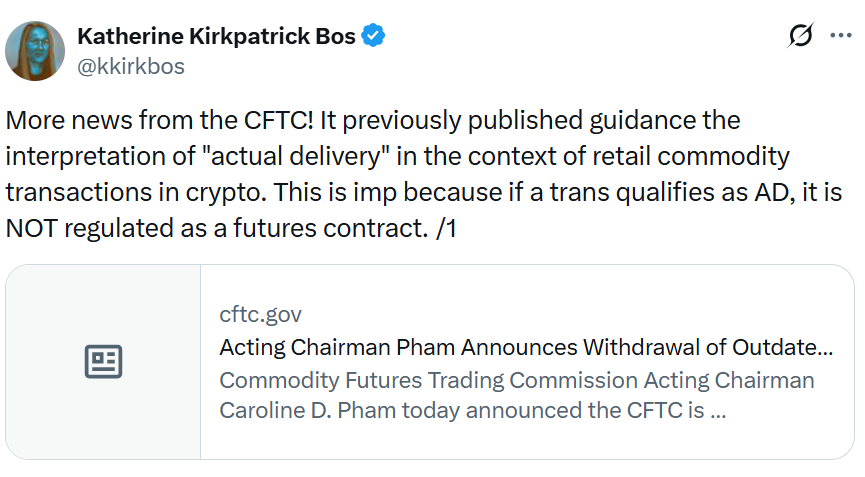
StarkWare general counsel Katherine Kirkpatrick Bos applauded the move, saying the guidance was making it harder for exchanges to offer margin or leverage unless actual delivery occurred within 28 days.
Source: Katherine Kirkpatrick Bos

“This offers way more flexibility for exchanges,” she said. “But PSA - this isn’t law! Just guidance. All of this can be changed again should leadership change.”

The CFTC can issue guidance to clarify its interpretation of legislation and give insight into how it may enforce rules in certain situations; however, it’s not generally legally binding in the same way as formal regulation.

Garry Krugljakow, the head of Bitcoin (BTC) strategy at the Berlin-based Bitcoin treasury company aifinyo AG, speculated in an X post on Thursday that it’s a “major tell” of what’s to come.

“This move signals two things: cleaner jurisdiction for the CFTC and a regulatory path designed for scale, not hesitation,” he said.

Related: CFTC pilot opens path for crypto as collateral in derivative markets

“Actual delivery made sense in 2020. It doesn’t in a world of real custody, collateralization, and Bitcoin-backed credit,” Krugljakow said.

No guidance leaves uncertainty

Meanwhile, Todd Phillips, a fellow at the American think tank the Roosevelt Institute, said the definition of actual delivery is important, “as it decides what exchanges need to register with the CFTC and which don’t.”

“The CFTC replaced the prior guidance with nothing,” he said. “Right now, we have no idea what the CFTC thinks actual delivery means, or who has to register.”

Magazine: When privacy and AML laws conflict: Crypto projects’ impossible choice

Trending Cryptos

Related Reads

Currency & Stock Barometer | Strategy Sells MSTR Stocks for $2.007 Billion; BitMine Increases ETH Holdings by 32,447 Last Week, Asset Scale Reaches $14.9 Billion (August 25)

**Crypto & Stock Market Snapshot: Strategy Sells MSTR Stock for $2.007B; BitMine Adds 32,447 ETH (Aug 25)** Following a bullish crypto market triggered by positive US regulatory signals and political commentary, major crypto-related stocks saw significant rebounds. Data reveals a 1,431.6% weekly increase in net Bitcoin purchases by public companies (excluding miners), reaching $81.48M. Two key developments stood out: **Strategy** sold over 18.2 million shares of MSTR, raising $2.007 billion in cash, though its Bitcoin holdings of 840,447 BTC returned to a profit of ~$2.53B. Concurrently, **BitMine**, an Ethereum-focused firm, added 32,447 ETH last week, bringing its total holdings to ~5.847 million ETH (4.8% of supply) and its total assets under management to ~$14.9B. Chairman Tom Lee expressed strong confidence in Ethereum's future as a leading platform for tokenization and AI. Other notable updates include: **Solmate Infrastructure** increasing its SOL holdings; **AIxCrypto Holdings** planning an exit from crypto assets to pivot to robot leasing; and **Eightco Holdings** maintaining a large WLD treasury while repurchasing shares. Meanwhile, in traditional markets, hedge funds recorded their largest weekly net selling of US stocks since April 2025, particularly in tech and industrial sectors, amid a cooling AI investment narrative and concerns over market concentration risks reminiscent of the dot-com bubble.

marsbit2m ago

Currency & Stock Barometer | Strategy Sells MSTR Stocks for $2.007 Billion; BitMine Increases ETH Holdings by 32,447 Last Week, Asset Scale Reaches $14.9 Billion (August 25)

marsbit2m ago

Goldman Sachs Bullish on Crypto Brokerage Trading Platforms: Can Prediction Markets Fuel a New Cycle?

Goldman Sachs remains cautiously optimistic about the prospects for crypto and brokerage platforms, forecasting potential for a new cycle driven by structural growth in traditional brokerage and prediction markets, rather than a broad crypto trading recovery alone. While retail stock trading cooled seasonally in July and August, Goldman notes that absolute volumes remain high, and adjusted for account growth, per-account activity is still below the 2021 peak, suggesting room for further expansion. Seasonal recovery and record equity issuance are expected to boost traditional brokerage commissions and trading volumes starting in September. Prediction markets show significant potential for autumn growth, with trading volume up approximately 1160% annually since 2024. Driven by sports, crypto, and political contracts, this segment could see a more pronounced rebound as major US sports seasons resume and election activity increases. The crypto market presents a more cautious picture. Trading volume has declined for about 10 months, exceeding historical median downturns. Although total market cap recently rose ~21%, a sustained price level is needed to drive a meaningful recovery in trading activity. Regulatory progress continues through agency actions, but comprehensive legislation is still seen as key for large-scale institutional adoption. To navigate the crypto trading slump, platforms are diversifying revenues and controlling costs. Goldman's top picks are FIGR (leveraging HELOC growth), HOOD (driven by account growth and business diversification including prediction markets), and IBKR (benefiting from global expansion). COIN is viewed as a play on direct crypto market recovery, given its exposure but also its growing subscription and service revenues. The report's thesis hinges on validating an autumn trading rebound and the sustainability of new revenue streams like prediction markets, rather than assuming a crypto bull market has already resumed.

marsbit7m ago

Goldman Sachs Bullish on Crypto Brokerage Trading Platforms: Can Prediction Markets Fuel a New Cycle?

marsbit7m ago

Trading

Spot

Hot Articles

Discussions

Welcome to the HTX Community. Here, you can stay informed about the latest platform developments and gain access to professional market insights. Users' opinions on the price of US (US) are presented below.

活动图片