Brokerage and crypto-related stocks performed better than market expectations following the Q2 earnings season.
According to Goldman Sachs statistics, since the first company in the sector reported Q2 results on July 21, the average stock price of its covered companies has risen by 3%, outperforming the S&P 500 by approximately 1 percentage point. The sector's Q2 earnings were 8% higher than market consensus, revenues were 2% higher, but expenses were also 5% higher.
Goldman Sachs remains cautiously optimistic for the second half of the year. The core support for this judgment is not that crypto trading has already recovered, but that both traditional brokerage business and prediction markets possess structural growth potential along with room for a seasonal recovery in the autumn. The recent rebound in crypto asset market capitalization provides an additional potential upside for the industry.
Valuations also offer some margin of safety. The sector's current forward adjusted P/E ratio is about 24x, and EV/EBITDA is about 14.5x, both around the 30th percentile over the past five years. Goldman Sachs believes that if trading volumes begin to improve starting in September, there is still room for the sector to be re-rated.
Summer Trading Cooling, Cycle May Not Have Peaked
In July and August, US retail equity trading volumes declined month-over-month by approximately 15% and 14%, respectively. Against the backdrop of Q2 stock trading volume and margin balances being about 40% and 100% higher than their 2021 peaks, the market began to worry whether this retail trading cycle had already peaked.
Goldman Sachs's assessment is relatively moderate. The report suggests that record absolute trading volumes partly stem from the expanded scale of brokerage platforms. From 2023 to 2025, account numbers at major brokerages grew annually by about 13%, and client assets grew annually by about 40%. Adjusted for account growth, the per-account trading volume in Q2 2026 was still about 8% lower than the cycle high in 2021.
Margin balances show a similar picture. Although their absolute size has significantly surpassed 2021 levels, the ratio of margin balances to client assets remains below the previous cycle peak. Given the historically strong correlation between margin balances and retail stock trading volumes, Goldman Sachs concludes that this cycle still has room for further expansion, although growth rates may slow.
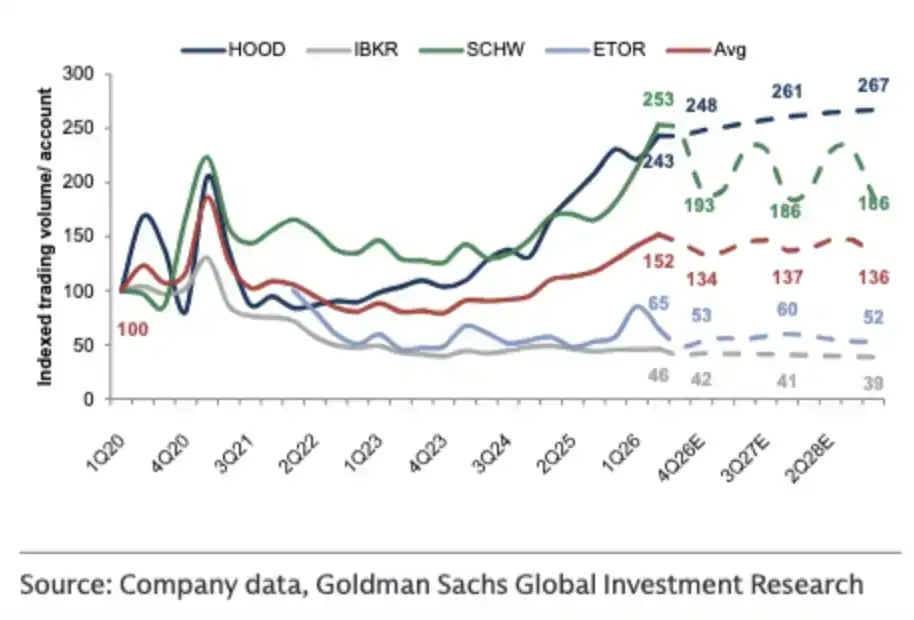
Per-account trading volume, adjusted for account growth, remains below the 2021 high
Seasonality also needs to be factored in. July and August are typically months of weaker retail trading activity for the year. This year's declines were more pronounced than historical seasonal patterns, but some trading may have been pulled forward into June. Active equity capital markets activity during that month drove retail participation and trading volumes to record levels.
Goldman Sachs expects total US equity issuance to reach a record $675 billion in 2026, with Q2 issuance around $252 billion. Historical data shows that equity issuance activity typically boosts retail trading with a lag of about one quarter, which should also benefit securities lending, stock trading, and IPO subscription businesses.
Based on seasonal recovery and equity issuance activity, Goldman Sachs forecasts that traditional retail brokerage commissions will increase by 28% year-over-year in Q3, with stock and option trading volumes averaging growth of about 19%. This forecast still depends on whether trading activity recovers as expected in September.
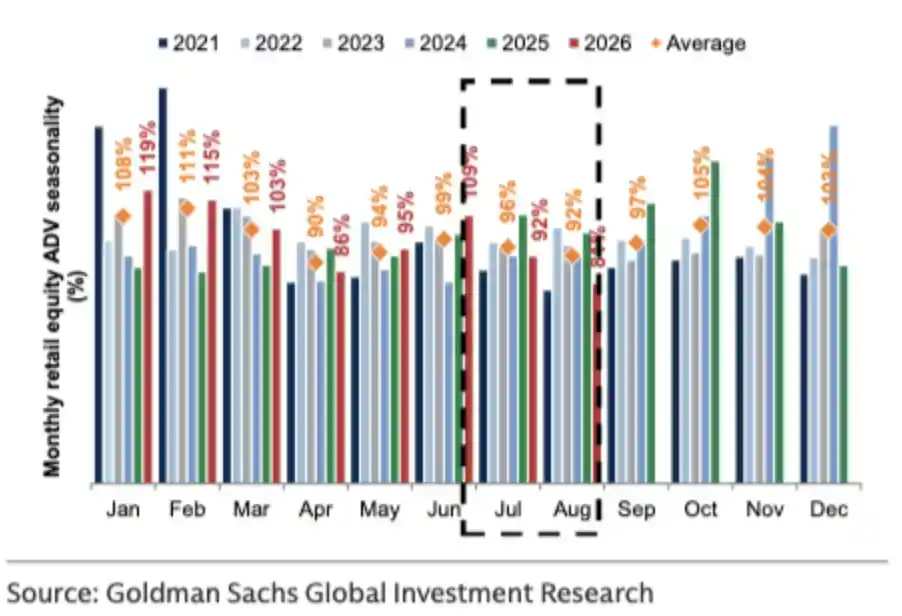
Annual seasonality of retail trading volumes
Prediction Markets May Exhibit Greater Autumnal Elasticity
Goldman Sachs believes that prediction markets possess both structural growth and cyclical recovery potential, and the magnitude of the autumn trading rebound could be more pronounced than for traditional brokerage business.
From January 2024 to July 2026, the annualized trading volume of prediction markets has grown cumulatively by approximately 1160%. Since August 2025, the monthly unique user count has shown month-over-month growth every month except April 2026, indicating the user base is still expanding.
Rapid growth has at times masked the seasonality of prediction markets. According to data provided by Goldman Sachs, sports, crypto, and political contracts constitute the vast majority of trading volume. In July 2026, sports contracts accounted for about 79% of industry trading volume, crypto contracts about 15%, and political contracts about 2%.
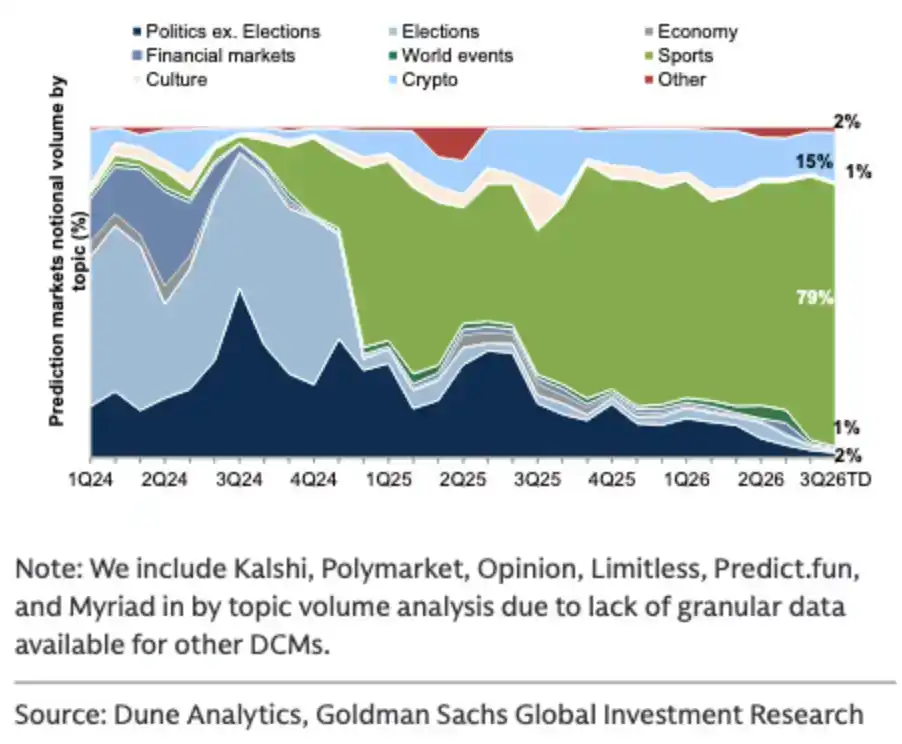
Category composition of prediction market trading volume
These three types of contracts are driven by different cycles. Sports trading typically recovers after major US professional sports leagues resume, with relatively high activity from September to January; political contracts see increased volume as elections approach; crypto event contracts are influenced by coin prices and crypto market trading cycles.
Due to relatively fewer major sports events in summer and the US midterm election trading not yet entering its peak, prediction market trading volume declined about 15% month-over-month in August. Goldman Sachs attributes this primarily to the seasonality of underlying event contracts, rather than a cessation of the industry's structural growth.
Starting in September, the US sports schedule resumes, and the midterm elections approach. If crypto market activity also improves simultaneously, the three main contract types could create a combined effect. However, prediction markets as an asset class with less than three years of development history still have limited historical data, and the stability of seasonal patterns needs further observation.
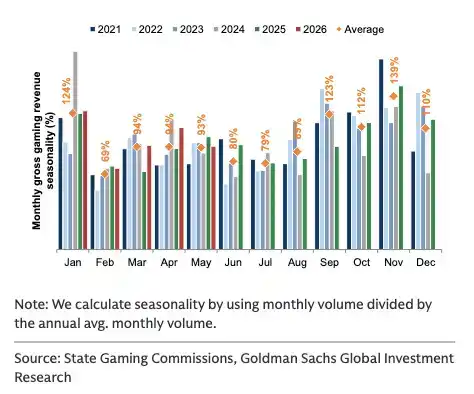
Online sports betting revenue is relatively more active from September to January
Crypto Market Cap Rebound, Not Yet Translated to Volume
Compared to traditional trading and prediction markets, Goldman Sachs is more cautious in its assessment of crypto trading.
Industry crypto trading volume declined 30% month-over-month in July, and has fallen a further 21% so far in August. This round of trading decline has lasted about 10 months, exceeding the median of about 4 months from peak to trough across the past five crypto cycles.
According to the report's statistics, across the past six crypto cycles, total market capitalization and trading volume fell by an average of approximately 51% and 66%, respectively; this cycle has seen declines of about 40% and 75%, respectively, as of the report's publication date. This implies the contraction in crypto trading activity has already surpassed historical averages, but based solely on the magnitude and duration of the decline, it cannot yet be confirmed that the cycle has bottomed.
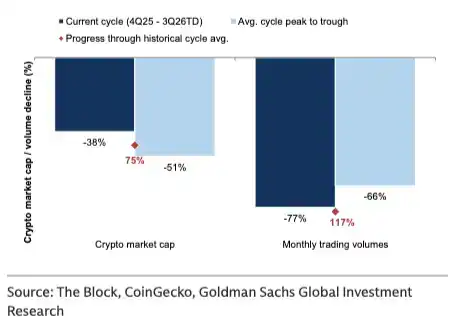
Average declines in crypto market cap and trading volume across previous cycles
A positive signal comes from asset prices. In the week prior to the report's publication, the total crypto asset market cap rose about 21%. Goldman Sachs believes that if the total market capitalization can be sustained at current levels for a prolonged period, trading volumes may recover alongside improving risk appetite.
The key here is "sustained." From April to May of this year, the crypto asset market cap also experienced a brief rally of about 5%, but subsequently retreated, and trading volumes did not form a sustained rebound. Therefore, the recent price increase only raises the possibility of a trading recovery and is not yet sufficient evidence for a trend reversal.
The impact on brokerages and crypto companies is also not uniform. Goldman Sachs statistics show that the median correlation between the stock prices of crypto-related companies and the total crypto market cap in 2026 is about 36%. Platforms with more diversified businesses, like Robinhood and Figure, have historically shown relatively lower correlation to crypto prices; Coinbase's operational elasticity is more direct.
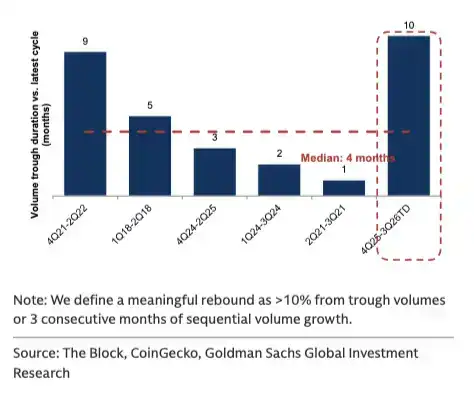
Duration of the current crypto trading downturn exceeds the historical median
Regulatory Reforms Continue, But Institutional Entry Still Requires Legislation
Regulation is another variable determining whether the crypto market can transition from a cyclical rebound to structural expansion.
Goldman Sachs believes the likelihood of the US Congress passing the "CLARITY Act" crypto market structure bill within the current term is diminishing. The Senate failed to hold a vote before the August recess, and the midterm elections and subsequent congressional recess further compress the legislative timeline.
Meanwhile, US regulators continue to advance some reforms. The SEC recently proposed a digital asset "innovation exemption," planning to offer temporary registration and qualification requirement exemptions for eligible digital asset issuers and securities. The OCC continues to approve digital asset firms for trust bank charters, enabling them to engage in money transmission and asset custody businesses.
These measures may drive expansion in applications like tokenization, custody, and decentralized finance, but Goldman Sachs emphasizes that administrative regulatory actions are less durable than congressional legislation. To drive large-scale institutional adoption of digital assets, the market still requires a more stable and clear legal framework.
Goldman Sachs's 2025 institutional survey showed that 35% of respondent managers cited lack of regulatory clarity as the biggest barrier to entering the crypto market, while 32% ranked regulatory clarity as the top catalyst for driving institutional adoption. Therefore, while short-term adjustments by regulators can improve the market environment, the pace of congressional legislation remains the core indicator determining whether institutional capital can systematically enter.
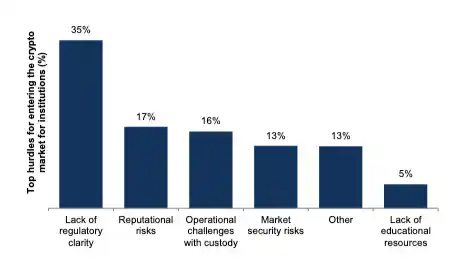
Major barriers to institutional entry into the crypto market
Platforms Are Seeking Revenue Beyond Crypto Trading
Against the backdrop of sluggish crypto trading, related companies are primarily stabilizing profits through two methods: compressing expenses, and developing new businesses with lower correlation to spot trading volumes.
According to Goldman Sachs estimates, five brokerages and crypto companies implemented cost adjustment measures in 2026, cutting annual expenses by an average of about 4% to 5%, equivalent to providing about 5.8 percentage points of support to adjusted operating margins. Cost controls did not fully offset revenue downgrades but mitigated the impact of trading weakness on profitability.
On a stock-specific basis, Goldman Sachs' top picks are FIGR, HOOD, and IBKR, and views COIN as an upside allocation upon a crypto market recovery.
The core thesis for Robinhood (HOOD) is account asset growth and business diversification. Goldman Sachs expects HOOD's average revenue per user (ARPU) to grow at a compound annual growth rate (CAGR) of approximately 16% from 2025 to 2028, with client assets and revenue growing about 29% and 21%, respectively. Growth sources include traditional brokerage, prediction markets, digital banking, credit cards, and wealth management.
Among these, prediction markets are forecast to contribute about 13% of HOOD's revenue in 2026. Its newly established Rothera prediction market exchange achieved about a 3-percentage-point market share less than two months after launch, which, according to the report's calculations, corresponds to an annualized revenue of about $150 million. The growth rate for prediction markets is faster, but the platform is relatively new, and whether the current market share can be maintained needs observation.
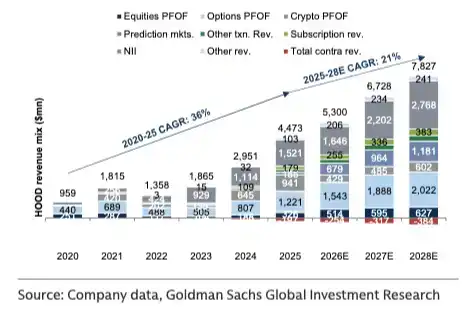
HOOD revenue diversification toward prediction markets, subscriptions & other businesses
Figure's (FIGR) primary growth driver is the Home Equity Line of Credit (HELOC) market. So far in Q3, its consumer lending marketplace volume continues to trend towards year-over-year growth exceeding 100%. Goldman Sachs believes that the decline in the company's composite rate stems primarily from product mix and channel changes, not just price reductions: large first-lien HELOCs have lower rates, and the capital-light FIGR Connect business also has lower rates but higher margins.
Interactive Brokers' (IBKR) advantage stems from its global reach. Year-to-date in 2026, over 75% of its monthly active users and about 85% of app downloads originated from markets outside the US. Goldman Sachs forecasts IBKR's account numbers to grow 33%, 24%, and 21% in 2026, 2027, and 2028, respectively, with revenue growing at a 15% CAGR from 2025 to 2028. Global account growth and a pre-tax margin exceeding 75% make it relatively less sensitive to crypto price fluctuations.
Coinbase (COIN) offers more direct exposure to crypto market elasticity. Since Q1 2024, the company's crypto derivatives market share has increased by about 8 percentage points; subscription and services businesses like stablecoins, custody, staking, and Prime Brokerage already contributed to about 40% of revenue in 2025. These revenues have relatively lower correlation to crypto trading volumes.
COIN is also expanding into prediction markets, stock trading, banking, and wealth management. Currently, these products contribute limited revenue, so Goldman Sachs primarily views them as potential upside, not yet realized profit sources.
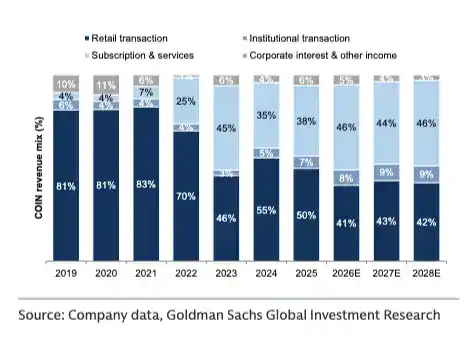
COIN revenue migration toward subscription & services
What to Watch For Next?
Goldman Sachs' optimistic view on brokerage and crypto stocks rests on several conditions that still require validation.
First, whether September retail stock and options trading volumes can break free from summer doldrums will determine if the seasonal recovery in traditional brokerage holds. Second, whether sports events and midterm elections can drive prediction market volume will test whether prediction markets are a sustainable new business or merely a temporarily high-growth category.
The crypto market needs to satisfy both price and volume conditions. Sustaining the total market cap at higher levels is only the first step; whether spot and derivatives trading volumes subsequently recover will truly improve transaction-related revenue for relevant companies. On the regulatory front, while administrative agencies continuing to ease rules can support near-term innovation, whether Congress can form a stable market structure bill still determines the ceiling for institutional adoption.
Current sector valuations have retreated, but growth quality within the industry differs. FIGR, HOOD, and IBKR rely on lending, prediction markets, and global account growth to provide a relatively independent fundamental base; COIN retains higher exposure to crypto cycle elasticity.
Therefore, this report is not betting on a crypto bull market restart. Goldman Sachs places greater emphasis on the fact that brokerage and crypto platforms are increasing revenue sources not reliant on a single trading cycle. What needs to be verified next is whether these new businesses can continue to support growth after the anticipated autumn trading recovery.