During the US trading session on Monday (August 24th), spot silver fluctuated around $69. While gold gained 0.82% driven by factors related to bonds, the US dollar, and debt, silver received trading-level support but did not see a full-fledged safe-haven capital inflow.
Last week, gold ETF funds saw a net inflow of 46.7 tons, marking the highest single-week inflow in 10 months. However, silver did not experience a comparable inflow. The 200-day moving average continues to exert resistance overhead, and the market failed again on Monday to surpass Friday's high.
This week is packed with economic data: Wednesday's PCE inflation data, Federal Reserve Chairman Kevin Wash's Jackson Hole speech on Friday, and details of the latest sanctions announced by Baisent today could all stir the US dollar and US Treasury yields, which are the core drivers of the current silver price.
Spot silver was quoted at $68.649, down $0.32 or 0.46%; it hit a session high of $69.893 and a low of $68.348.
Silver's Uptick Relies on the US Dollar and Long-term Treasuries
On Monday, silver moved in tandem with the broader macro picture without an independent upward logic. Reports suggest the US Treasury might deploy approximately $950 billion from the General Account to expand purchases of long-term government bonds. The Treasury had previously indicated it would increase the single-purchase size of existing long-term bonds from at least $2 billion to $4 billion, and Baisent suggested the actual purchase size could be larger.
After the initial buyback news, US Treasury yields briefly declined before rebounding again. Last week, the 30-year yield surged above 5.30%, hitting its highest level since 2007. Monday's report related to the General Account gives the Treasury more operational flexibility. The 10-year yield fell over 3 basis points to around 4.70% on Monday; the 30-year yield dropped about 4 basis points to near 5.24%. The US dollar, after declining last week, is now consolidating within a multi-month low range.
There is genuine buying support for spot silver underneath: a weaker dollar and yields retreating from highs. Gold and various metal products are all trading on the same theme—whether the Treasury can stabilize long-term bonds amidst expanding US debt issuance and fiscal deficits. Silver is part of this trend but is not the leading asset.
Three Key Events This Week Could Shake Silver's Macro Support
Silver's trajectory is highly dependent on external macro conditions and cannot dictate the trend itself. The upcoming Wednesday PCE inflation report is immediate. This data will simultaneously release personal income, consumption spending (883434), and revised GDP figures. Both the bond market and the US dollar will react synchronously, and the silver price will fluctuate accordingly. The bond market is currently pricing in mild inflation data; should the figures come in higher than expected, the entire macro logic supporting silver would be repriced.
Federal Reserve Chairman Kevin Wash will speak at Jackson Hole on Friday. He has not yet sent a clear signal on the interest rate path to trading markets. Even without direct policy adjustments, his remarks alone could stir precious metals (881169) markets. Any discussion about inflation, long-term Treasuries, or debt supply could significantly unsettle the dollar and Treasury yields. The market is watching both his tone and any signals of a policy pause he might offer.
Baisent is expected to announce details of a new round of sanctions against Iran later on Monday. The sanctions themselves are not surprising; the focus is on whether they will extend to requiring Chinese compliance in enforcement. If Chinese buyers face new risks, the practical impact of the sanctions will be significantly amplified. Oil prices remain high, keeping inflation risks on the Fed's radar; compared to gold, silver is more sensitive to changes in interest rates. Middle East geopolitical risks directly benefit gold, persistently boosting safe-haven buying; silver can only indirectly capture a small portion of this benefit. Silver's real risk stems from the interest rate front, not geopolitical conflict.
Spot Silver Daily Technical Analysis
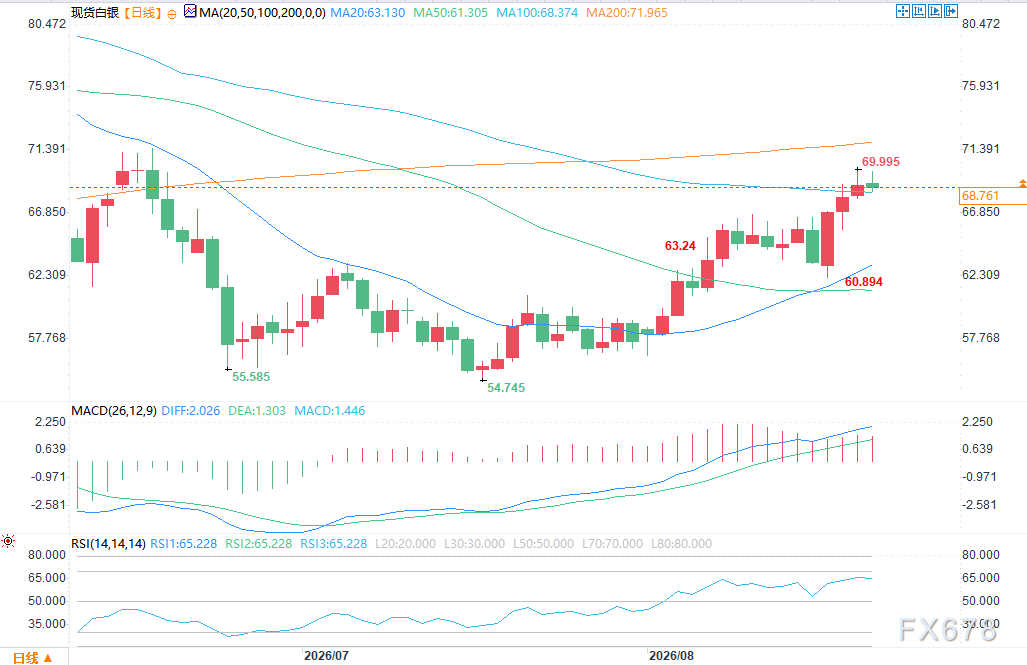
On Monday, spot silver failed in its upward push, unable to hold above Friday's high of $70.02, and the price retreated slightly. Gold rose significantly, but this move did not transmit to silver, prompting some funds to take profits and exit.
Looking at the daily oscillators, the overall trend remains upward. If the price convincingly breaks above $70.02, the uptrend will be confirmed. The first target is the 200-day moving average at $72.03, followed by the medium-term 50% retracement level at $72.08. The price is likely to encounter selling pressure upon first testing this resistance cluster; however, if it can solidly hold above the 200-day MA, the price has the potential to further target the long-term 61.8% Fibonacci level at $74.63.
The secondary trading range is $62.56 to $70.02. If downward pressure persists, spot silver could fall back to the 50% retracement level at $66.29, a level that may attract value-based buying.
Key Focus Points
Silver's support is entirely built on the premise of a persistently weaker US dollar and US Treasury yields not rebounding. Wednesday's PCE inflation data is the first test: figures higher than expected would push yields up, directly stripping away silver's cushion. Friday's Jackson Hole speech by Wash is the second test; the speech content alone can unsettle yields, impacting silver more than gold. Regarding the sanction details announced by Baisent today, the market is closely watching whether China is brought into the enforcement loop.
The 200-day moving average is a key technical target. Despite gold's significant rise, silver remained powerless to break higher on Monday. Repeated failures to challenge previous highs suggest silver is stuck in a range-bound consolidation. Only when silver independently breaks past this level to attack the 200-day MA can it shed its passive following of gold and carve out its own trend.