Burning $160,000, Frenziedly Coding 1 Million Lines: Bun's Creator Rewrites the Foundation with Claude

marsbitPublished on 2026-07-17Last updated on 2026-07-17

Abstract

**The Bun creator used Claude to rewrite its core in Rust in under two weeks for $165,000.** Jarred Sumner, the creator of the Bun JavaScript runtime, leveraged Claude Code to migrate the project's entire codebase from Zig to Rust—generating 1 million lines of code in less than two weeks. This cost approximately $165,000 in API tokens, a fraction of the estimated $3 million and 4 years a manual rewrite might have required. The new Rust-based version passed all existing tests and was quietly released in June. Inspired by this, Instagram co-founder Mike Krieger also used Claude to migrate a Python library to 165,000 lines of TypeScript over a weekend, slashing build times dramatically. Anthropic, the creator of Claude, formalized the process into a six-step framework for large-scale AI-assisted migrations. The core principle is to "fix the loop, not the code": the system uses existing code as specification, automated tests as judges, and iterates through generation, review, and repair cycles without constant human intervention. This approach makes large-scale migrations, once a daunting and costly task, a feasible and cost-effective automated process.

A project that once required 4 years was forcefully compressed into two weeks by Claude Code!

Costs were slashed from $3 million to just over a hundred thousand.

Recently, Anthropic publicly unveiled the full process of large-scale code migration using Claude Code for the first time. Their six-step framework has left the entire internet in awe.

The protagonist of the story is Jarred Sumner, the creator of Bun.

He once spent a year writing Bun, a JavaScript runtime that outperforms Node.js.

Now, in less than two weeks, he frenziedly wrote one million lines of code, migrating the entire project from Zig to Rust.

Bun's Creator Has AI Rewrite a Million Lines of Code

Back then, Jarred Sumner's logic for betting on Zig was pure: achieve performance comparable to C language through extreme simplicity.

This was almost a tool tailor-made for solo founders.

In his own words, "Before LLMs existed, I built Bun in a small apartment in Oakland in one year."

However, the dark side of extreme simplicity is the countless hidden pitfalls laid down early on.

Now, Bun's CLI monthly downloads have robustly surpassed the 10 million mark, and it has even become a heavy dependency at the core of Claude Code.

With the ecosystem's frenetic growth, the "technical debt" accrued over the years has come due, demanding repayment with interest.
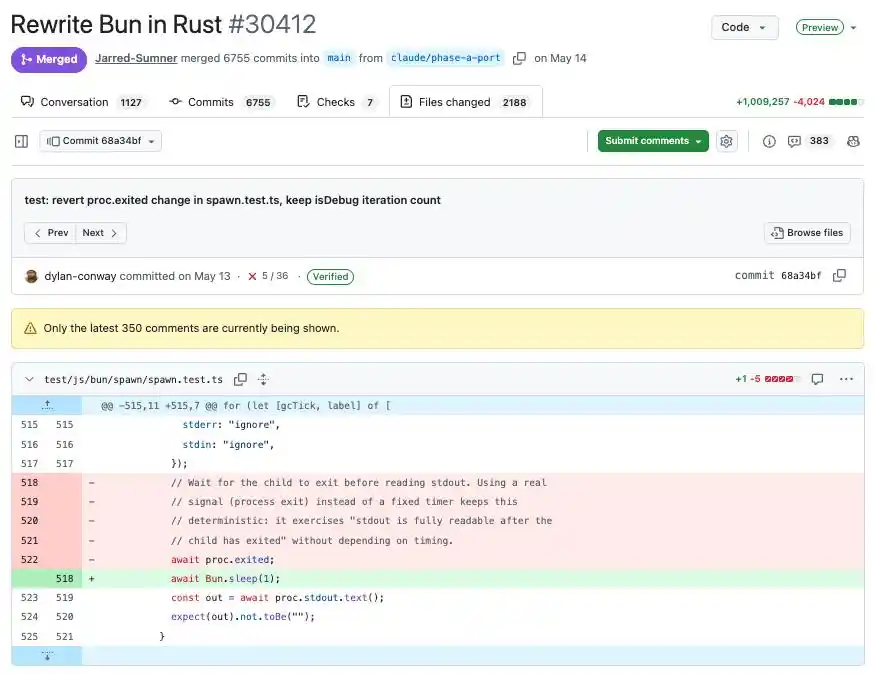
So he did something he never dared to think of before: using Claude Code to migrate the entire Bun codebase from Zig to the more memory-safe Rust.

In less than two weeks, it produced one million lines of code.

Before merging, all existing Bun test cases passed 100% in CI. After merging, 19 regressions surfaced, but they have all been fixed now. The Rust version quietly went live with Claude Code in June.

This migration consumed 5.9 billion input tokens and 690 million output tokens. Calculated at API pricing, it cost approximately $165,000.

It sounds expensive, but compared to the old budget of 4 years and $3 million, this amount is practically pocket change.

A Python Library Transformed into 165,000 Lines of TypeScript

Jarred Sumner is far from the only one using CC as an efficiency engine.

Mike Krieger, Head of Anthropic Labs and co-founder of Instagram, has an even more representative story.

Over a weekend, he migrated an entire Python codebase to 165,000 lines of TypeScript. The core part consumed about 27 million tokens.

Hundreds of agents, 8 checkpoints, 3 rounds of adversarial reviews, and finally, a consistency check that compared the output of every single command with the original Python version line-by-line. Any behavioral deviation was treated as a bug to be fixed.

He even had Claude design a set of end-to-end tests that ran for four consecutive nights, specifically targeting unforeseen corner-case issues.

Why was migration absolutely necessary?

His team's internal tools needed to be packaged as a single binary for delivery to users.

Using the Python toolchain, compilation took 8 minutes per platform, and the entire build matrix required a half-hour wait for each release.

After the migration, the same compilation takes only 2 seconds. The binary launches 6 times faster, and they also managed to retire an entire deployment pipeline.

Don't Fix the Code: The Six-Step Core Framework

So, what is the soul of this approach?

Anthropic summarizes it in one sentence: Don't fix the code; fix the loop that produces the code.
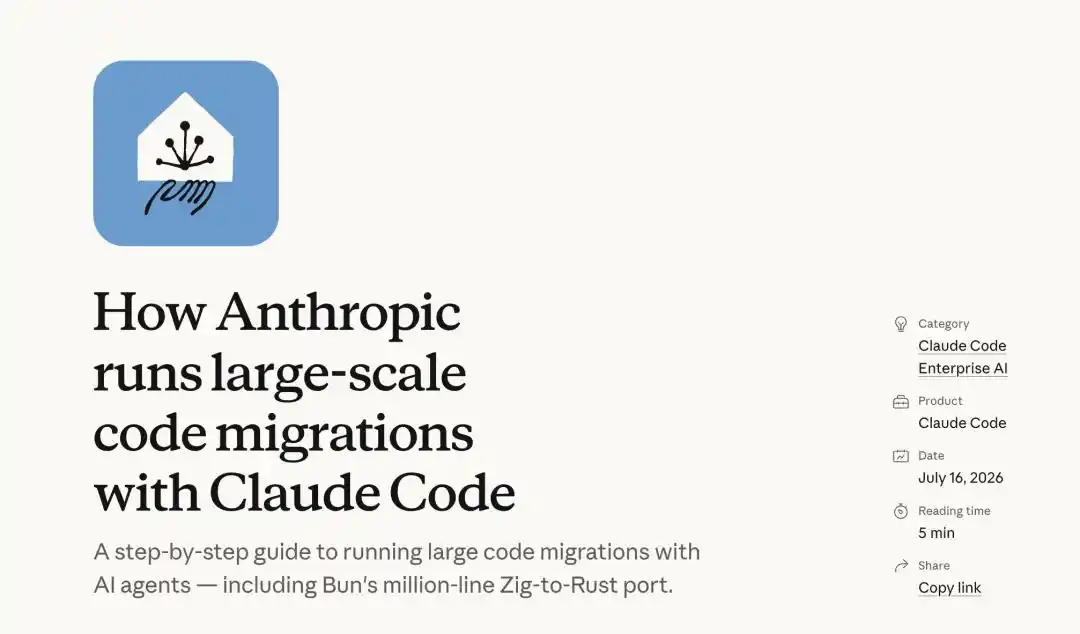
Large-scale migrations are particularly well-suited for AI, for simple reasons—

The work is inherently parallelizable; thousands of files can be processed simultaneously.

The old code itself serves as the best specification.

The test suite is a ready-made judge.

If compilation or testing fails, the next task automatically surfaces.

The model can relentlessly iterate against this "objective truth" for days, with no human arbitration needed in between.

Thus, Anthropic proposes a reusable six-step framework: First, set up the judge (tests), write the rulebook, draw the dependency graph, and list the gap inventory.

Then, conduct a small-scale "shakedown" to stress-test the rules, catching critical issues before scaling to thousands of files.

Next, perform the full translation, running a multi-agent cycle of "implementation—review—fix"; finally, compile, run, and compare behavior line-by-line.
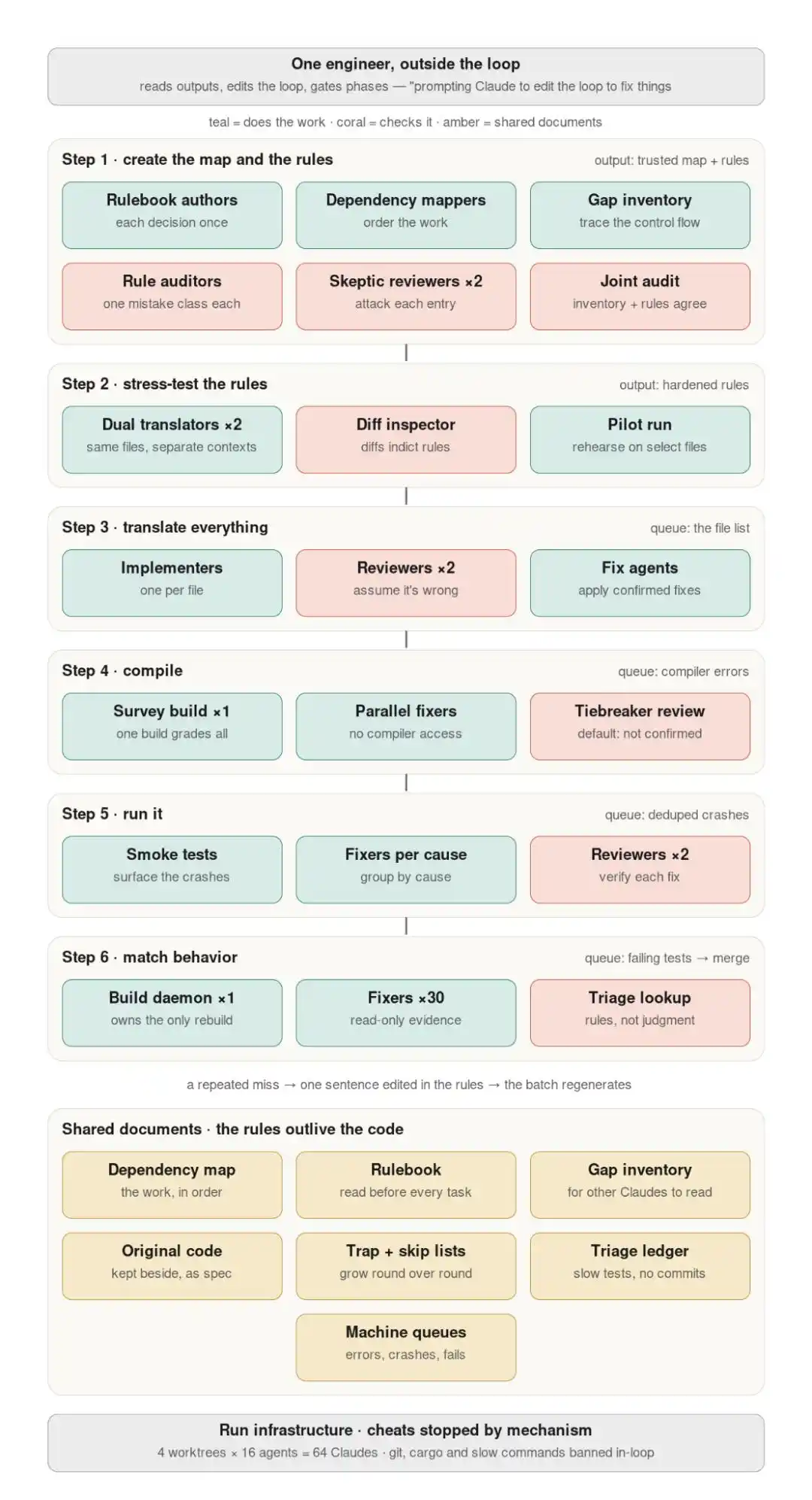
Throughout the entire process, rules are never manually patched:

Every time a reviewer catches an error, they add a sentence to the rulebook and regenerate the affected batch of files.

Anthropic's final suggestion: Pick a codebase you've been tolerating for too long, and go ask Claude what its migration process would look like.

Four years ago, this statement was a joke. Today, it's a check that can actually be cashed.

In the past, migration was a chasm developers dared not cross; now, it's just a progress bar waiting to be cleared.

This article is from the WeChat public account "New Zhi Yuan," author: ASI Revelation

Trending Cryptos

Related Questions

QWho is the main developer behind the migration of Bun from Zig to Rust using Claude Code, and what is notable about his previous work?

AThe main developer is Jarred Sumner, known as the 'father of Bun'. He is notable for previously writing the Bun JavaScript runtime, which is faster than Node.js, in just one year from a small apartment in Oakland before the era of large language models (LLMs).

QWhat was the estimated cost and time saved by using Claude Code to migrate Bun from Zig to Rust, compared to the traditional method?

AThe migration using Claude Code cost approximately $165,000 and was completed in less than two weeks. In contrast, the traditional method was estimated to take 4 years and cost $3 million, making the AI-assisted approach drastically cheaper and faster.

QWhat are the six key steps in Anthropic's framework for large-scale code migration using AI?

AThe six-step framework involves: 1) Setting up the 'referee' (test suites), 2) Writing the rulebook (specifications), 3) Mapping dependencies, 4) Listing gaps, 5) Running a small-scale pilot to test rules, and 6) Conducting full translation with a multi-agent 'implement-review-fix' loop, followed by compilation, execution, and behavioral verification.

QBesides the Bun migration, what is another example of a successful code migration using Claude Code mentioned in the article?

AAnother example is by Mike Krieger, co-founder of Instagram, who migrated a Python codebase to 16.5万 lines of TypeScript over a weekend. This migration reduced compilation time from 8 minutes per platform to 2 seconds, sped up binary startup by 6 times, and eliminated an entire deployment pipeline.

QWhat is the core philosophy behind Anthropic's approach to AI-assisted code migration, as summarized in the article?

AThe core philosophy is: 'Don't fix the code; fix the loop that produces the code.' Instead of manually patching individual issues, the process focuses on improving the automated generation and review cycle, using existing code as the specification and test suites as the objective referee to guide the AI.

Related Reads

CLARITY Act Delays Have Become a Compliance Crisis, Not Just a Political Stalemate

The article discusses the ongoing delay in the US Senate regarding the CLARITY Act, a bill intended to clarify the regulatory status of digital assets as either securities under the SEC or commodities under the CFTC. A year after the House passed it, this inaction is creating a concrete governance, risk, and compliance crisis for businesses, moving beyond mere political gridlock. While related bills for stablecoins and CBDC prohibitions have become law, the comprehensive CLARITY Act remains stalled. The delay creates profound uncertainty for companies on fundamental rules for exchanges, custodians, and all market participants. Without clear congressional action, regulatory classification depends on shifting enforcement actions and presidential administrations, making stable compliance impossible. The Senate's window for action is narrowing, with key votes needed before the August recess. Several major issues are blocking passage, including ethical concerns over crypto holdings by officials, law enforcement opposition to certain provisions, perceived loopholes for stablecoin rewards, and regulatory agency vacancies at the SEC and CFTC. Bipartisan support is fragile. Further delay risks postponing the legislation until 2030, perpetuating a costly "regulation by enforcement" environment. In contrast, passage would provide a durable regulatory framework. Regardless of the outcome, compliance leaders are urged to immediately map their digital asset exposures, prepare governance materials for both scenarios, and stress-test their arrangements. The article concludes that while the Senate's action is uncertain, corporate preparedness is not.

Foresight News3m ago

CLARITY Act Delays Have Become a Compliance Crisis, Not Just a Political Stalemate

Foresight News3m ago

The 'Big Short' Burry: Now is an Excellent Time to Bottom-Fish in Hong Kong Stocks

The article discusses growing optimism towards Hong Kong stocks, led by prominent investor Michael Burry of "The Big Short" fame. Burry recently stated it is an "excellent time" to find cheap stocks in the Hong Kong market. His bullish view is based on the prediction that as the global AI chip stock frenzy cools, capital will flow out of markets like South Korea and Japan and seek undervalued opportunities, positioning Hong Kong as a potential beneficiary. Supporting this view, Goldman Sachs' Asia equity capital markets head, Wang Yajun, argues the Hong Kong market has already entered the AI era, but major indices have not yet reflected this reality. He points to active AI-related IPOs and transactions as evidence of underlying market vitality, contrasting with the weak performance of key indices like the Hang Seng. Data highlights Hong Kong's underperformance: the Hang Seng Index is down about 7% year-to-date, while markets in South Korea and Japan and semiconductor ETFs have seen significant gains. This disparity is seen by Burry and others as creating a valuation gap and a potential buying opportunity. The article notes Burry has acted on his view by increasing holdings in Chinese e-commerce firm JD.com. Morgan Stanley has also recently advocated buying Hong Kong stocks, citing positive corporate earnings expectations. However, challenges remain, including persistent concerns over Chinese consumer spending and e-commerce profitability, which continue to weigh on the market. The divergence between weak index performance and strong activity in specific sectors like AI presents both opportunity and complexity for investors looking to capitalize on Hong Kong's potential turnaround.

marsbit32m ago

The 'Big Short' Burry: Now is an Excellent Time to Bottom-Fish in Hong Kong Stocks

marsbit32m ago

The Big Short's Burry: Now is the Perfect Time to Bottom-Fish in Hong Kong Stocks

Michael Burry, the investor famous for predicting the 2008 financial crisis, recently stated on X that now is an "excellent time" to look for cheap stocks in the Hong Kong market. His bullish view is based on the expectation that the global AI chip stock frenzy will cool, leading funds to flow out of Korea, Japan, and semiconductor ETFs and into undervalued areas like Hong Kong. He has already acted by increasing his stake in JD.com. Hong Kong stocks have significantly underperformed global peers this year, with the Hang Seng Index down about 7% and the Hang Seng Tech Index falling over 15%. This contrasts sharply with major gains in Korean, Japanese, and semiconductor markets. Burry sees this disparity as creating a bargain-hunting opportunity. Adding another perspective, Goldman Sachs' Asia equity capital markets head, Wang Yajun, argues that while the Hong Kong market has already entered the AI era with active related IPOs and trading, its major indices have not yet reflected this reality due to structural lag. He expects record equity fundraising this year, driven by more AI company listings. Morgan Stanley has also recently advocated buying Hong Kong stocks, citing optimistic corporate earnings prospects. However, challenges remain, including concerns over China's consumer recovery and e-commerce profitability. The key for investors is navigating the overall index pressure while identifying specific structural opportunities highlighted by these bullish narratives.

链捕手37m ago

The Big Short's Burry: Now is the Perfect Time to Bottom-Fish in Hong Kong Stocks

链捕手37m ago

Xi Jinping Attends Opening Ceremony of World Artificial Intelligence Conference 2026 and High-Level Meeting on Global AI Governance, Delivers Keynote Speech

On July 17, 2026, Chinese President Xi Jinping delivered a keynote speech titled "Working Together to Build a Fair and Equitable Global Governance System on Artificial Intelligence" at the opening ceremony of the 2026 World Artificial Intelligence Conference and High-level Conference on Global AI Governance in Shanghai. President Xi pointed out that the rapid development of AI, alongside the accelerated global changes, presents both significant opportunities and governance challenges. He raised critical questions for humanity regarding human-machine coexistence, safety, ethics, and bridging divides. China advocates for a people-oriented, benevolent approach to AI, making it a force for common prosperity and security, and jointly building a fair and reasonable global AI governance system. Xi Jinping put forward a four-point proposal: 1. **Uphold Openness for Win-Win Cooperation and Drive Innovation:** Seize the historic opportunity by encouraging open-source collaboration and sharing to foster AI innovation, industry growth, and application, empowering all sectors. 2. **Enhance Risk Awareness and Ensure Security and Controllability:** Attach great importance to AI's inherent and derivative risks. Build systems for laws, technical monitoring, risk warning, and emergency response to safeguard security, prevent misuse, and ensure human control. Oppose the practice of politicizing national security in AI. 3. **Encourage Inclusiveness and Promote Cultural Exchange:** Shape AI's values with humanity's common values. Use AI to enhance understanding and tolerance between civilizations, fostering a garden of diverse cultures. 4. **Advocate Solidarity and Improve Global Governance:** Practice true multilateralism, leverage the UN's role, and strengthen coordination on AI development strategies, governance rules, and technical standards to form a widely accepted global governance framework. Assist Global South countries in capacity building to bridge the digital divide and avoid new historical inequities. Xi highlighted that as a responsible major country, China, in its 15th Five-Year Plan period, is committed to being a provider of international public goods in AI, contributing Chinese solutions. China has promoted an "AI Plus" initiative, with its core intelligent economy exceeding RMB 10 trillion. To support global AI development, China will provide 5,000 AI training opportunities for developing countries, establish international AI application cooperation centers with regional organizations, and deploy its "Mazu" meteorological AI warning system in 30 countries. The establishment of the World Artificial Intelligence Cooperation Organization in Shanghai marks a significant milestone. Leaders from Kazakhstan, Cambodia, Thailand, and the UN Secretary-General delivered speeches, commending China's contributions to global AI governance and echoing President Xi's proposals. They agreed that AI's opportunities and challenges are borderless, requiring cooperative, inclusive, and equitable international efforts to ensure a secure, prosperous future that leaves no country behind. The conference issued a Chair's Statement. President Xi and his wife hosted a welcome banquet for international dignitaries on July 16. Senior Chinese officials attended the events.

链捕手40m ago

Xi Jinping Attends Opening Ceremony of World Artificial Intelligence Conference 2026 and High-Level Meeting on Global AI Governance, Delivers Keynote Speech

链捕手40m ago

Trading

Spot

Hot Articles

What is SONIC

Sonic: Pioneering the Future of Gaming in Web3 Introduction to Sonic In the ever-evolving landscape of Web3, the gaming industry stands out as one of the most dynamic and promising sectors. At the forefront of this revolution is Sonic, a project designed to amplify the gaming ecosystem on the Solana blockchain. Leveraging cutting-edge technology, Sonic aims to deliver an unparalleled gaming experience by efficiently processing millions of requests per second, ensuring that players enjoy seamless gameplay while maintaining low transaction costs. This article delves into the intricate details of Sonic, exploring its creators, funding sources, operational mechanics, and the timeline of significant events that have shaped its journey. What is Sonic? Sonic is an innovative layer-2 network that operates atop the Solana blockchain, specifically tailored to enhance the existing Solana gaming ecosystem. It accomplishes this through a customised, VM-agnostic game engine paired with a HyperGrid interpreter, facilitating sovereign game economies that roll up back to the Solana platform. The primary goals of Sonic include: Enhanced Gaming Experiences: Sonic is committed to offering lightning-fast on-chain gameplay, allowing players and developers to engage with games at previously unattainable speeds. Atomic Interoperability: This feature enables transactions to be executed within Sonic without the need to redeploy Solana programmes and accounts. This makes the process more efficient and directly benefits from Solana Layer1 services and liquidity. Seamless Deployment: Sonic allows developers to write for Ethereum Virtual Machine (EVM) based systems and execute them on Solana’s SVM infrastructure. This interoperability is crucial for attracting a broader range of dApps and decentralised applications to the platform. Support for Developers: By offering native composable gaming primitives and extensible data types - dining within the Entity-Component-System (ECS) framework - game creators can craft intricate business logic with ease. Overall, Sonic's unique approach not only caters to players but also provides an accessible and low-cost environment for developers to innovate and thrive. Creator of Sonic The information regarding the creator of Sonic is somewhat ambiguous. However, it is known that Sonic's SVM is owned by the company Mirror World. The absence of detailed information about the individuals behind Sonic reflects a common trend in several Web3 projects, where collective efforts and partnerships often overshadow individual contributions. Investors of Sonic Sonic has garnered considerable attention and support from various investors within the crypto and gaming sectors. Notably, the project raised an impressive $12 million during its Series A funding round. The round was led by BITKRAFT Ventures, with other notable investors including Galaxy, Okx Ventures, Interactive, Big Brain Holdings, and Mirana. This financial backing signifies the confidence that investment foundations have in Sonic’s potential to revolutionise the Web3 gaming landscape, further validating its innovative approaches and technologies. How Does Sonic Work? Sonic utilises the HyperGrid framework, a sophisticated parallel processing mechanism that enhances its scalability and customisability. Here are the core features that set Sonic apart: Lightning Speed at Low Costs: Sonic offers one of the fastest on-chain gaming experiences compared to other Layer-1 solutions, powered by the scalability of Solana’s virtual machine (SVM). Atomic Interoperability: Sonic enables transaction execution without redeployment of Solana programmes and accounts, effectively streamlining the interaction between users and the blockchain. EVM Compatibility: Developers can effortlessly migrate decentralised applications from EVM chains to the Solana environment using Sonic’s HyperGrid interpreter, increasing the accessibility and integration of various dApps. Ecosystem Support for Developers: By exposing native composable gaming primitives, Sonic facilitates a sandbox-like environment where developers can experiment and implement business logic, greatly enhancing the overall development experience. Monetisation Infrastructure: Sonic natively supports growth and monetisation efforts, providing frameworks for traffic generation, payments, and settlements, thereby ensuring that gaming projects are not only viable but also sustainable financially. Timeline of Sonic The evolution of Sonic has been marked by several key milestones. Below is a brief timeline highlighting critical events in the project's history: 2022: The Sonic cryptocurrency was officially launched, marking the beginning of its journey in the Web3 gaming arena. 2024: June: Sonic SVM successfully raised $12 million in a Series A funding round. This investment allowed Sonic to further develop its platform and expand its offerings. August: The launch of the Sonic Odyssey testnet provided users with the first opportunity to engage with the platform, offering interactive activities such as collecting rings—a nod to gaming nostalgia. October: SonicX, an innovative crypto game integrated with Solana, made its debut on TikTok, capturing the attention of over 120,000 users within a short span. This integration illustrated Sonic’s commitment to reaching a broader, global audience and showcased the potential of blockchain gaming. Key Points Sonic SVM is a revolutionary layer-2 network on Solana explicitly designed to enhance the GameFi landscape, demonstrating great potential for future development. HyperGrid Framework empowers Sonic by introducing horizontal scaling capabilities, ensuring that the network can handle the demands of Web3 gaming. Integration with Social Platforms: The successful launch of SonicX on TikTok displays Sonic’s strategy to leverage social media platforms to engage users, exponentially increasing the exposure and reach of its projects. Investment Confidence: The substantial funding from BITKRAFT Ventures, among others, emphasizes the robust backing Sonic has, paving the way for its ambitious future. In conclusion, Sonic encapsulates the essence of Web3 gaming innovation, striking a balance between cutting-edge technology, developer-centric tools, and community engagement. As the project continues to evolve, it is poised to redefine the gaming landscape, making it a notable entity for gamers and developers alike. As Sonic moves forward, it will undoubtedly attract greater interest and participation, solidifying its place within the broader narrative of blockchain gaming.

1.8k Total ViewsPublished 2024.04.04Updated 2024.12.03

What is SONIC

What is $S$

Understanding SPERO: A Comprehensive Overview Introduction to SPERO As the landscape of innovation continues to evolve, the emergence of web3 technologies and cryptocurrency projects plays a pivotal role in shaping the digital future. One project that has garnered attention in this dynamic field is SPERO, denoted as SPERO,$$s$. This article aims to gather and present detailed information about SPERO, to help enthusiasts and investors understand its foundations, objectives, and innovations within the web3 and crypto domains. What is SPERO,$$s$? SPERO,$$s$ is a unique project within the crypto space that seeks to leverage the principles of decentralisation and blockchain technology to create an ecosystem that promotes engagement, utility, and financial inclusion. The project is tailored to facilitate peer-to-peer interactions in new ways, providing users with innovative financial solutions and services. At its core, SPERO,$$s$ aims to empower individuals by providing tools and platforms that enhance user experience in the cryptocurrency space. This includes enabling more flexible transaction methods, fostering community-driven initiatives, and creating pathways for financial opportunities through decentralised applications (dApps). The underlying vision of SPERO,$$s$ revolves around inclusiveness, aiming to bridge gaps within traditional finance while harnessing the benefits of blockchain technology. Who is the Creator of SPERO,$$s$? The identity of the creator of SPERO,$$s$ remains somewhat obscure, as there are limited publicly available resources providing detailed background information on its founder(s). This lack of transparency can stem from the project's commitment to decentralisation—an ethos that many web3 projects share, prioritising collective contributions over individual recognition. By centring discussions around the community and its collective goals, SPERO,$$s$ embodies the essence of empowerment without singling out specific individuals. As such, understanding the ethos and mission of SPERO remains more important than identifying a singular creator. Who are the Investors of SPERO,$$s$? SPERO,$$s$ is supported by a diverse array of investors ranging from venture capitalists to angel investors dedicated to fostering innovation in the crypto sector. The focus of these investors generally aligns with SPERO's mission—prioritising projects that promise societal technological advancement, financial inclusivity, and decentralised governance. These investor foundations are typically interested in projects that not only offer innovative products but also contribute positively to the blockchain community and its ecosystems. The backing from these investors reinforces SPERO,$$s$ as a noteworthy contender in the rapidly evolving domain of crypto projects. How Does SPERO,$$s$ Work? SPERO,$$s$ employs a multi-faceted framework that distinguishes it from conventional cryptocurrency projects. Here are some of the key features that underline its uniqueness and innovation: Decentralised Governance: SPERO,$$s$ integrates decentralised governance models, empowering users to participate actively in decision-making processes regarding the project’s future. This approach fosters a sense of ownership and accountability among community members. Token Utility: SPERO,$$s$ utilises its own cryptocurrency token, designed to serve various functions within the ecosystem. These tokens enable transactions, rewards, and the facilitation of services offered on the platform, enhancing overall engagement and utility. Layered Architecture: The technical architecture of SPERO,$$s$ supports modularity and scalability, allowing for seamless integration of additional features and applications as the project evolves. This adaptability is paramount for sustaining relevance in the ever-changing crypto landscape. Community Engagement: The project emphasises community-driven initiatives, employing mechanisms that incentivise collaboration and feedback. By nurturing a strong community, SPERO,$$s$ can better address user needs and adapt to market trends. Focus on Inclusion: By offering low transaction fees and user-friendly interfaces, SPERO,$$s$ aims to attract a diverse user base, including individuals who may not previously have engaged in the crypto space. This commitment to inclusion aligns with its overarching mission of empowerment through accessibility. Timeline of SPERO,$$s$ Understanding a project's history provides crucial insights into its development trajectory and milestones. Below is a suggested timeline mapping significant events in the evolution of SPERO,$$s$: Conceptualisation and Ideation Phase: The initial ideas forming the basis of SPERO,$$s$ were conceived, aligning closely with the principles of decentralisation and community focus within the blockchain industry. Launch of Project Whitepaper: Following the conceptual phase, a comprehensive whitepaper detailing the vision, goals, and technological infrastructure of SPERO,$$s$ was released to garner community interest and feedback. Community Building and Early Engagements: Active outreach efforts were made to build a community of early adopters and potential investors, facilitating discussions around the project’s goals and garnering support. Token Generation Event: SPERO,$$s$ conducted a token generation event (TGE) to distribute its native tokens to early supporters and establish initial liquidity within the ecosystem. Launch of Initial dApp: The first decentralised application (dApp) associated with SPERO,$$s$ went live, allowing users to engage with the platform's core functionalities. Ongoing Development and Partnerships: Continuous updates and enhancements to the project's offerings, including strategic partnerships with other players in the blockchain space, have shaped SPERO,$$s$ into a competitive and evolving player in the crypto market. Conclusion SPERO,$$s$ stands as a testament to the potential of web3 and cryptocurrency to revolutionise financial systems and empower individuals. With a commitment to decentralised governance, community engagement, and innovatively designed functionalities, it paves the way toward a more inclusive financial landscape. As with any investment in the rapidly evolving crypto space, potential investors and users are encouraged to research thoroughly and engage thoughtfully with the ongoing developments within SPERO,$$s$. The project showcases the innovative spirit of the crypto industry, inviting further exploration into its myriad possibilities. While the journey of SPERO,$$s$ is still unfolding, its foundational principles may indeed influence the future of how we interact with technology, finance, and each other in interconnected digital ecosystems.

122 Total ViewsPublished 2024.12.17Updated 2024.12.17

What is $S$

What is AGENT S

Agent S: The Future of Autonomous Interaction in Web3 Introduction In the ever-evolving landscape of Web3 and cryptocurrency, innovations are constantly redefining how individuals interact with digital platforms. One such pioneering project, Agent S, promises to revolutionise human-computer interaction through its open agentic framework. By paving the way for autonomous interactions, Agent S aims to simplify complex tasks, offering transformative applications in artificial intelligence (AI). This detailed exploration will delve into the project's intricacies, its unique features, and the implications for the cryptocurrency domain. What is Agent S? Agent S stands as a groundbreaking open agentic framework, specifically designed to tackle three fundamental challenges in the automation of computer tasks: Acquiring Domain-Specific Knowledge: The framework intelligently learns from various external knowledge sources and internal experiences. This dual approach empowers it to build a rich repository of domain-specific knowledge, enhancing its performance in task execution. Planning Over Long Task Horizons: Agent S employs experience-augmented hierarchical planning, a strategic approach that facilitates efficient breakdown and execution of intricate tasks. This feature significantly enhances its ability to manage multiple subtasks efficiently and effectively. Handling Dynamic, Non-Uniform Interfaces: The project introduces the Agent-Computer Interface (ACI), an innovative solution that enhances the interaction between agents and users. Utilizing Multimodal Large Language Models (MLLMs), Agent S can navigate and manipulate diverse graphical user interfaces seamlessly. Through these pioneering features, Agent S provides a robust framework that addresses the complexities involved in automating human interaction with machines, setting the stage for myriad applications in AI and beyond. Who is the Creator of Agent S? While the concept of Agent S is fundamentally innovative, specific information about its creator remains elusive. The creator is currently unknown, which highlights either the nascent stage of the project or the strategic choice to keep founding members under wraps. Regardless of anonymity, the focus remains on the framework's capabilities and potential. Who are the Investors of Agent S? As Agent S is relatively new in the cryptographic ecosystem, detailed information regarding its investors and financial backers is not explicitly documented. The lack of publicly available insights into the investment foundations or organisations supporting the project raises questions about its funding structure and development roadmap. Understanding the backing is crucial for gauging the project's sustainability and potential market impact. How Does Agent S Work? At the core of Agent S lies cutting-edge technology that enables it to function effectively in diverse settings. Its operational model is built around several key features: Human-like Computer Interaction: The framework offers advanced AI planning, striving to make interactions with computers more intuitive. By mimicking human behaviour in tasks execution, it promises to elevate user experiences. Narrative Memory: Employed to leverage high-level experiences, Agent S utilises narrative memory to keep track of task histories, thereby enhancing its decision-making processes. Episodic Memory: This feature provides users with step-by-step guidance, allowing the framework to offer contextual support as tasks unfold. Support for OpenACI: With the ability to run locally, Agent S allows users to maintain control over their interactions and workflows, aligning with the decentralised ethos of Web3. Easy Integration with External APIs: Its versatility and compatibility with various AI platforms ensure that Agent S can fit seamlessly into existing technological ecosystems, making it an appealing choice for developers and organisations. These functionalities collectively contribute to Agent S's unique position within the crypto space, as it automates complex, multi-step tasks with minimal human intervention. As the project evolves, its potential applications in Web3 could redefine how digital interactions unfold. Timeline of Agent S The development and milestones of Agent S can be encapsulated in a timeline that highlights its significant events: September 27, 2024: The concept of Agent S was launched in a comprehensive research paper titled “An Open Agentic Framework that Uses Computers Like a Human,” showcasing the groundwork for the project. October 10, 2024: The research paper was made publicly available on arXiv, offering an in-depth exploration of the framework and its performance evaluation based on the OSWorld benchmark. October 12, 2024: A video presentation was released, providing a visual insight into the capabilities and features of Agent S, further engaging potential users and investors. These markers in the timeline not only illustrate the progress of Agent S but also indicate its commitment to transparency and community engagement. Key Points About Agent S As the Agent S framework continues to evolve, several key attributes stand out, underscoring its innovative nature and potential: Innovative Framework: Designed to provide an intuitive use of computers akin to human interaction, Agent S brings a novel approach to task automation. Autonomous Interaction: The ability to interact autonomously with computers through GUI signifies a leap towards more intelligent and efficient computing solutions. Complex Task Automation: With its robust methodology, it can automate complex, multi-step tasks, making processes faster and less error-prone. Continuous Improvement: The learning mechanisms enable Agent S to improve from past experiences, continually enhancing its performance and efficacy. Versatility: Its adaptability across different operating environments like OSWorld and WindowsAgentArena ensures that it can serve a broad range of applications. As Agent S positions itself in the Web3 and crypto landscape, its potential to enhance interaction capabilities and automate processes signifies a significant advancement in AI technologies. Through its innovative framework, Agent S exemplifies the future of digital interactions, promising a more seamless and efficient experience for users across various industries. Conclusion Agent S represents a bold leap forward in the marriage of AI and Web3, with the capacity to redefine how we interact with technology. While still in its early stages, the possibilities for its application are vast and compelling. Through its comprehensive framework addressing critical challenges, Agent S aims to bring autonomous interactions to the forefront of the digital experience. As we move deeper into the realms of cryptocurrency and decentralisation, projects like Agent S will undoubtedly play a crucial role in shaping the future of technology and human-computer collaboration.

788 Total ViewsPublished 2025.01.14Updated 2025.01.14

What is AGENT S

Discussions

Welcome to the HTX Community. Here, you can stay informed about the latest platform developments and gain access to professional market insights. Users' opinions on the price of S (S) are presented below.

活动图片