The 'Big Short' Burry: Now is an Excellent Time to Bottom-Fish in Hong Kong Stocks

marsbitPublished on 2026-07-17Last updated on 2026-07-17

Abstract

The article discusses growing optimism towards Hong Kong stocks, led by prominent investor Michael Burry of "The Big Short" fame. Burry recently stated it is an "excellent time" to find cheap stocks in the Hong Kong market. His bullish view is based on the prediction that as the global AI chip stock frenzy cools, capital will flow out of markets like South Korea and Japan and seek undervalued opportunities, positioning Hong Kong as a potential beneficiary. Supporting this view, Goldman Sachs' Asia equity capital markets head, Wang Yajun, argues the Hong Kong market has already entered the AI era, but major indices have not yet reflected this reality. He points to active AI-related IPOs and transactions as evidence of underlying market vitality, contrasting with the weak performance of key indices like the Hang Seng. Data highlights Hong Kong's underperformance: the Hang Seng Index is down about 7% year-to-date, while markets in South Korea and Japan and semiconductor ETFs have seen significant gains. This disparity is seen by Burry and others as creating a valuation gap and a potential buying opportunity. The article notes Burry has acted on his view by increasing holdings in Chinese e-commerce firm JD.com. Morgan Stanley has also recently advocated buying Hong Kong stocks, citing positive corporate earnings expectations. However, challenges remain, including persistent concerns over Chinese consumer spending and e-commerce profitability, which continue to weigh on the ma...

Author: Zhao Ying

A battle between bulls and bears, epitomized by Michael Burry, is playing out in the Hong Kong stock market, with bullish sentiment steadily gathering.

Investor Michael Burry, who gained fame for accurately predicting the 2008 U.S. subprime mortgage crisis and served as the prototype for the film 'The Big Short,' recently stated publicly that now is an 'excellent time' to look for cheap stocks in the Hong Kong market. His bullish logic is based on the expectation that the global AI chip stock frenzy will cool down, leading capital to flow out of South Korea, Japan, and the semiconductor sector in search of undervalued opportunities.

Simultaneously, Wang Yajun, Head of Asia (ex-Japan) Equity Capital Markets at Goldman Sachs, also noted that the Hong Kong market has in fact entered the AI era, though this reality is not yet reflected in the major indices.

Both perspectives point to the same conclusion from different angles: there is a significant divergence between Hong Kong stocks' current weak performance and the underlying vitality within the market. This divergence itself may constitute an investment opportunity. For investors seeking value, the attractiveness of Hong Kong stocks is on the rise.

Burry Bullish on HK Stocks: A Value Play Post-AI Frenzy

Michael Burry, founder of Scion Asset Management, posted on X on July 17, stating, 'It is an excellent time to look for cheap stocks in Hong Kong. They should do well as the shine comes off Korea, Japan, and SOXX (a semiconductor ETF).'

Burry's statement has its market context. Global chip stocks have recently faced massive sell-offs, as doubts persist about whether AI companies can translate technological investments into actual profits. Coupled with high capital expenditure pressures, this has weighed on the semiconductor sector, which previously led global gains. In contrast, Hong Kong stocks' decline this year has made their valuations relatively more attractive.

Notably, Burry had already taken action earlier this month. According to Bloomberg, he increased his stake in Chinese e-commerce giant JD.com and opened new positions in DraftKings and Flutter, indicating his bullish stance on Hong Kong stocks and related Chinese tech stocks is not merely verbal.

Hong Kong Stocks Lag Far Behind Global Major Markets This Year

The relative weakness of Hong Kong stocks is clear from the data. The Hang Seng Index has fallen about 7% year-to-date, and the Hang Seng Tech Index has dropped even more deeply by 15.22%. Major drags include weak consumer spending and insufficient market confidence in the outlook for China's e-commerce industry.
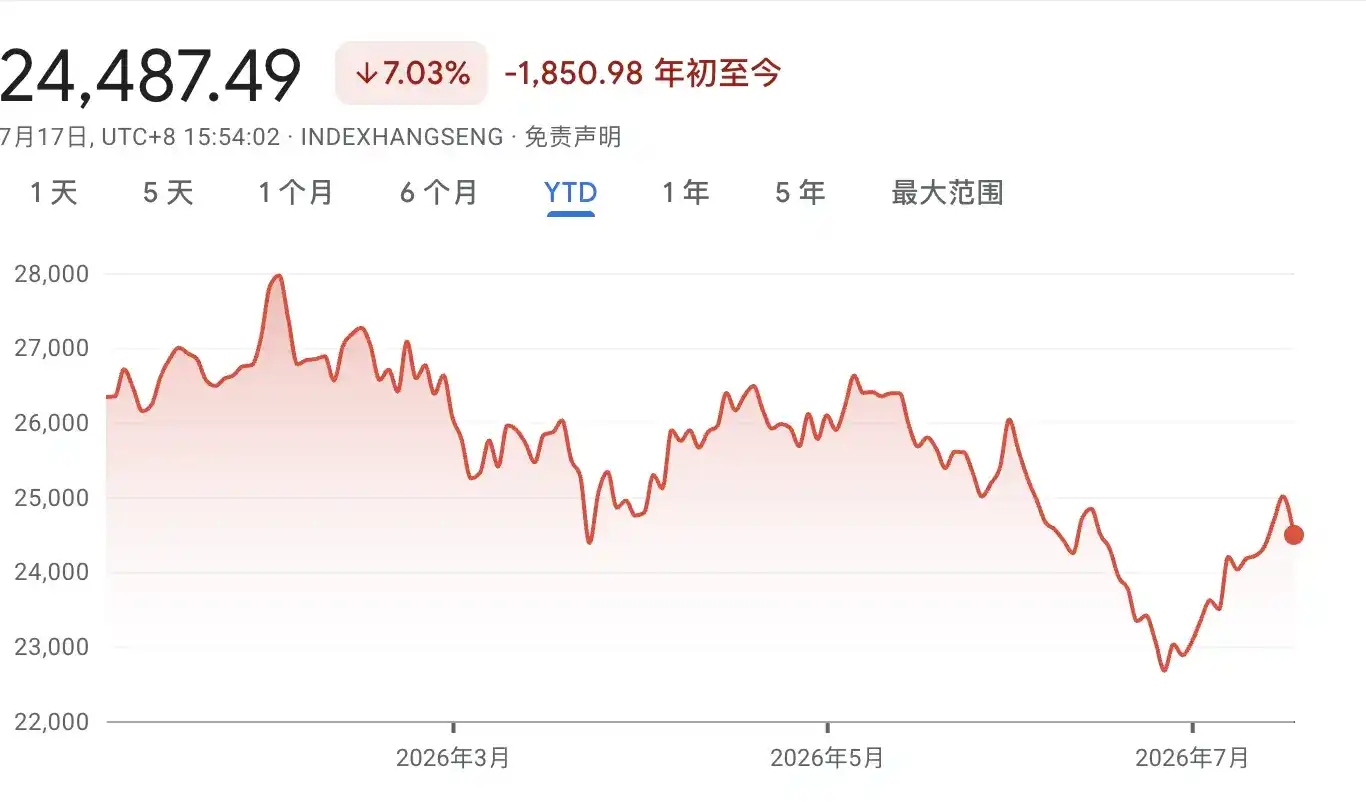
This stands in stark contrast to the strong performance of other major global markets. According to Bloomberg data, South Korea's benchmark index has surged 62% year-to-date, benefiting from the robust performance of two major chip giants; Japan's Nikkei 225 has risen 26%; and the iShares SOXX ETF tracking the semiconductor sector has skyrocketed 76%.

It is precisely this significant underperformance that leads Burry to believe Hong Kong stocks present a 'bargain-hunting' condition—when global capital begins to reassess the sustainability of the AI frenzy, previously overlooked Hong Kong stocks may usher in a catch-up opportunity.

Goldman Sachs: Index Distortion, HK Market Already in AI Era

Goldman Sachs' perspective offers another dimension of interpretation—the sluggishness of Hong Kong stocks is, to some extent, a 'false impression' caused by the structural lag of the indices.

Wang Yajun, Goldman Sachs' Head of Asia (ex-Japan) Equity Capital Markets, bluntly stated at a recent media briefing, the Hong Kong market has entered the AI era, but the major stock indices have not yet been able to reflect this reality. This is the fundamental reason for the 'hot IPO market vs. weak index performance' dichotomy.

Wang pointed out that the hottest topic in the Hong Kong stock market this year is AI. The most actively traded, best performing, and largest fundraising stocks are all AI-related. However, adjustments to index components take a relatively long time, leading to a mismatch between the indices and the true market landscape. He expects total equity financing volume in the Hong Kong market this year could hit a record high, with full-year IPO proceeds potentially surpassing the historical peak of 2021. More AI companies are also expected to list in Hong Kong in the second half of the year.

Regarding fundamental judgment, Wang believes that supported by end-demand growth, capital expenditure by AI companies will continue, providing a basis for the long-term performance of related sectors.

Multiple Bullish Voices Converge, Divergence Remains

Burry is not alone. According to Bloomberg, Morgan Stanley recently also urged investors to buy Hong Kong stocks, citing optimism about corporate earnings prospects and the belief that the impact of restricted share sales will be relatively limited.

However, the bullish logic for Hong Kong stocks is not without challenges. The Hang Seng Index's decline this year reflects persistent market concerns about the pace of China's consumption recovery and the profitability of the e-commerce sector. These structural pressures are difficult to dissipate completely in the short term. The 'index-market mismatch' described by Goldman's Wang also means that ordinary investors, referencing only the indices, may both underestimate the structural opportunities within Hong Kong stocks and overlook the pressures still facing traditional heavyweights.

For investors, Burry's bottom-fishing signal and Goldman's AI narrative together sketch a picture of opportunity for Hong Kong stocks. Yet, the core challenge facing the market remains how to precisely position between overall index pressure and structural bright spots.


Related Questions

QWhy does Michael Burry believe that now is a 'great time' to look for bargains in the Hong Kong stock market?

AMichael Burry believes it's a great time to look for bargains in Hong Kong stocks because he anticipates a cooling off of the global AI chip stock frenzy, which would cause capital to flow out of markets like South Korea and Japan and out of semiconductor sectors. This shift would make the currently underperforming and more attractively valued Hong Kong market a potential destination for that capital.

QWhat supporting action has Michael Burry taken regarding his bullish view on Hong Kong/Chinese stocks?

AAccording to Bloomberg, Michael Burry has taken action by increasing his holdings in the Chinese e-commerce company JD.com and establishing new positions in DraftKings and Flutter, indicating his view extends beyond just verbal statements.

QHow has the performance of the Hong Kong stock market compared to other major global markets in 2024, according to the article?

AThe Hong Kong stock market has significantly underperformed other major global markets in 2024. The Hang Seng Index is down about 7% and the Hang Seng Tech Index is down over 15%. In contrast, South Korea's benchmark index is up 62%, Japan's Nikkei 225 is up 26%, and the iShares Semiconductor ETF (SOXX) has surged 76%.

QWhat is Goldman Sachs' Wang Yajun's argument regarding the perceived disconnect between Hong Kong's market activity and its main stock indices?

AGoldman Sachs' Wang Yajun argues that while the Hong Kong market has already entered the AI era, its main stock indices have not yet reflected this reality. He states that AI-related stocks are the most active, best-performing, and largest in fundraising, but index composition lags, creating a mismatch between the index performance and the market's true dynamism.

QAccording to the article, what are some of the key challenges or risks that remain for the Hong Kong stock market despite the bullish views presented?

AKey challenges include persistent concerns about the pace of China's consumption recovery and the profitability of the e-commerce sector, which have weighed on the market. Additionally, the 'mismatch' between index performance and market reality means that while there are structural opportunities in AI, traditional heavyweights in the index may continue to face pressure.

Related Reads

With Less Than 1% Support, Will BIP-110 Still Force a Bitcoin Soft Fork?

**English Summary:** Despite garnering minimal support (less than 1% from miners and around 14.6% of nodes), the controversial BIP-110 proposal is poised to enter its "forced activation" window in early August. Proposed in December 2025 by Dathon Ohm and backed by Bitcoin Core developer Luke Dashjr, BIP-110 aims to temporarily restrict non-monetary data (like Ordinals and Bitcoin NFTs) in transactions for one year to reduce network "spam" and refocus Bitcoin on its monetary function. The proposal's contentious mechanism means that supporting nodes will enforce the new rules starting at block height 965,664 (late August/early September), even without reaching the 55% activation threshold. This will likely cause a chain split between nodes enforcing BIP-110 and the main chain. **Supporters**, led by Luke Dashjr and his Ocean mining pool, view BIP-110 as a necessary correction to stop what they consider an "attack" on Bitcoin—the use of block space for data storage, which they argue drives up transaction fees and burdens nodes. They believe the stricter BIP-110 chain could eventually become the longest chain. **Opponents**, including figures like Adam Back, Jameson Lopp, and Michael Saylor, argue that BIP-110 fails to solve core issues while creating new risks. Their concerns include stifling future innovation (e.g., hindering BitVM), compromising Bitcoin's censorship-resistant and decentralized ethos, introducing potential chain-split uncertainties like double-spend risks, and fracturing the ecosystem's resources and consensus. They maintain the proposal addresses a cultural problem with a flawed technical solution and are confident it will fail economically. Potential outcomes post-activation range from the BIP-110 chain stalling due to insufficient miner support, to a sustained minority chain that struggles to attract economic activity, potentially leading to a permanent hard fork—an outcome Luke Dashjr currently opposes. Most analysts and prediction markets assign a low probability (around 10%) to BIP-110 successfully becoming the dominant Bitcoin chain.

Odaily星球日报11m ago

With Less Than 1% Support, Will BIP-110 Still Force a Bitcoin Soft Fork?

Odaily星球日报11m ago

CLARITY Act Delays Have Become a Compliance Crisis, Not Just a Political Impasse

A year after the passage of three landmark digital asset bills in the U.S. House of Representatives, two have become law, while the critical CLARITY Act remains stalled in the Senate. This bill, which would definitively classify digital assets as either securities (SEC-regulated) or commodities (CFTC-regulated), has evolved from a political issue into a pressing compliance deadline for businesses. The ongoing delay perpetuates significant regulatory uncertainty, forcing companies to navigate a "regulation by enforcement" landscape that complicates governance, risk management, and strategic planning. With the Senate's legislative window rapidly closing before the August recess, the failure to pass the CLARITY Act could postpone comprehensive market structure legislation for years. Major sticking points in the Senate include ethical concerns over officials' crypto holdings, law enforcement opposition to certain liability shields, potential loopholes in stablecoin regulations, and vacancies at the key regulatory agencies (SEC and CFTC). This impasse stands in contrast to other jurisdictions, like South Africa, which are advancing with clear regulatory frameworks. Regardless of the legislative outcome, compliance leaders are urged to proactively audit their digital asset exposures, document their compliance rationale, and prepare contingency plans for both regulatory scenarios. The clarity promised by Congress remains incomplete, and businesses must prepare for either outcome.

marsbit12m ago

CLARITY Act Delays Have Become a Compliance Crisis, Not Just a Political Impasse

marsbit12m ago

Trump’s Teleprompter Operator Investigated for Insider Trading, "Whistleblower" Turns Out to Be Prediction Platform Kalshi

According to reports from CNBC and ABC, a longtime teleprompter operator for President Trump, Gabriel Perez, is under federal investigation for allegedly using insider information to place bets on the prediction market platform Kalshi. Perez, who had handled Trump's speeches since 2016, is suspected of trading on over a dozen upcoming presidential addresses, including the State of the Union, based on his advance knowledge of speech content. Kalshi's monitoring systems flagged the atypical trading patterns in March, leading to his account being frozen and the case being referred to the Commodity Futures Trading Commission (CFTC). Perez reportedly profited over $90,000, though most funds are held by the platform. He is now in settlement talks with the CFTC and has been placed on unpaid leave by the White House. This incident is part of a broader pattern of insider trading on prediction markets. Similar cases involve a congressional candidate betting against his own attendance, military personnel using classified information, and a Google engineer trading on internal data. The growing liquidity of these markets, with some contracts seeing over $150,000 in volume, creates incentives for abuse. In response, platforms like Kalshi are enhancing monitoring, requiring occupational disclosures, and cooperating with regulators. The CFTC and the Justice Department are pursuing civil and criminal actions, while the White House has issued memos explicitly barring staff from such trading.

Foresight News21m ago

Trump’s Teleprompter Operator Investigated for Insider Trading, "Whistleblower" Turns Out to Be Prediction Platform Kalshi

Foresight News21m ago

CLARITY Act Delays Have Become a Compliance Crisis, Not Just a Political Stalemate

The article discusses the ongoing delay in the US Senate regarding the CLARITY Act, a bill intended to clarify the regulatory status of digital assets as either securities under the SEC or commodities under the CFTC. A year after the House passed it, this inaction is creating a concrete governance, risk, and compliance crisis for businesses, moving beyond mere political gridlock. While related bills for stablecoins and CBDC prohibitions have become law, the comprehensive CLARITY Act remains stalled. The delay creates profound uncertainty for companies on fundamental rules for exchanges, custodians, and all market participants. Without clear congressional action, regulatory classification depends on shifting enforcement actions and presidential administrations, making stable compliance impossible. The Senate's window for action is narrowing, with key votes needed before the August recess. Several major issues are blocking passage, including ethical concerns over crypto holdings by officials, law enforcement opposition to certain provisions, perceived loopholes for stablecoin rewards, and regulatory agency vacancies at the SEC and CFTC. Bipartisan support is fragile. Further delay risks postponing the legislation until 2030, perpetuating a costly "regulation by enforcement" environment. In contrast, passage would provide a durable regulatory framework. Regardless of the outcome, compliance leaders are urged to immediately map their digital asset exposures, prepare governance materials for both scenarios, and stress-test their arrangements. The article concludes that while the Senate's action is uncertain, corporate preparedness is not.

Foresight News51m ago

CLARITY Act Delays Have Become a Compliance Crisis, Not Just a Political Stalemate

Foresight News51m ago

Trading

Spot
活动图片