Author:Zhao Ying
A battle between bulls and bears, represented by Michael Burry, is playing out in the Hong Kong stock market, with bullish voices continuing to gather.
Michael Burry, the investor famous for accurately predicting the 2008 U.S. subprime mortgage crisis and who became the prototype for the film The Big Short, recently publicly stated that now is a "perfect time" to look for cheap stocks in the Hong Kong stock market. His bullish logic is based on the prediction of a cooling global AI chip stock frenzy, believing that funds will flow out of South Korea, Japan, and the semiconductor sector to seek undervalued areas.
Meanwhile, Wang Yajun, Goldman Sachs' head of equity capital markets for Asia (ex-Japan), also pointed out that the Hong Kong market has de facto entered the AI era, though the major indices have yet to reflect this reality.
The views from both sides point to the same conclusion from different angles: there is a significant disconnect between the current weak performance of Hong Kong stocks and the underlying vitality within the market. This disconnect itself may constitute an investment opportunity. For investors seeking undervalued assets, the attractiveness of Hong Kong stocks is rising.
Burry Bullish on Hong Kong Stocks: A Valuation Gap After AI Mania Cools
Michael Burry, founder of Scion Asset Management, posted on platform X on July 17, stating, "Perfect time to look for cheap Hong Kong stocks, should do well as Korea, Japan, and SOXX (semiconductor ETF) fade."
Burry's statement comes with a market backdrop. Global chip stocks recently faced large-scale sell-offs. Lingering doubts about whether AI companies can translate technological investment into actual profits, coupled with high capital expenditure pressure, have weighed on the previously global-leading semiconductor sector. In contrast, Hong Kong stocks' year-to-date decline has made their valuations relatively more attractive.
Notably, Burry had already taken action earlier this month – according to Bloomberg, he increased his stake in Chinese e-commerce firm JD.com and established new positions in DraftKings and Flutter, showing his bullish stance on Hong Kong stocks and related Chinese tech stocks is not merely talk.
Hong Kong Stocks Lag Far Behind Global Major Markets This Year
Data clearly shows the relative weakness of Hong Kong stocks. The Hang Seng Index is down about 7% year-to-date, while the Hang Seng Tech Index has fallen a deeper 15.22%, mainly dragged down by weak consumer spending and insufficient market confidence in the outlook for China's e-commerce sector.
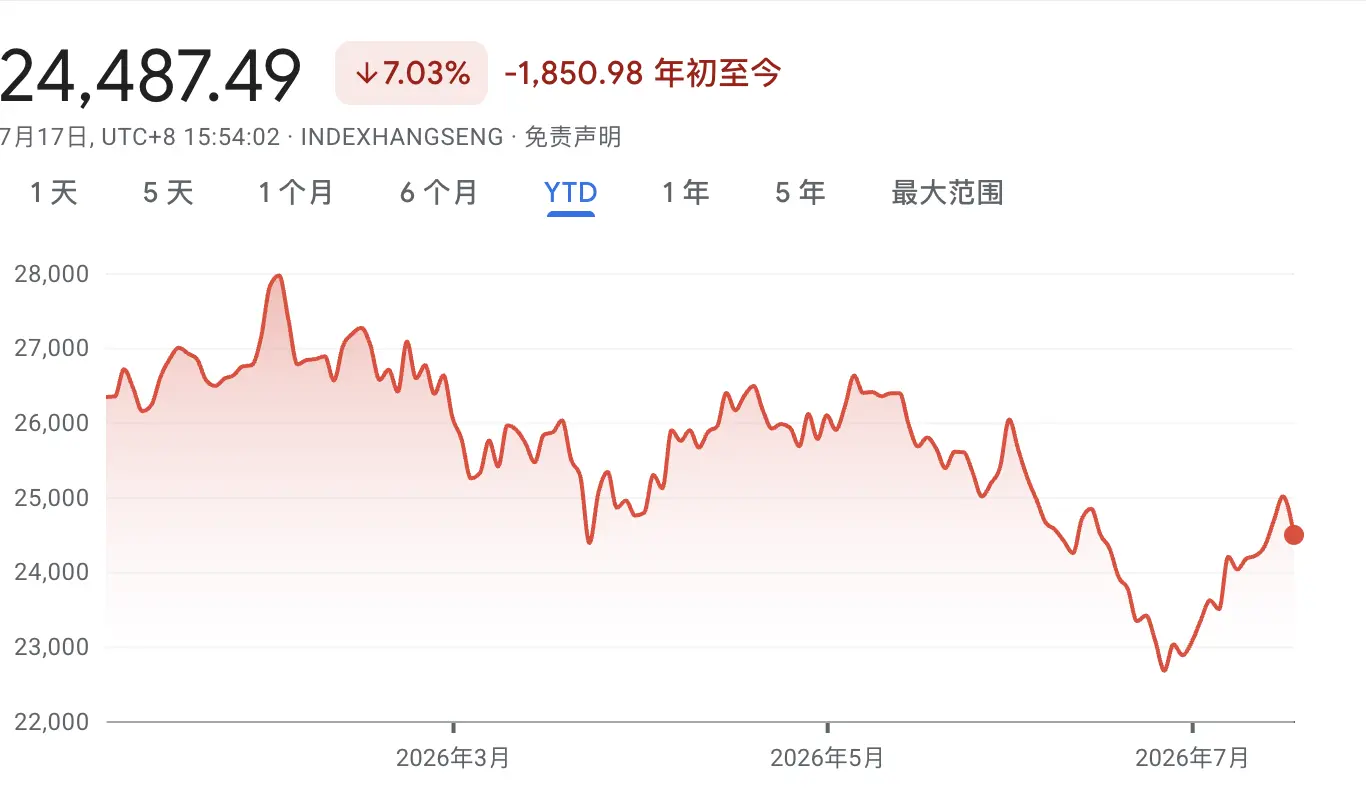
This starkly contrasts with the strong performance of other major global markets. According to Bloomberg data, South Korea's benchmark index has surged 62% year-to-date, benefiting from the strong performance of its two chip giants; Japan's Nikkei 225 has risen 26%; and the iShares SOXX ETF tracking the semiconductor sector has skyrocketed 76%.
It is precisely this significant underperformance that leads Burry to believe Hong Kong stocks meet the conditions for "bargain hunting" – when global capital begins to re-examine the sustainability of the AI frenzy, previously neglected Hong Kong stocks may see a catch-up opportunity.
Goldman Sachs: Index Distortion, Hong Kong Market Has Entered AI Era
Goldman Sachs' perspective provides another dimension of interpretation – the weakness of Hong Kong stocks is, to some extent, a "false impression" caused by structural lag in the indices.
Wang Yajun, head of equity capital markets for Asia (ex-Japan) at Goldman Sachs, bluntly stated at a recent media briefing, the Hong Kong market has entered the AI era, but the major stock indices have not yet been able to reflect this reality. This is the fundamental reason for the "icy fire double sky" phenomenon of a hot IPO market coexisting with sluggish index performance.
Wang Yajun pointed out that the hottest topic in the Hong Kong stock market this year is AI. The most active, best-performing, and largest fundraisers are all AI-related stocks. However, adjustments to index constituents take a relatively long time, leading to a mismatch between the index and the true face of the market. He expects that total equity financing in the Hong Kong market this year is likely to hit a record high, with annual IPO fundraising potentially surpassing the historical peak of 2021. More AI companies will list in Hong Kong in the second half of the year.
Regarding the fundamental outlook, Wang Yajun believes that supported by end-user demand growth, capital expenditure by AI companies will continue, providing a foundation for the long-term performance of related sectors.
Multiple Bullish Voices Gather, Divergence Remains
Burry is not fighting alone. According to Bloomberg, Morgan Stanley recently also called on investors to buy Hong Kong stocks, citing optimistic expectations for corporate earnings as one reason, and believing that the impact of lock-up expiries will be relatively limited.
However, the logic for being bullish on Hong Kong stocks is not without challenges. The Hang Seng Index's downtrend this year reflects persistent market concerns about the pace of China's consumption recovery and the profitability of the e-commerce sector. These structural pressures are difficult to completely dissipate in the short term. The "index-market mismatch" described by Goldman's Wang Yajun also means that ordinary investors who only refer to the index may both underestimate the structural opportunities within Hong Kong stocks and overlook the pressures still facing traditional heavyweight constituents.
For investors, Burry's bottom-fishing signal and Goldman's AI narrative together sketch a picture of opportunity for Hong Kong stocks. However, the core challenge facing the market remains how to position precisely between overall index pressure and structural bright spots.