Author: Kinjal Shah
Compiled by: Jiahuan, ChainCatcher
In 2024, Sam Altman made a bold prediction: as AI rises, a one-person billion-dollar company will soon emerge.
The core shift lies in humanity, for the first time, being able to scale in the dimension that has always constrained us: time. When intelligence is no longer bottlenecked by the human need for sleep but is instead driven by machines that never tire, what will become of the "creation and building" we are familiar with?
Imagine this scene: one agent delegates a task to another, receives the results, pays in USDC, with the entire transaction settling on-chain in 400 milliseconds, with no intermediary needed for verification.
Or, an athlete licenses their signature touchdown celebration to a video game marketing campaign, regenerated by a world model. Or, a scientist pays the original researcher directly to access a niche dataset for an experiment.
We are closer to this vision than most people think.
And the prevalent fear in current discussions (that AI is taking jobs) misses a more interesting structural question: What happens when the fundamental unit of labor itself changes?
Every Transition
Ronald Coase provided the clearest answer to why firms exist in his 1937 paper, "The Nature of the Firm": companies bring labor "inside" when the cost of coordinating through the market is higher than the cost of directly employing people.
Every major labor transition in history has been a direct result of falling coordination costs. When the friction of finding, paying for, and managing work decreases, the boundaries of the firm move accordingly, and work that previously had to be done internally can be shifted outside.
Artisans of the past operated through multi-node supply chains, with each craftsman taking a share of the value, and skills passed down through generations of apprentices. The Industrial Revolution compressed this distributed model into factories, which captured the vast majority of production value by centralizing coordination "under one roof."
The internet and mobile devices once again lowered matching and coordination costs, giving rise to the gig economy (Uber, DoorDash) and the creator economy: ordinary people with a camera and an internet connection started doing work that previously only studios, publishers, and agencies could handle.
Bridge Classes
Before the emergence of infrastructure capable of capturing all value, each of these transitions first gave rise to a "bridge class," which proved the new model was viable.
Artisans proved distributed production was possible, then factories captured the value through centralization. Creators proved that individuals could build audiences and generate revenue at scale, then major platforms (YouTube, Instagram, Substack) took the lion's share of economic returns, becoming the default Schelling points for the entire system.
The bridge class bears the risk for new technologies and validates that demand is real. Once the infrastructure catches up, a new set of institutions captures value at scale.
The gig economy and the creator economy are the two most recent bridge classes. They proved that work could be broken down, distributed, and compensated outside traditional employment relationships.
But they still rely on platforms to package this economic activity: using Stripe for payments, YouTube for content distribution, Uber for ride matching. Coordination costs are lower, but not gone, because the payment and identity infrastructure still assumes that both parties to a transaction are human.
Programmable Labor Meets Programmable Money
We are now in the early stages of the next transition, and it hinges on two things arriving simultaneously.
The first is programmable labor. AI agents are a new class of labor participants, unconstrained by work hours, headcount, or geography, scaling with compute power rather than by hiring people.
A top-level agent can decompose a task, delegate to specialized sub-agents, evaluate their output, and arrange the next steps, all without human intervention. Here, the fundamental unit of labor is no longer a job, an hour, or even a deliverable, but the task itself.
In the past, humans bundled tasks into jobs, jobs into careers, and careers into companies, simply because that was the only organizational form available. When you can price a single task directly and dispatch it directly, "bundling" shifts from a structural necessity to an option.
The second is programmable money. Today, stablecoins are an asset class of about $300 billion, with credible projections from multiple institutions suggesting they could reach $2 trillion in the coming years. Stablecoins compress the entire payment supply chain into a programmable transaction.
The gig economy couldn't completely unbundle labor because you still rely on Stripe, PayPal, or bank accounts on both ends, and this infrastructure presupposes an ongoing relationship between known parties.
Stablecoins may be the optimal solution for this new labor class of agents. An agent can pay another agent based on output, in amounts as small as fractions of a cent, settled within 500 milliseconds, with no account opening, invoicing, or any intermediary.
Meta recently started distributing USDC to creators on Polygon and Solana, and AWS launched AgentCore with support for stablecoin micropayments, specifically for commercial interactions between agents. These are early signals that the world's largest tech companies see stablecoins as the settlement layer for the next generation of economic activity.
Programmable labor combined with programmable money makes it historically possible for the first time to have a production pipeline without an organizational entity—no company, no payroll system, no HR department—just a series of tasks assigned, executed, priced, and settled at machine speed.
This is the true unbundling of labor.
Practical Applications
Merit Systems has made this very concrete with a product called Poncho. Poncho gives an AI agent a wallet.
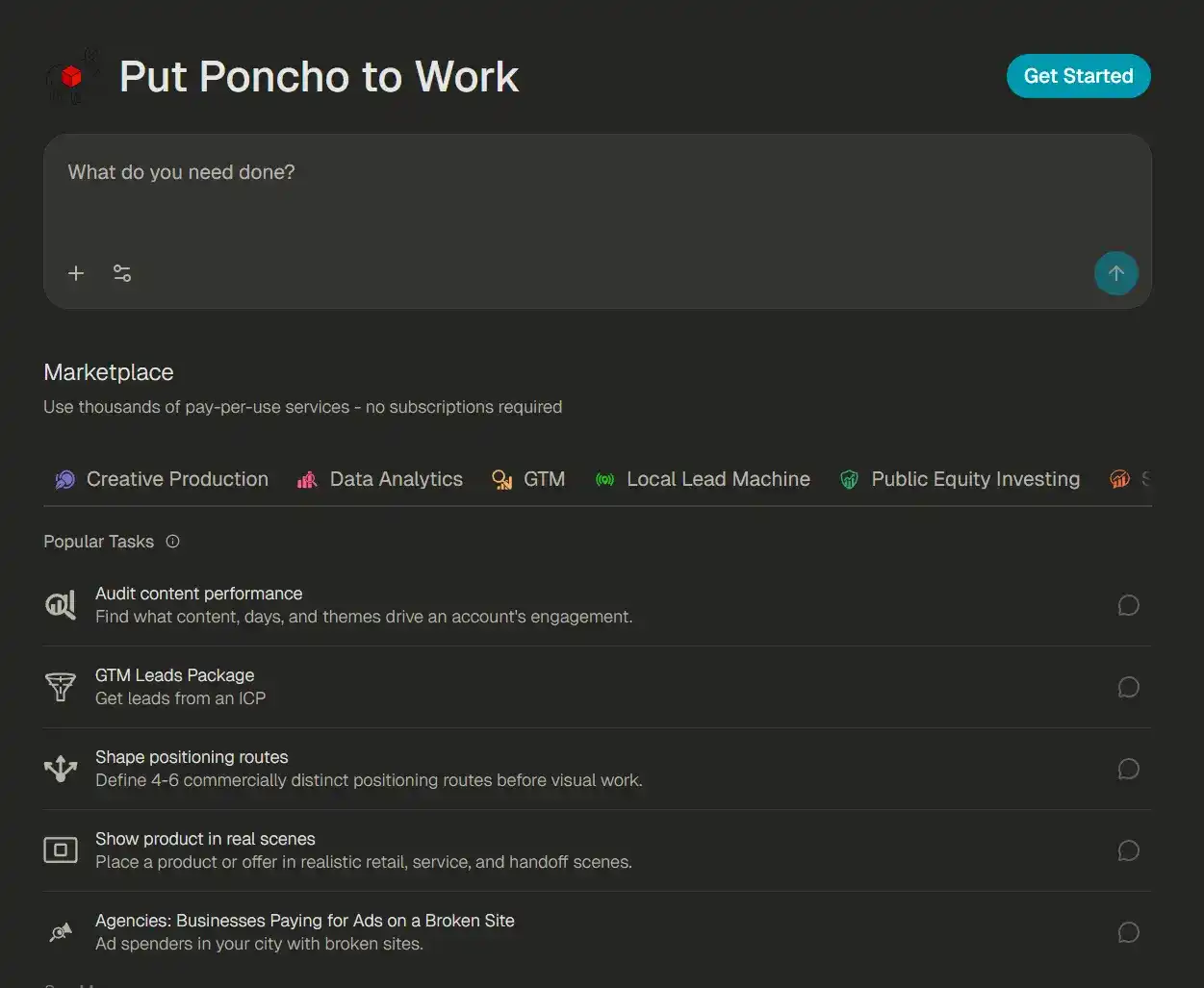
With it, an agent can cross paywalls on its own, call premium tools, pay for services, and pay only for the exact usage consumed. Poncho integrates with payment protocols like x402 and MPP, which embed payment authorization directly into HTTP requests: the agent sees the price, pays, and gains access.
This represents another way for economic value to flow across the internet. Agents don't have to subscribe to a large bundle of services they might or might not use. Instead, they can pay precisely for the specific data, API call, or compute needed for a particular task.
The early internet explored this idea under the banner of "micropayments" but never succeeded. One reason was that credit card fees made such small payments economically unviable, among other challenges, and there was no internet-native payment rail.
Stablecoins, powered by infrastructure like Solana and Ethereum, enable instant settlement for fractions of a cent, meaning pricing can finally match the granularity of work.
Rebundling
If you follow this hypothesis, as work is increasingly done by agents paying other agents per task, the form of the company will also change. You no longer need to bring every function in-house.
What you truly need to excel at is defining clearly what needs to be done, what standards measure quality, and how to combine these outputs into a whole greater than the sum of its parts.
This extends to the creator economy as well. Peer-to-peer tipping has never quite taken off, as evidenced by Clubhouse and Farcaster. But micropayments are particularly suitable for machine-to-machine interactions: small payments carry no social awkwardness and no expectation of reciprocity.
If agents become the primary consumers of digital content, the subscription and paywall models that have long dominated the internet might give way to programmatically executed, per-use fees.
As AI-generated content floods every channel, the premium for human judgment and craftsmanship will only increase. The most interesting business models will emerge at the intersection of human taste and machine execution.
In an agent-driven economy, the human role is to rebundle labor. You are the orchestrator. Your job is to design a system where different agents perform specific functions in a particular configuration, turning a flywheel to progressively generate the results you want.
Your value lies in: knowing what tasks to delegate, how to evaluate them, and how to combine them into something that generates compound returns.
Companies won't disappear, but future companies will look less like containers holding labor and more like an intelligent layer built on top of a global market of programmable labor.