BlackRock CEO's Annual Shareholder Letter: How Will Wall Street Continue to Make Money with AI and National Pension Funds?

marsbitPublished on 2026-03-24Last updated on 2026-03-24

Abstract

BlackRock CEO Larry Fink's 2026 shareholder letter warns that AI is creating a "K-shaped outcome," accelerating wealth concentration. Over the past 20 years, the S&P 500 grew eightfold, but 54% of stock wealth went to the top 1% of U.S. households, while the bottom 90% held just 7%. Fink argues that AI could exacerbate this inequality by benefiting large corporations and investors. He proposes two solutions: a bipartisan plan to inject $1.5 trillion into a government-managed investment fund to address Social Security shortfalls, and the promotion of tokenization to lower investment barriers for ordinary investors through regulated digital wallets. Notably, BlackRock’s tokenized U.S. Treasury fund (BUIDL) has grown significantly, positioning the firm to benefit from both proposals. Simultaneously, JPMorgan launched a credit default swap basket targeting major tech firms, signaling institutional preparation for AI-related debt risks. Fink’s diagnosis of inequality is accurate, but his solutions align closely with BlackRock’s business interests, highlighting a structural overlap between his policy advocacy and the firm’s growth strategy.

Larry Fink, CEO of BlackRock, which manages $14 trillion in assets, released his 2026 annual shareholder letter on March 23. In the letter, he warned that AI is creating a "K-shaped outcome," with leading companies accelerating away from everyone else. He wrote, "When market capitalization climbs while ownership remains narrow, prosperity can feel increasingly distant."

This is not an empty statement. Over the past 20 years, the S&P 500 has increased 8-fold. But according to the Federal Reserve's 2022 Survey of Consumer Finances (SCF), the distribution of this 8-fold growth has been extremely concentrated.

The wealthiest 1% of U.S. households captured 54% of all stock market wealth, a figure that was 40% 20 years ago. The next 2-10% captured 39%. The bottom 90% of Americans collectively hold only 7% of stocks, and the bottom 50% hold just 1%. According to Gallup data, 87% of households with an annual income over $100,000 own stocks, compared to only 28% of those with incomes under $50,000.
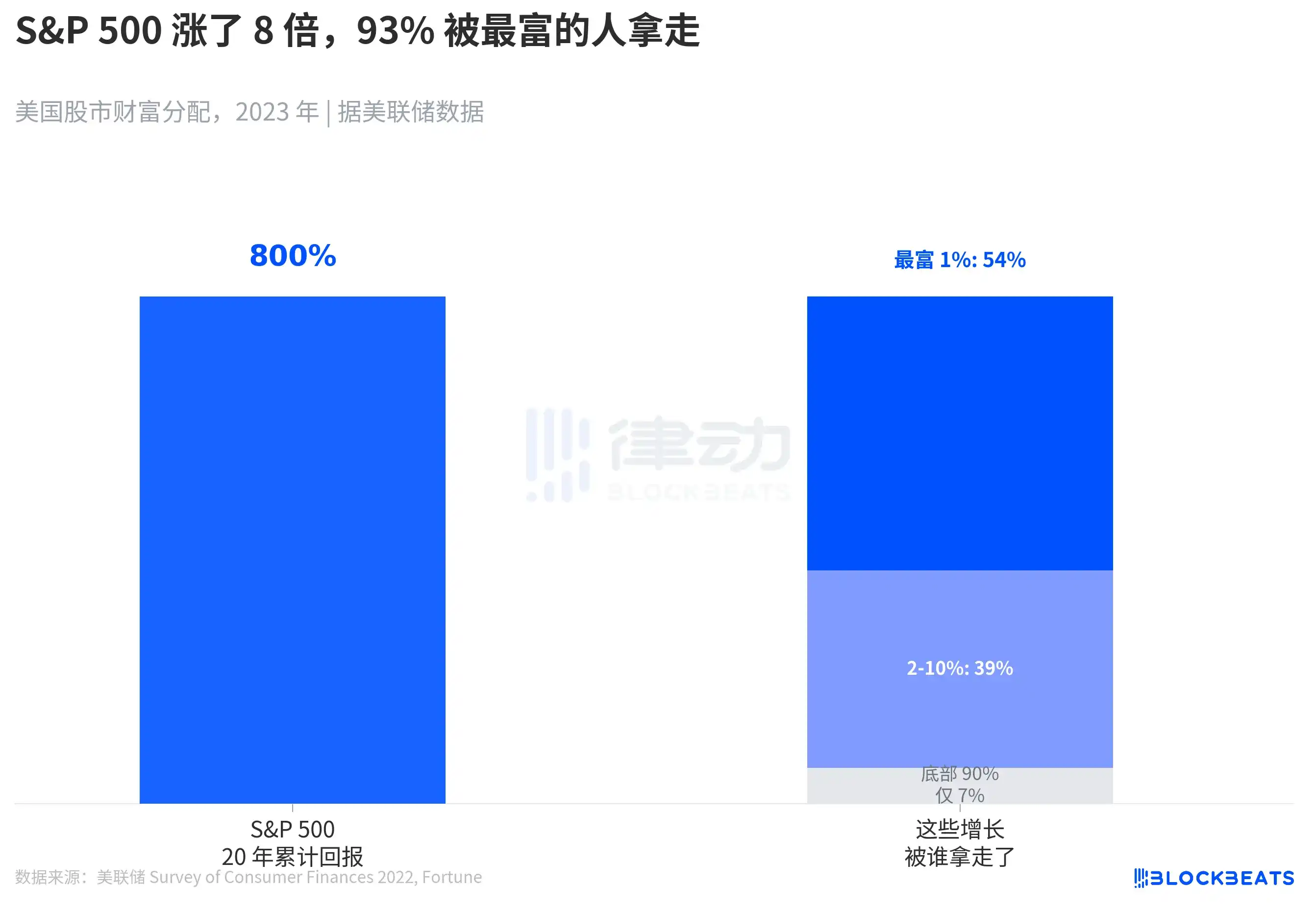
Fink used a precise analogy in his letter. "Since 1989, one dollar invested in the U.S. stock market has appreciated more than 15 times one dollar tied to the median wage." In other words, the gap between those with money to invest and those relying solely on wages has widened 15-fold over 35 years. He worries that AI will "repeat this pattern on a larger scale, concentrating wealth in the companies and investors capable of capturing it."

This diagnosis is accurate. The prescription that follows is the part of the letter that is truly worth dissecting.

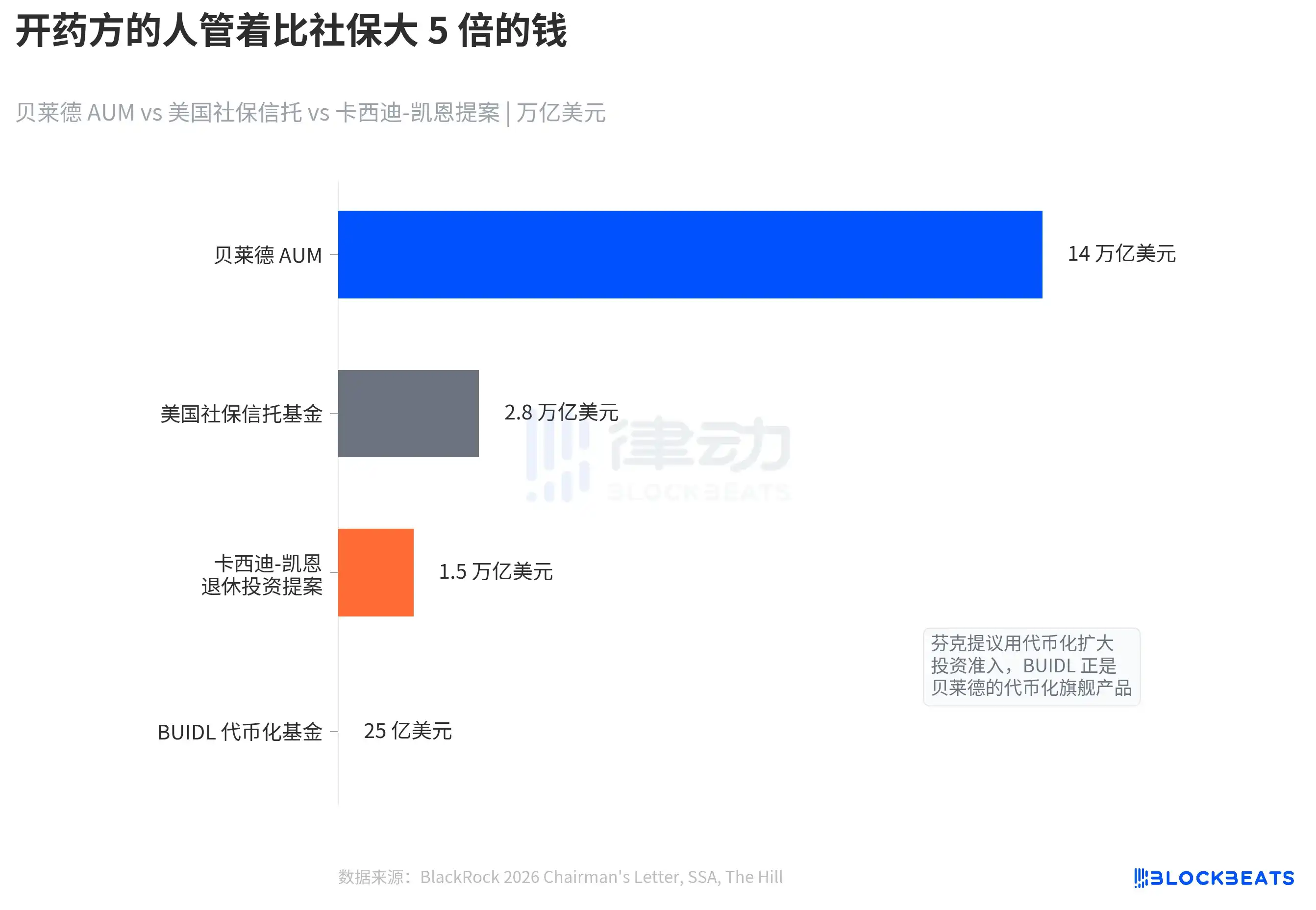
Fink cited a bipartisan proposal by Senators Bill Cassidy and Tim Kaine. The content involves the federal government borrowing $1.5 trillion over 5 years to inject into an investment fund independent of the existing social security system. This fund would buy stocks, private equity, and other assets, lock them in for 75 years, and use the returns to supplement the social security shortfall. The U.S. Social Security Trust Fund is projected to be depleted by 2033, at which point beneficiaries would receive only 83% of promised benefits.

Compare the numbers. The U.S. Social Security Trust Fund is about $2.8 trillion; the Cassidy-Kaine proposal would inject $1.5 trillion. BlackRock's assets under management are $14 trillion, 5 times the size of the Social Security fund. If the government really establishes a $1.5 trillion investment fund, who will manage it? Fink didn't say it directly, but BlackRock is the world's largest asset manager.
Even more intriguing is the second prescription Fink offers. He positions tokenization as being "roughly equivalent to the internet in 1996" and proposes establishing "a regulated digital wallet" that would allow ordinary investors to use it to hold ETFs, bonds, stablecoins, and infrastructure shares. This would lower the barrier to investment and allow more people to participate in the market.

This vision corresponds perfectly to BlackRock's biggest business bets over the past two years. BlackRock's BUIDL fund (an on-chain tokenized U.S. Treasury fund) surpassed $1 billion in AUM in March 2025, peaking at nearly $2.9 billion mid-year, capturing over 40% of the tokenized Treasury market. In February 2026, BUIDL launched on Uniswap, allowing whitelisted investors to trade with stablecoins 24/7. According to CCN, BUIDL has become one of the world's largest tokenized cash products.

Fink's declaration of interest and policy recommendations align perfectly. He calls for more people to enter the investment market through tokenization, and BlackRock's flagship tokenized product is already waiting to onboard clients. He proposes the government establish a large investment fund, and BlackRock is the most qualified institution to manage that money. This is not an accusation that he is lying; it is pointing out a structural fact. When the CEO of the world's largest asset manager calls for expanded investment access, he is simultaneously calling for an expansion of his own client base.

On the same day, another signal came from Wall Street.

According to Bloomberg, JPMorgan Chase launched a CDS (credit default swap) basket in February 2026 targeting the five hyperscale companies (Alphabet, Amazon, Meta, Microsoft, Oracle), with a trading unit of $25 million. These five companies issued approximately $121 billion in bonds in 2025, 4.3 times the average annual issuance of $28 billion from 2020-2024. According to Bank of America forecasts, issuance will further climb to $175 billion in 2026.
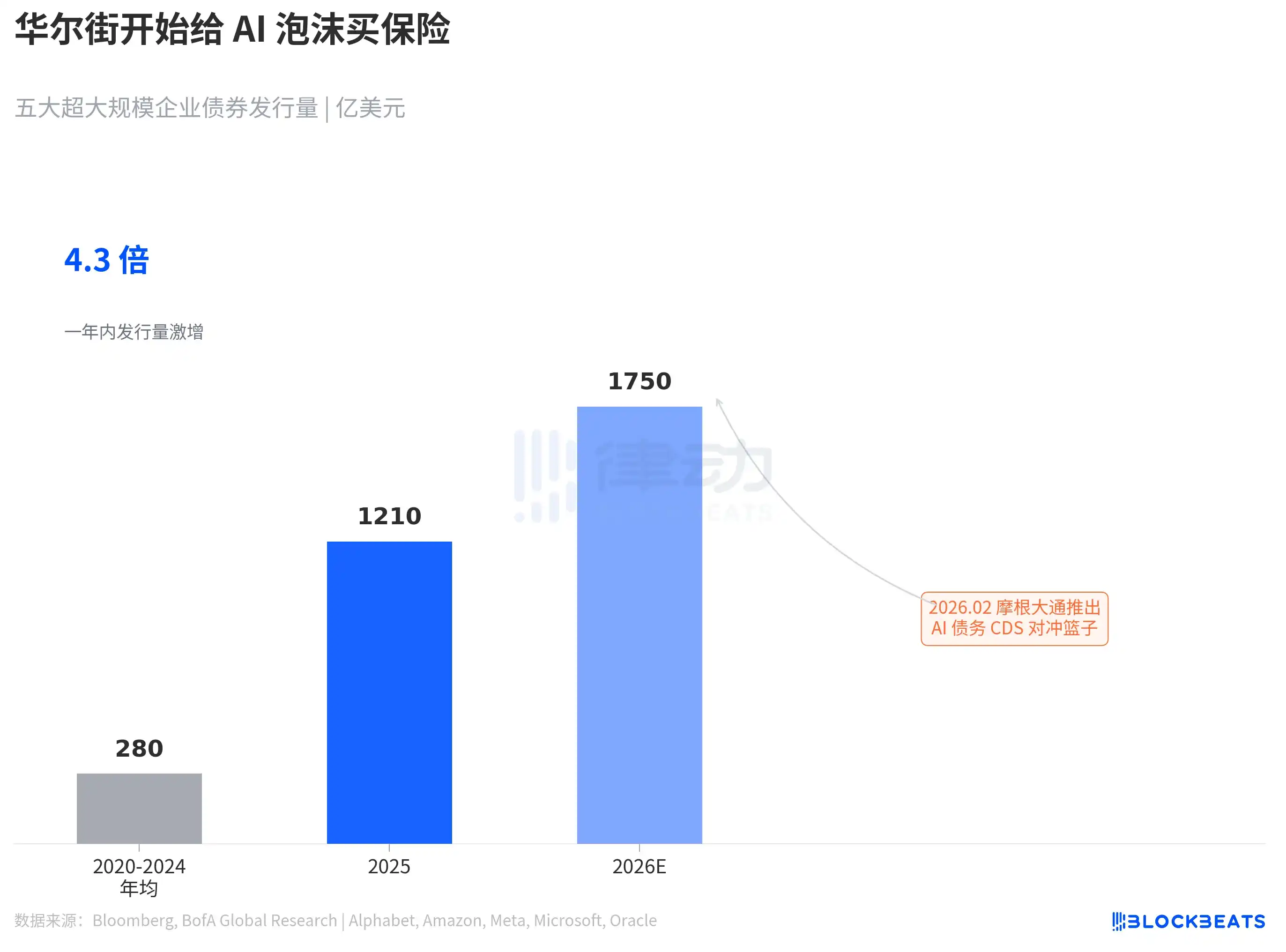
When Wall Street starts designing hedging tools for AI infrastructure debt, it indicates that institutional investors are already preparing for a potential bubble burst. Fink says AI will exacerbate inequality; JPMorgan says AI's debt risk is already significant enough to warrant selling insurance. Both signals point to the same fact. The AI boom is creating enormous wealth, but the distribution of this wealth and its risk exposure are repeating the pattern of the previous cycle in a familiar way.

Fink manages $14 trillion. His diagnosis of inequality is accurate. But the medicine he prescribes happens to be his own product.


Trending Cryptos

Related Questions

QWhat is the 'K-shaped outcome' that BlackRock CEO Larry Fink warns about in his annual shareholder letter?

ALarry Fink warns that AI is creating a 'K-shaped outcome,' where leading companies accelerate and pull away from everyone else, concentrating wealth among those with the capacity to capture it.

QAccording to the Federal Reserve's 2022 Survey of Consumer Finances, what percentage of total stock market wealth do the top 1% of U.S. households hold?

AThe top 1% of U.S. households hold 54% of all stock market wealth, up from 40% twenty years ago.

QWhat is the bipartisan proposal mentioned by Fink that involves the federal government borrowing $1.5 trillion?

AThe bipartisan proposal by Senators Bill Cassidy and Tim Kaine suggests the federal government borrow $1.5 trillion over five years to inject into an independent investment fund that buys stocks, private equity, and other assets to supplement the Social Security shortfall.

QWhat is BlackRock's BUIDL fund, and what milestone did it achieve in 2025?

ABlackRock's BUIDL fund is an on-chain tokenized U.S. Treasury fund. In March 2025, it surpassed $1 billion in assets under management (AUM), with a mid-year value nearing $2.9 billion, capturing over 40% of the tokenized Treasury market.

QWhat does the launch of JPMorgan's CDS basket for five mega-cap tech companies indicate about the AI boom?

AJPMorgan's launch of a CDS basket for Alphabet, Amazon, Meta, Microsoft, and Oracle indicates that institutional investors are preparing for potential risks and a possible bubble burst in AI infrastructure debt, highlighting the concentrated wealth and associated risks in the AI sector.

Related Reads

Within Strategy's Framework, STRC's Dividend Yield Remains at 12% as Share Price Stays Below Par Value

Michael Saylor, Executive Chairman of Strategy (MSTR), confirmed that the dividend rate for its STRC perpetual preferred shares will remain at 12.00% through August 2026. The rate has increased from 9% at its July 2025 launch to the current high via a "ratchet" mechanism, which permanently raises the rate by 0.5% whenever the share price falls below $95. This mechanism is intended to push the price back toward its $100 par value and support Strategy's "at-the-market" (ATM) program for issuing new shares to fund Bitcoin purchases. However, the mechanism has not worked as intended. STRC shares closed at $89.46 on July 31, remaining about 10-11% below par value despite the record-high dividend. Competition from rival Strive's higher-yielding SATA securities has pressured demand. The persistent discount has forced Strategy to suspend new STRC issuances via its ATM program, limiting this funding channel for Bitcoin acquisitions. STRC's struggles reflect Bitcoin's own volatility, as the preferred shares historically move in tandem. Analysts have warned the ratchet structure carries long-term, one-way risk. A law firm is investigating Strategy's ability to maintain dividend payments if Bitcoin's price stays low. Retail investors own roughly 83% of outstanding STRC shares, a group seen as prone to panic selling during downturns. In response, Strategy has established financial reserves, including a liquidity cushion covering about 26 months of dividend/interest obligations, and a $2 billion share buyback program alongside a Bitcoin monetization framework, though the company emphasized it is not obligated to sell any Bitcoin.

cryptonews.ru11m ago

Within Strategy's Framework, STRC's Dividend Yield Remains at 12% as Share Price Stays Below Par Value

cryptonews.ru11m ago

Analyst: Bitcoin's Price Will Drop to $60k in August, Then Rebound to $70k

Financial analyst Andrey Poroshin has provided a new forecast for Bitcoin's price dynamics in August. Poroshin, an analyst at the Bitbanker exchange, expects the cryptocurrency market to experience a downturn this month, with prices retesting the $60,000 level due to a lack of supportive macroeconomic catalysts. He noted that the recent US Federal Reserve decision to hold interest rates did not significantly impact the market, while inflation remains above the 2% target. Poroshin stated that Bitcoin is ending July under pressure from moderate volatility and a lack of new macroeconomic stimuli, leading to continued market caution. According to his base scenario, Bitcoin will drop to a range of $60,000 to $62,000 before recovering to $70,000. He pointed out that even $70,000 remains below the cost of mining in the US, which has prompted some miners to shift towards AI data center operations. Poroshin cited the winding down of BitMEX's operations as a potential catalyst for a price rebound, suggesting the exit of weaker players often coincides with market reversals and reduced short-term selling pressure. He believes Bitcoin is currently less susceptible to geopolitical shocks, such as the Iran-US conflict, and does not expect significant market changes in August related to the pending CLARITY Act. Looking ahead, Poroshin forecasts that September will bring more active price fluctuations driven by potential Fed rate decisions and possible discussions or approval of the CLARITY Act.

cryptonews.ru12m ago

Analyst: Bitcoin's Price Will Drop to $60k in August, Then Rebound to $70k

cryptonews.ru12m ago

Trading

Spot

Hot Articles

Discussions

Welcome to the HTX Community. Here, you can stay informed about the latest platform developments and gain access to professional market insights. Users' opinions on the price of AI (AI) are presented below.

活动图片














