Bernstein Report: Agentic AI Will Transform CPU from Supporting Role to Leading Role, Bullish on Hygon Information

marsbitPublished on 2026-06-17Last updated on 2026-06-17

Abstract

Bernstein research report: Agentic AI will turn CPUs from supporting players to leading roles, bullish on Hygon Information. Analysts led by David Dai argue that AI is transitioning from the chatbot era to the agentic AI era. Unlike simple query-response models, agentic AI involves complex workflows including retrieval, planning, tool calling, and multi-step reasoning. This shift dramatically increases the demand for CPU compute to orchestrate these tasks, manage memory, and prevent expensive GPU idling. The report forecasts that the GPU-to-CPU ratio in inference clusters will reverse from 8:1 in 2025 to 1:1 by 2029. In agentic AI workloads, CPUs could account for 50% of the compute, on par with GPUs. Consequently, the server CPU Total Addressable Market (TAM) is projected to surge from $37 billion in 2025 to $223 billion by 2030, representing a 6x expansion. Arm is identified as a key beneficiary due to its superior performance-per-watt and a strategic shift from IP licensing to designing its own chips, targeting $15 billion in chip revenue by 2030. Bernstein raises Arm's price target to $500. For x86 vendors, the report is Overweight on AMD (target $600) and Hygon Information (target CNY 450), citing leadership and strong growth in the Chinese market respectively. Intel's target is raised to $100, reflecting upgraded earnings assumptions. The analysis acknowledges significant supply-side risks, questioning whether foundry and memory capacity can support such rapid CPU ...

Written by: Tide Research

When an AI agent is awakened, it is not waiting for an answer. It needs to retrieve information, plan steps, invoke tools, reason about intermediate results, call the model again, and finally execute actions. The entire workflow requires far more CPU computing power than ChatGPT popping up a single response.

The team led by Bernstein analyst David Dai released a report titled "Global Semiconductors: CPU Renaissance?" on June 17th. Its core thesis is: AI is transitioning from the chatbot era to the agentic AI era, and the CPU's role in the data center is shifting from a supporting role for the GPU to a leading role. This will drive the server CPU Total Addressable Market (TAM) to reach $223 billion by 2030, six times the $37 billion in 2025.

Reasoning is No Longer "One Q&A", CPU is Making a Comeback

Since the rise of large language models, GPUs/AI accelerators have been the core of AI computing. In custom inference clusters like Google TPU v6e and Meta Grand Teton, the GPU-to-CPU ratio was once 8:1.

But Bernstein believes that as agentic AI becomes mainstream, this ratio is reversing.

The core characteristic of Agentic AI is "looped reasoning": a single request may trigger retrieval, planning, tool calling, intermediate reasoning, another model invocation, and action execution. The GPU handles dense mathematical operations, but the CPU determines whether the entire system can efficiently orchestrate the workflow, schedule tasks, manage memory, and prevent accelerator idling. If the CPU is too weak, expensive GPUs are forced to wait idle, significantly reducing overall system efficiency.

Bernstein predicts that the GPU:CPU ratio in CSP inference clusters will drop from 8:1 in 2025 to 1:1 by 2029. In agentic AI workloads, the CPU's computational share will leap from 14% in traditional LLMs to 50%, on par with the GPU.

The report specifically points out that hardware roadmaps already corroborate this direction. AMD's next-generation Venice compute tray pairs each CPU with 4 MI455X GPUs. Nvidia's Vera superchip pairs each Vera CPU with 2 Rubin GPUs. Google's TPU v7x expansion unit pairs each CPU with 4 TPUs. The physical ratio of CPUs is already increasing; this is not a prediction but a current reality.

How is the $223 Billion Market Calculated?

Bernstein has significantly raised its 2030 server CPU TAM forecast from the previous $137 billion to $223 billion, based on the following core assumptions:

  • 2030 AI capital expenditure reaches $3.5 trillion, corresponding to 70GW of AI data center deployment.
  • AI accelerator market size is $1.6 trillion, accounting for 45% of AI DC capital expenditure.
  • Inference share rises from 35% to 70%, with a CPU:GPU ratio of 1:1 in inference scenarios and 0.5:1 in training scenarios.
  • CPU price is equivalent to 13% of GPU price.

Under this framework, the $223 billion TAM includes $174 billion from agentic AI workloads and $49 billion from non-AI traditional server CPUs. Compared to current levels, the entire server CPU market in 2025 is only $37 billion, with only $6 billion AI-related. This means that in Bernstein's forecast, the CPU market will undergo a six-fold expansion over the next five years, with a compound annual growth rate of 43%, almost unprecedented in semiconductor industry history. Bernstein also provided bull-case ($330 billion, assuming $4 trillion AI capital expenditure + 1.5:1 inference ratio) and bear-case ($137 billion, assuming $3 trillion capital expenditure + 0.5:1 inference ratio) ranges.

An interesting cross-verification comes from server CPU core counts: Arm data shows that agentic AI requires 120 million CPU cores per GW, four times that of traditional data centers. Calculated accordingly, 70GW of AI deployment in 2030 would require 8.4 billion CPU cores, corresponding to $168 billion in AI CPU TAM, highly consistent with the aforementioned model.

Why is Arm the Biggest Winner? Not Just IP, It's Making Chips Now

Arm is listed by Bernstein as a structural beneficiary of the CPU renaissance. The Arm architecture is becoming increasingly attractive in AI data centers due to its performance per watt. AWS Graviton offers 40% better price-performance and 60% lower power consumption compared to x86 instances.

More critically, in March 2026, Arm announced a strategic shift: from solely providing IP licensing to independently manufacturing CPUs, aiming for $15 billion in chip revenue by 2030. The Arm AGI CPU has already secured Meta as its first customer and co-developer, with partners including OpenAI, Cerebras, and Cloudflare. Based on this, Bernstein raised Arm's FY2030 EPS forecast to $11.79 (previously $9.83) and believes its chip revenue forecast could reach $22 billion, exceeding Arm's own target. Using a 42x P/E ratio, they set a price target of $500 (previously $300).

This also drove up the price target for SoftBank (which holds about 90% of Arm) from ¥8,200 to ¥11,200, implying 58% upside. Bernstein's valuation for SoftBank is based on a 30% discount to the Net Asset Value (NAV) of its holdings, with the discount narrowing from before, reflecting the increased value of Arm's stake and improvements in SoftBank's own business.

AMD, Intel, Hygon: Who Benefits?

AMD (Outperform, target price $600): Its products remain leading within the x86 camp and are expected to continue gaining market share. Its existing model already embeds strong CPU assumptions. After rolling valuations to CY27/28 averages, the target price is raised to $600.

Intel (Market-Perform, target price $100): Benefits from stronger, more sustained server CPU demand, leading to significant upward revisions in profit forecasts. Bernstein adjusted Intel's model from conservative assumptions to align with the industry, raising the target price from $65 to $100.

Hygon Information Hygon (Outperform, target price 450 RMB): Bernstein believes China's x86 CPU demand will grow faster than the global rate. Hygon's share in China's server CPU market will continue expanding from current levels, exceeding 35% by 2030, reaching not only government and state-owned enterprise clients but also penetrating CSPs. The target price is significantly raised from 280 RMB to 450 RMB.
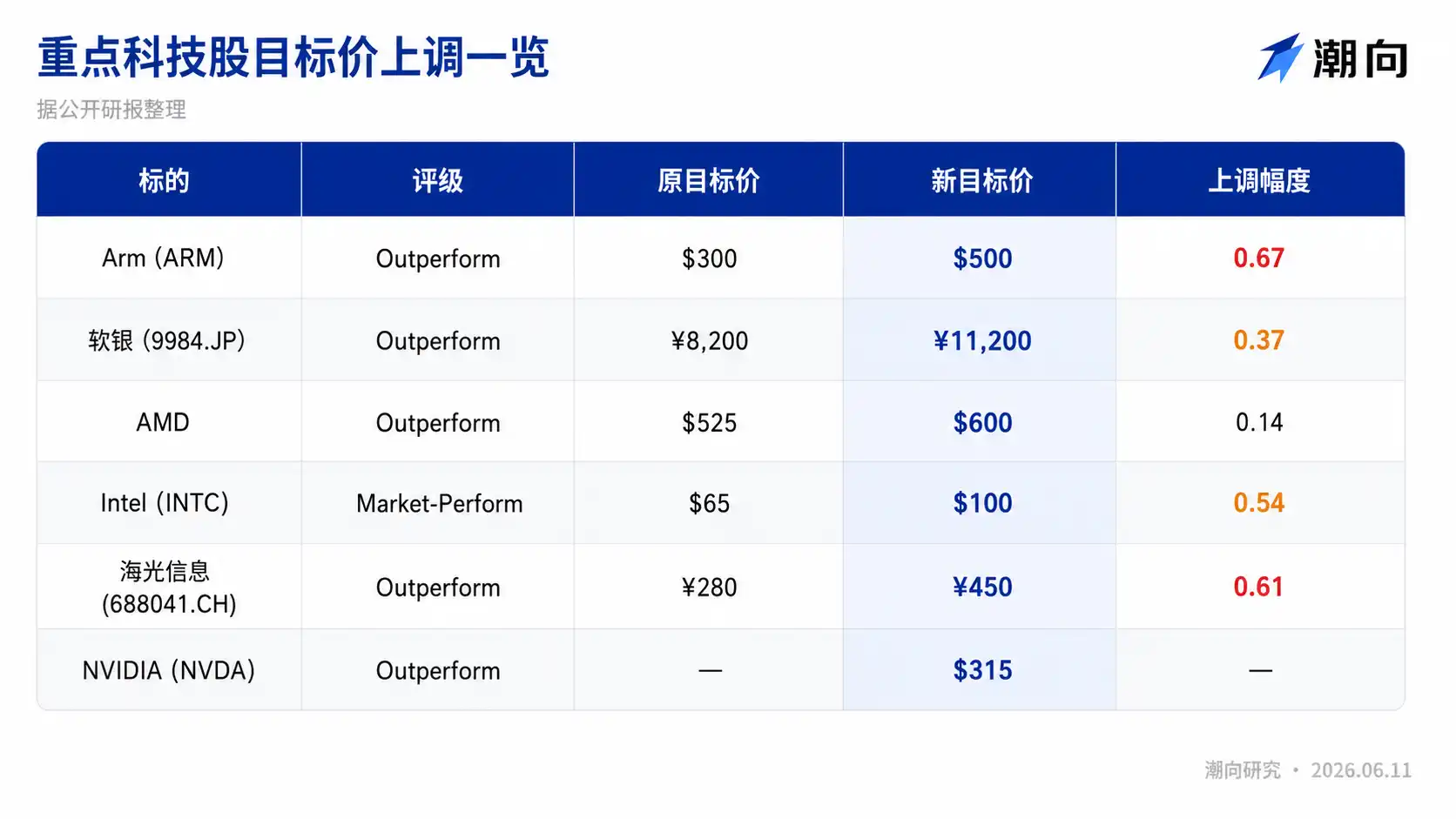
Source: Bernstein

Tide Research's Interpretation

Within Bernstein's thesis, the weakest link may not be on the demand side, but the supply side.

The report acknowledges in a footnote that it is "still assessing whether foundry and memory capacity is sufficient to support CPU growth," marking the greatest uncertainty in the entire report. Pulling CPU TAM from $37 billion to $223 billion implies needing roughly an additional $30 billion in annual CPU capacity by 2030.

TSMC's 3nm/5nm capacity is currently being occupied by AI accelerators and smartphone chips. Whether there is enough flexibility in foundry capacity allocated to server CPUs is not definitively mapped out in the report. Additionally, the report's core assumptions are built upon Nvidia's guidance of "AI infrastructure annual spending exceeding $1 trillion by 2027," which itself is among the most optimistic sell-side forecasts. Using this as the demand starting point for another research report carries the risk of expectation stacking.

Another noteworthy signal is that Nvidia's Vera CPU uses a self-developed Arm architecture. This means Nvidia could play the role of both partner and competitor to Arm in the CPU field, posing a subtle influence on whether Arm's long-term market share can reach 54%.

For investors, the most valuable aspect of this report is not just a specific price target. It provides a clear analytical framework: If you believe agentic AI is the genuine next phase, then CPU allocation must be repriced from "just enough" to a strategic priority. This implies that the entire semiconductor investment landscape needs to shift from GPU dominance towards a more balanced CPU+GPU narrative.

Risk Disclosure

This article is Tide Research's compilation and interpretation of a third-party brokerage research report. The ratings, target prices, profit forecasts, and related judgments cited herein represent the views of that brokerage's analysts, reflecting only the stance of their respective institutions. They do not represent Tide Research's views and do not constitute any investment advice.


Trending Cryptos

Related Questions

QAccording to the Bernstein report, what is the core reason for a potential 'CPU renaissance' in data centers?

AThe core reason is the shift from simple chatbot-style AI to 'agentic AI.' Unlike single-turn Q&A, agentic AI involves complex, multi-step reasoning cycles requiring retrieval, planning, tool calling, and execution. This process demands significant orchestration, task scheduling, and memory management, workloads where the CPU is critical. A weak CPU becomes a bottleneck for the entire system, causing expensive GPUs to idle. Therefore, CPU importance increases dramatically to manage these complex workflows efficiently.

QWhat is Bernstein's forecast for the Server CPU Total Addressable Market (TAM) by 2030, and what key assumptions drive this prediction?

ABernstein forecasts the server CPU TAM to reach $223 billion by 2030, a significant increase from $37 billion in 2025. The key assumptions driving this prediction are: 1) AI capital expenditure reaching $3.5 trillion, corresponding to 70GW of AI data center deployment. 2) AI accelerators making up 45% of this spend ($1.6 trillion market). 3) The inference share of AI workloads rising from 35% to 70%. 4) A CPU-to-GPU ratio in inference clusters reaching 1:1 (and 0.5:1 in training). 5) A CPU unit price equivalent to 13% of a GPU's price.

QWhy does Bernstein identify Arm as a major structural winner from the agentic AI trend?

ABernstein identifies Arm as a major winner for two key reasons. First, its architecture offers superior performance per watt, making it highly attractive for power-constrained AI data centers (e.g., AWS Graviton offers 40% better price-performance). Second, and more importantly, Arm has strategically shifted from being just an IP licensor to designing and manufacturing its own chips (AGI CPU), with Meta as a lead partner. This move directly positions Arm to capture a larger share of the growing CPU TAM, with Bernstein projecting its chip revenue could reach $22 billion by 2030.

QWhat are the key investment rating changes for semiconductor companies mentioned in the report?

AThe report maintains or issues favorable ratings for several companies: 1) Arm: Target price raised to $500 (from $300), EPS estimates increased. 2) AMD: Maintains 'Outperform' rating, target price raised to $600. 3) Intel: Rating raised to 'Market-Perform', target price significantly increased to $100 (from $65). 4) Hygon (Haiguang Information): Issued an 'Outperform' rating for the Chinese market, with a target price of 450 RMB (up from 280 RMB), expecting its share in China's server CPU market to exceed 35% by 2030.

QWhat are the primary risks or uncertainties identified in the Bernstein report's bullish CPU thesis?

AThe report highlights two major uncertainties. First, on the supply side: it questions whether foundry (like TSMC) and memory capacity will be sufficient to support the projected massive growth in CPU production, requiring an additional ~$30 billion in annual CPU capacity by 2030. Second, on the demand side: the entire forecast is built upon the optimistic assumption (from Nvidia's guidance) of AI infrastructure spending exceeding $1 trillion annually by 2027. Using this optimistic forecast as a baseline introduces a 'stacking' risk if the underlying demand materializes slower. Additionally, Nvidia's Vera CPU using its own Arm design makes it both a partner and potential competitor to Arm.

Related Reads

In Conversation with Ray Dalio: We Are Currently in an AI Bubble, with 1% of My Portfolio in Bitcoin

Ray Dalio, founder of Bridgewater Associates, warns in an interview that the current AI boom shows classic bubble characteristics, which could lead to significant economic downturns as seen in past cycles like 1929 or 2000. He explains that speculative enthusiasm, fueled by debt and overvaluation, often precedes a crash when rising rates or taxation force asset sales, causing widespread losses and recession. Dalio also outlines his "Big Cycle" theory, describing an approximate 80-year pattern where widening wealth gaps, massive government deficits, and shifting geopolitical power (like China's rise) create internal conflict and global instability. He emphasizes that we are in a late-cycle, transitional phase where traditional powers like the US and UK face decline. For personal wealth protection, Dalio advises diversification beyond cash into assets like stocks, bonds, real estate, and particularly gold, which he prefers over Bitcoin. While he holds about 1% of his portfolio in Bitcoin as a non-printable hard asset, he views gold as more secure from technological or governmental threats. Regarding AI's impact, Dalio believes it will disproportionately benefit capital owners, worsening inequality by replacing both physical and cognitive labor. He suggests that human intuition and emotional intelligence, combined with AI, will be key for future workers. On taxation, Dalio argues that wealth taxes are impractical and risk triggering asset sell-offs, reducing productive investment. He points to the UK as a cautionary example of debt, low productivity, and political strife. Geopolitically, Dalio foresees a more regionalized world, with the US showing weakness in prolonged conflicts like with Iran, akin to past imperial declines. The ideal outcome, he suggests, is coexisting powerful blocs (e.g., Americas, China-Asia Pacific) without major war.

marsbit14m ago

In Conversation with Ray Dalio: We Are Currently in an AI Bubble, with 1% of My Portfolio in Bitcoin

marsbit14m ago

Daily 7.2 Trillion KRW: Foreign Capital's Record Net Buying on Friday! Wall Street Says Headwinds for Korean Stock Fund Flows Have Subsided

South Korean stock market sees a dramatic shift in fund flows. On July 31, foreign investors made a record net purchase of approximately KRW 7.2 trillion in KOSPI stocks, marking a fundamental reversal from the persistent large-scale net outflows seen in previous months. This contributed to a significant narrowing of foreign net selling in July to KRW 9.8 trillion, down sharply from KRW 48.4 trillion in June and KRW 44.5 trillion in May. Simultaneously, domestic institutional pressure eased. South Korean pension funds and asset managers turned to a net buying position in July, purchasing KRW 1.0 trillion worth of KOSPI shares, contrasting with net sales in May and June. Market volatility is expected to be dampened by new financial regulations. Effective July 31, the Financial Services Commission tightened access for retail investors to single-stock leveraged ETFs by raising the minimum cash deposit requirement. Trading volumes for these products subsequently dropped to about 50% of their monthly average. Citigroup Research maintains its year-end KOSPI target of 10,000 points. The firm cites several supportive factors: the substantial easing of headwinds from capital outflows, a robust fundamental outlook for the semiconductor sector, historically low market valuations, strong economic fundamentals, and the potential for policy support from financial authorities if needed.

marsbit14m ago

Daily 7.2 Trillion KRW: Foreign Capital's Record Net Buying on Friday! Wall Street Says Headwinds for Korean Stock Fund Flows Have Subsided

marsbit14m ago

Thanks to Dice Rolls, Bitcoin Keys Are Stored Offline, But Not Everyone Will Do It

The article discusses using dice rolls to generate secure Bitcoin wallet seeds, providing entropy independent of potentially flawed hardware random number generators. It explains that each fair dice roll offers about 2.585 bits of entropy, with around 50 rolls needed for a standard 12-word seed phrase and 99+ recommended for higher security. This method gained attention after a vulnerability was revealed in some Coldcard hardware wallets, where a faulty firmware RNG (dating back to 2021) compromised generated keys. The analysis notes that while a dice-generated main seed was safe from this specific flaw, other Coldcard functions (like creating paper wallets, backup keys, or passwords) could still be vulnerable if they used the defective RNG. The piece argues that while dice-based entropy is technically robust, the manual process is error-prone, tedious, and unrealistic for most new users, who might make mistakes in recording or inputting rolls. It concludes that while manual entropy generation should remain an option for advanced users, the long-term goal is to develop reliable, user-friendly hardware and software that securely generates randomness without requiring specialized knowledge. Coldcard users are advised to check their firmware version and replace any secondary secrets (like paper wallet keys) created with vulnerable devices, while also considering multi-signature setups with devices from different manufacturers for added security.

cryptonews.ru5h ago

Thanks to Dice Rolls, Bitcoin Keys Are Stored Offline, But Not Everyone Will Do It

cryptonews.ru5h ago

Trading

Spot

Hot Articles

Discussions

Welcome to the HTX Community. Here, you can stay informed about the latest platform developments and gain access to professional market insights. Users' opinions on the price of AI (AI) are presented below.

活动图片














