An AI Read SpaceX's Prospectus and Wrote This Investment Memo in 12 Minutes

marsbitPublished on 2026-05-25Last updated on 2026-05-25

Abstract

An AI agent autonomously analyzed SpaceX's 226MB S-1 filing, purchased real-time market data on-chain for $1.87, and generated a comprehensive investment memo in 12 minutes. The memo concludes a "Hold" recommendation. Bull Thesis: SpaceX holds a near-monopoly in commercial launch (80% of global orbital mass since 2023), operates the profitable Starlink business (10.3M subscribers, $7.2B adj. EBITDA), and is vertically integrated from rockets to AI via the xAI acquisition. Starlink alone is a standout, high-margin business. Bear Thesis: The AI division is a massive cash burn ($6.4B operating loss on $3.2B revenue in 2025). True debt obligations approach ~$42B, not the headline $29B, due to bridge loans and X-related debt. Significant contingent liabilities exist, including a potential $10B fee from a Cursor option agreement. The company faces concentrated counterparty risk (e.g., a $45B Anthropic contract), slowing revenue growth, and complex governance as a controlled company with four share classes. Valuation anchors Starlink's standalone value at ~$84B (applying Iridium's 7.4x sales multiple), suggesting the current ~$500B+ IPO target prices in immense future execution risk for Starship and AI. Key risks include Starship delays, accelerating AI losses, and underwriter conflicts (the IPO's lead banks are also lenders on the $20B bridge loan it aims to refinance). Investment triggers: upgrade to "Overweight" if priced ≤$350B and Starship meets milestones; downgrade to "Pa...

Author:Nick Prince

Compiled by: Deep Tide TechFlow

Deep Tide Introduction: An AI agent autonomously completed work that would take an investment analyst team days: reading a 226MB SpaceX S-1 filing, purchasing real-time market data using USDC on the Base chain, and generating an investment committee memo with multi-faceted arguments, valuation models, and risk matrices—all for a total cost of just $1.87. This is not a demo, but a record of real, paid API calls. When AI agents can pay for data themselves and decide their own analytical paths, the way Wall Street works is being reshaped.

An AI agent read the 226MB SpaceX S-1 filed on Monday, purchased real-time market data using USDC on the Base chain, and generated this investment committee memo in 12 minutes. Total cost: 6 paid API calls, $1.87 USDC, no API keys required.

Decision Card (Conclusion = Hold/Watch)
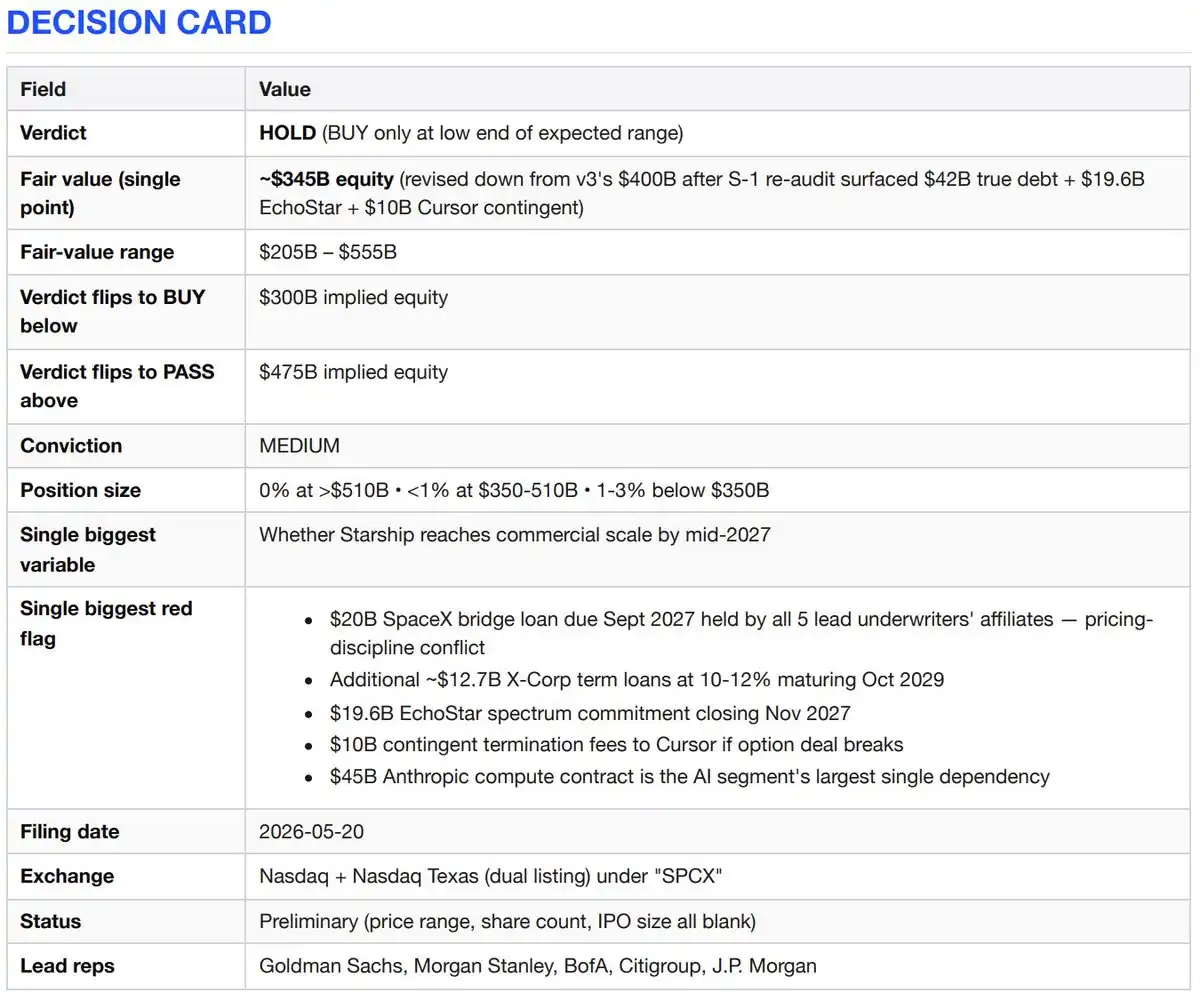
Bull Case

SpaceX has three businesses that competitors cannot replicate. First, a near-monopoly on commercial space access—80% of global orbital mass since 2023, 99% Falcon mission success rate, reusability technology leading by a decade. Second, the world's only deployed low-Earth orbit broadband network—Starlink has 10.3 million subscribers in 164 countries, up 49.8% YoY, with segment adjusted EBITDA of $7.2 billion. Third, since acquiring xAI in February 2026, it's the only AI lab vertically integrated down to the launch rocket level, with orbital compute capability planned for deployment. By any reasonable valuation method, this is a generational asset.

Bear Case

The Connectivity business is real and profitable. But everything else is either burning cash at an astounding rate—the AI segment lost $6.4 billion on $3.2 billion revenue in 2025—or betting on Starship, which has completed 11 flight tests but hasn't delivered payloads to orbit yet. This IPO is partly a refinancing event. SpaceX borrowed a $20 billion bridge loan to acquire xAI, maturing September 2027, and the bridge lenders are the underwriters of this IPO. If the valuation exceeds $500 billion, you're paying for yet-to-be-realized execution capabilities, corporate governance you have no say over, and a refinancing transaction underwriters need to succeed.

Investment Thesis

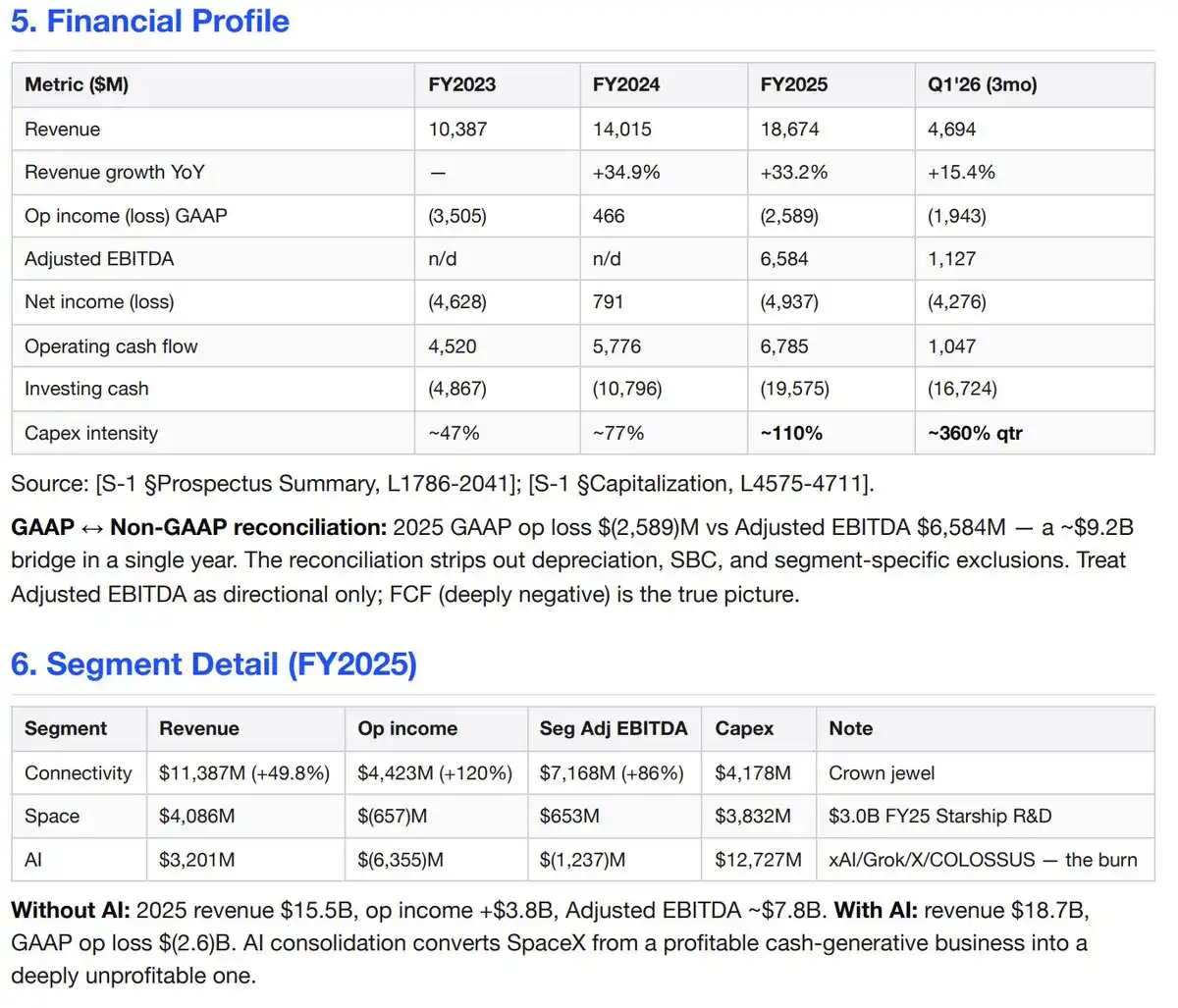
Starlink is an excellent standalone business. 2025 revenue $11.4B (+49.8%), operating income $4.4B (+120%), segment adjusted EBITDA $7.2B (+86%). High-price subscription services, 10.3 million paid users.

Launch business is unique. Over 80% of global orbital mass since 2023, Falcon success rate over 99%, Falcon 9 first stage flown up to 34 times.

Vertical integration is real and compounding. Rocket → Satellite → Spectrum (EchoStar AWS-4/H-band deal FCC approved) → AI Compute (two COLOSSUS clusters ~1GW).

Government reliance is a moat, not a risk. Primary U.S. national security launch provider: 11 of 12 NSS launches in 2025, all 5 NASA crew and cargo flights.

Option value of orbital AI compute, planned for 2028. If Starship achieves even 50% of targeted economics—99% launch cost reduction—addressable market expands by an order of magnitude.

Counter-Thesis

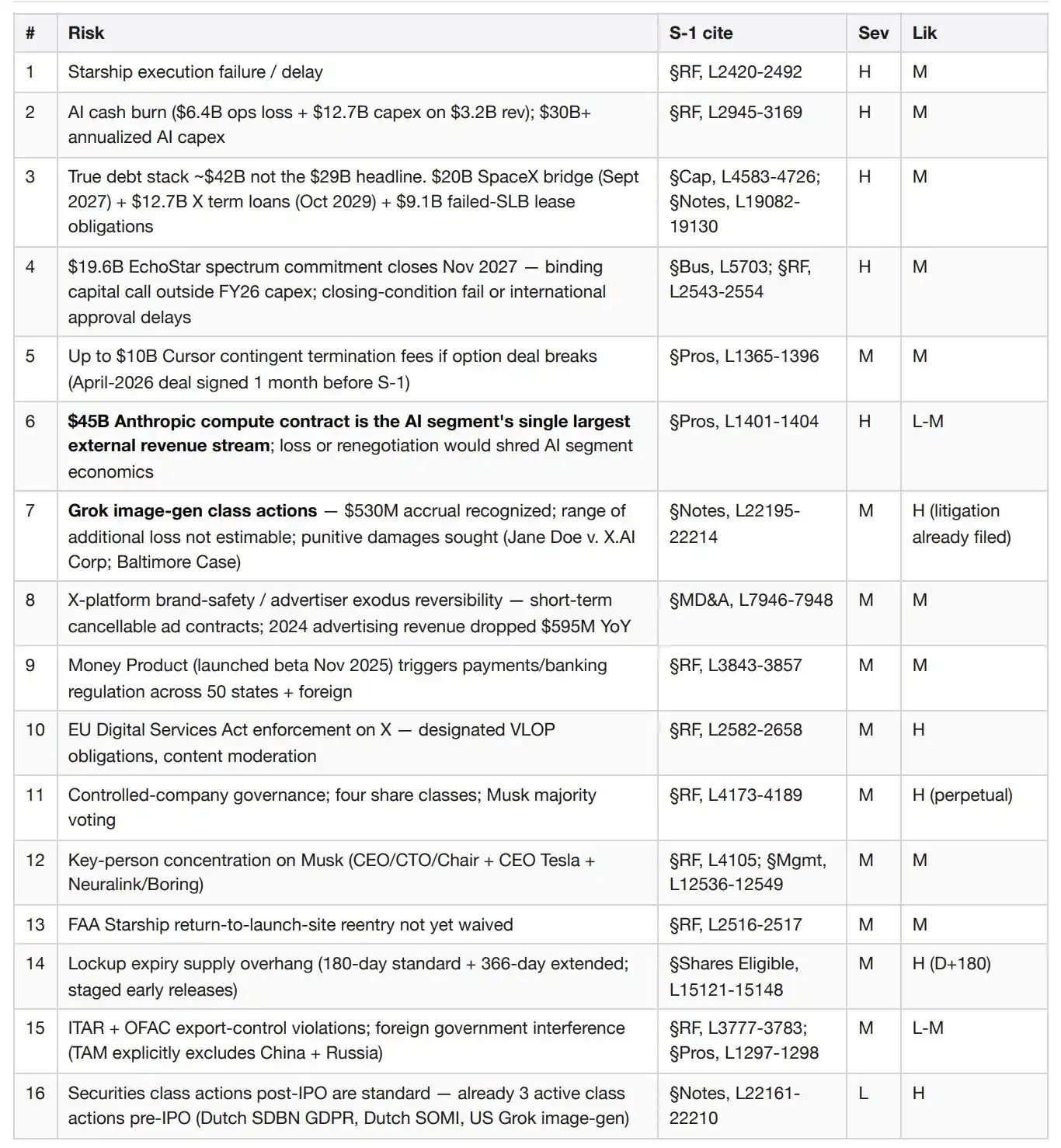
The AI segment is a money pit burning over $6B annually. 2025: $3.2B revenue vs. $6.4B operating loss, segment adjusted EBITDA -$1.2B, CapEx $12.7B. Just Q1 2026: $818M revenue vs. $2.5B operating loss, CapEx $7.7B. Annualized AI CapEx now exceeds $30B, versus AI revenue of $3.2B.

True debt load is ~$42B, not the headline $29B figure. Comprises: ~$20B SpaceX bridge loan (Sept 2027 maturity), ~$6.7B X Corp B-1 Term Loan and ~$6B X Corp B-3 Term Loan (both Oct 2029 maturity, effective rate 10-12%), and ~$9.1B "Other Financing" including obligations from failed AI infrastructure sale-leasebacks. X-related loans alone generate ~$1.2-$1.3B annual interest expense, booked to AI segment.

$19.6B EchoStar spectrum commitment due November 2027. Equity-plus-cash consideration for 65MHz U.S. spectrum and global mobile satellite service licenses. A binding capital commitment on top of bridge loan and FY26 CapEx.

Option agreement with Cursor could trigger up to $10B in termination fees. SpaceX signed a compute-and-option deal with Anysphere (Cursor) in April 2026—one month before this S-1 filing—implying a $60B Cursor valuation. If either party terminates, SpaceX pays Cursor $1.5B termination fee plus $8.5B deferred service fees, payable in cash or Class A stock.

$45B Anthropic contract is AI segment's largest single external revenue source. Cloud services agreement signed May 2026 obligates Anthropic to pay $1.25B monthly until May 2029. SpaceX is selling its COLOSSUS compute to a directly competing frontier model company, creating extreme counterparty concentration risk.

$530M litigation provision recognized on balance sheet for Grok image generation class actions—Jane Doe v. X.AI Corp (Jan 2026), Jane Doe 1 (March), Baltimore (March). Plaintiffs seek compensatory, statutory, and punitive damages. S-1 states additional loss range cannot be estimated.

Q1 2026 revenue growth slowed to 15.4% ($4.69B vs. $4.07B YoY), below 33.2% for full-year 2025.

SpaceX will be a controlled company with four share classes. Musk holds majority voting post-IPO. Company will rely on Nasdaq controlled company exemptions, waiving independent compensation and nominating committees.

Adjusted EBITDA prettifies ~$9B. Management's 2025 headline figure is $6.6B "Adjusted EBITDA" vs. GAAP operating loss of -$2.6B. Adjustments strip depreciation, stock comp, and segment-specific exclusions.

Company Overview

SpaceX (Space Exploration Technologies Corp.; SEC CIK 0001181412) designs and operates reusable rockets, the world's largest LEO satellite constellation (~9,600 broadband sats plus ~650 direct-to-cell sats), and—since acquiring xAI in February 2026—gigawatt-scale AI training infrastructure. Three reportable segments: Space, Connectivity (10.3M Starlink subs), and AI (Grok models, X social platform with 550M MAUs, and COLOSSUS/COLOSSUS II compute clusters). 2025 revenue $18.7B; GAAP operating loss -$2.6B; cash on hand $15.85B versus $29.1B long-term debt per capitalization table cover.
X (Social Platform) Is a Business Unit, Not a Footnote

The corporate chain is worth retracing. SpaceX acquired xAI in Feb 2026. xAI acquired X Holdings in March 2025. X Holdings acquired Twitter in Oct 2022. Result: Twitter/X is now folded into SpaceX's AI segment, with its own balance sheet items, its own litigation, and its own debt structure.

Scale. 1.3B accounts supported over past 12 months, 550M monthly active users (up from 520M in Dec 2025), 350M posts daily. Of those MAUs, 117M use Grok features—X is the primary distribution channel for that model. Money product (payments, banking, financial services) launched beta Nov 2025 and moving toward general availability. X Ads Manager began phased rollout April 2026.

Financial contribution. AI segment revenue 2023-2024 almost entirely from X—advertising, X Premium subscriptions, data licensing. In 2024 alone, ad revenue fell $595M YoY due to "loss of advertising partners at X," partially offset by $157M increase in X Premium subs and $90M increase in data licensing.
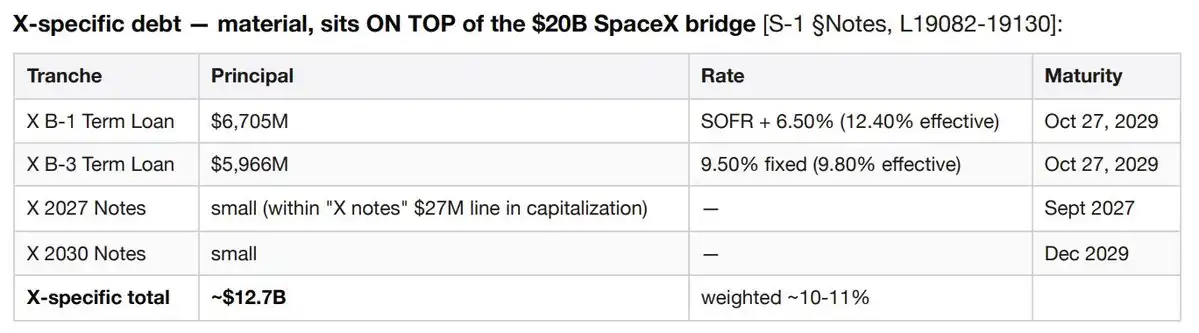
Adding the $20B SpaceX bridge loan (Sept 2027) and $9.1B "Other Financing" line, total long-term debt is ~$42B—not the headline $29B figure on the capitalization cover.

X-specific risks not present in SpaceX's other businesses. EU Digital Services Act enforcement on VLOPs. Advertiser brand safety reversibility on short-term ad contracts cancellable at will—the 2024 exodus could replay in a single news cycle. Money product triggers payments/money transmission/banking regulation in all 50 U.S. states and every foreign jurisdiction. Content moderation policy reversals could trigger simultaneous advertiser pauses and user migration.

Market Position — Live Comparable Data

This comp table was assembled live during analysis by paying $0.10 to Jintel's GraphQL endpoint for bulk fundamental data on all five comps. No Bloomberg terminal, no FactSet contract.
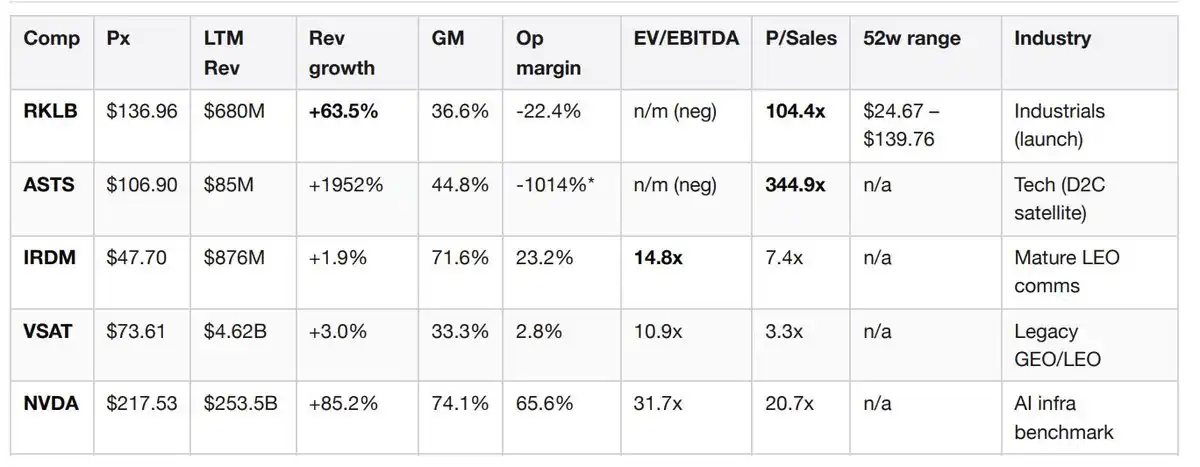
ASTS operating margin reflects pre-revenue massive investment. Source: via x402 on Base chain from Jintel entitiesByTickers, retrieved 2026-05-22.

Reading the comp set. Rocket Lab's 104x P/S is the closest narrative comp—investors willing to pay extreme multiples for scaled reusable launch plus LEO option value, even at negative margins. SpaceX deserves higher multiples than RKLB, but blindly applying 104x to SpaceX's Connectivity-only $11.4B revenue implies $1.2T equity value, which can't anchor to anything. AST SpaceMobile's 345x is purely pre-revenue narrative valuation, just an upper bound reference for direct-to-cell option value. Iridium's 7.4x Sales and 14.8x EBITDA represents what mature profitable LEO comms looks like—applying 7.4x to Starlink's $11.4B yields $84B Starlink standalone business value (bear anchor). NVIDIA's 31.7x EV/EBITDA on 85% revenue growth is the level the AI segment needs to grow into to merit a fundamentals-based valuation. Not there yet.

Signal worth noting. Rocket Lab filed a 424B5 prospectus supplement on May 20, 2026—the same day SpaceX dropped the S-1. RKLB doing a secondary equity raise in SpaceX's news cycle suggests management sees the IPO window open and competitive supply pressure imminent.

Pending Major Deals & Contingent Obligations

Each of these four is individually material and they layer on top of each other. Two were signed within 60 days of this S-1 filing.
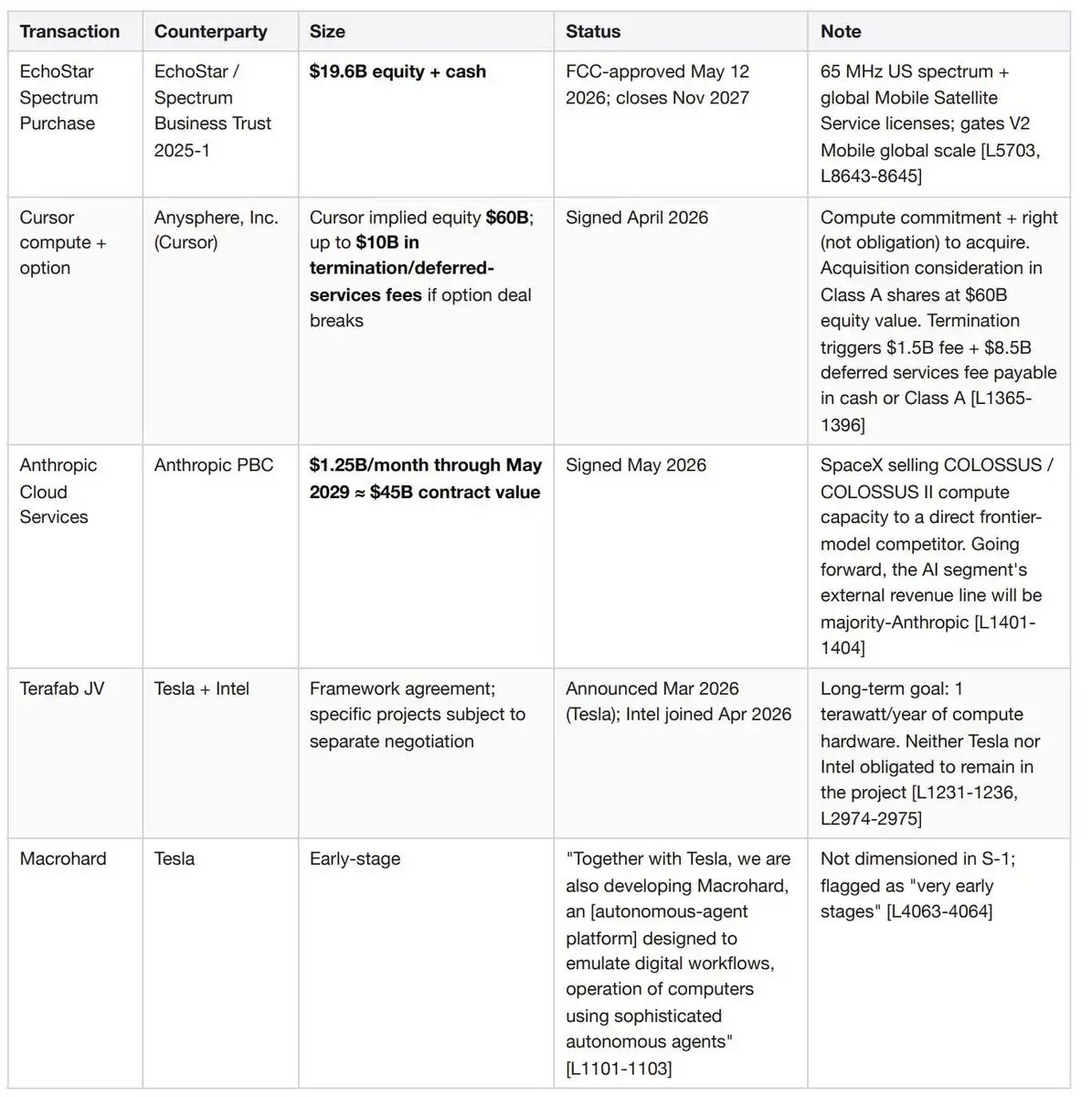
Why this matters for valuation. A clean "adjusted net obligations" view: $42B total debt plus $19.6B EchoStar commitment plus up to $10B Cursor contingent liability, minus $15.85B cash on hand, equals ~$55B net obligations, not counting any IPO proceeds. That's three to four times the number a naive read of the capitalization cover page suggests, materially changing the bear case.

Valuation

Method 1 — Based on Connectivity segment standalone trading multiples, as it's the only segment with positive standalone economics.
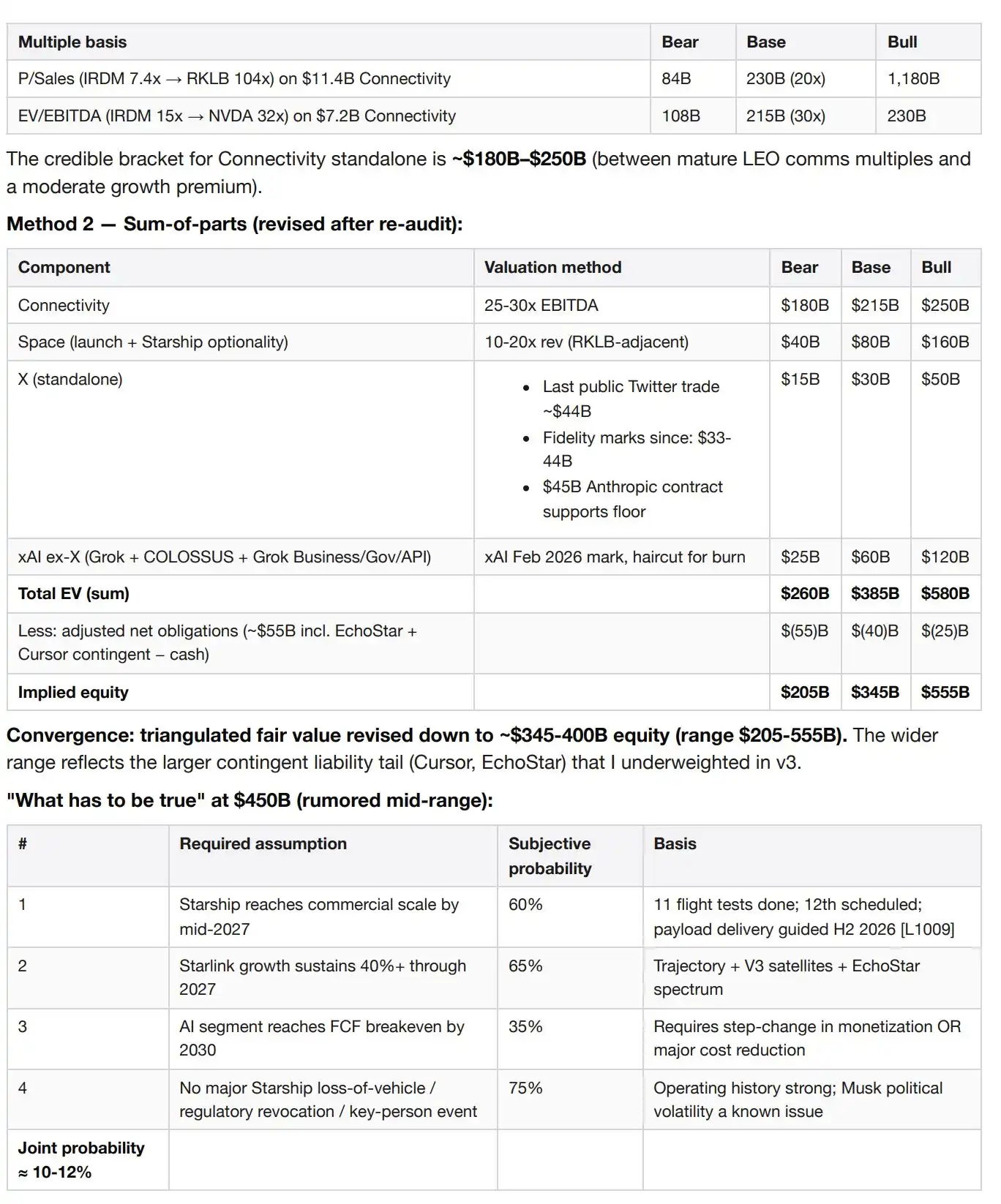
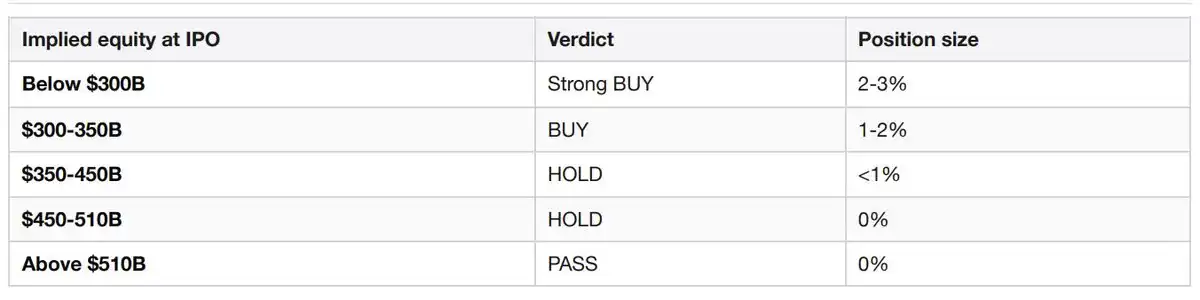
Position Sizing Ladder
Key Risks (Severity × Likelihood)
Underwriter Conflicts of Interest

This is buried in the Underwriting section, rarely picked up in news coverage, but material. Affiliates of the five lead underwriters (Goldman Sachs, Morgan Stanley, BofA, Citi, JPMorgan) plus the five additional bookrunners (Barclays, Deutsche Bank, RBC, UBS, Wells Fargo) were lenders on the $20B SpaceX bridge loan they are now pricing the IPO to refinance. Morgan Stanley additionally advised SpaceX on the xAI acquisition (which the bridge loan funded). The underwriting syndicate has a direct financial interest in maximizing IPO proceeds. This should keep the investment committee alert on pricing discipline.

Related-Party Density
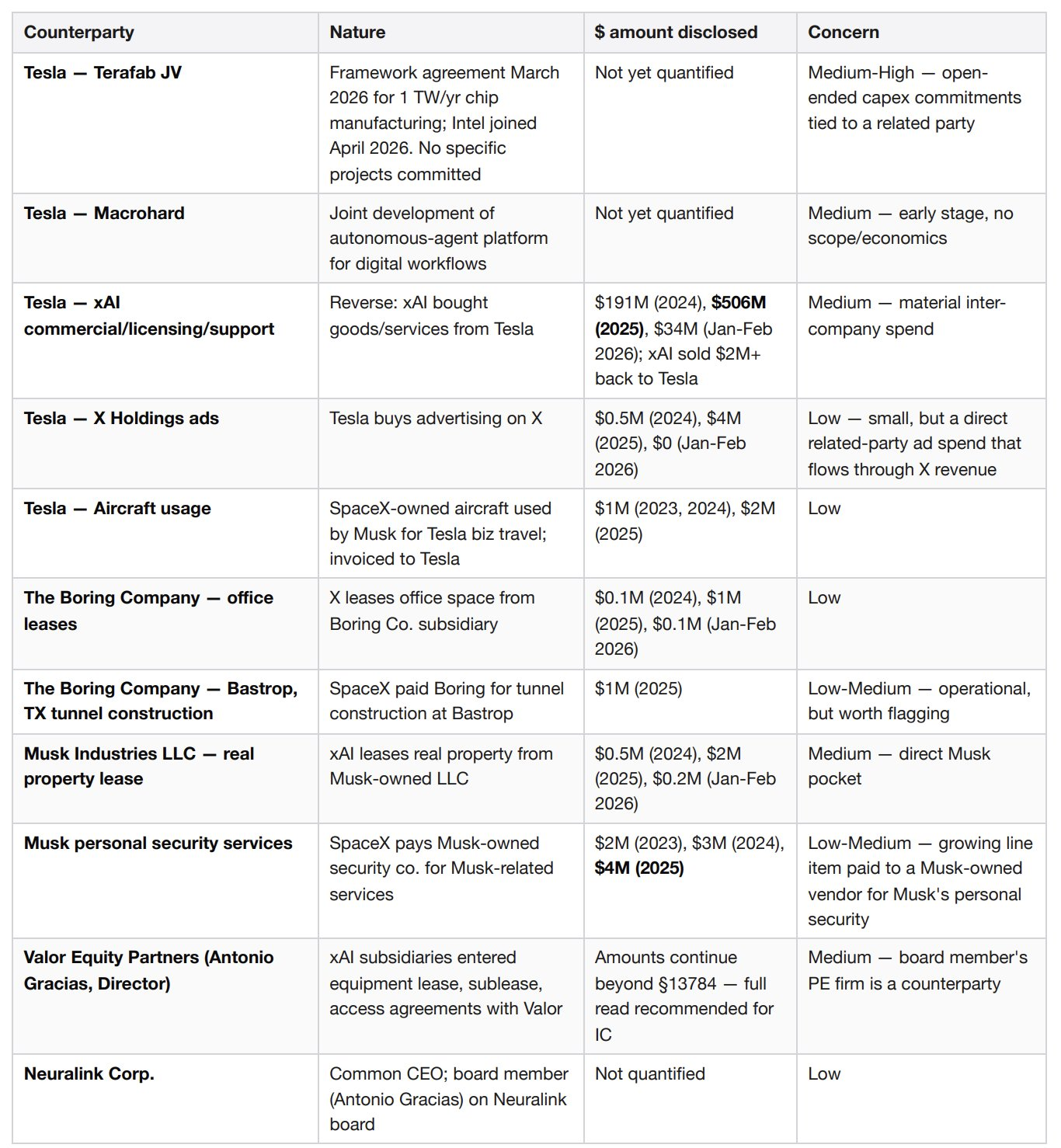
None individually looks concerning. What is concerning is the density—a network of Musk-controlled entities has at least nine distinct financial touchpoints with SpaceX. Public company governance committees typically review one or two such relationships. Here there's an order of magnitude more.

Decision Triggers

Upgrade to Overweight if deal prices at implied equity $350B or below, AND Starship achieves commercial payload delivery in H2 2026 per guidance, AND Q2 2026 Connectivity revenue growth exceeds 40% YoY.

Downgrade to Pass if deal prices above $510B, OR Starship experiences a vehicle loss event delaying V3 sat deployment post-2027, OR AI segment burn accelerates in Q2-Q3 2026 to >$8B annualized operating loss, OR FAA grounds Starship long-term.

First 180 Days & Multi-Year Watchlist

D+1: First-day pop benchmark vs. comp IPOs

D+30: First quarterly earnings (Q2 2026)—triggers early-release lockup tiers (20% immediate release, +10% if stock +30% vs. offer price)

D+70, +90, +105, +120, +135: Staggered early-release lockup tiers, 7% each

D+90: Quiet period ends, sell-side analyst coverage initiates

D+180: All standard tier lockups expire

H2 2026: Starship guidance hit for commercial payload delivery

Q2-Q3 2026: Grok image generation class action procedural milestones (watch if $530M provision increases)

April 2027: Cursor option agreement one-year mark—watch for exercise or termination signals

September 2027: $20B SpaceX bridge loan maturity (must refinance or repay)

November 2027: $19.6B EchoStar spectrum deal completes—V2 mobile global rollout contingent on this

May 2029: $45B Anthropic compute contract ends; renewal terms will define AI segment economics for years after

October 2029: Combined $12.7B X Corp B-1 & B-3 term loans mature

Sources

SpaceX S-1, SEC Accession No. 0001628280-26-036936, filed 2026-05-20

Live comp fundamentals via Jintel GraphQL entitiesByTickers, x402 on Base, retrieved 2026-05-22

Live SEC EDGAR via x402helper /companies/profile for RKLB, IRDM, VSAT, retrieved 2026-05-22

Industry IPO context via Parallel Search, x402 on Base, retrieved 2026-05-22

Four Scenarios for the SpaceX IPO—Acadian Asset Management

Generated by IPO Analysis pack on agentic.market. 6 paid x402 calls. $1.87 USDC on Base. No API keys. No sign-up. Pay-per-request.

A Bloomberg terminal seat is $24,000 a year. This memo shows what agents can now produce when they can pay for data themselves.


Related Questions

QWhat is the main conclusion and recommendation given by the AI agent's investment memo on SpaceX?

AThe AI agent's conclusion is 'Hold-Wait' (Hold & See). It recommends not buying immediately but waiting for specific triggers. The decision would be upgraded to 'Overweight' if the IPO prices at or below $350B implied equity, Starship achieves commercial payload delivery in H2 2026 as guided, and Starlink revenue growth exceeds 40% YoY in Q2 2026. It would be downgraded to 'Abandon' if pricing exceeds $510B, Starship suffers a vehicle loss delaying V3 satellite deployment beyond 2027, AI segment burn accelerates, or the FAA grounds Starship long-term.

QWhat are the three core businesses of SpaceX as identified in the memo, and which one is currently profitable?

AThe three core businesses are: 1) Space Launch (a near-monopoly with ~80% of global orbital mass since 2023), 2) Connectivity (the Starlink low-Earth orbit broadband network with 10.3M subscribers), and 3) AI (the vertically integrated AI lab from the xAI acquisition, including Grok, X platform, and COLOSSUS compute clusters). Among these, only the Connectivity business (Starlink) is currently profitable, generating $11.4B in revenue and $7.2B in segment-adjusted EBITDA in 2025.

QWhat significant financial risks and obligations does the memo highlight beyond the headline debt figure of $29.1 billion?

AThe memo identifies several major obligations that bring total commitments to approximately $550 billion. Key items include: ~$20B SpaceX bridge loan (due Sep 2027), ~$12.7B in X Holdings term loans, ~$9.1B in 'Other financing' (including failed AI infrastructure sale-leasebacks), a $19.6B binding commitment for the EchoStar spectrum deal (due Nov 2027), and a potential $10B termination fee from the Cursor option agreement. When offset by $15.85B cash on hand, the net obligation is roughly $55B, much higher than the simple headline debt.

QHow does the AI agent characterize the governance and control structure of SpaceX post-IPO?

AThe memo states SpaceX will be a controlled company with four classes of stock. Elon Musk will retain majority voting control after the IPO. The company will rely on Nasdaq's 'controlled company' exemptions, which allow it to forego requirements for an independent compensation committee and an independent nominating committee. This structure, combined with a high density of related-party transactions (at least nine distinct financial touchpoints with Musk-controlled entities), presents significant corporate governance concerns.

QWhat is the estimated cost and time for the AI agent to complete this analysis, and what does this imply for traditional finance roles?

AThe AI agent completed the entire analysis in 12 minutes at a total cost of $1.87. This cost covered 6 paid API calls to process the 226MB SpaceX S-1 filing, purchase real-time comparable company data on-chain, and generate the full investment memo. The article contrasts this with the annual cost of a Bloomberg Terminal seat at $24,000, suggesting that AI agents capable of autonomously paying for and synthesizing data are fundamentally restructuring the workflow and cost basis of traditional financial analysis roles like those on Wall Street.

Related Reads

Three Years Later: Looking Back at My Predictions About ChatGPT in 2023

Three Years Later: Revisiting My 2023 Predictions on ChatGPT In March 2023, shortly after ChatGPT's launch, I made 20 predictions about its future. Now, in mid-2026, I've used AI agents to fact-check each one against the latest data. Overall, most major directional forecasts were correct, with only one outright error (incorrectly stating GPT-4 had 100 trillion parameters). Key successes included predicting that RAG and retrieval architectures would become the standard for handling knowledge and hallucinations, that natural language interfaces (LUI) would create a massive new industry layer beyond the models themselves, and that China would develop viable large language models, significantly closing the performance gap with Western counterparts within about three years. Predictions about the absence of mass unemployment, the rise of a new "robot network" for agent communication, and ChatGPT not possessing consciousness also held true in their core arguments. However, the "devil was in the details." Errors frequently involved specific numbers, timelines, or overlooking distributional effects. I tended to overestimate the speed of adoption (e.g., for agent networks) while underestimating the ultimate scale of capabilities or costs (e.g., AI winning IMO gold without tools, or the extreme capital required for frontier models). Other misjudgments included: underestimating how AI would reinforce, not dissolve, information filter bubbles; incorrectly assuming AI-generated content would easily circumvent copyright (it has instead triggered record-breaking settlements); and misidentifying where value would be captured (it accrued overwhelmingly to the compute layer, like Nvidia, not just the application or model layers). Key lessons from reviewing these predictions are: 1) Directional and mechanistic insights are far more reliable than precise numbers or absolute statements. 2) There's a consistent bias to overestimate short-term speed but underestimate long-term magnitude. 3) Errors often lie in missing distributional impacts within a generally correct aggregate trend. 4) Predictions phrased with nuance and caveats aged the best. 5) Some fundamental debates (e.g., on machine consciousness or the ultimate value chain) remain unresolved even after three years. This exercise is less about scoring the past and more about establishing rules for clearer thinking about the next three years of AI.

marsbit2h ago

Three Years Later: Looking Back at My Predictions About ChatGPT in 2023

marsbit2h ago

Three Years Later: Looking Back on My 2023 Predictions for ChatGPT

Looking Back After Three Years: Revisiting My 2023 Predictions on ChatGPT In March 2023, shortly after ChatGPT's debut and before GPT-4's release, I made over twenty predictions about AI's future based on limited information and intuition. Now, in May 2026, I revisited those forecasts using an AI-driven analysis with 41 Opus 4.8 agents to cross-reference them with the latest data. The assessment used symbols: ✅ Correct, 🟢 Mostly Correct, 🟡 Partially Correct, ❌ Incorrect. Overall, the directional judgments held up well, with only one major factual error regarding GPT-4's rumored parameter size (incorrectly cited as 100T). However, nuances and degrees of accuracy revealed more. **What Was Largely Correct:** Predictions about mechanisms and directions proved accurate. The rise of RAG (Retrieval-Augmented Generation) as the standard architecture for combating AI hallucination was confirmed, as was the transformative potential of LUI (Language User Interface) in creating a new industry layer atop GUIs. The emergence of "robot networks" (agent-to-agent communication protocols) and China's rapid catch-up in developing capable large models (closing the performance gap with top models to ~2.7%) were also on point. The analysis affirmed that LLMs lack consciousness and that the Turing Test merely measures perceived intelligence. **What Was Off Target:** Errors often involved specific numbers, over-optimistic timelines, or misjudged distributions. The prediction that value would primarily accrue to the application layer was half-right but missed NVIDIA's dominance as the profitable infrastructure layer. Forecasts about AI circumventing copyright issues and fostering a "global common ground" by averaging human viewpoints were incorrect; instead, major copyright settlements occurred and AI personalization is increasing. Estimates for model training costs ("$5-10 billion cap") were significantly off, underestimating frontier costs and overestimating replication costs. The notion that LLMs could never do complex math without tools was disproven by later models winning IMO gold. **Key Patterns from the Review:** 1. **Direction over precision:** Judgments about mechanisms and trends were more reliable than specific numbers or definitive statements. 2. **Timing bias:** There was a tendency to overestimate short-term speed but underestimate long-term magnitude and transformation. 3. **The distribution blind spot:** Aggregate-level correctness often masked uneven impacts (e.g., on young professionals' employment). 4. **The value of qualifiers:** Predictions framed with caution (e.g., "reportedly," "for now," "prototype in 2-3 years") aged better. 5. **Some debates continue:** Issues like the nature of "emergent abilities" or machine consciousness remain unresolved. This three-year review highlights that while seeing the big picture is crucial, humility regarding specifics, timelines, and disparate impacts is essential for future forecasting.

链捕手4h ago

Three Years Later: Looking Back on My 2023 Predictions for ChatGPT

链捕手4h ago

AI Bubble Warning: AI Investments Are Negative Returns for Most Tech Giants

The article issues a stark warning about a potential AI investment bubble. It notes that while the AI boom shares similarities with the TMT bubble of the late 1990s, its scale is vastly larger, currently driving 93% of U.S. GDP growth. Major hyperscale cloud providers like Microsoft, Alphabet, Amazon, Meta, and Oracle are planning to invest trillions in AI data centers over the coming years. However, calculations based on analyst projections for 2025-2030 reveal a concerning math problem: expected capital expenditure growth far outpaces projected revenue growth. Even under an extremely optimistic scenario of zero costs, the implied return on investment for most of these tech giants (except Amazon) is deeply negative. This suggests that the current trajectory could lead to one of history's largest shareholder value destruction events. The piece outlines two potential escapes: AI generating vastly more revenue than currently anticipated—a near-impossible task—or a significant cutback in the planned investment splurge. The latter scenario could trigger a domino effect, severely impacting the entire tech supply chain (from Nvidia to TSMC), potentially pushing the U.S. economy into recession, and causing a major stock market downturn. The author suggests upcoming high-profile IPOs by companies like OpenAI and Anthropic might represent a transfer of risk from early investors to public market participants. While the peak of the hype cycle might sustain investment through 2026, the fundamental financial dilemma remains unresolved, setting the stage for a potential market correction in 2027 or 2028, similar to the years following Alan Greenspan's "irrational exuberance" warning.

marsbit5h ago

AI Bubble Warning: AI Investments Are Negative Returns for Most Tech Giants

marsbit5h ago

From Tokens to Machine Labor: AI is Shifting from Tool to "Worker"

The article "From Token to Machine Labor: AI is Evolving from Tool to 'Worker'" argues that the business model for AI is shifting beyond simply selling computational resources (tokens, GPU hours) or model access. Instead, a new "machine labor market" is emerging, where the core economic transaction is the purchase of economically useful work directly performed by software. The central thesis is that AI pricing will evolve through four stages: 1) raw tokens, 2) standardized LLM capabilities (e.g., text generation), 3) industry-specific labor markets (e.g., legal review, radiology), and finally 4) a programmable results market where tasks like resolving a support ticket are bid on and priced based on outcome. In this future, buyers will care less about *which* model or GPU completes a task and more about whether the work meets specified standards for accuracy, latency, and cost. This transition reframes the impact of AI on human labor. Rather than simple replacement, it suggests a re-coordination where machines handle standardized, verifiable work, freeing humans for roles involving oversight, context management, responsibility, and final judgment. In some cases, this "last 1%" of human input becomes more valuable as it enables the other 99% to be automated. Furthermore, as AI reduces the cost of work, demand may expand, creating larger markets (e.g., 24/7 customer service) rather than just cheaper versions of existing ones. The article concludes that while infrastructure (GPUs, models, tokens) remains crucial upstream, the market is converging on a simpler, tradeable unit: machine labor that can be defined, measured, priced, and procured based on contractible specifications.

marsbit5h ago

From Tokens to Machine Labor: AI is Shifting from Tool to "Worker"

marsbit5h ago

Xiaomi MiMo's 99% Price Cut is Not Marketing! Luo Fuli Posts on X to Refute Critics

The price of Xiaomi's MiMo-V2.5 series API has been permanently reduced by up to 99%, specifically for the "Input (Cache Hit)" cost, which covers users re-reading historical context in long conversations. MiMo's head, Luo Fuli, published a detailed technical blog to clarify that this drastic price cut stems from genuine engineering breakthroughs, not a marketing stunt or a simple price war. The core of the achievement lies in six key engineering optimizations. First, the model architecture adopts a Hybrid Sliding Window Attention (SWA), reducing the memory footprint (KVCache) to 1/7th of a traditional model. Second, a dual-pool memory management system actually utilizes these savings, allowing a single GPU to handle over 5 times more concurrent users. Third, an upgraded prefix caching mechanism achieves a cache hit rate of 93-95% for repeated reads, meaning most such requests bypass GPU computation entirely. Fourth, a self-developed distributed cache (GCache) utilizes idle SSD space on existing GPU servers, eliminating additional storage costs. Fifth, an intelligent scheduling system (LLM-Router) efficiently routes requests to maximize cache reuse and performance. Sixth, Multi-Token Prediction (MTP) accelerates the model's text generation ("output") side. Together, these systemic optimizations dramatically lower the real computational cost per request, enabling the 99% price reduction for cached inputs while reportedly maintaining positive gross margins. Luo Fuli's disclosure aims to shift the narrative from "price war" to a demonstration of substantive AI engineering progress.

marsbit7h ago

Xiaomi MiMo's 99% Price Cut is Not Marketing! Luo Fuli Posts on X to Refute Critics

marsbit7h ago

Trading

Spot
Futures

Hot Articles

Discussions

Welcome to the HTX Community. Here, you can stay informed about the latest platform developments and gain access to professional market insights. Users' opinions on the price of AI (AI) are presented below.

活动图片














