AI is Red-Hot, Crypto is Left in the Cold

marsbitPublished on 2026-02-12Last updated on 2026-02-12

Abstract

The article discusses the significant shift of venture capital investments from the crypto sector to AI, as observed in the strategies of major firms like Sequoia, a16z, Lightspeed, and Y Combinator. Many early Web3 adopters are now leaving for AI or prediction markets. The author argues against two extreme reactions: dismissing departures as a lack of faith or abandoning crypto for AI. Instead, he asserts that blockchain-driven finance is inevitable, citing cryptocurrencies' potential to serve as a superior, trust-minimized, and cost-effective global monetary system. He highlights the efficiency of decentralized systems like Uniswap, which operates with drastically lower overhead than traditional exchanges, and emphasizes the importance of censorship-resistant financial infrastructure, particularly for underserved regions. While acknowledging AI's value as a tool, the author believes crypto represents a larger, transformative opportunity for building equitable and efficient financial systems globally.

Written by: Patrick Collins

Compiled by: Chopper, Foresight News

In 2025, venture capital firms like Sequoia, A16z, Lightspeed, and Y Combinator are heavily investing in AI companies, with funds flowing from the crypto sector to AI, not to mention the recent sharp decline in overall cryptocurrency prices.
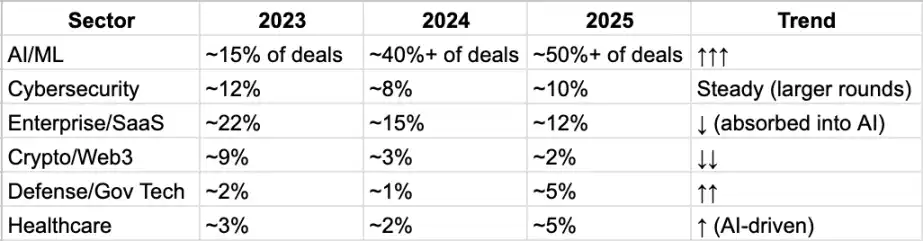
Sequoia Capital's investment trends over the past three years
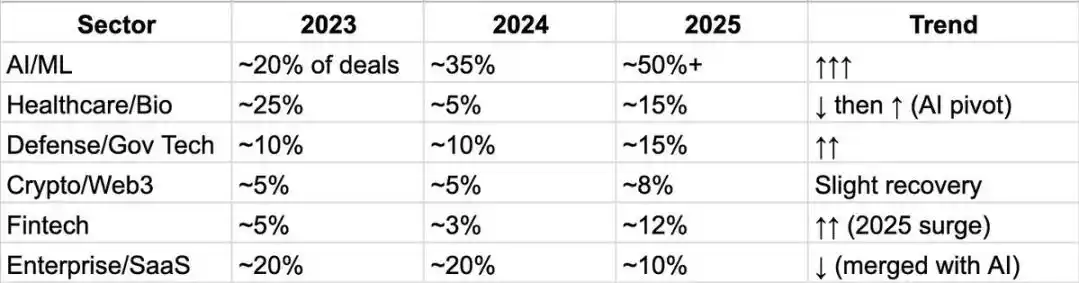
a16z's investment trends over the past three years
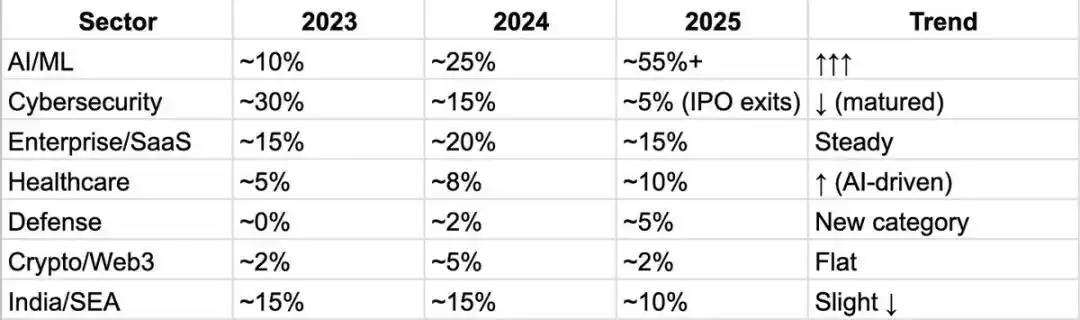
Lightspeed's investment trends over the past three years
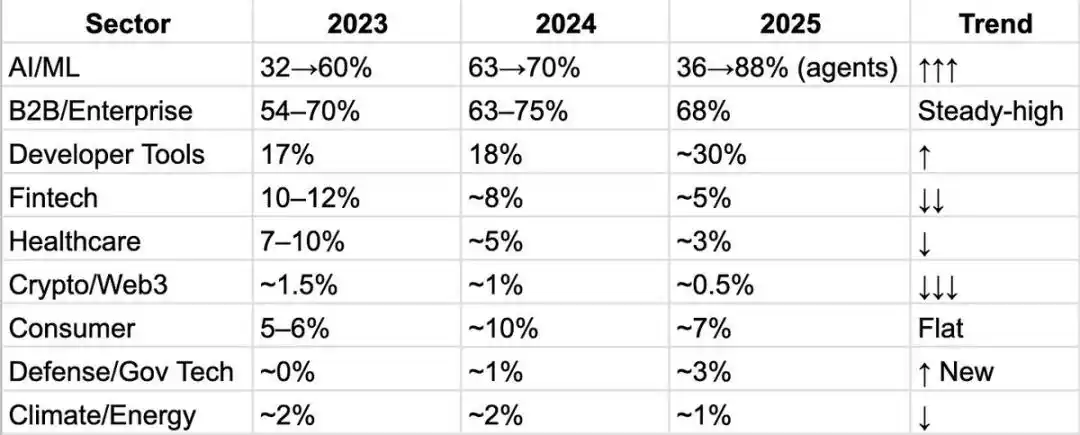
Y Combinator's investment trends over the past three years

I've seen many people who entered Web3 with me in 2019/2020 starting to leave, joining AI companies or prediction markets. As someone fully committed to the blockchain and decentralized finance space, I believe there are a few different mindsets one can have in the face of this situation.

Good Riddance, They Never Had Faith Anyway

It's a bit like a bad breakup—you say a few harsh words when they're gone. "Now only the true builders remain, and everything will be better." I don't think this mindset or approach is right. We need talent in this industry, even if they don't fully subscribe to our underlying philosophy.

As long as we have the vision, we will always need people to turn that vision into reality. Many people just want to live a good life and don't necessarily want to change the world, and I think that's perfectly fine.

Both types of people are great in the world: those with extreme passion, and those with less intense passion but who are willing to work hard, improve themselves, and do the right thing. To me, this is a bit like the difference between "rock stars" and "superstars."

Crypto is Dead, Hurry Up and Switch to AI

This is the topic I want to focus on, and it's a sentence I want to engrave in your heart: It is inevitable that the world's finance will ultimately be entirely powered by cryptocurrency.

Let that sink in. Once you accept this, switching to AI seems utterly nonsensical.

Yes, AI is exploding, AI is amazing, but AI is just a tool to build other things. And among those "other things" is the future of finance.

Of course, you can do what's best for you. There might be a fast-moving bandwagon in AI beckoning you, go ahead and hop on. But I believe you will miss a much bigger opportunity.

Why is Blockchain Inevitable?

The reason is the same reason gold has a market cap of $35 trillion today. I've talked about "what is money" countless times, especially in my explanations of stablecoins. Money has three functions: a store of value, a medium of exchange, and a unit of account.

Throughout human history, finding a currency that is credibly neutral and convenient has been nearly impossible, until recently. Gold is recognized as a "credibly neutral" currency, but it's very non-portable and inconvenient. Cryptocurrency is the solution.

Blockchain's Overwhelming Advantages

This alone is compelling enough, but when combined with smart contracts, the explosive potential is astronomical. Take the stock market as an example: the NYSE has a daily trading volume of about $80 billion, while Uniswap might only have $20 billion—a 40-fold difference. But then look at the operating costs: the parent company of the NYSE has about 12,000 employees; Uniswap, in theory, can operate with just liquidity providers and has only about 200 employees.

Operating costs are directly reduced by 60 times! From a cost perspective alone, the advantage of running a decentralized exchange is overwhelming.

Not to mention censorship resistance and credible neutrality, which are the core meaning of this technology. I won't elaborate here on why credibly neutral financial products are the future; just look at the data: DeFi has extremely low operating costs and is more fair.

Many people dismiss the logic of "credible neutrality." I'll skip that part in this article. Most of these people are from developed countries and will never understand how important this technology is for less developed nations. But I still believe this is the core reason for the inevitable success of crypto technology.

Many people, once they see the enormous costs of the existing financial system, will start asking: "Why am I paying such high fees and waiting two days for stock settlement?"

Conclusion

It's fine if you want to leave, but I believe you will miss the massive adoption that is happening, and the opportunity here is bigger than ever.

Many so-called "opportunities" in the history of the crypto space were, to some extent, scams. NFTs, yield farming, meme coins—these products exploited people's ignorance of new technology to harvest attention. We've moved past that stage; we all know those things were silly.

Now, we can have institutions and ordinary users actually using products that improve their lives: Aave, Uniswap, zero-knowledge privacy protocols, stablecoins... They provide financial services to the world with extremely low costs and lower barriers to access.

The entire world will eventually run on this infrastructure. And I will continue to do everything I can to make that day come sooner.


Trending Cryptos

Related Questions

QAccording to the article, what is the main reason for the shift of venture capital investments from crypto to AI in 2025?

AThe article states that venture capital firms like Sequoia, A16z, Lightspeed, and Y Combinator are making large investments in AI companies, with funds flowing from the crypto sector to AI, especially as cryptocurrency prices have recently fallen significantly.

QWhat does the author believe is the inevitable future of global finance?

AThe author believes it is inevitable that the world's finance will ultimately be entirely powered by cryptocurrency.

QWhat key advantage does the author highlight when comparing a decentralized exchange like Uniswap to a traditional one like the NYSE?

AThe author highlights the massive operational cost advantage, noting that while the NYSE has about 12,000 employees, Uniswap can theoretically run with just liquidity providers and about 200 employees, representing a 60-fold reduction in operating costs.

QWhat are the three functions of money as described in the article?

AThe three functions of money are a store of value, a medium of exchange, and a unit of account.

QWhat does the author argue is the core significance of blockchain technology beyond just lower costs?

AThe author argues that the core significance of the technology is its censorship resistance and credible neutrality, which are crucial for the future of financial products.

Related Reads

Goldman Sachs: July Smashes Through Crowded Trades, U.S. Stock Bull Market Not Broken but Harder to Navigate

Goldman Sachs: July Sees Crowded Trades Unwound, U.S. Bull Market Intact but Getting Tougher. The U.S. stock market in July did not see an index-level crash, but rather a significant unwinding of speculative positions. While the S&P 500 remained stable—trading within a narrow 3.5% range and staying within 2% of its high—underlying market dynamics were volatile. Heavily crowded trades, particularly in high-momentum tech, AI-linked stocks, and Asian strategies, faced severe pressure and forced deleveraging. Data indicates this was a meaningful cleanse, not a minor adjustment. Global tech exposure saw its largest sell-off in over five years, leverage in Korean equity ETFs plummeted, and Goldman's prime brokerage recorded the largest gross exposure reduction since late 2022. Leverage on momentum factors among fundamental long/short clients fell to the 28th percentile of its one-year range. The AI trade narrative shifted from pure potential to a focus on tangible returns. While Meta failed to show clear AI monetization, Microsoft and Amazon provided evidence that massive capital expenditure is translating into scalable revenue and product growth, preventing a blanket sell-off of the AI sector. The Federal Reserve's more opaque communication style and volatility in long-end Treasury yields have introduced new friction, particularly for rate-sensitive growth and tech stocks. The broader outlook for U.S. equities remains favorable, supported by a strong economy, robust earnings, and substantial AI capital expenditure. However, risk/reward is no longer cheap, and the market's upward elasticity has weakened. The Nasdaq 100's trajectory—up 12% year-to-date despite significant pullbacks—illustrates that the bull trend persists but the path is becoming more difficult. The key lesson from July is that the market no longer rewards crowded, highly leveraged trades, requiring more disciplined and liquid portfolio approaches.

marsbit1h ago

Goldman Sachs: July Smashes Through Crowded Trades, U.S. Stock Bull Market Not Broken but Harder to Navigate

marsbit1h ago

Interview with Robinhood Executive: Meme + Tokenized US Stocks as "Barbell" Customer Acquisition Strategy, All Business Lines Achieve Hundreds of Millions in Revenue

Interview with Robinhood executive Johann Kerbrat reveals the company's "barbell" customer acquisition strategy for its new Robinhood Chain, combining meme tokens with tokenized stocks. Three weeks after mainnet launch, the chain has seen over $3B in weekly DEX volume and 105M transactions. Kerbrat explains the logic behind the permissionless chain: meme tokens attract DeFi users, while tokenized real-world assets (RWA), currently over 90 US stocks and ETFs accessible in 120+ countries, serve global users. The goal is to bring Robinhood's 27 million funded accounts on-chain by simplifying DeFi with a user-friendly interface, exemplified by features like Robinhood Earn which offers yield without requiring wallet management. Built on Arbitrum's technology stack for its speed, low cost, and Ethereum's security, the chain focuses on financial products like Earn, spot trading, and perpetuals. Kerbrat downplays direct competition with platforms like Base, emphasizing the goal of expanding the overall market for on-chain assets. He details selective partnerships (e.g., Morpho, Lighter) based on compliance, unique UX, and differentiation. While regulatory clarity is pending for US perpetuals, the expansion continues via Bitstamp in Europe. Finally, Kerbrat positions Robinhood as a "super app" integrating stocks, options, crypto, banking, and AI trading, with all major business lines generating hundreds of millions in revenue. For the chain, current priority is driving adoption over maximizing gas fee revenue.

marsbit3h ago

Interview with Robinhood Executive: Meme + Tokenized US Stocks as "Barbell" Customer Acquisition Strategy, All Business Lines Achieve Hundreds of Millions in Revenue

marsbit3h ago

Fidelity Q3 Report: BTC, ETH, and SOL Continue to Build Bottoms; How Much Further Will This Crypto Bear Market Go?

Fidelity's Q3 Crypto Signal Report analyzes the current bear market, noting Bitcoin (BTC), Ethereum (ETH), and Solana (SOL) are in a prolonged bottoming phase. Key indicators like the weighted Net Unrealized Profit/Loss (NUPL) have turned negative (-0.01), signaling the market is slightly below its aggregate cost basis, with BTC acting as the primary stabilizing asset. BTC's dominance has risen to 68%, indicating a lack of capital rotation to other digital assets. Performance has been weak across the board, with BTC, ETH, and SOL down significantly year-to-date. Market sentiment is depressed, exacerbated by substantial outflows from spot ETPs and a challenging macro environment. The report compares the current ~203-day downtrend to historical ~300-day bottoming cycles, suggesting the process may be two-thirds complete, with late 2026 as a potential timeframe to monitor. For Bitcoin, NUPL at 0.09 indicates cautious sentiment, while momentum signals remain negative. The Yardstick metric points to potential undervaluation relative to network security (hashrate). Ethereum's NUPL is deep in the "capitulation" zone at -0.43, a historically positive signal for future returns, though its momentum and network fee revenue are negative. Solana shows the deepest NUPL at -0.72 but demonstrates relative resilience in on-chain activity and stablecoin transfer volume. The report concludes that while several metrics are near historical capitulation levels, a definitive market bottom has not yet been established. The path forward likely involves continued consolidation, with BTC's relative strength and fundamental on-chain usage for ETH and SOL providing key areas for investor observation.

marsbit3h ago

Fidelity Q3 Report: BTC, ETH, and SOL Continue to Build Bottoms; How Much Further Will This Crypto Bear Market Go?

marsbit3h ago

Trading

Spot

Hot Articles

Discussions

Welcome to the HTX Community. Here, you can stay informed about the latest platform developments and gain access to professional market insights. Users' opinions on the price of AI (AI) are presented below.

活动图片