Why Moonshot AI’s $30B IPO could matter for crypto, not just AI

ambcryptoPublished on 2026-07-20Last updated on 2026-07-20

Abstract

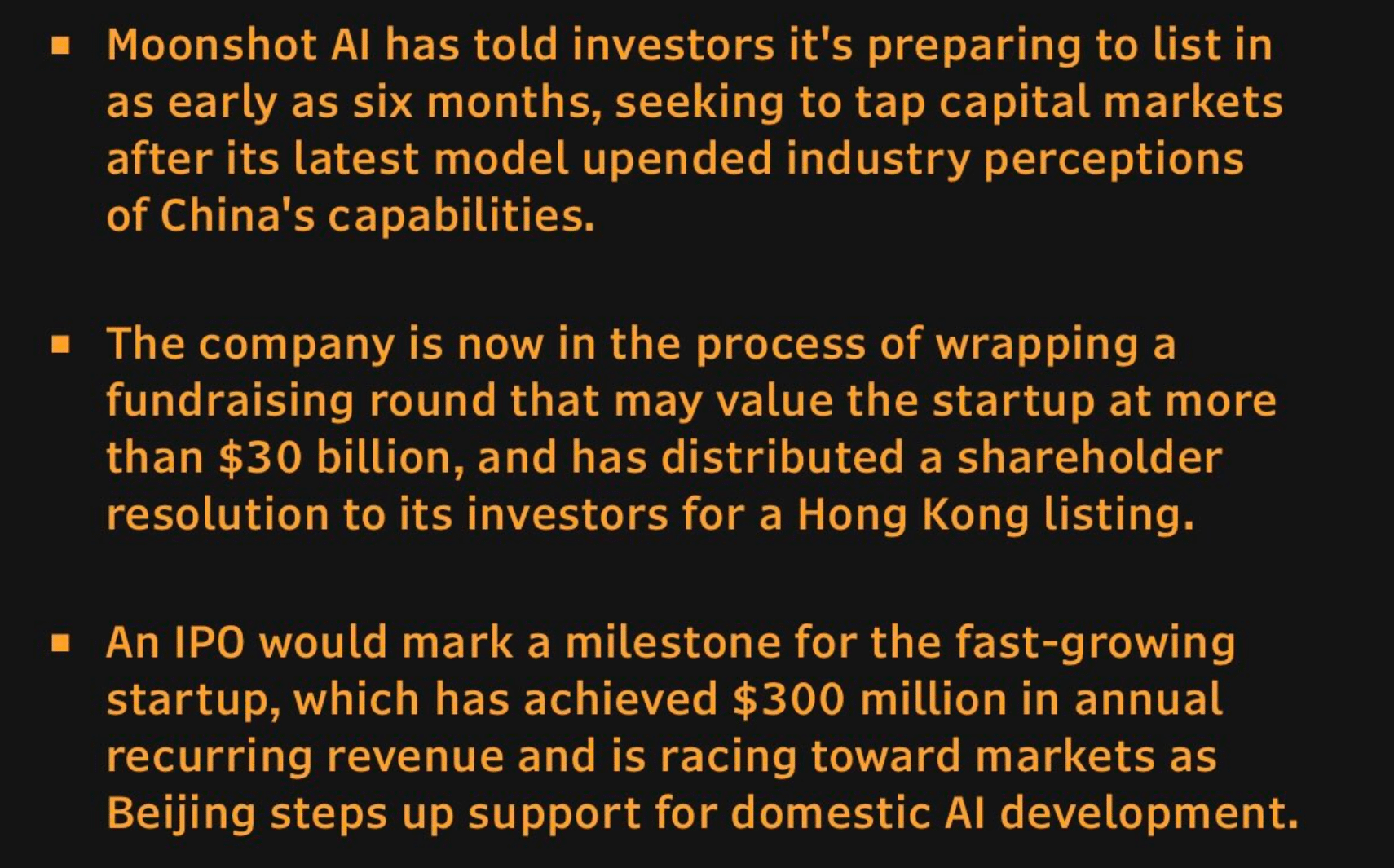
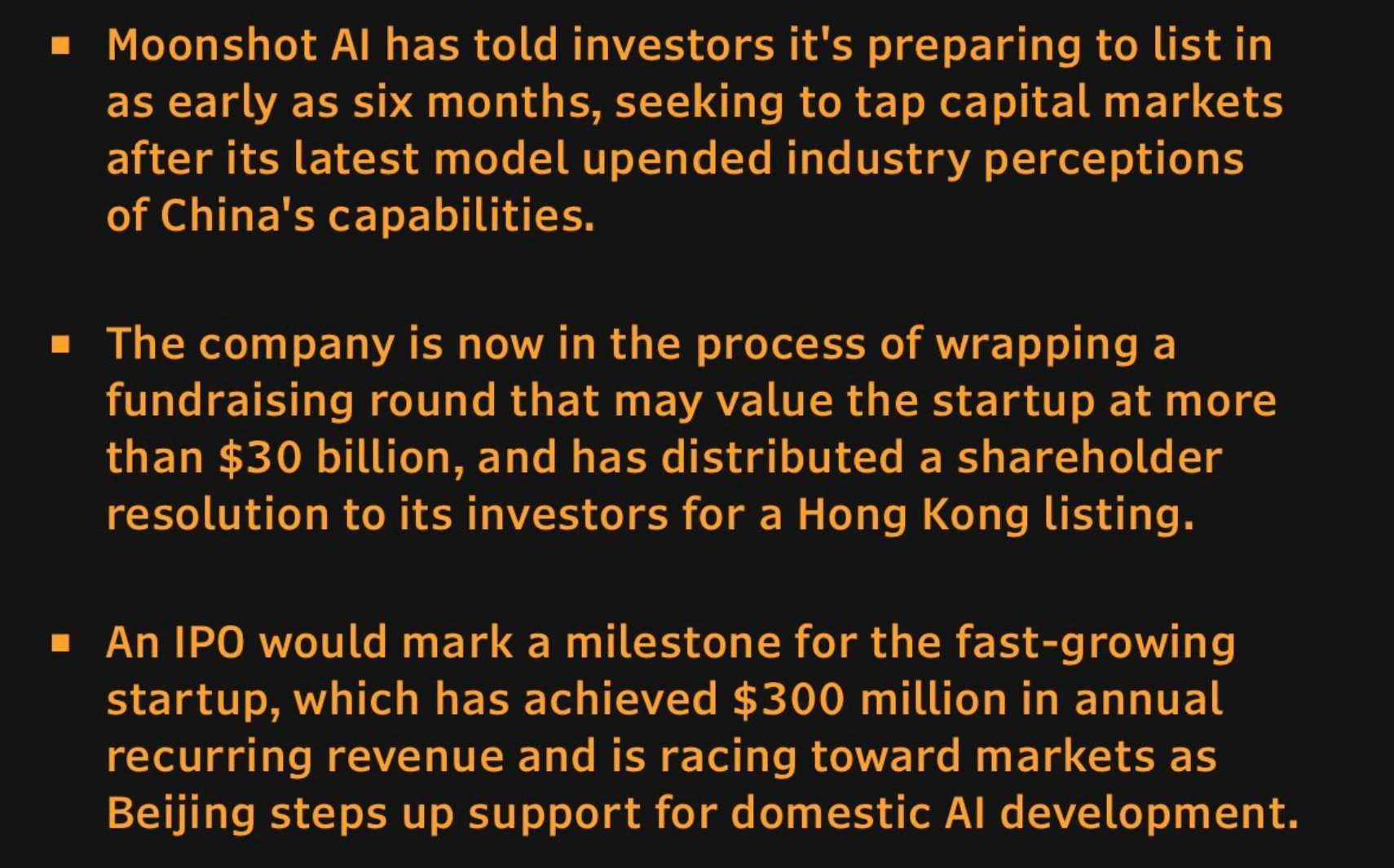
Moonshot AI is preparing for a Hong Kong IPO, targeting a valuation above $30 billion within six months. The company’s revenue grew significantly, from around $200 million in April to approximately $300 million by mid-June, accelerated by the release of its Kimi K3 model. While AI's resurgence is reshaping public market capital flows, with IPOs averaging $1.75 billion in 2026, the cryptocurrency market's reaction has been muted. Bitcoin and Ethereum remain range-bound despite improving AI sentiment, though ample stablecoin liquidity suggests capital is available. Ultimately, successful AI IPOs like Moonshot’s could strengthen confidence in tokenized capital markets and blockchain-based infrastructure, potentially paving the way for a broader crypto rally in the future.

Just a month after the SpaceX IPO drew strong global investor attention, another high-profile technology listing is gathering momentum. Moonshot AI is preparing for a Hong Kong IPO, reflecting confidence in investor demand and the broader AI market.

Management is targeting a valuation above $30 billion within the next six months. Recurring annual revenue increased from approximately $200 million in early April to approximately $300 million in mid-June, indicating the rate of business growth.
Source: Bloomberg

That momentum accelerated after the release of the Kimi K3 model. This strengthened the company’s competitive position and attracted fresh investor interest. Notably, Moonshot’s value has already risen significantly above previous estimates of $18 billion to $20 billion thanks to private funding.

Furthermore, shareholder resolutions and corporate restructuring indicate listing preparations are progressing steadily. Still, sustaining revenue growth and product adoption will be essential to securing its targeted valuation and a successful market debut.

Can AI momentum reshape crypto capital flows?

AI’s resurgence is becoming a broader market story rather than an equity story alone. The next question is whether crypto follows that momentum or continues trading on its cycle. Public markets already hint at changing investor behavior.

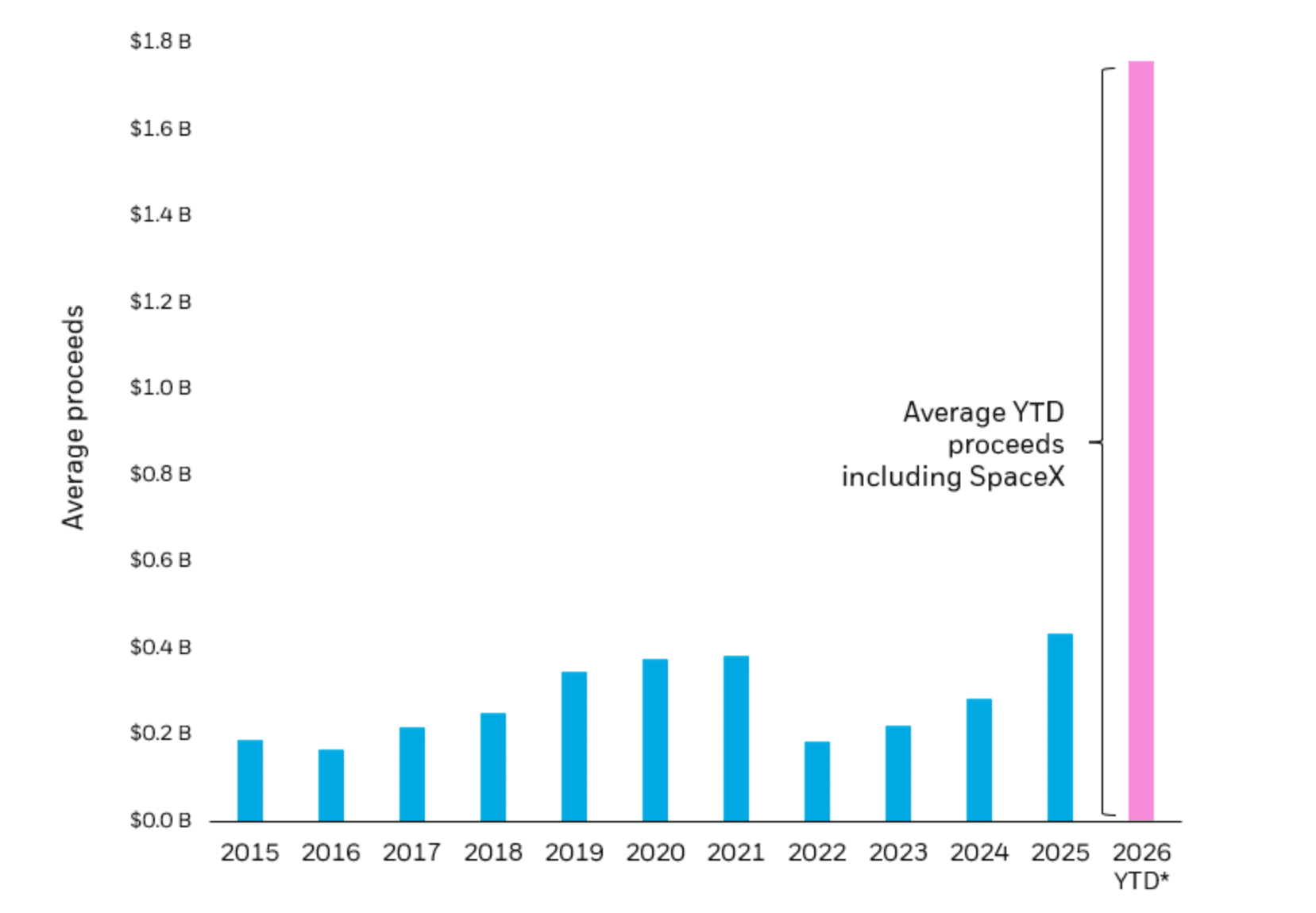
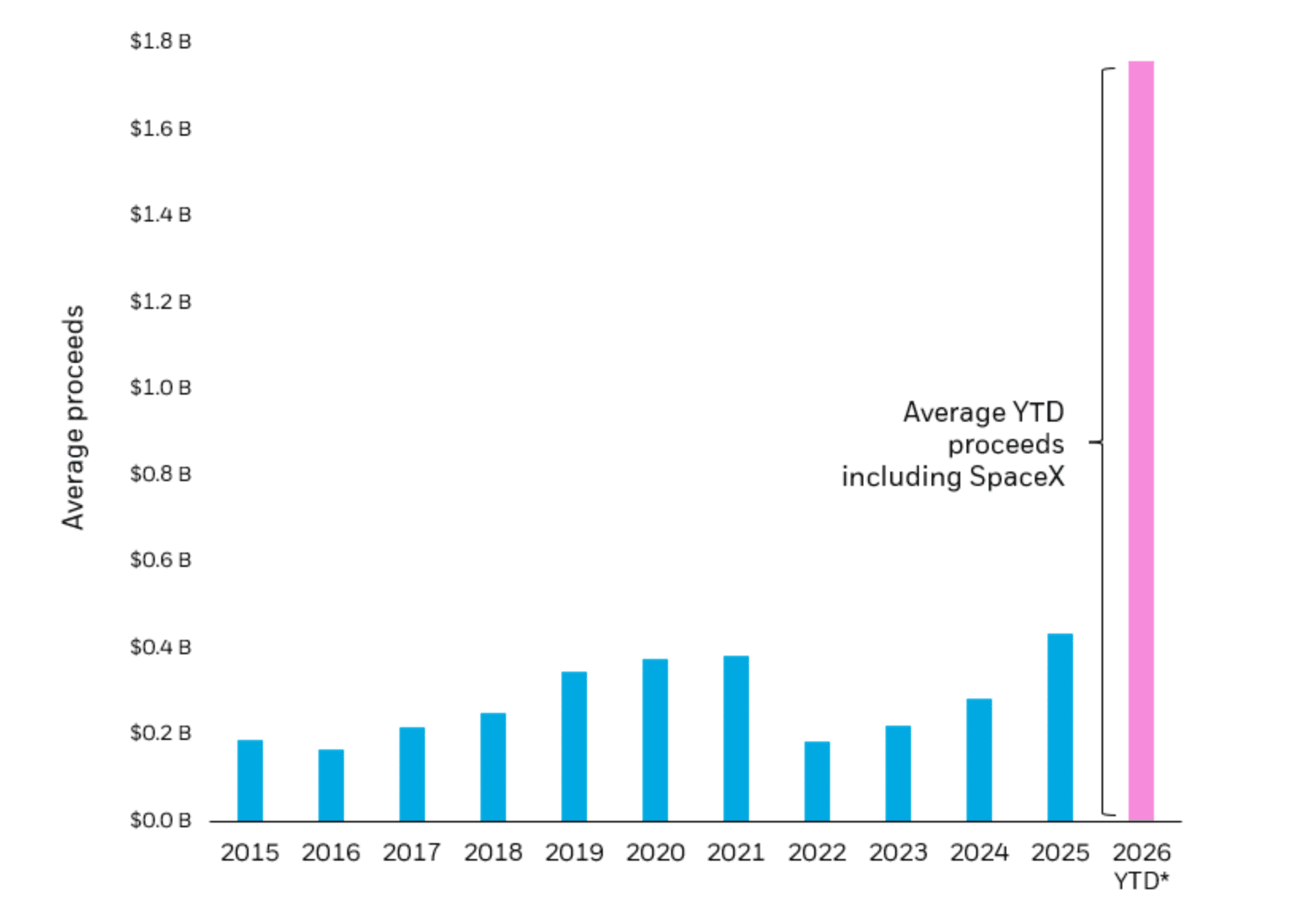
IPO offerings averaged about $1.75 billion in 2026, approximately four times what was seen in 2025. This was as a result of greater demand for listing companies with strong growth potential. In contrast, crypto’s reaction has been muted.
Source: iShares

Bitcoin [BTC] continues consolidating between $63,000 and $65,000, while Ethereum [ETH] trades near $1,850 to $1,870, despite improving AI sentiment. Meanwhile, stablecoin supply exceeding $300 billion suggests liquidity remains available rather than exhausted.

That cautious positioning explains why the AI token sector holds roughly a $21.7 billion market capitalization despite softer inference pricing. Beyond price action, the bigger shift may lie in capital formation.

All in all, Moonshot AI’s IPO reinforces AI’s growing influence while strengthening confidence in tokenized capital markets and blockchain. Still, as that ecosystem expands, successful AI IPOs could help build confidence in blockchain-based infrastructure before triggering a larger overall rally in cryptocurrency.


Final Summary

  • Moonshot AI’s IPO reflects rising demand for high-growth AI companies.
  • Successful AI IPOs could strengthen tokenized capital markets and blockchain fundraising.

Trending Cryptos

Related Questions

QWhat is the targeted valuation for Moonshot AI's upcoming Hong Kong IPO?

AManagement is targeting a valuation above $30 billion.

QWhat key factor strengthened Moonshot AI's competitive position and attracted fresh investor interest?

AThe release of the Kimi K3 model accelerated the company's momentum and strengthened its competitive position.

QAccording to the article, how could successful AI IPOs potentially impact the cryptocurrency sector?

ASuccessful AI IPOs could help build confidence in blockchain-based infrastructure and tokenized capital markets, potentially triggering a larger overall rally in cryptocurrency.

QWhat does the current stablecoin supply exceeding $300 billion suggest about market liquidity?

AIt suggests that liquidity remains available rather than exhausted.

QHow did the average IPO offering size in 2026 compare to 2025, and what does this indicate?

AIPO offerings averaged about $1.75 billion in 2026, approximately four times what was seen in 2025, indicating greater investor demand for listing companies with strong growth potential.

Related Reads

L2 'Recalibration': When L1 Becomes Its Own Rollup, What Is Ethereum's Endgame?

The article discusses the evolving relationship between Ethereum's Layer 1 (L1) and Layer 2 (L2) solutions, moving beyond the initial "L2 for scaling" model. As Ethereum L1 itself scales (increasing Gas Limit, statelessness, zkEVM), the unique value proposition of L2s shifts from merely providing cheap execution to offering differentiated features like application-specific optimization, privacy, and flexible governance. The piece explores three key themes: 1. **L2's New Role:** L2s are transitioning from a pure scaling technology to a spectrum of execution environments with varying degrees of security inheritance from Ethereum L1. 2. **Interoperability as State Trust:** Solving L2 fragmentation is less about cross-chain bridges and more about enabling faster, trust-minimized state verification between environments. This involves initiatives like faster L1 finality, intent-based architectures (Open Intents Framework), and native account abstraction. 3. **Blurring Layers:** With the potential integration of zk-proofs into L1 validation (making L1 akin to its own "Rollup") and the concept of "Native Rollups," the rigid boundary between L1 and L2 may fade. The future could be a unified system with multiple execution domains (for DeFi, gaming, privacy, etc.) sharing a common security, settlement, and state framework. In conclusion, Ethereum's goal is not to abandon L2s or re-centralize everything on L1, but to re-integrate the fragmented user experience—liquidity, accounts, applications—while preserving the scaling benefits of a multi-environment ecosystem. The endgame is a cohesive "one chain" feeling for users, powered by diverse but securely interconnected execution layers.

marsbit8m ago

L2 'Recalibration': When L1 Becomes Its Own Rollup, What Is Ethereum's Endgame?

marsbit8m ago

The Encryption Bill Clarity's Challenge: A Thorny Path of Bipartisan Compromise in the U.S.

U.S. lawmakers are attempting to advance the Clarity Act, a significant crypto market structure bill, but its path is fraught with partisan hurdles. The process has been rocky since January, when a prior bipartisan deal in the Senate Banking Committee was upended. A key compromise in May on "yield" issues allowed the bill to move forward in committee, but only with the conditional support of two Democratic senators, Angela Alsobrooks and Ruben Gallego. They emphasized that their final vote depends on reaching an agreement on ethics provisions for elected officials. Ultimately, the Senate Agriculture Committee passed its version along party lines without Democratic support. As Republicans push for a full Senate vote in July, the demand for strong ethics language has expanded beyond Democrats. Additional controversies surround provisions related to yields (aligning some Republicans with large banks) and developer protections (opposed by enforcement agencies). Core concerns about illicit finance and consumer protection remain central to the debate. Despite consensus on the need for legislation, achieving the necessary bipartisan compromise is proving difficult. While momentum exists—including recent meetings between senators and White House officials—a reconciled bill text faces skepticism. Senator Gallego has stated that without ethics terms acceptable to Democrats, they will not provide the needed votes. The immediate goals for the crypto community in Congress are unclear: a symbolic Senate vote before the August recess, eventual passage into law by 2026, or forging a final compromise framework. The arduous, vote-by-vote effort to build bipartisan support continues, mirroring the traditional legislative grind the industry must now navigate.

Foresight News59m ago

The Encryption Bill Clarity's Challenge: A Thorny Path of Bipartisan Compromise in the U.S.

Foresight News59m ago

Trading

Spot

Hot Articles

Discussions

Welcome to the HTX Community. Here, you can stay informed about the latest platform developments and gain access to professional market insights. Users' opinions on the price of AI (AI) are presented below.

活动图片