Before the AI Bubble Bursts, the 'Big Short' Makes $100 Million First from Subscription Fees

marsbitPublished on 2026-08-14Last updated on 2026-08-14

Abstract

Michael Burry, known as "The Big Short," is generating significant revenue from his Substack investment newsletter "Cassandra Unchained," which reached over 300,000 subscribers within 231 days. At an annual fee of $379, this could translate to theoretical revenue of approximately $113.7 million. While this figure represents a theoretical maximum before Substack's cut and includes free subscribers, it highlights a potentially lucrative venture. In contrast, Burry's well-publicized short positions in AI and semiconductor stocks like Nvidia, Micron, and Applied Materials have faced substantial pressure. These stocks have surged dramatically in 2024, with Micron rising 697% year-to-date, leading to significant unrealized losses on his short bets. Through his newsletter, Burry discloses his investment moves. His long portfolio includes value-oriented stocks like PayPal, Lululemon, and Chinese equities such as Alibaba and JD.com. He argues that fear surrounding AI has created undervalued opportunities in software and that capital will eventually rotate into Chinese markets. Despite the mounting losses from his short trades against the AI rally, which he compares to the dot-com bubble, the success of his paid subscription service may emerge as his most profitable endeavor this year.

Michael Burry's paid newsletter, 'Cassandra Unchained,' surpassed 300,000 subscribers in just 231 days. At an annual fee of $379, this translates to a theoretical yearly revenue of approximately $113.7 million. Meanwhile, his short positions in AI and semiconductor stocks like NVIDIA, Micron, and AMAT have faced significant pressure this year, with Micron's stock price surging as much as 697% year-to-date.

Shorting AI stocks is losing big, but selling subscriptions could be a jackpot—Michael Burry's most profitable venture this year might not be stock trading, but blogging.

'Big Short' investor Michael Burry's investment newsletter on Substack, 'Cassandra Unchained,' surpassed 300,000 subscribers in just 231 days. At an annual fee of $379, this translates to a theoretical yearly revenue of approximately $113.7 million.

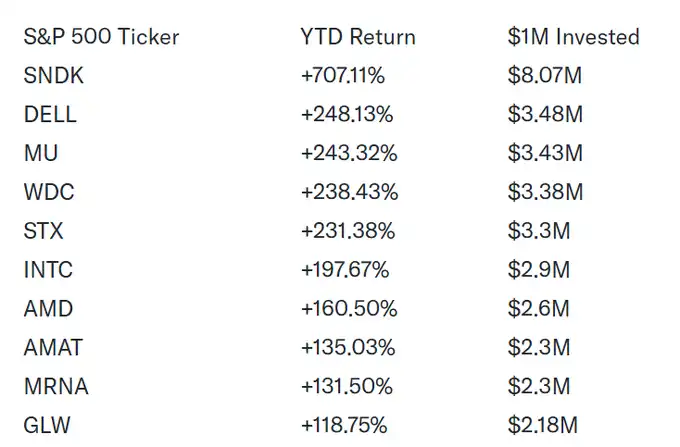
How staggering is this number? According to a report from Stocktwits, if $1 million were invested in each of the year's top 10 performing stocks in the S&P 500, the total return would be around $34 million—less than one-third of Burry's theoretical newsletter revenue.
300,000 Subscribers in 231 Days

In a post titled 'Short & Thankful: 300,' Burry disclosed that 'Cassandra Unchained' has reached 300,044 subscribers and 346,680 followers. Subscribers come from all 50 U.S. states and 212 countries, with 52% located outside the United States.

Data shows that the 'Cassandra Unchained' newsletter had about 218,000 followers in January of this year, growing to nearly 347,000 by July, indicating a consistently upward growth trajectory.
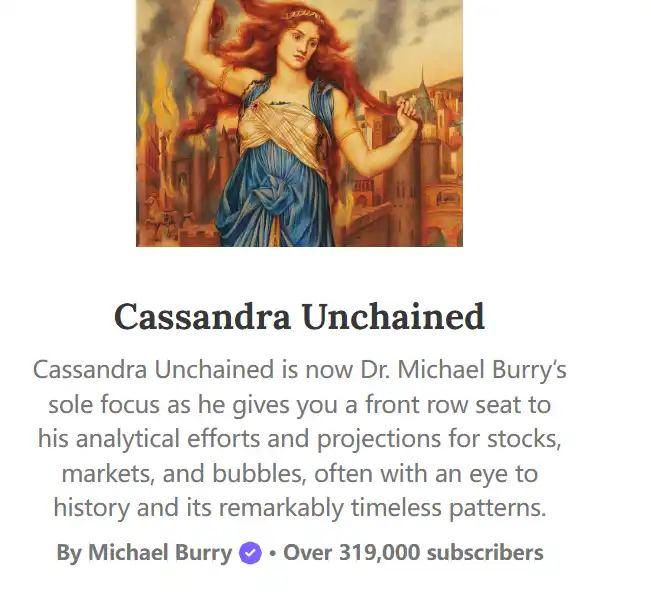
The newsletter is priced at $39 per month or $379 per year, with a free tier also available. Burry has not disclosed the specific proportion of paid subscribers. Substack's subscriber count includes both free and paid readers, and the aforementioned calculation does not deduct Substack's platform fees. Therefore, the $113.7 million figure represents a theoretical maximum, not actual net income.

Burry launched the newsletter in November 2025, shortly after deregistering his hedge fund with the SEC, returning to social media, and resuming his criticism of the AI frenzy. The newsletter attracted over 60,000 subscribers at launch and has gradually evolved into his primary platform for publishing real-time portfolio updates, valuation analyses, and detailed trading records.

Long Value Stocks: PayPal, Lululemon, Alibaba

In the newsletter, Burry continuously discloses specific trades.

In April, he made his first large-scale public disclosure of holdings, initiating a position in PayPal Holdings (PYPL) at around $49, making it 3.5% of his portfolio and naming it his top pick in the software and payments sector, ahead of Fiserv (FI) and Adobe (ADBE). He subsequently added to his PayPal position around $45 and simultaneously bought Fiserv. That same month, he also initiated positions in Adobe, Autodesk (ADSK), and Veeva Systems (VEEV), citing that 'AI disruption fears have compressed software valuations below intrinsic value.'

In April, he also reaffirmed his confidence in Molina Healthcare (MOH), stating that market expectations had 'bottomed out' and that he would continue adding to the position, as the investment thesis is based on normalized earnings over the coming years.

In June, Burry turned his attention to Lululemon Athletica (LULU), adding to the position multiple times. He stated bluntly: 'Terrible management is a value investor's best friend.' He believes Wall Street is overly focused on management missteps, tariffs, and slowing growth, while neglecting its long-term value.

Regarding Chinese assets, Burry disclosed in April that he held over 6% of Alibaba's stock and continued adding to his position in JD.com (JD). Last week, he stated that JD.com is one of his top three holdings and predicted that 'as the enthusiasm for AI and memory chips wanes, capital will rotate toward Hong Kong and Chinese stocks.'

Shorting AI Stocks: NVIDIA, Micron, Palantir

Simultaneously, Burry has been consistently expanding his short positions in AI and semiconductor stocks.

In April, he disclosed holding additional put options on NVIDIA (NVDA), including contracts expiring in January 2027 with a strike price of $115, while maintaining his previous $100 puts. On June 30th, he escalated the trade to directly shorting NVIDIA, entering at a price of $198.09. The same update also disclosed new short positions in Applied Materials (AMAT), the iShares Semiconductor ETF (SOXX), Tesla (TSLA), and Caterpillar (CAT). He compared the current semiconductor frenzy to the dot-com bubble.

'The immediate trigger for today's rally is Korea's announced massive spending. I think this is the beginning of the end,' Burry said.

Earlier this month, he disclosed directly shorting Micron Technology (MU), stating that the memory chipmaker's deviation from its 200-day moving average exceeded any point since 1984.

Regarding Palantir Technologies (PLTR), Burry has maintained one of Wall Street's most closely watched bearish stances since first disclosing the short last November. Although he partially covered the position, in June he reiterated that 'there's still no sign of seller capitulation or exhaustion.'

The Cost of Being Short: Getting 'Slapped' by the Market

However, reality has not been on Burry's side.

This year, many of the stocks he has shorted have significantly outperformed the broader market. The S&P 500 ETF (SPY) is up 22% year-to-date, the Nasdaq 100 ETF (QQQ) is up 31%, while NVIDIA has gained 29%, AMAT has skyrocketed 206%, and Micron has surged a staggering 697%.

Shorting these stocks means Burry has incurred substantial paper losses on these positions.

This is precisely why his newsletter revenue appears particularly striking—while under pressure on the trading front, the 'Big Short's' other business venture may quietly be becoming his biggest source of profit this year.


Trending Cryptos

Related Questions

QHow many subscribers did Michael Burry's paid newsletter 'Cassandra Unchained' gain in 231 days, and what is its theoretical annual revenue based on its annual fee?

AMichael Burry's paid newsletter 'Cassandra Unchained' gained over 300,000 subscribers in 231 days. With an annual fee of $379, the theoretical annual revenue is approximately $113.7 million.

QWhich major AI and semiconductor stocks did Michael Burry short in 2025, and what was their performance?

AMichael Burry shorted NVIDIA, Micron, Applied Materials (AMAT), and the iShares Semiconductor ETF (SOXX) in 2025. These stocks performed strongly: NVIDIA rose 29%, AMAT surged 206%, and Micron skyrocketed 697% year-to-date.

QWhat were some of the value stocks Michael Burry invested in and disclosed in his newsletter?

AIn his newsletter, Michael Burry disclosed investments in several value stocks, including PayPal Holdings (PYPL), Fiserv (FI), Adobe (ADBE), Autodesk (ADSK), Veeva Systems (VEEV), Molina Healthcare (MOH), Lululemon Athletica (LULU), and Chinese companies like Alibaba and JD.com.

QWhy is the revenue from Michael Burry's newsletter highlighted as significant in the context of his investment performance?

AThe revenue from Michael Burry's newsletter is highlighted as significant because, while his short positions in AI and semiconductor stocks are experiencing substantial paper losses due to the stocks' massive rallies, his newsletter business is generating a large theoretical income, potentially making it his most profitable venture this year.

QWhat did Michael Burry compare the current semiconductor boom to, and what was his reasoning for his short positions?

AMichael Burry compared the current semiconductor boom to the dot-com bubble. His reasoning for the short positions was his belief that the massive rally, partly triggered by announcements of large-scale spending (like from South Korea), signaled 'the beginning of the end' for the boom, indicating an impending market correction.

Related Reads

New ChatGPT Feature: AI Begins Monitoring Users

OpenAI has launched "Computer History," a new feature for its ChatGPT desktop app on macOS, designed to track user activity across applications and websites. This allows the AI model to use this data to provide more accurate and personalized responses in subsequent conversations. The feature, released on August 13th, is available to Pro, Business, and Enterprise subscribers. However, its rollout in the European Economic Area, the UK, and Switzerland is delayed as OpenAI works to align the tool with local data processing regulations. Computer History operates in the background, logging user activity into a temporary timeline. Users can review, manage, or delete this history via the app's interface or macOS menu bar. The feature is opt-in and requires explicit user activation in the settings. This release replaces and expands upon an earlier experimental project called Chronicle. OpenAI states the new version is more computationally efficient and offers improved privacy controls. The launch coincides with other AI advancements from the company, including a high-speed GPT-5.6 model. The article notes potential technical risks associated with the predecessor, Chronicle, such as prompt injection vulnerabilities and unencrypted local data storage. It also highlights the competitive landscape, where similar memory features are being developed by rivals like Anthropic's Claude and Google's Gemini. The delayed European rollout underscores the ongoing challenge of balancing deep personalization with stringent data protection laws.

cryptonews.ru18m ago

New ChatGPT Feature: AI Begins Monitoring Users

cryptonews.ru18m ago

GPT-5 Also Has Tip-of-the-Tongue Moments, Google Tested 4.5 Million Times: The Keys Are Lost

Google researchers have discovered that advanced AI models like GPT-5 and Gemini 3 experience a phenomenon akin to the human "tip-of-the-tongue" state, where they possess knowledge but fail to retrieve it. Their study, "Empty Shelves or Lost Keys?" (ICML 2026), introduces the "Knowledge Portrait" framework to analyze factual knowledge in models, distinguishing between failure to encode a fact versus failure to recall it. Testing on 13 models across 2.15 million queries from the WikiProfile benchmark revealed that state-of-the-art models successfully encode 95-98% of facts into their parameters. However, when asked directly, they fail to recall 26-34% of these known facts. Enabling chain-of-thought ("thinking") reasoning reduces this recall failure to 11-12%, recovering 40-65% of the previously unrecalled but encoded facts. The research identifies two key bottlenecks: recalling obscure ("long-tail") facts and answering reversed queries (e.g., "Who is Tom Cruise's mother?" vs. "Whose son is Tom Cruise?"). While scaling model size effectively reduces encoding failures, it does little to improve recall rates. In larger models, recall failure becomes the dominant source of factual errors, accounting for over 70% of mistakes in GPT-5.2. The findings suggest that for top models, the primary challenge is no longer storing knowledge but accessing it efficiently. Future accuracy gains may depend more on improved inference-time methods and "meta-cognitive" abilities, enabling models to recognize when they need to engage in deeper reasoning to retrieve information they already know.

marsbit38m ago

GPT-5 Also Has Tip-of-the-Tongue Moments, Google Tested 4.5 Million Times: The Keys Are Lost

marsbit38m ago

The Dollar is a Technology: Stablecoins Are Exporting U.S. Institutions to the World

This article argues that stablecoins and blockchain infrastructure are becoming a vehicle for exporting American financial systems globally. The core thesis is that the U.S. dollar, as a "technology," is increasingly embedded in blockchain rails, moving beyond a reserve currency to represent the institutional stability of the United States itself. The piece highlights three key areas where this is happening: 1. **Cross-border payments and trade finance:** Companies like Keyrails use stablecoins and blockchain to streamline and secure trade finance for emerging markets (e.g., Nigeria-China trade), offering faster, often cheaper dollar liquidity than traditional systems. 2. **Programmable collateral and credit:** Platforms like SemiLiquid allow institutions to use tokenized assets (e.g., treasuries, stocks) as "programmable collateral" for loans without moving them from custody, unlocking capital efficiency and improving transparency in institutional lending. 3. **Financing real-world assets:** Protocols like USD.AI create lending markets for productive, hard-to-finance assets like AI GPUs, connecting global stablecoin liquidity to physical capital. The author concludes that the true value of these new blockchain-based financial platforms lies not just in transaction volume, but in the deep, hard-to-replicate "context" (data, trust, operational knowledge) they build around specific economic activities like trade and asset finance. This represents crypto's evolution into an operating system for real-world capital formation, moving beyond speculation.

marsbit42m ago

The Dollar is a Technology: Stablecoins Are Exporting U.S. Institutions to the World

marsbit42m ago

Trading

Spot

Hot Articles

Discussions

Welcome to the HTX Community. Here, you can stay informed about the latest platform developments and gain access to professional market insights. Users' opinions on the price of AI (AI) are presented below.

活动图片