Coinbase CEO touts agentic finance as Base tops 100M AI payments

cointelegraphPublished on 2026-07-27Last updated on 2026-07-27

Abstract

Coinbase CEO Brian Armstrong emphasizes the growing importance of cryptocurrency for the AI era, introducing the concept of "agentic finance" (AiFi). He argues that AI agents will require programmable money like crypto, rather than traditional banking, for automated transactions. This vision is supported by Coinbase's infrastructure: the Base Ethereum layer-2 network, the x402 payment protocol for automated stablecoin payments, and the USDC stablecoin. Recent data from Chainalysis shows agentic payment activity on Base via x402 has surpassed 100 million transactions, highlighting rapid adoption. Armstrong concludes that the AI megatrend actually strengthens crypto's relevance as the necessary financial rail for autonomous machine-to-machine economies.

Coinbase CEO Brian Armstrong is pushing back against calls for crypto to pivot to artificial intelligence, arguing AI agents will instead stoke demand for crypto-based financial services.

Armstrong took to X on Sunday to tout agentic finance (AiFi), highlighting Coinbase’s Base network, USDC and x402 as the infrastructure for autonomous machine-to-machine payments.

“AI being a megatrend takes nothing away from crypto,” Armstrong wrote, because AI agents will need programmable money rather than traditional banking rails. “If anything, it makes crypto more important,” he added.

His comments come as crypto companies increasingly position blockchain networks as payment infrastructure for AI agents, with agentic payment activity on Base topping 100 million transactions in June.

How Coinbase’s AiFi stack came together

Armstrong’s AiFi vision centers on the idea that AI agents will become active participants in the digital economy, making payments and interacting with financial services without human intervention.

Coinbase launched Base in 2023 as an Ethereum layer-2 network designed to make onchain applications faster and cheaper to use. The network was built as general-purpose blockchain infrastructure rather than specifically for AI payments.

Two years later, Coinbase introduced x402, a payment protocol built around the HTTP “402 Payment Required” standard that enables automated stablecoin payments between software applications. The protocol allows AI agents and other autonomous systems to pay for digital resources such as APIs and data without traditional accounts or manual checkout flows.

Related: Base’s 1:1-backed tokenized equities launch ‘imminent,’ Pollak says

USDC, the dollar-pegged stablecoin launched by Circle and Coinbase-backed Centre Consortium in 2018, is one of the assets used for x402 payments, allowing software agents to make automated transactions.

Base, x402 and USDC together form the core of Coinbase’s current approach to building infrastructure for agentic payments.

Coinbase is slated to report second quarter earnings on Thursday. Analysts average is for revenue of $1.29 billion, with sales estimated to show a 13.8% decline over last year’s comparable period, Yahoo Finance data shows. Earnings per share are expected to be flat.

Base agentic activity tops 100 million transactions

Chainalysis reported in June that agentic payments on Base via x402 surpassed 100 million transactions within roughly nine months of activity.

The analytics firm said it tracked the activity by identifying x402-related payment flows onchain, with transactions worth at least $1 accounting for 95% of total value transferred.
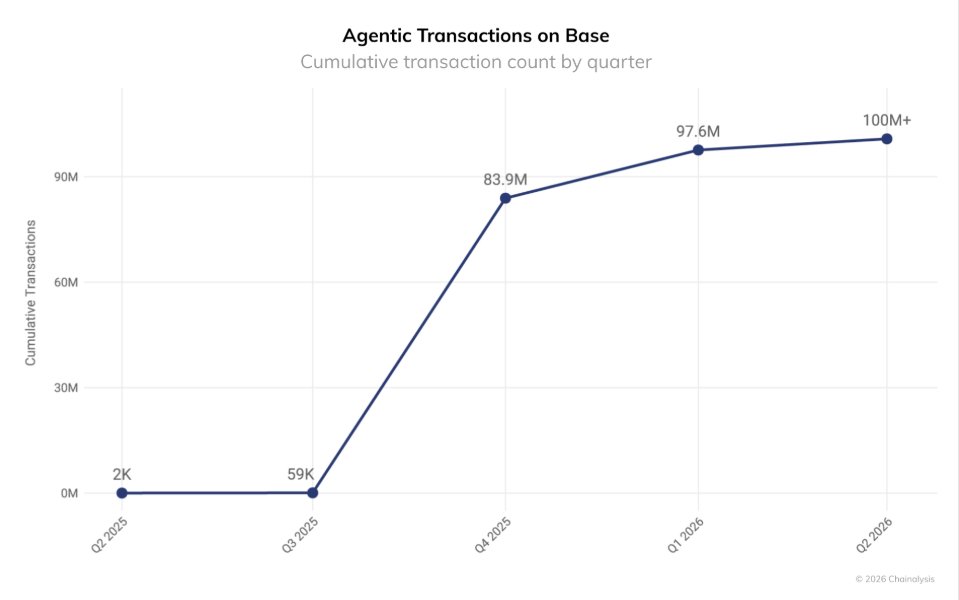
Source: Chainalysis

Chainalysis also found that agentic payment wallets were typically newer, held more asset types and carried smaller balances than average Base users.

Cointelegraph asked Chainalysis for updated x402 activity figures and details on its tracking methodology, but the firm had not responded by publication time.

Magazine: CLARITY hopes fade, BitMEX shuts as lawsuit looms: Hodler’s Digest, July 26

Trending Cryptos

Related Questions

QWhat is Coinbase CEO Brian Armstrong's main argument regarding the relationship between crypto and AI?

AHe argues that AI does not diminish crypto's importance; instead, AI agents will increase demand for crypto-based financial services because they need programmable money, not traditional banking systems.

QWhat three core components make up Coinbase's AiFi (agentic finance) stack?

AThe core components are Base (an Ethereum layer-2 network), the x402 payment protocol, and the USDC stablecoin.

QWhat was the reported milestone for agentic payment activity on the Base network in June?

AAgentic payments on Base via the x402 protocol surpassed 100 million transactions in roughly nine months of activity.

QAccording to Chainalysis, how do wallets used for agentic payments typically differ from average Base user wallets?

AAgentic payment wallets are typically newer, hold more types of assets, and maintain smaller balances than wallets of average Base users.

QWhat is the purpose of the x402 protocol as mentioned in the article?

AThe x402 payment protocol, built around the HTTP '402 Payment Required' standard, enables automated stablecoin payments between software applications, allowing AI agents to pay for digital resources like APIs and data without traditional accounts or manual processes.

Related Reads

Take a Calm Look at Domestic Lithography Machines: 5 Units Delivered, How Far Are We from Challenging ASML?

This article analyzes recent news about China's domestic DUV lithography machines, advising a measured perspective. A state-backed enterprise plans to deliver about 5 immersion DUV systems this year, with a 2027 target of 20 units, aimed at 28nm processes. While this marks a step from R&D into initial customer validation, the author cautions against over-optimism. The piece clarifies this is DUV, not EUV technology. DUV is crucial but cannot economically solve challenges for advanced nodes like 5nm or below, where EUV is key. The 5-unit volume is minimal compared to ASML's annual output of over 130 such machines. The author highlights unverified claims regarding specs like 90% yield and warns against conflating this news with unconfirmed reports about Shanghai Micro Electronics' production. China's EUV efforts, while progressing with a prototype, remain in early testing, facing significant hurdles in core components like high-precision optics. The analogy of a "DeepSeek moment" is deemed misleading, as lithography involves slow, iterative precision engineering, not rapid software-like breakthroughs. Current progress represents establishing a potential second supply source and gaining vital engineering experience rather than an imminent industry disruption. For investors, the key indicators to watch are formal customer acceptance, stable operational performance, repeat orders, and growth in production volume and component localization. The conclusion is that this is a positive but early-stage development, far from altering the global competitive landscape.

marsbit25m ago

Take a Calm Look at Domestic Lithography Machines: 5 Units Delivered, How Far Are We from Challenging ASML?

marsbit25m ago

The 800x Golden Dog, "Gacha" Saves NFT Trading

Title: 800x Golden Dog: How 'Gacha' Mechanics Are Rescuing NFT Trading In the past month, the on-chain TCG (Trading Card Game) narrative, centered around "gacha" or loot box mechanics, has emerged as a major crypto-native revenue generator, second only to platforms like Hyperliquid and pump.fun. Recently, this trend hit Ethereum with Fake World Assets (FWA). Within just over a week, FWA generated approximately $1.3 million in revenue, ranking 15th in the past week's crypto app earnings. Its token, $FWA, surged from an initial market cap of ~$47,550 to a peak of ~$38.8 million—an 800x gain. Meanwhile, Collector Cards' token $CARDS declined significantly from its previous highs. FWA, developed by the team behind "PunkStrategy," operates as an NFT gacha system with a built-in token flywheel. Users deposit NFTs paired with ETH as liquidity into pools. Each deposit creates a personal pool; more ETH deposited lowers the chance of the NFT being "won" in a draw. Players spend ETH to "draw" (gacha). If they get an undesirable NFT, they can instantly sell it back to the original depositor at an 85% discount, generating income for the depositor. A 1% fee is taken on each draw and on depositor earnings when an NFT is kept. The key to FWA's momentum is its token $FWA. It cannot be bought directly externally. The primary way to acquire it is by playing the gacha and choosing to receive $FWA (instead of ETH) when selling back an unwanted NFT. This mechanism creates constant buy pressure for $FWA as players engage, especially during its price ascent. Early participants who held $FWA benefited massively from subsequent inflows. This contrasts with projects like Collector Cards, which, despite strong revenues, suffer from perceived low token utility beyond buybacks. In conclusion, while FWA's flywheel design—linking speculative token gains directly to NFT trading activity—has driven rapid growth, its sustainability is questionable. The model relies heavily on continuous $FWA price appreciation to offset the inherent negative expectancy of each draw. When price momentum stalls, activity will likely decline. The case highlights that in crypto markets, pure profitability narratives can be fleeting; understanding the relationship between attention, token buy pressure, and sustainable mechanics is crucial to avoid speculative pitfalls.

marsbit50m ago

The 800x Golden Dog, "Gacha" Saves NFT Trading

marsbit50m ago

The Quantum Computing Threat Approaches, Cryptocurrency May Be Exposed to Risks Before Banks

Quantum computing poses a significant threat to all cryptographic systems, including banks and governments, but decentralized cryptocurrencies with public ledgers like Bitcoin are likely the first practical target. Experts warn that a cryptographically relevant quantum computer (CRQC), capable of running Shor's algorithm to break the elliptic curve cryptography securing most crypto wallets, could emerge around 2029. Recent research shows the required quantum resources for such attacks are shrinking dramatically, potentially enabling key extraction in minutes. The core vulnerability for cryptocurrencies is not the cryptography itself—post-quantum standards are being developed—but the slow, decentralized governance required to implement upgrades. Unlike centralized banks that can swiftly transition, Bitcoin needs near-unanimous consensus among its global network, a historically difficult process as seen in past upgrades. Estimates suggest migrating all vulnerable Bitcoin funds could take at least 76 days of dedicated network time, and it must be completed before a CRQC exists to prevent "now-or-never" attacks on exposed keys. The threat is not binary; it begins when a quantum computer can decrypt data before it loses value, not necessarily in real-time. A significant portion of Bitcoin (estimated at millions of coins) already has public keys permanently exposed on-chain, making them vulnerable to eventual "static attacks." While technical solutions exist, the race is against time for decentralized networks to coordinate a defensive transition, serving as an early warning for the broader financial system.

marsbit1h ago

The Quantum Computing Threat Approaches, Cryptocurrency May Be Exposed to Risks Before Banks

marsbit1h ago

Trading

Spot

Hot Articles

Discussions

Welcome to the HTX Community. Here, you can stay informed about the latest platform developments and gain access to professional market insights. Users' opinions on the price of AI (AI) are presented below.

活动图片