Overnight Global Shock: Why Did AI Stocks Plunge Across the Board?

marsbitPublished on 2026-08-19Last updated on 2026-08-19

Abstract

Overnight, U.S. AI-related stocks fell sharply, with the Nasdaq down 1.33% and the Philadelphia Semiconductor Index plunging nearly 5%. Panic spread globally, dragging down Asia-Pacific markets. Key negative drivers included: 1. **Geopolitical Tension & Macro Pressure:** Escalating U.S.-Iran tensions pushed oil prices higher, fueling inflation fears and expectations of prolonged high interest rates. Rising bond yields pressured high-valuation, capital-intensive AI stocks, especially as soaring AI infrastructure financing costs became evident. 2. **AI Commercialization Concerns:** OpenAI's Q2 results showed slowing revenue growth and widening losses, dampening market optimism about near-term AI application profitability. This shifted investor focus from pure capital expenditure narratives to actual commercial returns. 3. **Supply Chain Uncertainty:** U.S.-South Korea semiconductor investment disputes intensified. Market fears that Korean memory giants (Samsung, SK Hynix) face a dilemma—either divert capital to costly U.S. production or risk trade barriers—disrupted the critical HBM memory sector, amplifying sell-offs via leveraged ETFs. While long-term AI demand remains, the market is now scrutinizing real profitability, financing costs, and supply chain stability rather than paying premiums for unchecked growth stories. For markets like China's A-shares, the impact is primarily sentiment-driven, requiring distinction between short-term panic and fundamental deterioration.

Author: Gelong

Overnight, U.S. stock AI industry chain stocks plunged sharply, with the Nasdaq closing down 1.33% and the Philadelphia Semiconductor Index dropping nearly 5%. Stocks related to storage, optical communication, and AI computing power were generally hit hard.

Panic sentiment quickly spread across markets. Today, Asia-Pacific markets opened with full declines. South Korean stocks Samsung Electronics and SK Hynix tumbled over 6%, while leveraged ETFs such as the double-long Samsung and double-long SK Hynix funds plummeted over 14%, with leveraged fund stampedes further amplifying the volatility.
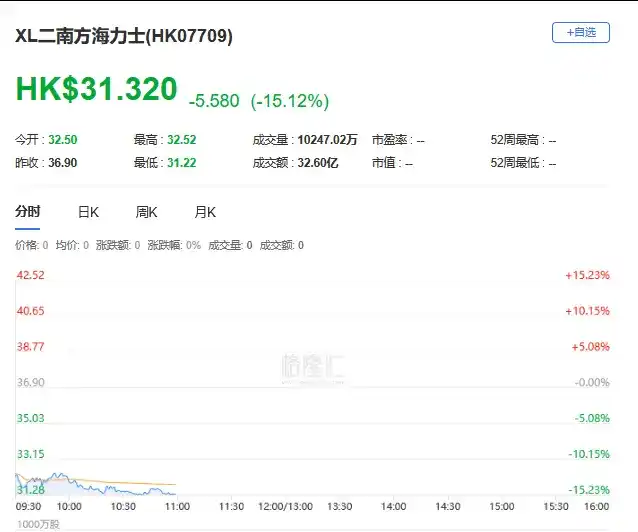
A-shares' AI industry chain also saw a significant impact. Core sectors such as computing power, optical modules, and storage generally fell over 5%, with several leading companies in sub-sectors dropping more than 8%.
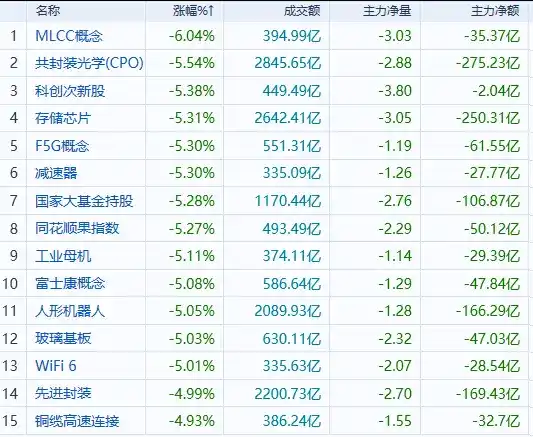
The negative stimuli primarily stemmed from several aspects.

First, the sudden escalation of U.S.-Iran tensions pushed up oil prices and inflation expectations, suppressing the valuation of the entire growth sector from a macro perspective.

The U.S. announced the suspension of negotiation contacts with Iran, further intensifying regional conflicts. Risks in the Strait of Hormuz heated up, driving international oil prices higher to a three-week high. Simultaneously, the UAE has announced the suspension of all trade and financial dealings with Iran, further tightening regional tensions.
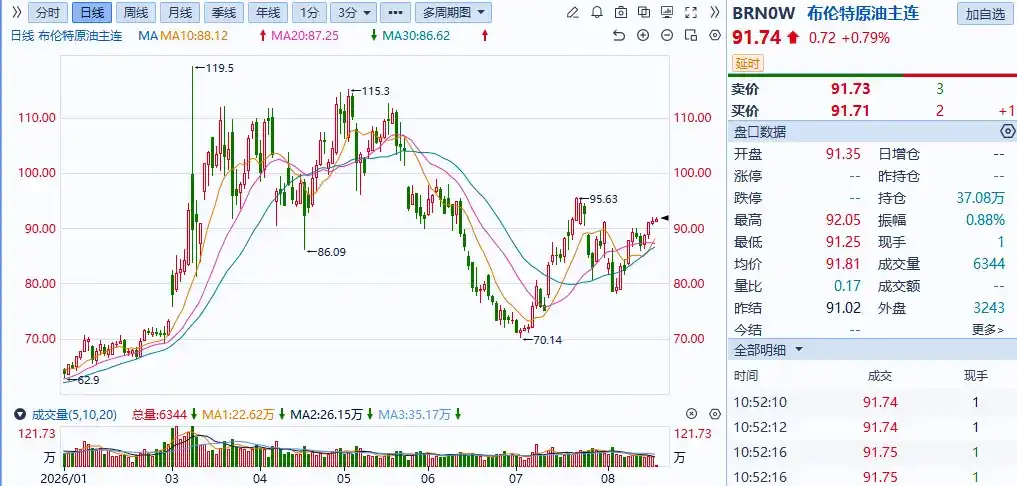
Rising oil prices directly fuel concerns about an inflation rebound, prompting the market to reassess the Federal Reserve's monetary policy room.

Long-term U.S. Treasury yields surged sharply, with the 30-year yield briefly touching its highest level since 2007, and the 10-year U.S. Treasury yield also rising significantly.

Under a high-interest-rate environment, the high-valuation, high-capital-expenditure AI sector is hit most directly.

AI computing power construction heavily relies on debt financing. This year's AI-related bond supply has far exceeded previous annual expectations. The yield on bonds issued by Blackstone for Microsoft's data centers is already approaching junk bond levels, directly reflecting the rising financing costs for AI infrastructure.

Goldman Sachs noted that massive AI capital expenditures combined with sovereign deficits are funneling large amounts of capital into the bond market, potentially forcing the Fed to maintain a tight policy stance even in a weakening economic data environment.

As financing costs continue to rise, the market is beginning to re-evaluate the logic of expanding computing power at all costs, leading to a sell-off in the AI hardware sector first.

Secondly, significant divergence has emerged in the commercialization of AI large models, with OpenAI's disappointing performance shattering the market's linear optimistic imagination for the AI application end.

Newly disclosed Q2 data shows OpenAI's quarterly revenue grew only 18% sequentially, with operating losses continuing to widen. Concurrently, high-level executives have left one after another, raising market doubts about the company's internal management stability.

Although competitor Anthropic achieved explosive revenue growth and slight profitability, differences in revenue recognition exist between the two, and this does not mean the entire industry has smoothly entered a profitable era.

OpenAI's decelerating growth has made the market realize that the commercialization of AI large models is not a smooth journey, with huge challenges remaining in enterprise customer conversion and cost control.

Previously, the market was accustomed to unconditionally believing the AI capital expenditure story. Now, investors are beginning to question how much real revenue and profit the massive computing power investment can actually translate into. The AI industry chain has officially entered a phase of assessing commercialization capabilities, moving away from the 'burn cash to scale' stage.

Third, the ongoing U.S.-South Korea semiconductor investment dispute continues to ferment, exacerbating uncertainty in the global memory industry chain and directly impacting the HBM memory sector, a core component of AI computing power.

South Korea has publicly denied related reports about U.S. demands to prioritize building memory chip factories in the U.S. South Korea itself has already planned a massive fund exceeding 580 billion dollars to invest in domestic chip and data center clusters.

If Samsung and SK Hynix are forced to establish large-scale memory production lines in the U.S., it would consume significant corporate capital and weaken the domestic semiconductor industry ecosystem.

However, U.S. pressure is multi-dimensional, using not only tariffs as leverage, but also implying that delays in investment commitments could spill over and affect U.S.-South Korea security cooperation.

This is the reality of 'earning money from the U.S. market, but keeping the capital in the U.S. and complying with industrial demands.' Korean memory companies reap huge profits by supplying HBM to the U.S. AI market, while the U.S. demands these companies repatriate capital to build factories locally or face trade penalties.

The market worries that if subsequent negotiations remain protracted, whether South Korea chooses compromise or confrontation, it will disturb the global memory supply structure.

If South Korea compromises, corporate capital will be diverted, and profits will be eroded by high U.S. construction costs. If it takes a tough stance, it may face trade barrier risks.

This dilemma directly triggered fund selling in Samsung and SK Hynix, with leveraged ETFs further amplifying the decline. Panic sentiment spread outward along the storage industry chain.

Of course, a short-term sharp decline does not mean the AI industry logic has completely ended.

Long-term demand for AI computing power objectively exists, but the market is no longer willing to pay a high premium for an indefinitely optimistic long-term narrative.

Moving forward, market focus will shift from merely looking at the scale of capital expenditure to examining corporate actual profitability, changes in financing costs, and the ultimate direction of global supply chain games.

For the A-share market, external sentiment shocks mostly bring short-term disturbance. Subsequent observation needs to focus on the domestic industry chain's own orders and profit realization, distinguishing between short-term emotional sell-offs and fundamental deterioration.


Trending Cryptos

Related Questions

QAccording to the article, what were the main reasons for the sharp decline in AI-related stocks globally?

AThe article cites three main reasons: 1) Macroeconomic headwinds from escalating US-Iran tensions, which pushed oil prices and inflation expectations higher, leading to rising bond yields and putting pressure on high-valuation growth sectors like AI. 2) Signs of a slowdown in AI model commercialization, highlighted by OpenAI's decelerating revenue growth and widening losses, challenging the linear optimism about AI application monetization. 3) Geopolitical uncertainty in the semiconductor supply chain, specifically the ongoing US-South Korea investment dispute over memory chip production, which created concerns about the HBM supply crucial for AI computing.

QHow did the geopolitical tensions between the US and Iran impact the AI sector, as described in the article?

AThe heightened US-Iran tensions, including the suspension of talks and regional escalations around the Strait of Hormuz, led to a significant rise in international oil prices. This increase fueled concerns about a rebound in inflation. Consequently, long-term US Treasury yields, such as the 30-year and 10-year yields, surged to multi-year highs. This high-interest-rate environment directly pressured high-valuation, capital-intensive sectors like AI, as their significant debt-financed expansion (e.g., for data centers and computing power) becomes more costly.

QWhat specific concerns about AI commercialization were raised by OpenAI's recent performance?

AOpenAI's recently disclosed Q2 results showed a significant slowdown, with quarterly revenue growth decelerating to just 18% quarter-over-quarter, while its operating losses continued to widen. Additionally, the departure of several company executives raised questions about internal management stability. This performance challenged the market's previous linear and optimistic assumptions about the smooth commercialization of AI large language models, highlighting ongoing challenges in enterprise customer conversion and cost control.

QWhat is the core issue in the US-South Korea semiconductor investment dispute mentioned in the article, and why is it causing market panic?

AThe core issue is a conflict over where major South Korean memory chip manufacturers like Samsung and SK Hynix should invest. The US is pressuring these companies to prioritize building memory chip factories in the US, using potential tariffs and impacts on security cooperation as leverage. South Korea, however, has denied such reports and plans massive investments in its domestic semiconductor ecosystem. The market panic stems from the 'lose-lose' dilemma this creates: if South Korea compromises, company profits could be eroded by high US construction costs and capital diversion; if it resists, the companies face potential trade barrier risks. This uncertainty directly threatens the stable supply of HBM memory, a core component for AI computing power.

QWhat does the article suggest will be the new focus for the AI market following this sell-off?

AThe article suggests that following the sell-off, the market's focus will shift away from blindly funding massive capital expenditure stories. Instead, investors will increasingly scrutinize and demand clearer evidence of actual corporate profitability, monitor changes in financing costs, and watch for the final resolution of global supply chain negotiations (like the US-South Korea dispute). The era of paying high premiums for purely optimistic long-term narratives is giving way to a period of evaluating tangible commercial viability and financial fundamentals.

Related Reads

Frenzy Surrounding Unitree's Humanoid Robots Exceeds Hyperliquid Traders' Expectations

The Chinese robotics company Unitree Robotics made a highly anticipated debut on the Shanghai Stock Exchange on August 19, 2026. Its shares soared 629% above their IPO price, valuing the company at approximately $66 billion at the start of trading. This represents one of the most significant investor frenzies around physical AI—systems combining AI with robots. Prior to the listing, crypto traders on the Hyperliquid platform had already been speculating on the company's value through a perpetual futures contract, pegging its valuation at around $38 billion. The actual debut massively exceeded these crypto market predictions by about 75%. The contract's trading volume reached $64 million. Unitree, specializing in humanoid and quadruped robots, is now mainland China's first publicly listed humanoid robot company. It shipped over 5,500 humanoid units in 2025, leading global sales. The company's 2025 revenue surged to 1.7 billion yuan from 393 million yuan a year earlier, with a net profit of 278 million yuan and gross margins exceeding 60%. The IPO, which raised about 6.1 billion yuan ($905 million), reflects intense investor interest in the physical AI sector. JPMorgan estimates the humanoid robot market could grow from $2 billion in 2025 to $300 billion by 2035, with China holding about 75% of the global market share due to lower production costs. However, analysts warn of potential overvaluation, noting the stock's price far exceeds traditional financial metrics and is driven by retail speculation. The company faces the challenge of translating pilot projects and demonstrations into widespread commercial adoption. Strategic investors in the IPO included AI firm DeepSeek, Tencent, and units of major state-owned companies.

cryptonews.ru4m ago

Frenzy Surrounding Unitree's Humanoid Robots Exceeds Hyperliquid Traders' Expectations

cryptonews.ru4m ago

Why Didn't Oil Prices Stabilize Above $100 as Traffic Through the Strait of Hormuz Plunged Again?

Despite a significant drop in daily oil tanker traffic through the critical Strait of Hormuz in August, Brent crude oil prices have failed to stabilize above $100 per barrel, instead hovering around $90. This contrasts with traditional market logic, where a threat to a chokepoint handling roughly 20 million barrels per day (27% of global seaborne oil) should trigger a sustained supply risk premium. The article explains that the market is pricing in increased transit costs rather than an imminent, complete supply cutoff. Investors currently believe multiple buffers can absorb the shock: strategic and commercial inventories, the potential for coordinated stock releases, available OPEC+ spare capacity, and alternative export routes from the Gulf. Furthermore, workarounds like ship-to-ship transfers outside the Strait and route adjustments by buyers and shippers add resilience, though at a higher cost for insurance, financing, and longer voyages. The underlying U.S.-Iran tensions frame this reassessment as a problem of cost allocation across the supply chain. The price action suggests traders are awaiting clearer signals—such as a military escalation, sustained Iranian attacks, or stricter enforcement of secondary sanctions on buyers—before pricing in a worst-case, long-term disruption scenario. In the longer term, the episode is accelerating investments to reduce dependency on the Strait, such as expanded storage and pipeline infrastructure, which will embed higher costs into the energy system. While Brent may remain range-bound for now, the real-time impact of the Hormuz risk is likely appearing first in freight rates, insurance premiums, and regional product spreads like diesel crack margins. The stability of current prices depends on how much longer these existing buffers can effectively absorb the mounting transit costs and logistical friction.

marsbit54m ago

Why Didn't Oil Prices Stabilize Above $100 as Traffic Through the Strait of Hormuz Plunged Again?

marsbit54m ago

BONK Crypto Treasury Company Has Only $2.14 Million Cash Left, 70% of Revenue Comes from Founder's Own Platform

BONK Inc. (BNKK), the NASDAQ-listed company associated with the Solana meme coin BONK, reported stark financials for the first half of the year. While revenue skyrocketed 6,218% year-over-year to $5.5 million, the company posted a net loss of $7.88 million and its cash reserves plummeted to just $214,000. Its auditors issued a "going concern" warning, citing cumulative losses of $191.4 million, negative operating cash flow, and critically low liquidity. A critical detail is that $3.92 million, or 71%, of its revenue came from an "affiliate revenue share" with LetsBonk.fun, a meme coin launchpad. This platform is linked to founder Mitchell Rudy, whose entity, Lucky Dog Holdings, beneficially owns approximately 40.2% of common stock and all C Series preferred shares. These preferred shares grant the holder the right to elect half of the company's board. The company's financial structure is further intertwined with Rudy; it sold $50 million worth of stock to his entities, accepting payment in BONK tokens. Fluctuations in the value of these and other held digital assets led to an $8.17 million unrealized loss, the primary driver of the net loss. With operating cash outflows of $4.17 million for the half-year, the remaining cash covers roughly nine days of operations at the current burn rate, highlighting severe financial strain despite top-line growth.

marsbit1h ago

BONK Crypto Treasury Company Has Only $2.14 Million Cash Left, 70% of Revenue Comes from Founder's Own Platform

marsbit1h ago

Trading

Spot

Hot Articles

Discussions

Welcome to the HTX Community. Here, you can stay informed about the latest platform developments and gain access to professional market insights. Users' opinions on the price of AI (AI) are presented below.

活动图片