The Chinese manufacturer of humanoid and quadruped robots, Unitree Robotics, debuted on the Shanghai Stock Exchange on August 19, 2026. At the start of trading, the company's stock price exceeded its IPO price by 629%. The company raised about 6.1 billion yuan ($905 million), and its market capitalization at the time of the first trade reached approximately $66 billion, making the listing one of the most striking examples of investor frenzy around physical AI, writes Bloomberg.
Unitree became the first public company from mainland China that specializes specifically in humanoid robots. Its debut also attracted the attention of the crypto market: even before trading began in Shanghai, traders on Hyperliquid, through a perpetual contract on Unitree shares, had effectively formed their own valuation of the company.
Crypto Traders Predicted Growth but Underestimated the Scale
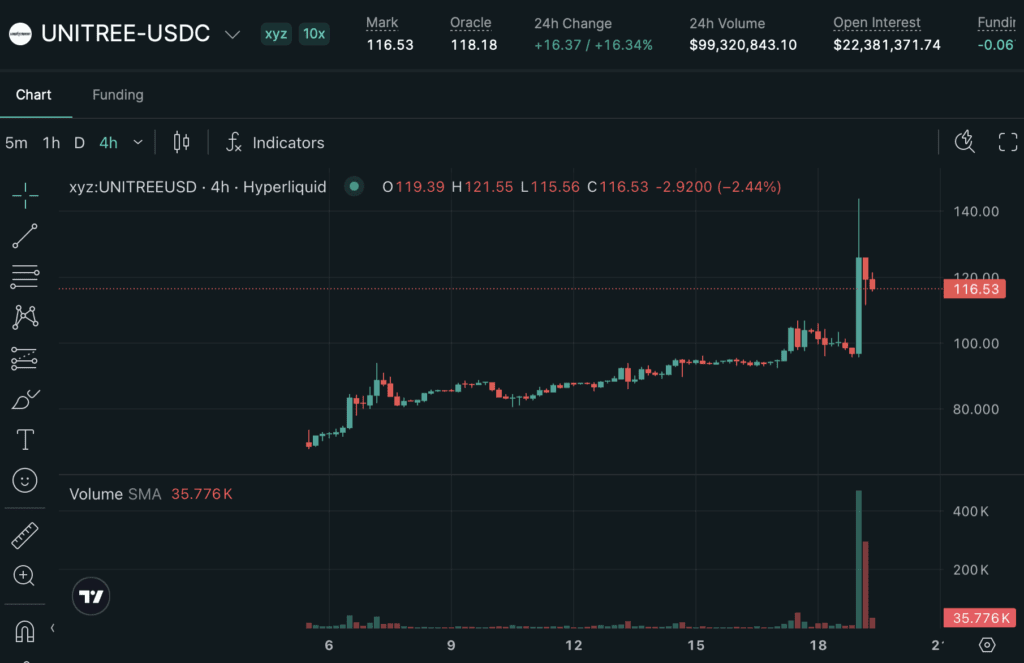
According to Hyperliquid, the synthetic market for Unitree traded at approximately $92-$94 per contract last week. This corresponded to a company valuation of about $38 billion — more than four times higher than the roughly $9 billion at which Unitree conducted its IPO, according to Allium Research.
However, the actual debut turned out to be even stronger. At the price of the first trade, the company was valued at approximately $66 billion — about 75% higher than the level factored in by crypto traders.
This is not about ordinary Unitree shares. The contract on Hyperliquid is a perpetual futures contract that allows betting on changes in the stock price without ownership rights to the shares. It was listed by a third-party developer, xyz.trade, using Hyperliquid's infrastructure, CoinDesk noted.
This gave crypto investors the opportunity to trade expectations about the IPO around the clock before the opening of the Chinese stock market.
After trading began, the UNITREE-USDC contract also surged sharply: on the morning of August 19, its price was around $121, having briefly exceeded $140 earlier. Trading volume reached $64 million, while open interest stood at about $29 million.
Meanwhile, the shares themselves, after starting at 1,100 yuan ($163), pulled back to around 884 yuan ($131) but still remained almost six times more expensive than the IPO price.
For comparison, before the SpaceX IPO in June, crypto traders, through a similar mechanism, valued the shares at approximately $170. During the first trading session, they exceeded $176 and ended the day at $161 — almost exactly at the level predicted by the crypto market.
The SpaceX market on Hyperliquid was significantly larger: open interest just before the IPO reached about $216 million, with over $150 million traded in 24 hours.
Unitree Receives Billion-Dollar Valuation Amid Physical AI Boom
Unitree's strong debut reflects not only speculative interest in the IPO but also growing investor attention to physical artificial intelligence — systems that combine AI with robots and other physical devices.
According to Bloomberg, the company delivered over 5,500 humanoid robots in 2025, ranking first in the world by this metric. Cumulative sales of its quadruped robots exceeded 33,000 units.
Financial indicators also demonstrate rapid business growth:
- Unitree's revenue in 2025 grew to 1.7 billion yuan from 393 million yuan a year earlier;
- net profit amounted to 278 million yuan;
- gross margin exceeded 60%;
- about 4.2 billion yuan from the IPO proceeds, the company plans to allocate to the development of physical AI models, humanoid robot research, new products, and production expansion.
The company also received support from strategic investors. About 20% of the offering was allocated to them, in particular to the Chinese AI company DeepSeek, an investment vehicle of Tencent, and subsidiaries of large state-owned companies.
DeepSeek received 2.31% of Unitree's shares with a three-year lock-up period. The collaboration involves using the company's AI developments to create physical intelligence models for humanoid robots.
Amid Unitree's debut, Bloomberg Intelligence analyst Ian Ma stated:
"Unitree's rapid surge on its debut day signals strong appetite for China's physical AI sector. IPO proceeds should accelerate AI development and commercialization. The strong debut may also provide a favorable benchmark for valuing Ubtech and other Chinese robotics competitors preparing for IPOs."
According to JPMorgan's estimate, the humanoid robot market could grow from about $2 billion in 2025 to $300 billion in 2035. China already accounts for about 75% of the global humanoid robot market, and its advantage is provided by large-scale production, developed supply chains, and lower costs: materials for one robot cost about $46,000 compared to $131,000 in the US.
At the same time, the market is already showing signs of overheating. Unitree's shares traded at levels during the debut that significantly exceed the company's valuation based on financial metrics.
"There is no fundamental basis for such a rise in the share price. It is driven by retail frenzy. Valuations are sky-high, and prospects are uncertain given the early stage of development and adoption of humanoid robots," noted Union Bancaire Privee Managing Director Wei-Sern Ling.
At the same time, analysts emphasize that shipment volumes alone do not guarantee technological leadership. Unitree, like other humanoid robot manufacturers, must prove its ability to translate pilot projects and demonstrations into large-scale commercial use.
Opinions from X users also showed varying perceptions of Unitree's rapid rise: some called the company's debut a signal of the start of a new phase in Chinese robotics and expect a wave of competitor IPOs, while others consider the company's valuation overinflated.
In particular, Rui Ma noted that with a market capitalization of about $54 billion, Unitree is valued at approximately 130 times its projected 2026 annual revenue, calling the company "overvalued." Meanwhile, John Koetsier pointed out the difference with the American Agility Robotics, valued at approximately $4 billion.
Recall that Elon Musk predicted exponential growth in the number of humanoid robots by 2040 and their surpassing humanity in numbers.
Furthermore, Barclays stated that the adoption of humanoid robots in China over 10 years could replace 37 million jobs.
end-content