Tidal Investment: We Remain Bullish on the AI Industry Chain, But for Different Reasons Now

链捕手Published on 2026-06-25Last updated on 2026-06-25

Abstract

Tidal Investments remains optimistic about the AI industry chain, but the rationale has shifted. The market is concerned about massive concurrent fundraising by tech giants like SpaceX, OpenAI, Alphabet, and Meta, fearing an AI peak. However, the authors argue this signals the next act of AI development, not its end. Capital expenditure (Capex) from major cloud providers (Alphabet, Amazon, Meta, Microsoft, Oracle) continues to surge aggressively into 2026. This investment cycle is more resilient than past hardware cycles due to its scale and complexity. Bottlenecks have shifted from chips to critical physical infrastructure like power grids, transformers, cooling, and data center construction—areas with long lead times and limited capacity for rapid expansion. Supply chain data (e.g., Eaton's orders) confirms substantial, tangible progress. Key market concerns are addressed: 1. **ROI vs. Capex Growth**: While Capex growth outpaces revenue, the authors note cloud giants have historically overcome similar phases through scale. The cycle will only be in danger if Capex guidance is cut, orders are canceled, or AI product demand falters—none of which are currently observed. 2. **Comparison to the 2000 Dot-com Bubble**: Unlike the telecom bubble, where cheap, oversupplied fiber crashed prices, AI infrastructure (especially power) is constrained, customized, and subject to lengthy approvals, making a similar supply glut and crash unlikely. In conclusion, the wave of fundraising...

Author: Tidal Investment

I. The Market Changed Its Script

Lately, the market is both excited and a bit nervous. SpaceX completed a massive $750 billion IPO, and OpenAI and Anthropic are also rumored to be preparing for listings. At the same time, Alphabet plans for an $80 billion equity financing round, and Meta is arranging new funding.

Frankly speaking, seeing so many giants collectively asking the market for money, few can stay calm. But interpreting this wave as AI peaking is a bit too simplistic. This looks more like AI's story has turned to the next chapter.

Over the past two years, the market was buying demand explosion and industry imagination, concerned with whether AI would work. By 2026, the question has become: How long can such massive investment intensity last?

Wu Shaokang, founder of Tidal Investment, said: "The market always sees fast-moving variables, but what determines the direction of a cycle is often the slow-moving variables."

Standing in mid-2026, we remain optimistic about the AI industry chain. But today's optimism can hardly be sustained by imagination alone. Talking about AI two years ago, you could talk about models, about AGI, but talking the same way today, the market might not buy it.

II. Money is Still Being Invested, and More Aggressively

How to tell if a cycle is over? See if the money people are still paying. Looking through the books of the five major cloud providers gives a pretty clear answer.

  • Alphabet: 2025 Capex $90 billion, 2026 guidance raised to $180 billion.

  • Amazon: 2025 Capex $130 billion, 2026 guidance raised to $200 billion.

  • The remaining three are also moving in the same direction: Meta 2026 guidance raised to $140 billion, Microsoft to $190 billion, Oracle FY26 already near $60 billion.
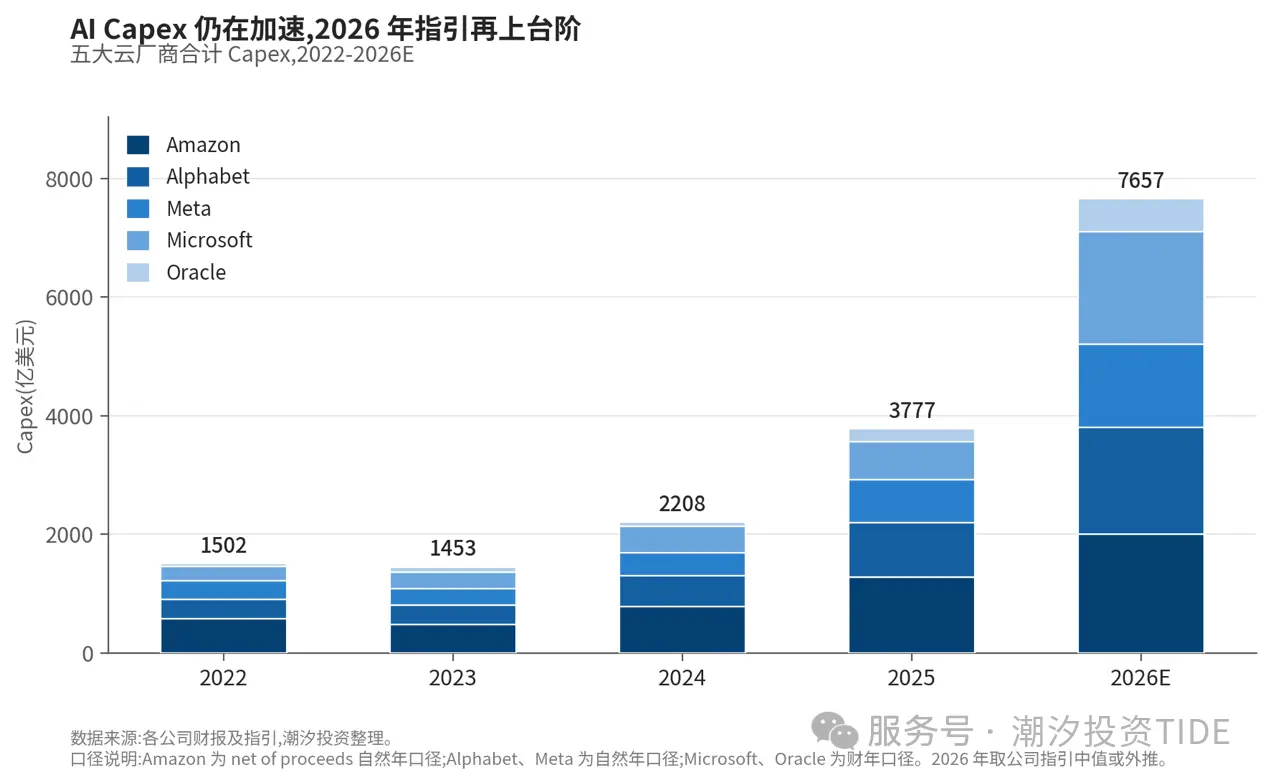
These numbers are a bit scary when laid out. People used to think the strongest aspect of these internet giants was their solid cash flow and plentiful cash on hand. But now, even they are starting to proactively ask the market for more money in the face of AI. Besides that $80 billion equity financing, Alphabet has also issued a significant amount of debt over the past year. AI infrastructure has become so massive that even companies with the best cash flow are restructuring their capital.

Money is still flowing in, that's not in question. The problem is, how long can this continue?

III. Why This Investment Cycle Won't Stop Easily

What are people most afraid of? Afraid that Capex will peak, afraid this cycle will run its course in two or three years like past tech hardware procurement cycles, then enter a long digestion period. Servers, phones, PCs—many hardware cycles followed this pattern: demand rises, then capacity expands, inventory piles up; once downstream slows, the whole industry chain faces valuation cuts.

This concern was not wrong in past cycles. But this round of AI Capex is probably not so simple.

First, the money is flowing to too many places. The cloud providers' money is all called Capex on the surface, but breaking it down reveals they are completely different categories: compute, memory, networking, power. Each layer has its own expansion rhythm and its own bottlenecks. And with engineering projects, once started, pulling back halfway is more costly than pushing through.

More critically, bottlenecks are shifting from chips down to more physical constraints. Chip shortages can eventually be resolved by expanding production. But power, transformers, high-power-density racks—these don't ramp up as quickly. Just getting a grid connection can take years of waiting.

And Capex is far beyond just GPUs now. Clear signals are coming from the supply chain: Eaton, which makes power distribution equipment, saw data center orders surge 240% YoY in Q1 2026.
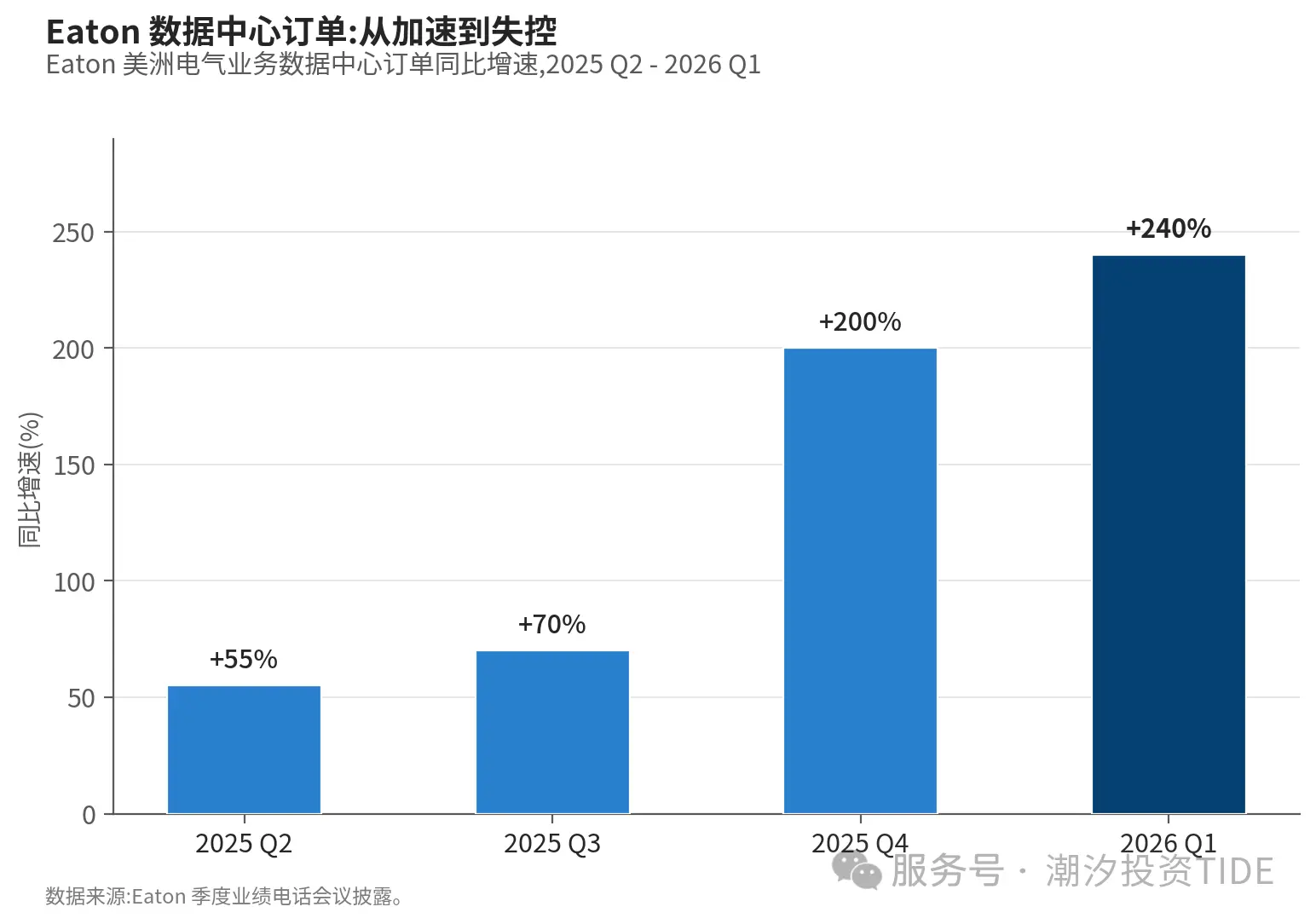
Activities like transformers, UPS, liquid cooling, thermal management, rack integration only appear in large volumes when cloud providers are determined to build campuses. The simultaneous explosion of these orders shows that behind this Capex wave lies solid construction progress.

Putting these together, you can see this investment cycle won't stop easily.

IV. What the Market Is Actually Worried About

We're optimistic, but we can't ignore two current market concerns.

Concern 1: Capex Growing Faster Than Revenue, Will ROI Be Realized?

The Capex growth rates of the five major cloud providers in 2025 all outpaced their revenue growth. Alphabet's depreciation rose from $15.3 billion in 2024 to $21.1 billion in 2025, a real 38% increase hitting the income statement. Amazon stated plainly in its earnings report that the FCF decline is due to AI investment pushing up PPE.
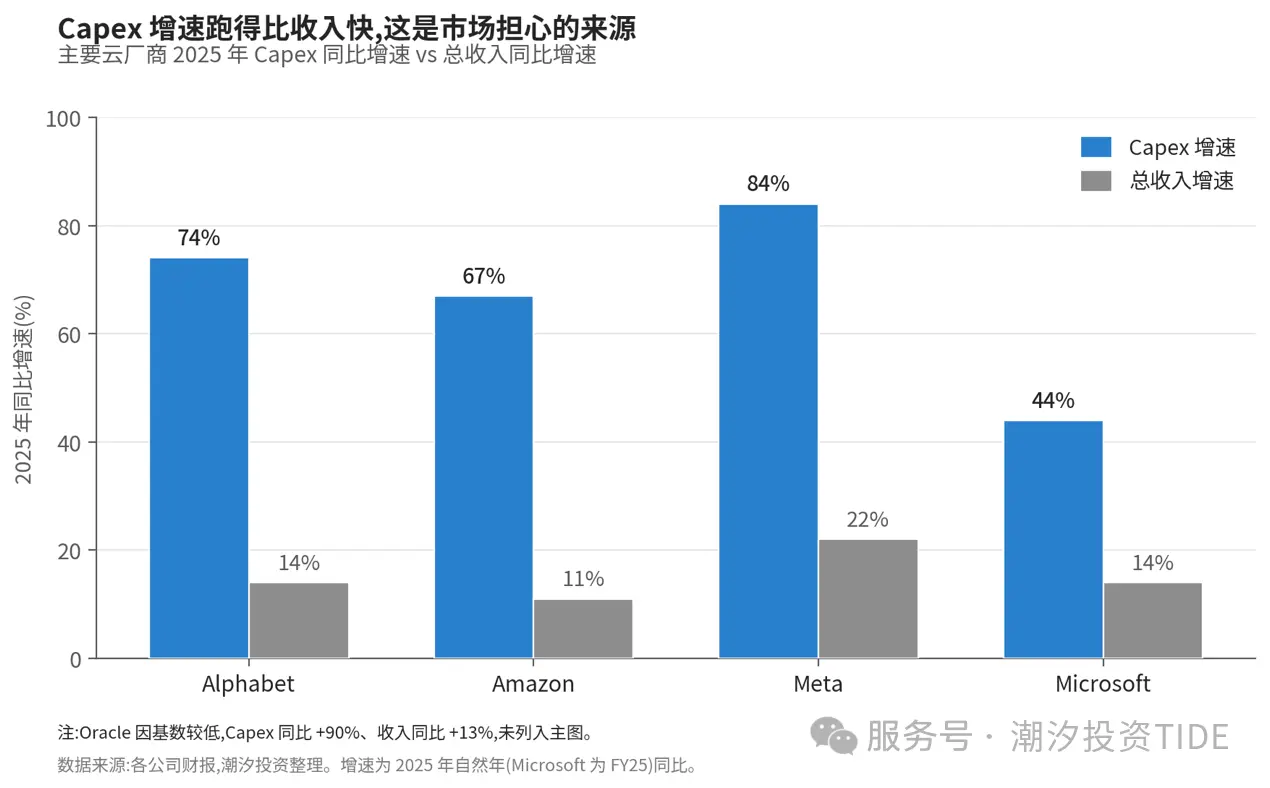
A popular market saying is that when Capex growth exceeds revenue growth, it signals peak ROI. This isn't wrong, but applying it to the cloud business is a bit simplistic. AWS, Azure, GCP all went through phases in the early 2010s where Capex far outstripped revenue, eventually monetizing through scale. The difference with this AI Capex round is the higher capital intensity; payback depends on whether future AI workloads can be monetized.

Of course, we're not blindly optimistic. To change our view, we'd need to see a few things: cloud providers starting to lower Capex guidance, order cancellations or delays, or AI product revenue and usage falling short of expectations. As of mid-2026, none of these have happened.

ROI risks certainly exist, but the current facts lean more towards optimism. If data truly starts to deteriorate, then it's time to revise judgment. We're not there yet.

Concern 2: Is This Another 2000?

How did the 2000 bubble burst? Back then, demand was also rising, with more people online and more traffic flowing every year. The problem was on the supply side.

There was a saying: Internet traffic doubled every 100 days. Telecom companies believed this curve and feverishly laid fiber along railways and roads. There was a cost advantage with fiber: once the trench was dug, adding more cable cost little extra, so they crammed in enough capacity for over a decade. Dozens of companies dug their own trenches simultaneously, resulting in supply far exceeding demand. Consequently, fiber prices crashed to the floor. By the time rising traffic filled them up, a decade had passed, and most of those companies couldn't survive that long.

There is certainly a bubble element in this round too. Any major cycle has some froth; some companies ride the AI wave, some money looks excessive in hindsight.

But on the supply side, it's the opposite this time, because AI doesn't just need a pipe buried. Transformers are customized heavy equipment, constrained by silicon steel and lengthy approvals. Grid connections can't be parallelized like digging trenches; they must queue behind the public grid for years. More importantly, electricity can't be pre-laid like fiber; you can't install electricity needed ten years from now and just leave it there.

So a 2000-style collapse is unlikely to repeat this time.

V. The AI Show Isn't Over

Just in the past couple of days, SpaceX has corrected sharply from its highs, even falling below its IPO closing price, making the market nervous again. Seeing so many giants collectively ask the market for money easily makes people tense, wondering if AI is peaking.

But we don't see it that way.

Giants are raising massive funds now because the show must go on, and the hurdles ahead are increasing. Look at the five cloud providers: none have lowered their 2026 Capex guidance; all have raised it. Looking further ahead, transformers take up to four years for delivery, data centers wait years for grid connection. These hurdles aren't easily overcome by just throwing more money at them.

So while a wave of financing looks scary, it's essentially just an intermission.

Don't rush to call the top. The AI show isn't over yet; it just switched scripts.

Trending Cryptos

Related Questions

QWhat is the core argument for remaining bullish on the AI industry chain according to the article?

AThe core argument is that the massive capital expenditure (Capex) cycle by major cloud providers (Google, Amazon, Meta, Microsoft, Oracle) is structurally different and harder to stop compared to past hardware cycles. Investment is expanding beyond just GPUs into critical physical infrastructure like power, transformers, cooling, and grid connections, which have long lead times and bottlenecks. This suggests sustained investment, not a near-term peak.

QWhat are the two main market concerns about the AI investment cycle mentioned in the article?

AThe two main concerns are: 1) Capex is growing faster than revenue, raising doubts about the Return on Investment (ROI). 2) Whether the current situation is a bubble reminiscent of the dot-com crash in 2000, driven by excessive, speculative over-investment.

QHow does the article counter the fear of a 2000-style dot-com bubble in the AI sector?

AThe article argues that the supply-side dynamics are reversed. Unlike the easily overbuilt fiber optic cables of the 2000s, AI infrastructure (like custom transformers, grid connections, and power supply) involves complex, heavy equipment with long manufacturing and regulatory approval lead times. Power cannot be stockpiled in advance like fiber. These physical bottlenecks prevent the kind of rapid, parallel over-supply that caused the 2000 crash.

QWhat specific evidence does the article provide to show that AI infrastructure investment is broadening beyond chips?

AThe article points to supply chain signals, such as Eaton (a power management company) reporting a 240% year-over-year increase in data center orders in Q1 2026. It also lists other areas seeing massive orders: transformers, UPS systems, liquid cooling, thermal management, and cabinet integration—all indicating real, on-the-ground construction progress for data center campuses.

QWhat does the article suggest would be a true signal to change its bullish view on the AI Capex cycle?

AThe article states that to change its view, it would need to see concrete data points such as: cloud providers starting to downgrade their Capex guidance, orders being cancelled or delayed, or AI product revenue and usage falling significantly below expectations. As of mid-2026, none of these signals have occurred.

Related Reads

STRC 跌破面值,比特币财库实验进入下半场

The price of STRC, Strategy's dividend-paying preferred stock, has fallen below its $100 face value, triggering a re-evaluation of the "bitcoin treasury" corporate model. This highlights a critical tension: the company's asset base consists of high-volatility, non-cash-flow-generating Bitcoin, while its capital structure requires continuous cash payouts for dividends and interest. The decline of STRC signals that market pressure is shifting from asset price volatility to the pricing of the company's financing tools. Strategy's core model involves a three-step conversion: turning equity into Bitcoin exposure, converting Bitcoin holdings into capital market credit, and packaging non-yielding BTC into cash-paying securities like STRC. While Strategy holds a massive 847,363 BTC, the focus is now on cash flow mismatches. The company faces annual preferred stock dividend obligations of approximately $1.7 billion, far exceeding the cash flow from its legacy software business. Its ability to meet these obligations relies on continued access to capital markets. The market is now scrutinizing which of three potential costs becomes untenable first: rising dividend costs to attract investors, dilution costs from issuing more common stock, or the reputational cost of selling BTC—a move contrary to its "hodl" narrative. For the broader crypto market, a constrained Strategy means the potential loss of a predictable, narrative-driven marginal buyer for Bitcoin. The STRC discount serves as a reminder that the longevity of such models depends not just on Bitcoin's price, but also on financing windows, cash reserves, and investor willingness to pay a "trust premium" for the structure.

marsbit28m ago

STRC 跌破面值,比特币财库实验进入下半场

marsbit28m ago

Standard Chartered Bank’s 50-Fold Fantasy: Predicting AAVE to Reach $3,500

Standard Chartered Bank has issued an optimistic research report predicting that the AAVE token could surge 50-fold to $3,500 by 2030. This forecast is based on the projection that the total value locked (TVL) in DeFi will grow 37x to approximately $2.7 trillion, driven by stablecoin expansion and the tokenization of real-world assets (RWA). The bank's model links Aave's potential valuation directly to its protocol revenue, which is primarily driven by net interest margins. The report highlights Aave's current dominant position, noting it captures over 80% of the net earnings ("protocol retained earnings") in the lending sector while holding only about half of its TVL. It also points to the recent launch of the Aave V4 architecture and a healthy revenue stream of $142 million in 2025 as positive fundamentals. Grayscale's separate analysis, applying traditional valuation metrics like DCF, concluded AAVE is currently undervalued. However, the article notes significant challenges. Aave's peer-to-pool lending model suffers from inherent capital inefficiency, with an estimated $52 million annual "deadweight loss" due to idle funds needed for liquidity buffers. This structural flaw was exposed during the April KelpDAO exploit, which locked a WETH pool at 100% utilization for days. Emerging protocols like Morpho, with more efficient point-to-point models, are cited as growing competitive threats. In summary, while institutional forecasts paint a macro picture of massive growth fueled by RWA adoption, Aave's path forward hinges on addressing its core structural limitations and competitive pressures within the evolving DeFi lending landscape.

链捕手1h ago

Standard Chartered Bank’s 50-Fold Fantasy: Predicting AAVE to Reach $3,500

链捕手1h ago

Tidal Investment: We Remain Bullish on the AI Industry Chain, But the Reasons Have Changed

Tidal Investment remains optimistic about the AI industry chain, but the rationale has shifted. The market narrative has changed. While recent large-scale IPOs (e.g., SpaceX) and major fundraising plans by tech giants like Alphabet and Meta have caused some nervousness, this isn't a sign of an AI peak. The focus has moved from the initial question of AI's viability to the sustainability of massive investment cycles. The key players—primarily the major cloud providers—are not slowing down; their capital expenditure (Capex) guidance for 2026 has been increased across the board (e.g., Alphabet to $180B, Amazon to $200B). This investment cycle is proving resilient and difficult to stop. Unlike traditional hardware cycles, current AI Capex is distributed across multiple physical layers—computing, memory, networking, and critically, power infrastructure. Bottlenecks are shifting from chips to elements like electricity, transformers, and cooling systems, which have much longer lead times and cannot be easily pre-built like fiber optics during the dot-com bubble. Supply chain data (e.g., Eaton's 240% YoY data center orders) confirms this broad-based, project-driven expansion. Market concerns are acknowledged but viewed differently. First, while Capex growth currently outpaces revenue growth, raising ROI questions, this mirrors the early scaling phase of cloud computing itself. A change in view would require concrete signals like downward Capex revisions or missed AI product targets, which haven't materialized by mid-2026. Second, comparisons to the 2000 dot-com bust are flawed. That crash was driven by a massive, parallel oversupply of cheap capacity (fiber). The current cycle faces *supply constraints* in critical, capital-intensive physical infrastructure that cannot be overbuilt as easily. In conclusion, the wave of fundraising reflects the next, more complex act of the AI story. Physical bottlenecks and sustained high Capex plans suggest this is not the finale but an ongoing, capital-intensive build-out phase. The script has changed, but the play is far from over.

marsbit2h ago

Tidal Investment: We Remain Bullish on the AI Industry Chain, But the Reasons Have Changed

marsbit2h ago

Trading

Spot
Futures

Hot Articles

Discussions

Welcome to the HTX Community. Here, you can stay informed about the latest platform developments and gain access to professional market insights. Users' opinions on the price of AI (AI) are presented below.

活动图片