Almost half of Shiba Inu’s initial circulating token supply has been burned

cryptoslatePublished on 2022-09-06Last updated on 2022-09-06

Abstract

Since the start of September, 329.8 million Shiba Inu tokens have been burned, according to shiba-burn-tracker.com.

Since the start of September, 329.8 million Shiba Inu tokens have been burned, according to shiba-burn-tracker.com.

Shiba Inu tokens are burned on multiple occasions daily to tackle the issue of oversupply. Over the last 30 days, the most significant daily burn totaled 455,699,414 SHIB on Aug. 31.

Why burn Shiba Inu?

Shiba Inu’s initial supply was just short of 1 quadrillion tokens, which hinders the ability of capital inflow to impact the token price positively.

The Shiba Inu community has its sights set on a $0.01 token price. But to achieve this based on its current circulating token supply, the SHIB market cap would need to be just under $5.5 trillion, equating to more than 5.5 times the existing total market cap.

“The actual problem with Shiba token is a big one. There is to much units of it, 999,992,188,828,143.538054853285409628 to be exact.”

By burning tokens, the number in circulating supply reduces over time and, in theory, should elevate the SHIB price.

The website shibburn.com illustrates the effect of token burns to date. The graphic below shows the project is approaching a halving of the initial supply. However, given the vastness of a quadrillion, burning multiple millions daily will some time to reach that point.
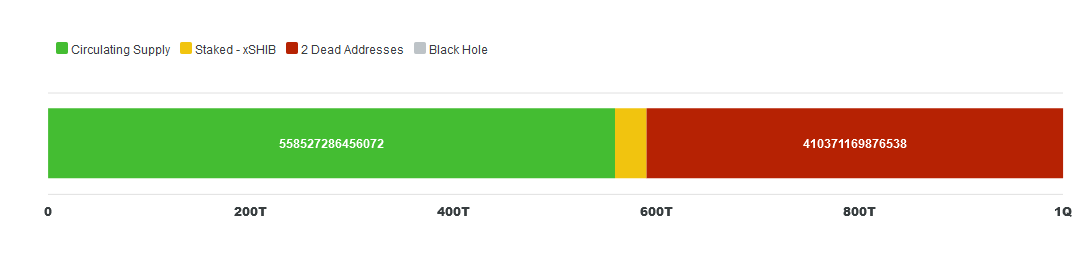
Shiba Inu burn progress

Source: Shibburn.com

Meanwhile, since July 12, Shiba Inu has been posting marginally higher lows leading to a gradual incline in the support price. However, similar to all altcoins during this bear market, SHIB is  86% down from its all-time high of $0.00008616 achieved on Oct. 28, 2021.
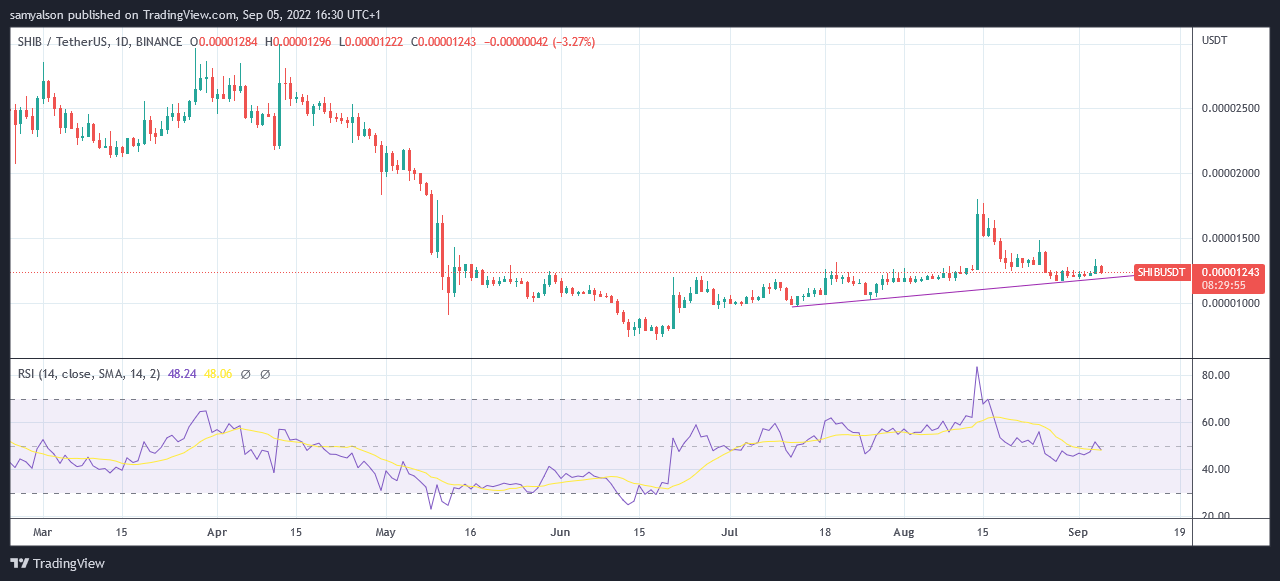
SHIBA INU daily chart

Source: TradingView.com

SHIB Metaverse in the works

The latest blog post from Shiba Inu revealed plans to develop a Metaverse, called WAGMI, in conjunction with art studio The Third Floor.

“WAGMI is short for “We’re All Gonna Make It”. It refers to a higher conviction and optimistic state about the future. The foundation of SHIB has always been the community.”

Currently, the project is in the early stages of development, with ideas being floated via concept artwork. The post stated that this is common practice in film and video game development to “present a set vision” and inspire “a deep connection with the atmosphere.”

The sketch below depicts the WAGMI temple and surrounding landscape, which is described as a “zen-inspired architecture” that captures the concept of a chilled and calming environment.
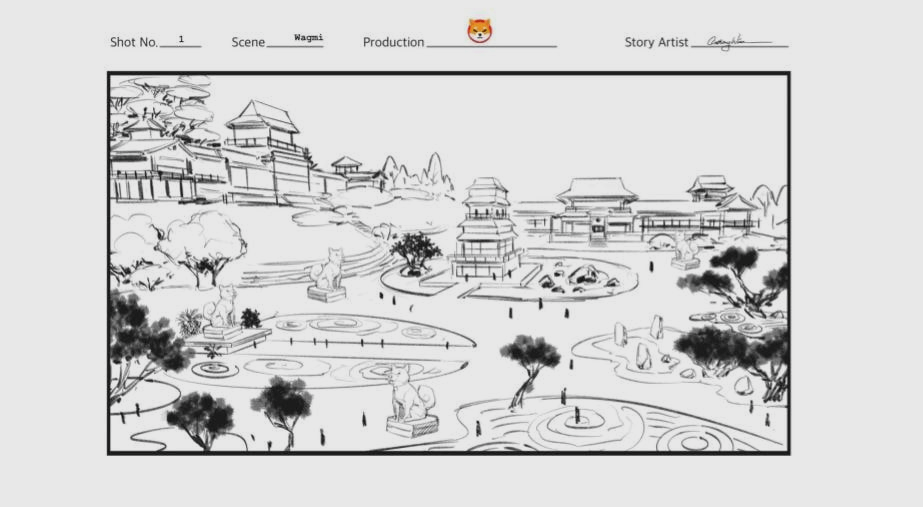
Concept art for WAGMI Metaverse

Trending Cryptos

Related Reads

The "Impossible Triad" Is Fundamentally a Pseudo-Problem

The article argues that blockchain's fundamental limitation is not the scalability trilemma (decentralization, scalability, security), which has been largely solved, but the lack of **privacy** and, until recently, clear **legitimacy**. Blockchain is described as a slow, expensive, globally shared computer whose core value is censorship resistance and verifiability. While ideal for native digital assets like money (e.g., stablecoins), its default transparency acts as a **tax**, exposing all transactions and enabling MEV extraction, which deters serious institutional capital. Simultaneously, its permissionless nature created regulatory ambiguity. The piece contends that **privacy** is the missing critical feature. It rejects the false choice between total transparency and complete anonymity. Modern cryptography (like zero-knowledge proofs) enables **compliant privacy**: users can prove facts (solvency, KYC status, compliance) without revealing the underlying sensitive data (specific holdings, identities). This preserves auditability for regulators and eliminates the leak of financial information. With recent regulatory progress (e.g., the GENIUS Act) addressing legitimacy, adding default, provably compliant privacy becomes a pure upgrade. It transforms blockchain from a costly, public ledger into a confidential settlement layer, finally bridging the gap to mainstream institutional and individual adoption of on-chain finance.

链捕手12h ago

The "Impossible Triad" Is Fundamentally a Pseudo-Problem

链捕手12h ago

Optical Chips: Collective Capacity Expansion

The global optical chip industry is experiencing a massive wave of expansion driven by surging AI data center demand. Major players across the US, Japan, Europe, and China are aggressively investing to ramp up production capacity. In the US, Coherent is expanding its 6-inch Indium Phosphide (InP) semiconductor fab in Texas, supported by CHIPS Act funding and a $2 billion strategic investment from NVIDIA. Lumentum is building a new factory for InP optical devices, and Nokia is scaling its advanced photonic chip packaging and testing capabilities. NVIDIA's investments aim to secure future supply of critical lasers and optical interconnect products for AI infrastructure. Japan's JX Advanced Metals, a leading InP substrate supplier, plans a multi-billion yen investment to increase its capacity 7-10 times, strengthening its grip on the crucial upstream materials market. In Europe, IQE and Tower Semiconductor settled a patent dispute and signed a multi-year InP epitaxial wafer supply agreement, highlighting that next-generation silicon photonics platforms will integrate high-performance InP components. STMicroelectronics and Sivers Semiconductors are also expanding silicon photonics production and partnerships. China is rapidly building out its domestic supply chain. Dongshan Precision's subsidiary, Source Photonics, announced a $12 billion project to expand optical chip and module production. Companies like Sanan Optoelectronics and Yunnan Germanium are scaling up InP chip manufacturing and substrate production, moving towards vertical integration from materials to modules. While debate continues around the exact future architecture—whether CPO (Co-Packaged Optics), NPO, or pluggables will dominate—analysts like Morgan Stanley argue the underlying driver is unchangeable: the explosive growth in bandwidth demand. This will inevitably increase the volume of optical engines, lasers, and related content per GPU, regardless of the final technical path. The competition for "more light" in the AI era has intensified into a global, full-chain capacity race.

marsbit14h ago

Optical Chips: Collective Capacity Expansion

marsbit14h ago

Trading

Spot
Futures

Hot Articles

How to Buy SHIB

Welcome to HTX.com! We've made purchasing SHIBA INU (SHIB) simple and convenient. Follow our step-by-step guide to embark on your crypto journey.Step 1: Create Your HTX AccountUse your email or phone number to sign up for a free account on HTX. Experience a hassle-free registration journey and unlock all features.Get My AccountStep 2: Go to Buy Crypto and Choose Your Payment MethodCredit/Debit Card: Use your Visa or Mastercard to buy SHIBA INU (SHIB) instantly.Balance: Use funds from your HTX account balance to trade seamlessly.Third Parties: We've added popular payment methods such as Google Pay and Apple Pay to enhance convenience.P2P: Trade directly with other users on HTX.Over-the-Counter (OTC): We offer tailor-made services and competitive exchange rates for traders.Step 3: Store Your SHIBA INU (SHIB)After purchasing your SHIBA INU (SHIB), store it in your HTX account. Alternatively, you can send it elsewhere via blockchain transfer or use it to trade other cryptocurrencies.Step 4: Trade SHIBA INU (SHIB)Easily trade SHIBA INU (SHIB) on HTX's spot market. Simply access your account, select your trading pair, execute your trades, and monitor in real-time. We offer a user-friendly experience for both beginners and seasoned traders.

11.1k Total ViewsPublished 2024.03.29Updated 2026.06.02

How to Buy SHIB

Discussions

Welcome to the HTX Community. Here, you can stay informed about the latest platform developments and gain access to professional market insights. Users' opinions on the price of SHIB (SHIB) are presented below.

活动图片