Bitcoin Must Hold $60K Or Risk Major Breakdown, TradingView Analyst Warns

bitcoinistPublished on 2026-06-21Last updated on 2026-06-21

Abstract

Bitcoin has reached a critical juncture around the $60,000 level, which analysts view as a major technical and psychological support zone. According to a TradingView analysis, a successful hold above this demand area could pave the way for a recovery toward $81,000. However, the warning is clear: a decisive and sustained break below $60,000 would invalidate the bullish outlook, likely triggering stop losses and a deeper market correction. The current setup is described as a binary test—maintaining support keeps the recovery narrative alive, while losing it would signal a shift toward a more significant downturn.

Bitcoin is back at a level that many traders view as psychologically and technically important. In a June 20 TradingView idea, analyst weslad said BTCUSDT had reached a fresh demand zone that could determine its next major move. The analysis framed this area as a place where buyers have already stepped in, but also as a level that cannot afford a decisive failure.
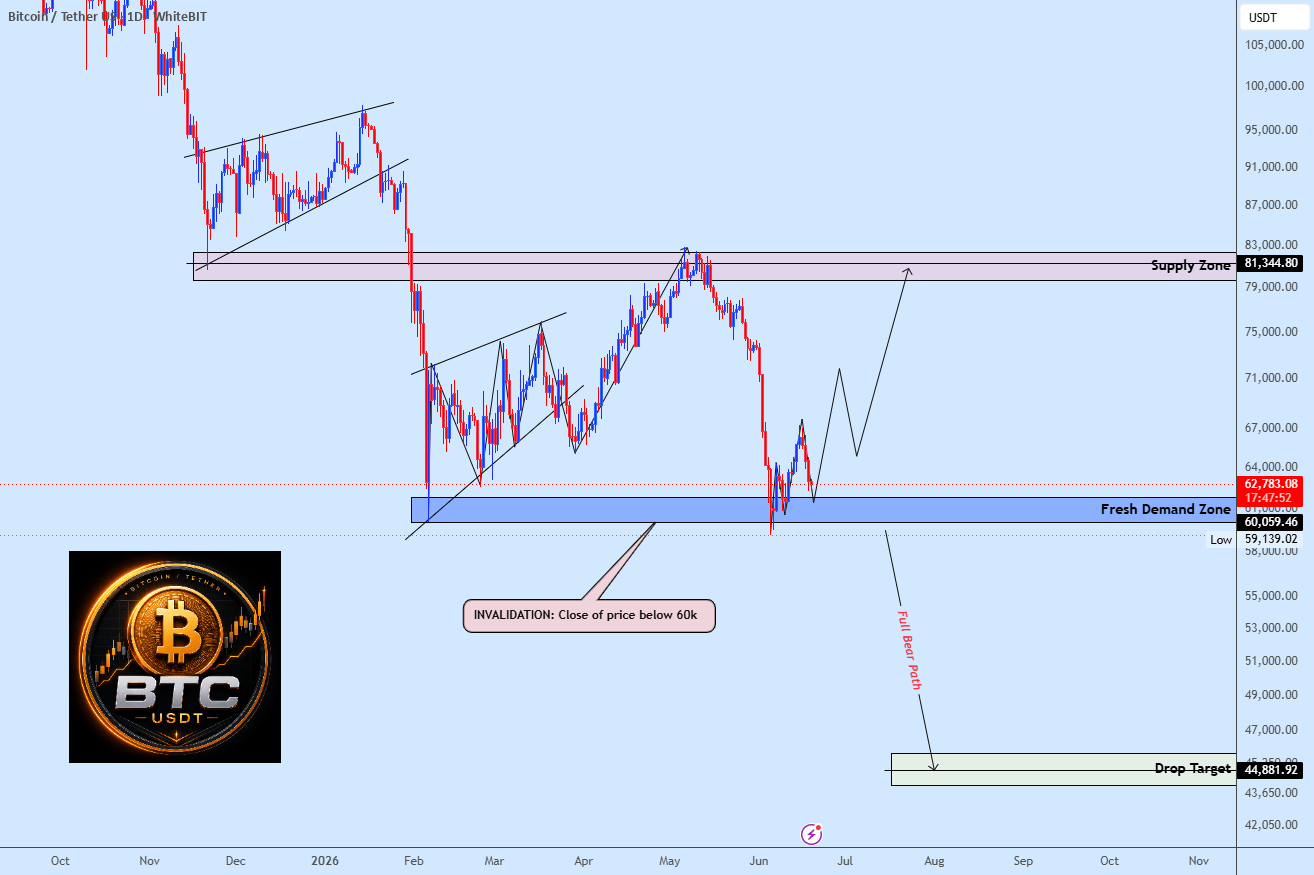
TradingView chart referenced in this analysis

The chart summary said that as long as Bitcoin respects the current demand zone, the probability of a recovery toward the $81,000 supply area remains high. That would represent a move back toward the origin of the recent decline and a possible liquidity grab if buyers can maintain pressure.

Break Below $60K Would Damage The Bullish Outlook

The warning is equally clear. Weslad described $60,000 as the line in the sand for bulls. A decisive close below that level would invalidate the bullish outlook and expose Bitcoin to a deeper breakdown.

This is why the level matters beyond simple round-number psychology. If many traders are watching the same support, a failure can trigger stop losses, forced exits and a shift in market sentiment. Holding the zone, on the other hand, gives bulls a clear argument that the recent selloff has reached an exhaustion point.

Recovery Case Needs Confirmation

The $81,000 upside area is an interesting target, but Bitcoin still needs to earn that move. Bulls would need to defend $60,000, reclaim nearby resistance and show that demand is strong enough to turn a defensive reaction into a trend reversal.

Until then, the setup is best understood as a binary support test. Hold the zone and the recovery case survives. Lose it decisively and the market likely starts pricing a deeper correction.

This report is based on information from TradingView weslad.

This article was written by the News Desk and edited by Samuel Rae.

Trending Cryptos

Related Questions

QAccording to the TradingView analyst weslad, what is the key price level that Bitcoin must hold to avoid a major breakdown?

ABitcoin must hold the $60,000 level to avoid a major breakdown.

QWhat is the upside price target mentioned in the analysis if Bitcoin successfully holds its current support zone?

AThe upside price target mentioned is the $81,000 supply area.

QWhy is the $60,000 level considered critical beyond just being a round psychological number?

AIt's critical because many traders are watching it as support; a failure there could trigger widespread stop losses, forced exits, and a negative shift in market sentiment.

QHow does the analyst describe the current market setup for Bitcoin?

AThe analyst describes the current setup as a binary support test: hold the $60K zone and the recovery case survives, lose it decisively and a deeper correction is likely.

QWhat needs to happen for Bitcoin to achieve a recovery toward the $81,000 target?

ABulls need to defend $60,000, reclaim nearby resistance levels, and show strong enough demand to turn the defensive reaction into a genuine trend reversal.

Related Reads

The "Impossible Triad" Is Fundamentally a Pseudo-Problem

The article argues that blockchain's fundamental limitation is not the scalability trilemma (decentralization, scalability, security), which has been largely solved, but the lack of **privacy** and, until recently, clear **legitimacy**. Blockchain is described as a slow, expensive, globally shared computer whose core value is censorship resistance and verifiability. While ideal for native digital assets like money (e.g., stablecoins), its default transparency acts as a **tax**, exposing all transactions and enabling MEV extraction, which deters serious institutional capital. Simultaneously, its permissionless nature created regulatory ambiguity. The piece contends that **privacy** is the missing critical feature. It rejects the false choice between total transparency and complete anonymity. Modern cryptography (like zero-knowledge proofs) enables **compliant privacy**: users can prove facts (solvency, KYC status, compliance) without revealing the underlying sensitive data (specific holdings, identities). This preserves auditability for regulators and eliminates the leak of financial information. With recent regulatory progress (e.g., the GENIUS Act) addressing legitimacy, adding default, provably compliant privacy becomes a pure upgrade. It transforms blockchain from a costly, public ledger into a confidential settlement layer, finally bridging the gap to mainstream institutional and individual adoption of on-chain finance.

链捕手13h ago

The "Impossible Triad" Is Fundamentally a Pseudo-Problem

链捕手13h ago

Optical Chips: Collective Capacity Expansion

The global optical chip industry is experiencing a massive wave of expansion driven by surging AI data center demand. Major players across the US, Japan, Europe, and China are aggressively investing to ramp up production capacity. In the US, Coherent is expanding its 6-inch Indium Phosphide (InP) semiconductor fab in Texas, supported by CHIPS Act funding and a $2 billion strategic investment from NVIDIA. Lumentum is building a new factory for InP optical devices, and Nokia is scaling its advanced photonic chip packaging and testing capabilities. NVIDIA's investments aim to secure future supply of critical lasers and optical interconnect products for AI infrastructure. Japan's JX Advanced Metals, a leading InP substrate supplier, plans a multi-billion yen investment to increase its capacity 7-10 times, strengthening its grip on the crucial upstream materials market. In Europe, IQE and Tower Semiconductor settled a patent dispute and signed a multi-year InP epitaxial wafer supply agreement, highlighting that next-generation silicon photonics platforms will integrate high-performance InP components. STMicroelectronics and Sivers Semiconductors are also expanding silicon photonics production and partnerships. China is rapidly building out its domestic supply chain. Dongshan Precision's subsidiary, Source Photonics, announced a $12 billion project to expand optical chip and module production. Companies like Sanan Optoelectronics and Yunnan Germanium are scaling up InP chip manufacturing and substrate production, moving towards vertical integration from materials to modules. While debate continues around the exact future architecture—whether CPO (Co-Packaged Optics), NPO, or pluggables will dominate—analysts like Morgan Stanley argue the underlying driver is unchangeable: the explosive growth in bandwidth demand. This will inevitably increase the volume of optical engines, lasers, and related content per GPU, regardless of the final technical path. The competition for "more light" in the AI era has intensified into a global, full-chain capacity race.

marsbit15h ago

Optical Chips: Collective Capacity Expansion

marsbit15h ago

Trading

Spot
Futures

Hot Articles

What is $BITCOIN

DIGITAL GOLD ($BITCOIN): A Comprehensive Analysis Introduction to DIGITAL GOLD ($BITCOIN) DIGITAL GOLD ($BITCOIN) is a blockchain-based project operating on the Solana network, which aims to combine the characteristics of traditional precious metals with the innovation of decentralized technologies. While it shares a name with Bitcoin, often referred to as “digital gold” due to its perception as a store of value, DIGITAL GOLD is a separate token designed to create a unique ecosystem within the Web3 landscape. Its goal is to position itself as a viable alternative digital asset, although specifics regarding its applications and functionalities are still developing. What is DIGITAL GOLD ($BITCOIN)? DIGITAL GOLD ($BITCOIN) is a cryptocurrency token explicitly designed for use on the Solana blockchain. In contrast to Bitcoin, which provides a widely recognized value storage role, this token appears to focus on broader applications and characteristics. Notable aspects include: Blockchain Infrastructure: The token is built on the Solana blockchain, known for its capacity to handle high-speed and low-cost transactions. Supply Dynamics: DIGITAL GOLD has a maximum supply capped at 100 quadrillion tokens (100P $BITCOIN), although details regarding its circulating supply are currently undisclosed. Utility: While precise functionalities are not explicitly outlined, there are indications that the token could be utilized for various applications, potentially involving decentralized applications (dApps) or asset tokenization strategies. Who is the Creator of DIGITAL GOLD ($BITCOIN)? At present, the identity of the creators and development team behind DIGITAL GOLD ($BITCOIN) remains unknown. This situation is typical among many innovative projects within the blockchain space, particularly those aligning with decentralized finance and meme coin phenomena. While such anonymity may foster a community-driven culture, it intensifies concerns about governance and accountability. Who are the Investors of DIGITAL GOLD ($BITCOIN)? The available information indicates that DIGITAL GOLD ($BITCOIN) does not have any known institutional backers or prominent venture capital investments. The project seems to operate on a peer-to-peer model focused on community support and adoption rather than traditional funding routes. Its activity and liquidity are primarily situated on decentralized exchanges (DEXs), such as PumpSwap, rather than established centralized trading platforms, further highlighting its grassroots approach. How DIGITAL GOLD ($BITCOIN) Works The operational mechanics of DIGITAL GOLD ($BITCOIN) can be elaborated on based on its blockchain design and network attributes: Consensus Mechanism: By leveraging Solana’s unique proof-of-history (PoH) combined with a proof-of-stake (PoS) model, the project ensures efficient transaction validation contributing to the network's high performance. Tokenomics: While specific deflationary mechanisms have not been extensively detailed, the vast maximum token supply implies that it may cater to microtransactions or niche use cases that are still to be defined. Interoperability: There exists the potential for integration with Solana’s broader ecosystem, including various decentralized finance (DeFi) platforms. However, the details regarding specific integrations remain unspecified. Timeline of Key Events Here is a timeline that highlights significant milestones concerning DIGITAL GOLD ($BITCOIN): 2023: The initial deployment of the token occurs on the Solana blockchain, marked by its contract address. 2024: DIGITAL GOLD gains visibility as it becomes available for trading on decentralized exchanges like PumpSwap, allowing users to trade it against SOL. 2025: The project witnesses sporadic trading activity and potential interest in community-led engagements, although no noteworthy partnerships or technical advancements have been documented as of yet. Critical Analysis Strengths Scalability: The underlying Solana infrastructure supports high transaction volumes, which could enhance the utility of $BITCOIN in various transaction scenarios. Accessibility: The potential low trading price per token could attract retail investors, facilitating wider participation due to fractional ownership opportunities. Risks Lack of Transparency: The absence of publicly known backers, developers, or an audit process may yield skepticism regarding the project's sustainability and trustworthiness. Market Volatility: The trading activity is heavily reliant on speculative behavior, which can result in significant price volatility and uncertainty for investors. Conclusion DIGITAL GOLD ($BITCOIN) emerges as an intriguing yet ambiguous project within the rapidly evolving Solana ecosystem. While it attempts to leverage the “digital gold” narrative, its departure from Bitcoin's established role as a store of value underscores the need for a clearer differentiation of its intended utility and governance structure. Future acceptance and adoption will likely depend on addressing the current opacity and defining its operational and economic strategies more explicitly. Note: This report encompasses synthesised information available as of October 2023, and developments may have transpired beyond the research period.

409 Total ViewsPublished 2025.05.13Updated 2025.05.13

What is $BITCOIN

Discussions

Welcome to the HTX Community. Here, you can stay informed about the latest platform developments and gain access to professional market insights. Users' opinions on the price of BTC (BTC) are presented below.

活动图片