Reddit一张神图疯传,2年后,你的笔记本就能跑Fable 5

marsbitPublished on 2026-07-07Last updated on 2026-07-07

Abstract

近日,r/LocalLLaMA社区的一张趋势图引发热议。该图梳理了历代前沿AI模型从云端发布到在消费级硬件上实现同级本地运行的时间间隔:GPT-3级能力约37个月,GPT-3.5级约17个月,GPT-4级约24个月,Claude 3.5 Sonnet/GPT-4o级约21个月,平均周期约为24.8个月。 依据这一趋势线外推,发帖人预测,目前被视为前沿的Fable/Mythos 5级AI能力,预计将在2028年7月左右,实现在高端笔记本电脑上本地、实用化的运行。这意味着未来用户可能无需依赖云端服务、订阅或担心数据隐私,通过一次性硬件投入即可获得顶级AI能力。 支撑该预测的主要因素包括:模型端通过MoE架构、量化技术、更好的强化学习与数据配方持续提升效率,使同等能力所需算力不断下降;现实端开源模型的追赶速度加快,例如Gemma 4 31B等模型已在多项基准测试中逼近甚至超越早期的Claude Opus与GPT-4水平。 这一趋势预示着AI能力正从云端垄断加速向桌面端民主化扩散。尽管当前存在模型访问的地域性管制,但历史表明,前沿能力难以被长期限制在云端。对于开发者、硬件厂商及整个行业而言,本地化、隐私保护、离线工作流等方向将变得愈发重要。最终,这张图以一种乐观的视角指出:技术扩散的时间力量,可能正悄然改变着AI能力的获取格局。

【导读】r/LocalLLaMA社区一张图刷屏AI圈:Fable 5级AI预计2年后可在笔记本上本地运行。

两年后,Fable 5 级 AI,可能就躺在你的笔记本里。

就在昨天,全球最大的本地大模型社区r/LocalLLaMA,一张图刷屏了整个AI圈——

标题简单粗暴:如果趋势持续,Mythos级能力可能在2年内运行在高端消费级硬件上。
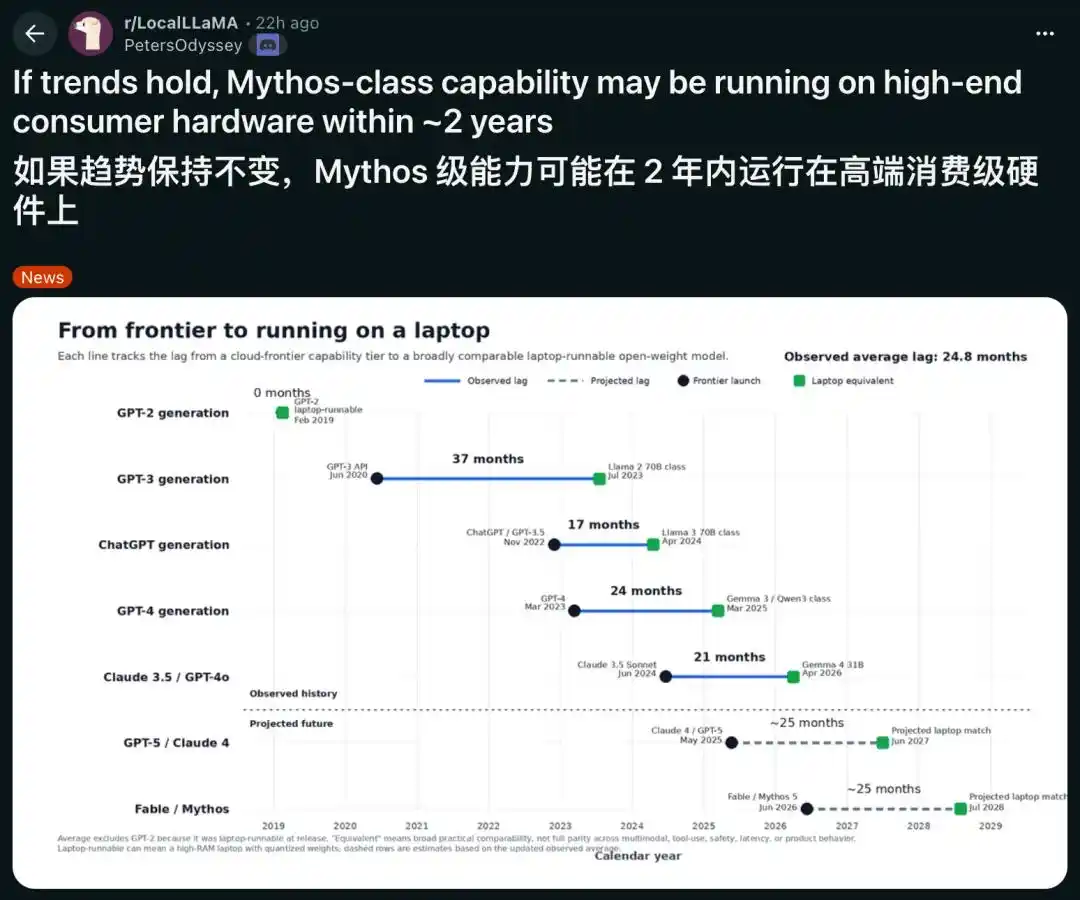
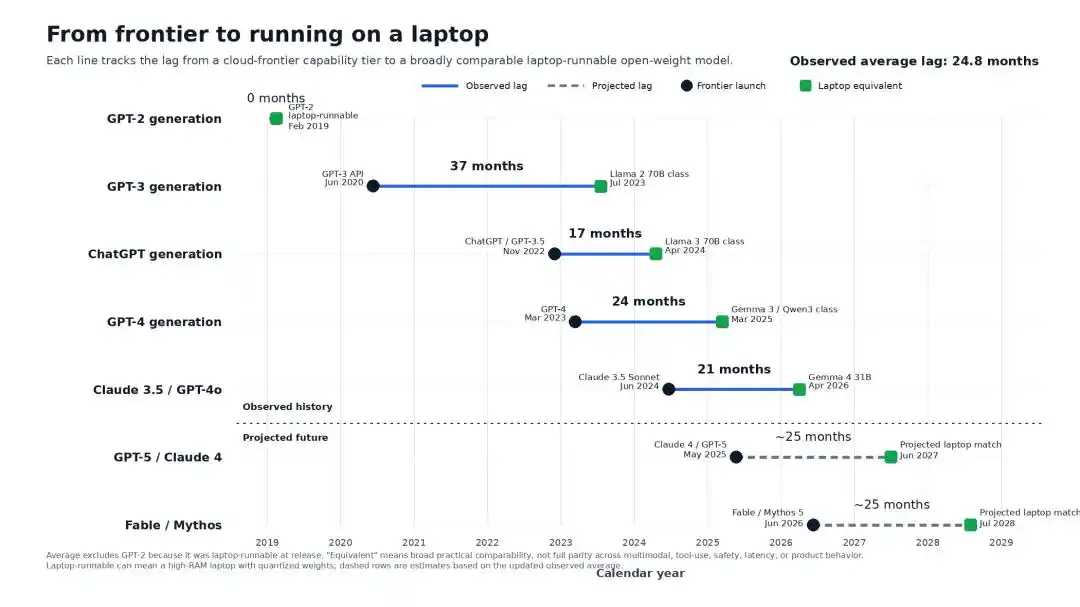
图的思路很简单:把历史上每一代前沿模型,从云端发布到本地开源硬件跑出同级能力,中间隔了多久,一代一代全标出来——

GPT-3级能力,等了37个月。GPT-3.5级,17个月。GPT-4级,大约24个月。Claude 3.5 Sonnet / GPT-4o级,21个月。

四代模型平均下来,约24.8个月——差不多正好两年。

然后,发帖人把这条趋势线往前一推,落点惊人:Fable / Mythos 5级的前沿能力,大约2028年7月,就能在一台高配笔记本上本地实用运行。
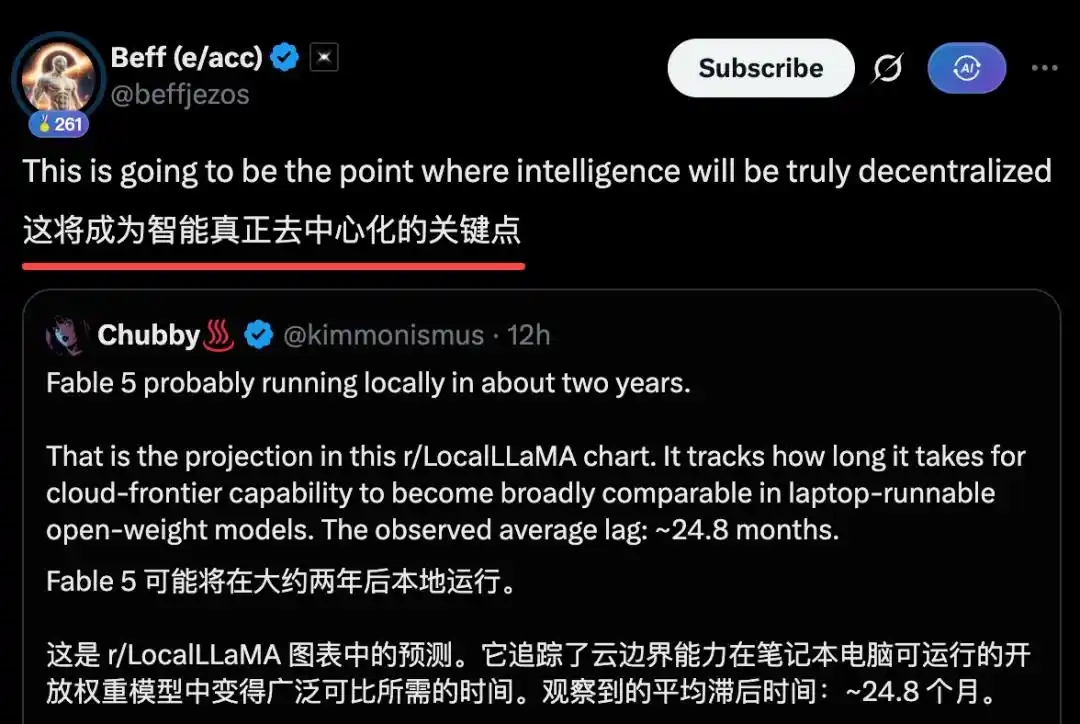
X大V转发了这张图,一句话点燃全网:「这将是智能真正去中心化的时刻。」
大V @GaryMarcus 更是质疑,如果这样的话,那么Anthropic、OpenAI们将会何去何从。
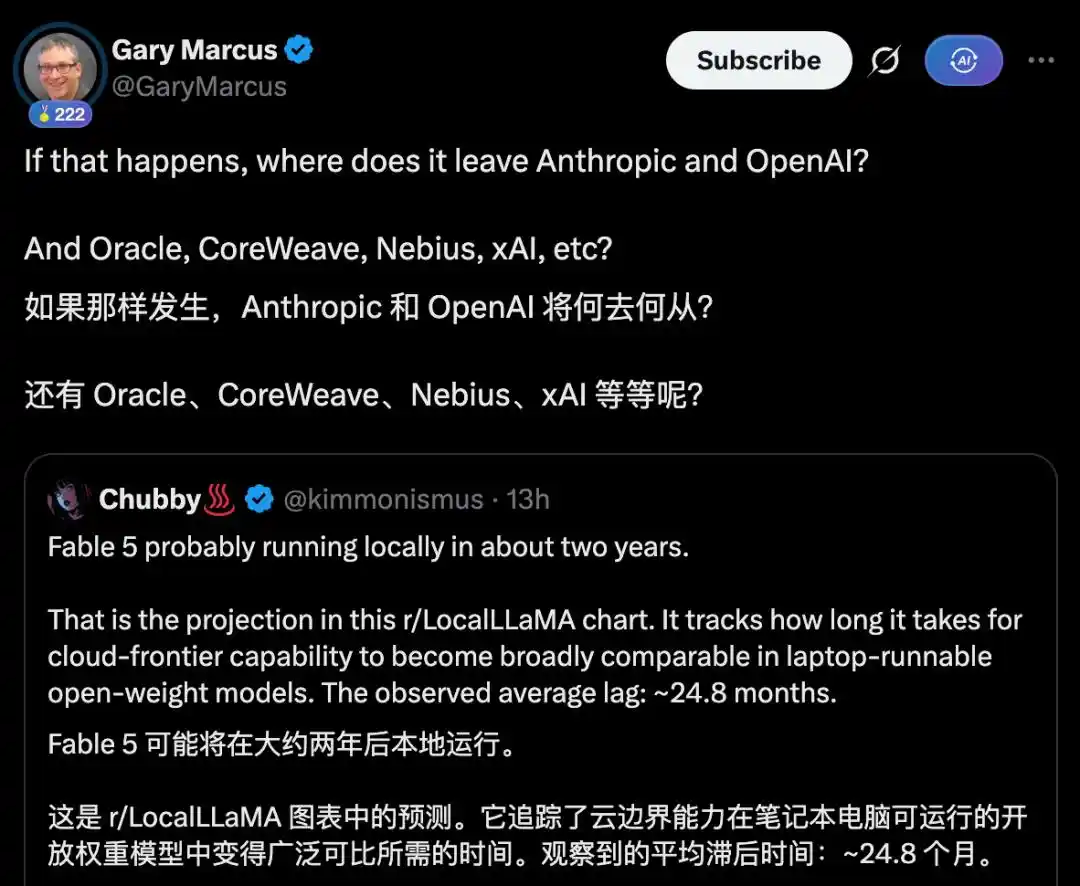
本地跑意味着什么?

不联网、不排队、不看订阅额度的脸色,数据一个字节都不出你的机器。

今天你在云端按token计费、小心翼翼租用的智能,两年后可能就是一笔一次性的硬件钱。

两条硬趋势,撑起24个月

支撑这个判断的,是两条硬趋势。

模型端,MoE架构、Q4/Q8量化、更好的RL和数据配方,让同等能力所需的算力一路下探。

开源社区对前沿能力的追赶周期,普遍落在12到25个月之间,而蒸馏出来的高效版本,下放消费级硬件的速度只会更快。

这张图里标出的最新数据点就是明证:2024年6月发布的Claude 3.5 Sonnet,到2026年4月Google发布Gemma 4 31B,用了21个月——一个310亿参数的开源模型,在Arena AI排行榜上已经和Claude Sonnet 4.5打平,在GPQA上甚至领先。

两年前那个高不可攀的云端王者,今天被一块消费级显卡装下了。

现实端,Gemma 4 31B在coding、推理、tool-calling上,已经摸到Claude 3.5 Sonnet甚至早期Opus的水平。

而GPT-4——两年前的前沿标杆——被Gemma 3和Qwen3在2025年3到4月就追上了,恰好24个月。

前沿能力从云端到桌面,只是时间问题,而且这个时间,正稳定收敛在两年上下。

还有人把目光投向中国:GLM 5.2,753B参数MoE架构,MIT开源协议,百万token上下文窗口,在SWE-bench Pro上紧追Claude Opus 4.8。

换句话说,就算Anthropic把门焊死,追赶者也会从另一条路,把同级能力送到你的桌面上。

封锁锁得住访问,锁不住时间

这张图真正戳中的,是当下最敏感的那根神经。

过去一个月,全世界刚见证了AI史上第一次「模型召回」:发布、封禁、谈判、解禁,Fable 5的每一步都在强调两个词——稀缺,管控。

谁能用最强的模型,第一次变成了一个需要护照来回答的问题。

而这张图给出了另一个视角:从GPT-3到今天,没有任何一代前沿能力,被成功留在云端超过三年。

蒸馏在扩散,开源在追赶。管制能决定谁今天能用Fable 5,决定不了两年后谁的笔记本里,跑着Fable 5级的模型。

对开发者,这意味着本地Agent、隐私计算、离线工作流,现在就值得动手布局;对硬件厂商,一场围绕大内存、大带宽的军备竞赛已经开跑;对整个行业,这意味着前沿模型的独占窗口,可能就是24个月——AI正在从云端垄断,走向桌面民主化。

这可能是那张图最讽刺、也最乐观的地方:华盛顿用一纸禁令回答「谁配用最强AI」,Reddit网友用四个历史数据点回答——两年后,所有人。

2028年7月,记住这个时间点。到那一天,今天的神话,可能就是你的日用品。

参考资料:https://www.reddit.com/r/LocalLLaMA/comments/1uoij3s/if_trends_hold_mythosclass_capability_may_be/

本文来自微信公众号“新智元”,作者:ASI启示录;编辑:所罗门

Trending Cryptos

Related Questions

Q根据文章预测,Fable 5级AI能力何时可能在高端消费级硬件(如笔记本)上本地运行?

A根据文章中的趋势线预测,Fable 5级AI能力大约在2028年7月就能在一台高配笔记本上本地实用运行。

Q文章提到从云端前沿AI模型到本地开源硬件能跑出同级能力,平均等待时间是多久?

A文章统计了GPT-3、GPT-3.5、GPT-4、Claude 3.5 Sonnet/GPT-4o四代模型从云端发布到本地硬件实现同级能力的时间,平均约为24.8个月,即差不多两年。

Q支撑“前沿AI能力两年内可本地化”这一判断的两条硬趋势是什么?

A两条硬趋势是:1. 模型端的技术进步,如MoE架构、模型量化、更好的强化学习和数据配方,让同等能力所需的算力持续下降。2. 现实端,开源社区对前沿能力的追赶周期稳定在12到25个月之间,高效版本下放消费级硬件的速度很快。

Q文章认为“本地运行”AI模型意味着什么?

A本地运行意味着不联网、不排队、无需依赖云端订阅服务,数据完全保留在用户自己的机器中,用户可能只需一次性支付硬件费用,即可拥有强大的AI能力,实现隐私计算和离线工作流。

Q这篇文章的核心观点是什么?它对整个AI行业预示着什么?

A核心观点是:最前沿的AI能力从云端发布到在消费级硬件上本地运行,其时间窗口正稳定收敛在两年左右。这预示着AI能力正从由少数大公司垄断的云端服务,走向在个人设备上普及和民主化,未来每个人都有可能低成本地使用顶级AI。

Related Reads

Elon Musk Building Terafab: The Largest Chip Factory for AI, Robots, and Space Data Centers

Elon Musk's SpaceX and Tesla have launched the Terafab project to build a massive semiconductor facility in Grimes County, Texas. The plant, exceeding 9.3 million square meters, aims to integrate logic chip manufacturing, memory production, advanced packaging, and testing. The initial phase requires $16.8 billion in capital investment, with a long-term goal of producing over 1 terawatt of computing power annually. This capacity will support Tesla's Optimus robots and Cybercab autonomous vehicles, as well as SpaceX's orbital data centers. Texas Governor Greg Abbott confirmed the project's start in August 2026, highlighting 3,000 new jobs and a $30 million state grant. Elon Musk emphasized the strategic advantage of combining logic, memory, and packaging under one roof. Musk called the future complex the "largest and most valuable building on Earth," with an area roughly 50 times that of the Pentagon. Intel is the key technology partner, with plans to use its 14A process node for chip production. This partnership aims to diversify supply chains currently dominated by TSMC. The project aligns with the U.S. Pax Silica initiative to secure semiconductor supply chains. An AI analysis notes the project's scale and potential challenges, comparing it to delays seen in other U.S. megafab projects like Intel's Ohio facility. It questions whether Terafab can avoid similar pitfalls related to timelines, budgets, workforce, and supply chain stability. The facility's success could significantly shift the global semiconductor balance and strengthen the U.S. position in the tech race.

cryptonews.ru33m ago

Elon Musk Building Terafab: The Largest Chip Factory for AI, Robots, and Space Data Centers

cryptonews.ru33m ago

Elon Musk is Building Terafab: The Largest Chip Plant for AI, Robots, and Space Data Centers

Elon Musk's SpaceX and Tesla have launched the massive Terafab project to build a semiconductor plant in Grimes County, Texas. Spanning over 9.3 million square meters, the facility will integrate logic chip and memory production, advanced packaging, and testing. The initial phase requires $16.8 billion in capital investment, with a long-term goal of producing over 1 terawatt of computing power annually. This output is intended to supply Tesla's Optimus robots and Cybercab autonomous vehicles, as well as SpaceX's orbital data centers. Texas Governor Greg Abbott confirmed the project's start on August 6, 2026, highlighting the creation of 3,000 jobs and a $30 million grant from the Texas Enterprise Fund. Musk emphasized the strategic advantage of combining chip design, memory production, and packaging under one roof to accelerate hardware development. He stated the fully built complex would be "the largest and most valuable building on Earth," about 50 times larger than the Pentagon. An estimated 25% of production is earmarked for Tesla's robotics, with 75% for SpaceX's space-based AI systems. Earlier tax documents suggested a total project cost of up to $119 billion, but this has not been officially confirmed. Intel is the key technology partner, with plans to use its 14A process node for chip manufacturing. This partnership aims to diversify supply chains and reduce dependence on dominant foundries like TSMC. The initiative aligns with the broader U.S. Pax Silica program, which seeks to build secure international semiconductor supply chains with allied nations. An AI-driven analysis notes that megafab projects, such as Intel's delayed Ohio facility, often face schedule and budget overruns. While Terafab represents a significant step toward U.S. semiconductor self-sufficiency and could shift the global tech balance, its success will depend on factors like skilled labor availability, energy supply, and supply chain stability. The final outcome may not be clear until the late 2030s.

cryptonews.ru48m ago

Elon Musk is Building Terafab: The Largest Chip Plant for AI, Robots, and Space Data Centers

cryptonews.ru48m ago

"AI God of Stocks" Blowup Dragged Down, Jane Street Suffered Massive 15 Billion Loss in July, First Monthly Loss in a Decade

Jane Street, a major proprietary trading firm, suffered an estimated $15 billion loss in July, marking its first monthly loss in about a decade. The loss was primarily triggered by the blow-up of the AI-focused hedge fund Situational Awareness, which faced massive margin calls amid a sharp sell-off in AI and semiconductor stocks in July. Jane Street, an investor in the fund, was significantly impacted. Compounding the loss were substantial declines in Jane Street's own Asian non-AI equity long positions, which had performed well earlier in the year. The firm described the losses as a concentrated reversal of previously successful trading strategies in AI and tech sectors. Despite the historic monthly loss, Jane Street's net trading income for the year to date remains strong at over $40 billion. In response, the firm stated it has become more selective in risk-taking, closing specific losing exposures and reducing risk in other strategies. Coinciding with the loss, Jane Street is undergoing a major debt refinancing of approximately $14.6 billion, led by JPMorgan. The move aims to shift more debt from public markets to private investors like Pimco and Fidelity, accepting higher costs for greater flexibility and less public disclosure. The Situational Awareness incident highlights systemic risks in the prime brokerage ecosystem, where leveraged bets on crowded AI trades can lead to forced liquidations and market volatility. Jane Street's subsequent risk reduction and debt restructuring are seen as key responses to this costly lesson.

marsbit53m ago

"AI God of Stocks" Blowup Dragged Down, Jane Street Suffered Massive 15 Billion Loss in July, First Monthly Loss in a Decade

marsbit53m ago

QCP Capital Analysts Explained Why Bitcoin Stalled at $63,000

QCP Capital's latest report explains that Bitcoin has stalled around $63,000, testing the lower boundary of its recent trading range ($62,500–$64,000). The retreat wasn't due to a single catalyst but stems from several cross-market pressures: heightened geopolitical risks, rising oil prices, uncertainty around global liquidity, and a muted reaction to positive U.S. macroeconomic data. While U.S. inflation and jobs data softened, reducing expectations of imminent Fed tightening, Bitcoin's price response has been subdued. This highlights the importance of other factors like trader positioning, liquidity conditions, and overall risk appetite. The regulatory landscape is progressing on two tracks: congressional legislation (like the CLARITY Act) is delayed, but SEC rulemaking continues. Corporate treasury activity, exemplified by Strategy's new Bitcoin monetization program, now creates a potential two-way flow, adding complexity to supply dynamics. Geopolitical tensions around the Strait of Hormuz keep oil prices elevated, impacting crypto indirectly through inflation expectations and financial conditions. Historical seasonality shows August and September are typically weak for Bitcoin, but this is descriptive, not predictive, in today's ETF-driven market. In conclusion, Bitcoin has shown resilience by absorbing multiple negative forces without a decisive breakdown. However, it has failed to convert improving macro fundamentals into sustained upward momentum. The market awaits key events like the U.S. PCE data, the Jackson Hole symposium, and the September FOMC meeting for a potential catalyst to break the current range.

cryptonews.ru1h ago

QCP Capital Analysts Explained Why Bitcoin Stalled at $63,000

cryptonews.ru1h ago

Trading

Spot

Hot Articles

Discussions

Welcome to the HTX Community. Here, you can stay informed about the latest platform developments and gain access to professional market insights. Users' opinions on the price of AI (AI) are presented below.

活动图片