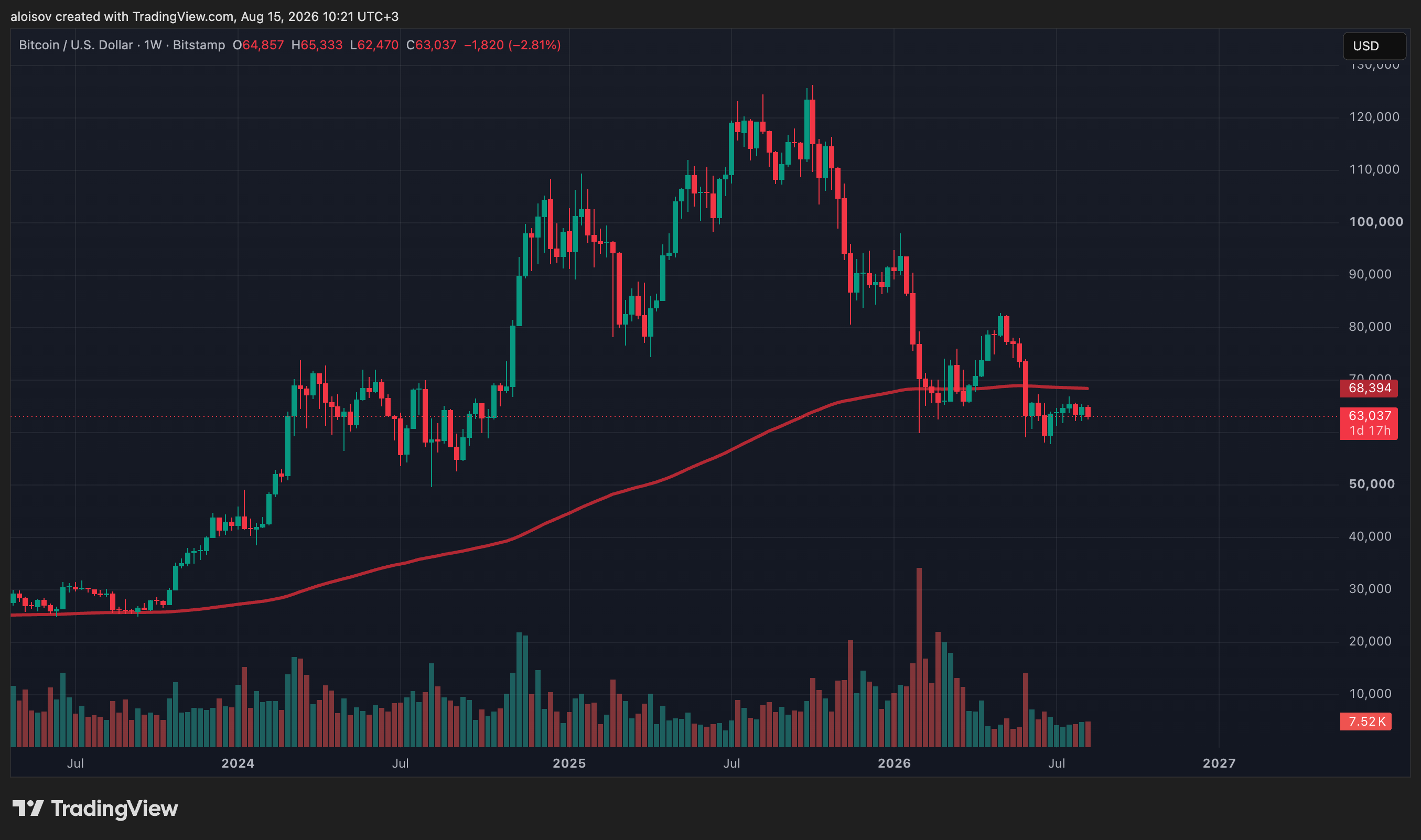
QCP Capital published a fresh report for traders, noting that Bitcoin's range has been tested for resilience but not broken. The asset retreated to the $63,000 mark, abandoning its earlier move towards $64,000, and returned to the lower boundary of its recent trading range. The company's analysts note that this pullback was not triggered by any single dominant industry catalyst—instead, digital assets are simultaneously facing several cross-market pressures: heightened geopolitical risks, rising oil prices, uncertainty surrounding global liquidity, and a weak response to generally favorable U.S. macroeconomic data.
Range Held but Lacked Momentum
According to QCP Capital's observation, last week Bitcoin demonstrated resilience, absorbing several negative headlines without a sharp breakdown. This week, as noted in the report, reinforced the distinction between resilience and momentum: the range remains unchanged, but softer inflation data has so far elicited only a muted response from the market.
The $62,500–63,000 area continues to act as the lower boundary of the recent trading range. Whether this range holds will increasingly depend on the interplay of macroeconomic data, liquidity conditions, and asset-specific fund flows, rather than any single trigger.
Inflation Slows, Bitcoin Remains in Sideways Trend
U.S. inflation data this week provided further confirmation that price pressures are easing. According to the report, the annual Consumer Price Index (CPI) for July fell to 3.4% from 3.5% in June, while core CPI slowed to 2.5% from 2.6%. The Producer Price Index (PPI) also came in softer than expected: the figure remained unchanged in July against a forecast of 0.2% growth, following a 0.3% decline in June.
This data came after a notably weaker July employment report, which showed a decline of 23k in non-farm payrolls and downward revisions to figures for the two previous months. Together, these releases have reduced market expectations for imminent monetary policy tightening, although inflation still exceeds the Fed's long-term target.
Bitcoin's response, however, remained subdued. QCP Capital emphasizes that this should not be interpreted as a directional signal—the divergence between softening macro data and a sluggish price reaction points to the importance of other variables: trader positioning, the state of liquidity, and overall risk appetite, which determine how macro data is translated into crypto asset prices.
Market attention is now shifting to the U.S. Personal Consumption Expenditures (PCE) index, due on August 26, and the September meeting of the Federal Open Market Committee (FOMC). Investors appear likely to focus on whether the slowdown in inflation is accompanied by sufficient economic resilience to keep financial conditions stable.
Regulation Progresses Along Two Trajectories
The report notes that U.S. digital asset policy is increasingly developing along two parallel paths. In Congress, Senate consideration of the CLARITY Act has moved beyond the August recess. Senate Majority Leader John Thune stated that the bill will return for House consideration in September, though disagreements over ethics provisions and banking issues remain unresolved.
Simultaneously, regulatory work continues independently of the legislative schedule. The Securities and Exchange Commission's (SEC) 2026 agenda includes further work on capital raising through crypto assets and tokenized securities, with the agency already taking steps this year regarding trading of tokenized stocks.
QCP Capital emphasizes that this is an important distinction: delays in passing comprehensive legislation do not mean regulatory development has stopped—individual elements of the regulatory framework continue to take shape through agency rulemaking, guidance, and existing legislative procedures.
Strategy Now Both Buys and Sells
Corporate treasury activity also remains significant for Bitcoin's supply dynamics. According to the report, Strategy disclosed another sale of 1,690 $BTC for $109 million last week, using the proceeds for preferred stock buybacks. Additionally, the company raised approximately $653 million through an issuance of common stock to replenish dollar reserves.
These transactions follow the launch of a formal Bitcoin Monetization Program, which Strategy introduced this summer. Under this program, the company can sell Bitcoin to support dollar reserves and other balance sheet needs. JPMorgan notes that this creates a risk of "two-way" fund flows, as Strategy can now act as both a major buyer and seller of Bitcoin—depending on its financing needs.
QCP Capital clarifies: this does not mean corporate treasuries should be viewed as a constant source of supply in the market. However, it makes the flow picture more conditional than in earlier stages of the cycle. For the market, it's now not only the volumes that corporate treasuries acquire that matter, but also their liquid position, financing conditions, and disclosed asset sale policies.
Negotiations Around the Strait of Hormuz Continue, Oil Remains High
Geopolitical uncertainty remains another source of pressure across several asset classes. According to the report, Oman-mediated negotiations on the framework conditions for commercial shipping through the Strait of Hormuz are ongoing, with Qatar and Pakistan still participating in the broader mediation process between the U.S. and Iran. Negotiators have made progress on possible shipping agreements, but full and sustainable resumption of passage is not yet secured.
This uncertainty is reflected in energy markets. Brent crude traded around $88 on the morning of August 14 and is heading for a significant weekly gain—limited shipping through the Strait of Hormuz and the absence of a sustainable agreement maintain a geopolitical risk premium.
For cryptocurrencies, QCP Capital notes, the macroeconomic transmission channel remains relevant. Sustained increases in energy prices can impact overall inflation, inflation expectations, and long-term bond yields—all of which, in turn, affect financial conditions for liquidity-sensitive assets.
As long as physical shipping does not normalize on a sustainable basis, the situation around the Strait of Hormuz remains significant for cryptocurrencies primarily through oil, interest rates, and global liquidity, rather than through a direct channel of influence on digital assets.
Seasonality as Context, Not as a Guide
The calendar also provides historical context for the current price dynamics. According to data from Bespoke Investment Group cited in the QCP Capital report, Bitcoin's median return for August historically stands around -7.5%, with positive returns occurring in roughly 30% of observations. September has also traditionally been weaker—with a median decline of about 5.3%. Bitcoin posted negative returns in August each year from 2022 through 2025.
QCP Capital emphasizes: historical seasonality is descriptive, not predictive, especially considering how the structure of the crypto market has changed due to exchange-traded funds (ETFs) and increased institutional participation. Nevertheless, seasonality provides useful context for periods when thinner late-summer liquidity may coincide with reduced trading activity and heightened sensitivity to trader positioning.
More relevant, according to the company's analysts, is not the question of whether history will repeat itself, but whether the current range will hold as the market moves through the seasonally calmer part of the calendar.
Resilience Exists, Momentum Not Yet Present
In the concluding part of the report, QCP Capital notes that Bitcoin is not reacting to any single dominant negative catalyst. Instead, it continues to absorb several competing forces simultaneously: easing U.S. inflation, a weakening labor market, elevated oil prices, evolving regulation, and the more conditional nature of flows from corporate treasuries.
The analysts' conclusion largely reiterates their conclusion from a week ago. Bitcoin has demonstrated the ability to absorb negative news without a sustained breakdown, but the market has so far failed to convert improving elements of the macroeconomic backdrop into sustained upward momentum.
An exit from the current range in either direction, according to QCP Capital, would give the market much more information than intraday fluctuations within it. Until then, resilience remains the market's main characteristic—but not momentum.
Key Events in the Coming Weeks
-
August 19 — Publication of FOMC meeting minutes
-
August 26 — U.S. PCE index for July, second estimate of Q2 GDP
-
August 27–29 — Economic Symposium in Jackson Hole
-
September 15–16 — FOMC meeting
Bitcoin's current range resembles a tightly coiled spring: pressure is building from all sides, but the form holds for now. The market is testing the strength of this structure from both sides, finding no immediate reason for a sharp move.
The coming weeks—with the release of PCE data, the Jackson Hole symposium, and the September Fed meeting—will test whether this structure can withstand the seasonally weaker period or whether the accumulated pressure finally finds an outlet.
AI Opinion
From the perspective of machine data analysis, the current linkage of "oil—liquidity—Bitcoin" is not new to the crypto market. Earlier this year, the asset already faced similar pressure: when Brent exceeded $119 per barrel, Bitcoin unexpectedly held firm and moved upward, breaking the usual correlation with risky assets. This shows that the transmission channel "oil → inflation expectations → yields → crypto market," described in the QCP Capital report, does not work mechanically—in practice, Bitcoin's behavior depends on whether the asset is perceived in the moment as a risky instrument or a defensive one.
A technical aspect not covered in the report: the narrow range of $62,500–64,000 amid declining realized volatility statistically increases the probability of a sharp, directional move—regardless of macro news. Will the current compression maintain directional uncertainty until the September FOMC meeting, or will the market find a reason to exit earlier?