美股在玩一种新型的 AI 转盘游戏

深潮Published on 2025-09-22Last updated on 2025-09-23

到底谁出了这 1000 亿?

撰文:五一番

最近美股圈里流传着一个段子:

“OpenAI 投资 Oracle 1,000 亿美金买云计算服务;Oracle 投资英伟达 1,000 亿美金买显卡;英伟达再投资 OpenAI 1,000 亿美金布局 AI 系统。提问,到底谁出了这 1,000 亿?”
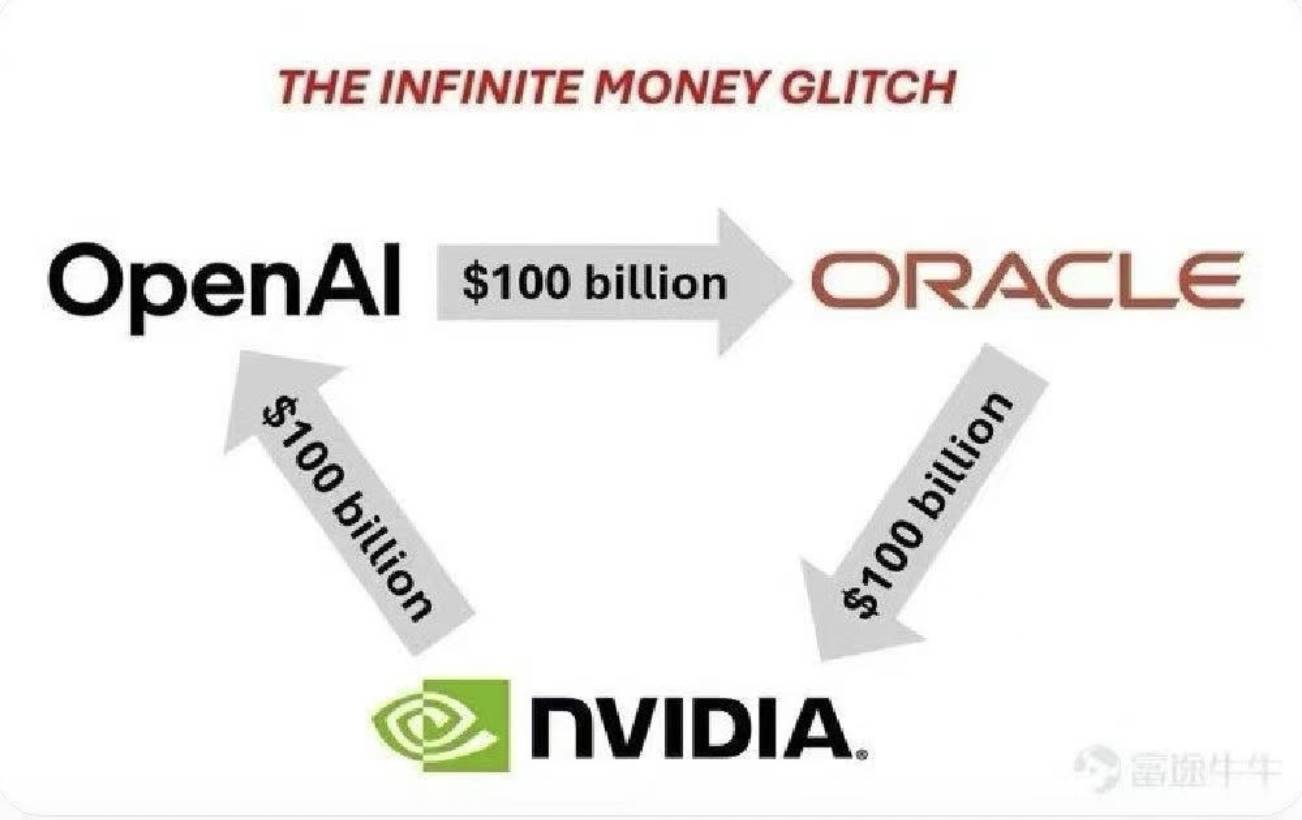
当然,以上只是段子,金额和事实有较大出入,也并不是三家公司拿同一笔钱在兜圈,但这的确反映了一种新型资本叙事的闭环

在这个闭环中,每个环节都是真实的合同或投资,每个动作都会被资本市场放大,进而带来数以万亿计的市值提升。

9 月 11 日,Oracle 股价暴涨 36%,创下 1992 年以来最大单日涨幅。一夜之间,公司市值飙升至 9,330 亿美元,创始人拉里·埃里森甚至短暂超越马斯克,成为世界首富。

9 月 22 日,英伟达与 OpenAI 宣布达成战略合作,英伟达计划对 OpenAI 投资最高 1,000 亿美元,英伟达收涨近 4%,市值突破 4.46 万亿美元,并引爆整个科技股行情,三大美股指齐创新高。

1,000 亿美元看似很多,但一夜带动美股上涨上万亿,妥妥的花小钱办大事。

美股在玩一种新型的 AI 转盘游戏。

三角循环:钱是怎么转起来的?

在现实版的投资迷宫中,三个名字构成了一个完美的资本闭环:OpenAI、Oracle、英伟达。

第一环:OpenAI 算力饥渴

故事的核心主角是 OpenAI。作为 ChatGPT 的缔造者,OpenAI 每天要处理来自 7 亿用户的请求。这种规模的 AI 运算,需要海量的计算能力。

今年,OpenAI 与 Oracle 签署了一份史上最大的技术合同,5 年 3,000 亿美元的云计算协议。按照这个合同,OpenAI 每年要向 Oracle 支付约 600 亿美元,相当于该公司目前年营收的 6 倍。

这笔钱买什么?4.5 吉瓦的数据中心容量,相当于 400 万美国家庭的用电量。Oracle 要为 OpenAI 建设遍布怀俄明、宾夕法尼亚、德克萨斯等五个州的数据中心园区。

对 OpenAI 来说,这保证了有地方和算力跑模型;对 Oracle 来说,这是未来五年的营收确定性。

第二环:Oracle 需要芯片

拿到 OpenAI 的巨额订单后,Oracle 面临一个问题:如何建设这些数据中心?

答案是芯片,大量的芯片。Oracle 计划在 Stargate 项目上投入数百亿美元购买英伟达的 GPU。按照业内估算,4.5 吉瓦的算力需要超过 200 万块高端 GPU。

Oracle CEO 萨夫拉·卡茨直言不讳:“我们资本支出投资的绝大部分都用于购买能产生收入的设备,这些设备将进入数据中心。”

这些“能产生收入的设备”,主要就是英伟达的 H100、H200 和最新的 Blackwell 芯片。

Oracle 成为了英伟达最大的客户之一。

第三环:英伟达反哺

就在 Oracle 疯狂采购芯片的同时,英伟达宣布了一个惊人的决定:投资 1,000 亿美元支持 OpenAI 建设 10 吉瓦的 AI 数据中心。

这笔投资将分阶段进行,每当 OpenAI 部署 1 吉瓦的算力,英伟达就投入相应资金。第一阶段计划在 2026 年下半年启动,使用英伟达的 Vera Rubin 平台。

英伟达 CEO 黄仁勋在接受采访时说:“10 吉瓦的数据中心容量相当于 400 万到 500 万块 GPU,这大约是我们今年全年的出货量。”

至此,一个完美的资本循环形成了:

OpenAI 付钱给 Oracle 买算力,Oracle 拿钱向英伟达买芯片,英伟达再把赚到的钱投资给 OpenAI。

虚实之间的财富放大器

3000 亿美元的长期合约带来 Oracle 单日超过 2500 亿美元市值上涨,1000 亿美元的投资带来英伟达单日 1700 亿美元的上涨。

三方公司互相站台,互相背书,形成了股价共振

股价上涨背后,有其合理性。

对资本市场来说,最稀缺的是未来的确定性。

Oracle 与 OpenAI 的合约,意味着它未来五年的云收入部分被锁定,投资人自然给出更高估值。

此外,英伟达这次用的是“GW(千兆瓦)”作为计量单位。1GW 大约相当于一个超级数据中心的规模。10GW 意味着英伟达和 OpenAI 在建的是新一代 AI 工厂。这个叙事新语言比“买了多少块 GPU”更有想象力,市场容易被带动。

英伟达投资 OpenAI,等于说“我认可它是未来的超级客户”;OpenAI 与 Oracle 签合同,等于说“Oracle 有能力支撑我未来的云算力需求”,OpenAI 可以获得更多融资;Oracle 采购英伟达 GPU,等于说“英伟达的芯片供不应求”。

这是一条稳定而繁荣的产业链。

这个循环看起来完美无缺,但仔细观察会发现其中的奥妙之处。

OpenAI 目前年营收约 100 亿美元,但承诺每年向 Oracle 支付 600 亿美元。这个巨大的缺口从哪里填补?

答案藏在一轮又一轮的融资中。4 月份,OpenAI 完成 400 亿美元的融资,预计还将继续融资。

实际上,OpenAI 用投资者的钱支付 Oracle,Oracle 用这些钱购买英伟达的芯片,英伟达再把部分收入投回 OpenAI。这是一个由外部资本驱动的循环系统。

此外,这些天文数字的合同,大多基于“承诺”而非即时交付,可以延迟、重新谈判,甚至在某些条件下取消。市场看到的是承诺的数字,而不是实际流动的现金。

这就是现代金融市场的魔法:预期和承诺可以创造出倍数级的财富效应。

谁来买单?

回到段子最初的提问:“到底谁出了这 1,000 亿?”

答案是,投资人和债务市场。

软银、微软、Thrive Capital 等投资机构,是这场游戏的直接买单者。他们向 OpenAI 投入数百亿美元,支撑起整个资本循环。此外,银行和债券投资者也为 Oracle 的扩张提供了资金支持,持有相关股票和 ETF 的普通人,则是链条尽头的“沉默买单者”。

这场 AI 资本轮转游戏,本质上是一种 AI 时代的金融工程。它利用市场对 AI 未来的乐观预期,构建了一个自我强化的投资循环。

在这个循环中,每一方都是赢家:OpenAI 获得了算力,Oracle 获得了订单,英伟达获得了销量和投资机会。股东们看着账面财富增长,皆大欢喜。

但这种欢乐建立在一个前提之上:AI 未来的商业化进程能够支撑起这些天文数字的投资。一旦这个前提动摇,优美的循环可能会变成危险的螺旋。

最终,这个游戏的买单者是每一个相信 AI 未来的投资者,用今天的钱,为明天的 AI 时代下注。

但愿音乐不会停止。

利益相关:笔者持有英伟达、AMD 相关股票。

Trending Cryptos

Related Reads

Report on the State of the Crypto Industry by 2026, Featuring Sumsub Vice President for North America, Danielle LaBarbera

The cryptocurrency industry is entering an era of regulated maturity, driven by frameworks like the CLARITY Act and the $GENIUS Act in the US. These provide clearer rules but also raise operational standards, requiring platforms to effectively demonstrate compliance. Simultaneously, fraud is evolving into sophisticated, AI-powered, lifecycle-based attacks, moving beyond simple onboarding scams. According to Daniel LaBarbera, VP of Sumsub for North America, companies must shift from one-time KYC checks to continuous, risk-based verification. This involves integrating identity, behavioral, device, and transaction data into a unified risk view. The 2026 State of Crypto Industry report highlights that while 55% of crypto firms faced fraud last year, effective strategies now combine AI-driven detection, continuous monitoring, and behavioral analytics. Key compliance challenges persist, particularly with the Travel Rule. Only 23% of companies are fully compliant, with high implementation costs, data security concerns, and regulatory fragmentation being major hurdles. Meanwhile, stablecoins are gaining traction, accounting for 36% of all crypto transactions in 2025, and evolving from trading tools into financial infrastructure for payments and settlements. The path forward lies in risk-based approaches that balance security, speed, and user experience. This includes adopting documentless verification, reusable KYC, and breaking down silos between compliance functions to create a holistic, lifecycle view of customer risk and trust.

cryptonews.ru5m ago

Report on the State of the Crypto Industry by 2026, Featuring Sumsub Vice President for North America, Danielle LaBarbera

cryptonews.ru5m ago

U.S. National Debt Approaches $40 Trillion in 5 Months, Bitcoin Debate Gains Momentum

The US national debt has surged to nearly $40 trillion in just five months, the fastest trillion-dollar increase on record. The debt's growth has accelerated dramatically over time, from taking 192 years to reach the first $1 trillion in 1981 to adding the latest $1 trillion in only five months. The federal budget deficit for the fiscal year is already over $1.8 trillion, exceeding last year's total, and net interest payments on the debt have surpassed $1 trillion, now exceeding defense or Medicare spending. This rapid debt accumulation is fueling arguments within the cryptocurrency industry that Bitcoin serves as a hedge against government-backed currencies and fiscal irresponsibility. Proponents, including some lawmakers and industry leaders, argue Bitcoin could act as a "hard currency" fiscal control mechanism. Legislation has even been proposed for the Treasury to acquire Bitcoin to help reduce the national debt. The International Monetary Fund has warned that global public debt could hit 100% of world GDP by 2029 if current trends continue, with the US and China as primary drivers. Some analyses suggest a sovereign debt crisis could drive capital into alternative assets like Bitcoin, similar to past regional banking crises. However, skeptics point out that both Bitcoin and gold have fallen in price at times during 2026 despite record debt, indicating the depreciation hedge theory may operate over a much longer timeframe than short-term price action.

cryptonews.ru15m ago

U.S. National Debt Approaches $40 Trillion in 5 Months, Bitcoin Debate Gains Momentum

cryptonews.ru15m ago

Technological Self-Reliance in China: A War from Lithography Machines to ABF Films

"China's Tech Independence: A Battle from Lithography Machines to ABF Film" In August 2026, Japan's Ajinomoto announced a 30% supply cut of ABF film to Chinese mainland clients, causing industry-wide shock and fears of price hikes and shortages in the semiconductor supply chain. That same year, Chinese company Lotus Holdings, known for its MSG business, acquired a small domestic ABF film startup for 103 million yuan, aiming to change this passive situation. ABF film is a core insulating material for advanced CPU, GPU, and AI chip packages. Ajinomoto, originally a food flavoring company, has monopolized over 95% of the global ABF film market for nearly 30 years, deriving its technology from byproducts of monosodium glutamate production. With AI chips consuming 5-10 times more ABF film than traditional chips, the supply-demand gap is widening. Ajinomoto's supply cut to China, where domestic ABF film production accounts for less than 5%, directly threatens the production of domestic high-end AI chips and their substrates. This incident highlights a crucial but often overlooked truth: the vulnerabilities in China's quest for technological self-reliance extend beyond headline areas like lithography machines to critical but seemingly minor components—insulating films, photoresists, electronic specialty gases, etc. The article frames China's tech independence as a multi-front war. While major breakthroughs have been achieved in chip design (e.g., Huawei's HiSilicon), foundry (e.g., SMIC), and memory chips (e.g., YMTC), countless smaller "Ajinomoto-style" chokepoints remain. Lotus Holdings' acquisition represents a significant shift: the battle is no longer fought only by tech giants but has become a collective, industry-wide effort involving companies from diverse backgrounds. Historically, external blockades have often spurred China's technological breakthroughs, as seen with Huawei's Kirin chips and YMTC's 3D NAND flash memory. Ajinomoto's supply cut, while a short-term challenge, may similarly catalyze domestic innovation in ABF film and other critical materials. The path to technological sovereignty is long and arduous, requiring sustained patience and investment to fill every gap in the complex supply chain. Lotus's move is not an immediate solution but a step towards that future, symbolizing a broader, relentless march toward independence.

marsbit34m ago

Technological Self-Reliance in China: A War from Lithography Machines to ABF Films

marsbit34m ago

Trading

Spot

Hot Articles

Discussions

Welcome to the HTX Community. Here, you can stay informed about the latest platform developments and gain access to professional market insights. Users' opinions on the price of AI (AI) are presented below.

活动图片