U.S. National Debt Approaches $40 Trillion in 5 Months, Bitcoin Debate Gains Momentum

cryptonews.ruPublished on 2026-08-17Last updated on 2026-08-17

Abstract

The US national debt has surged to nearly $40 trillion in just five months, the fastest trillion-dollar increase on record. The debt's growth has accelerated dramatically over time, from taking 192 years to reach the first $1 trillion in 1981 to adding the latest $1 trillion in only five months. The federal budget deficit for the fiscal year is already over $1.8 trillion, exceeding last year's total, and net interest payments on the debt have surpassed $1 trillion, now exceeding defense or Medicare spending. This rapid debt accumulation is fueling arguments within the cryptocurrency industry that Bitcoin serves as a hedge against government-backed currencies and fiscal irresponsibility. Proponents, including some lawmakers and industry leaders, argue Bitcoin could act as a "hard currency" fiscal control mechanism. Legislation has even been proposed for the Treasury to acquire Bitcoin to help reduce the national debt. The International Monetary Fund has warned that global public debt could hit 100% of world GDP by 2029 if current trends continue, with the US and China as primary drivers. Some analyses suggest a sovereign debt crisis could drive capital into alternative assets like Bitcoin, similar to past regional banking crises. However, skeptics point out that both Bitcoin and gold have fallen in price at times during 2026 despite record debt, indicating the depreciation hedge theory may operate over a much longer timeframe than short-term price action.

The rate of U.S. debt accumulation warrants separate consideration. It took 192 years to accumulate the first trillion dollars of debt—this milestone was reached in 1981. Each subsequent trillion accumulated faster: for instance, going from $5 trillion to $10 trillion by 2008 took five years, and then—just five years to climb from $20 trillion in 2017 to $30 trillion in 2022.
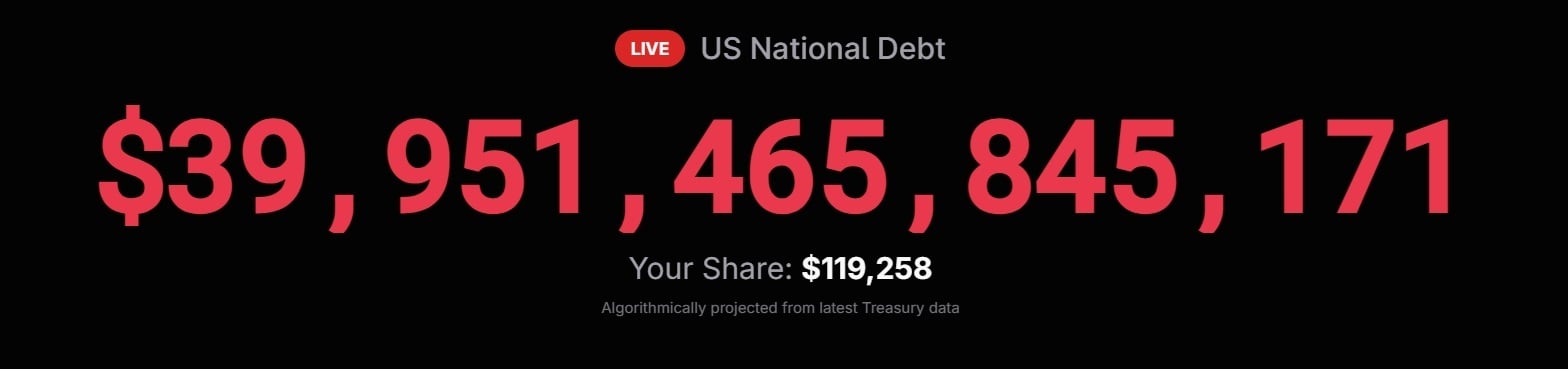
Image Source: US-Debt-Clock.com

The latest surge—from $39 trillion to the recently surpassed mark of $39.95 trillion—took only five months, marking the fastest trillion-dollar increase in history.

What Fuels the Debt Growth and Interest Payment Expenses

In July alone, the federal budget deficit was $432 billion, bringing the deficit for the first ten months of the fiscal year to approximately $1.8 trillion—a figure that already exceeds the entire deficit recorded in the 2025 fiscal year. Maya MacGuineas from the Committee for a Responsible Federal Budget directly pointed to this pace, noting that the government is currently increasing debt by "$14 billion per day," and stating that to stabilize the trend, the deficit must decrease to a level close to 3% of GDP.

An increasing share of this problem is occupied by interest payment expenses. Net interest payments on the debt for the fiscal year have already exceeded $1 trillion—this sum currently exceeds Washington's spending on national defense or the Medicare program. The total federal debt has risen to 124% of GDP, with just the debt held by external investors accounting for approximately 101% of GDP, approaching the record level of 106.1% of GDP recorded in 1946 after World War II.

Bitcoin.com News covered this previous debt-to-GDP ratio milestone in July when this indicator first surpassed the comparable threshold.

Arguments for Bitcoin as a Hedge Against Debt Grow Louder

The movement toward the $40 trillion mark has directly bolstered the crypto industry's favorite argument that Bitcoin serves as a hedge against a currency backed by a government that cannot stop borrowing. This argument was detailed in an analytical piece when the debt first exceeded $39 trillion in July, and has since been supported by an increasing number of institutional sector representatives.

Senator Cynthia Lummis has also been vocal on the matter, and her BITCOIN Act bill (which would require the Treasury Department to acquire up to 1 million BTC within five years and hold the coins for at least two decades) asserts that this could reduce the national debt by a third or even by half. Coinbase CEO Brian Armstrong separately put forward the idea of using Bitcoin as a "hard currency-backed" mechanism to control federal spending, positioning debt as a constitutional issue as much as a fiscal one.

Finally, the International Monetary Fund warned that by 2029, global public debt could reach approximately 100% of world GDP if current trends persist, with the U.S. and China named as two primary contributing factors. The IMF's own analysis shows that such a scenario could play into Bitcoin's favor, i.e., unlike a bond sell-off driven by a quest for yield, a debt solvency crisis could redirect capital into alternative assets rather than simply withdrawing it from markets (this dynamic favored Bitcoin during the Cyprus banking crisis in 2013 and again during the U.S. regional banking crisis in 2023).

Not everyone agrees that this trading strategy works as advertised, given that both Bitcoin and gold have fallen in price for a significant part of 2026, even as the debt set one record after another—a reminder that the debasement theory operates on a longer timeframe than price behavior over a single month.

end-content

Related Questions

QAccording to the article, how long did it take for the U.S. national debt to increase from $39 trillion to nearly $40 trillion?

AIt took just five months, marking the fastest trillion-dollar increase in history.

QWhat is the current U.S. federal debt-to-GDP ratio mentioned in the article?

AThe total federal debt has grown to 124% of GDP.

QWho is Maya MacGuineas and what did she state about the U.S. government's debt accumulation?

AMaya MacGuineas is from the Committee for a Responsible Federal Budget. She stated that the government is currently increasing debt at a rate of '$14 billion a day' and that the deficit must shrink to near 3% of GDP to stabilize the trajectory.

QWhat is the main argument presented by the crypto industry regarding Bitcoin's role in relation to the U.S. debt?

AThe crypto industry argues that Bitcoin serves as a hedge against a government-backed currency issued by an entity that cannot stop borrowing.

QWhat warning did the International Monetary Fund (IMF) issue regarding global debt, and what potential consequence for Bitcoin is suggested?

AThe IMF warned that global sovereign debt could reach roughly 100% of world GDP by 2029 if current trends continue. Their analysis suggests such a debt solvency crisis could redirect capital into alternative assets like Bitcoin, rather than simply exiting markets.

Related Reads

Tencent Reaps a Paper Profit of 50 Billion

A decade ago, China held no share in the global DRAM market. Today, Changxin Technology, after listing on the STAR Market, has become the most valuable A-share company. Its landmark IPO has generated historic returns for investors. Among them, Tencent, which invested approximately 2 billion RMB in 2022 through its entity Beijing Fengyi, now holds an estimated paper gain of around 50 billion RMB based on Changxin's current market valuation of approximately 4 trillion RMB. Alibaba also made significant bets. Its affiliates invested a total of roughly 7.6 billion RMB across two funding rounds in 2022 and 2025. Their combined stake is now worth an estimated 170 billion RMB—a paper profit surpassing Alibaba's entire net profit for fiscal year 2026. The shareholder registry reveals a who's who of Chinese capital. Major state-backed funds like the National Integrated Circuit Industry Investment Fund (Big Fund II) and Anhui provincial capital hold stakes worth hundreds of billions. Early and crucial support came from the Hefei municipal government, which played a foundational role in the company's establishment and growth. Strategic industrial investor GigaDevice, under the same leadership as Changxin, invested about 2.3 billion RMB, now worth roughly 53 billion. Home appliance giant Midea's 1 billion RMB investment has ballooned to an estimated 22 billion RMB. Virtually all major domestic financial institutions, venture capital, and private equity firms participated. However, the story also includes a notable exit: Country Garden's venture arm sold its stake for 2 billion RMB in late 2024 to address its own liquidity crisis. Those shares would be worth approximately 44 billion RMB at the IPO price, highlighting a stark contrast in timing between the downturn of the real estate cycle and the rise of the semiconductor sector.

marsbit35m ago

Tencent Reaps a Paper Profit of 50 Billion

marsbit35m ago

Calterah Races for the STAR Market: 31% Market Share, Over 900 Million in Losses, the Berkeley Mentor-Student Duo's Path to Breakthrough in Millimeter-Wave Radar

Calterah Microelectronics (Calterah), a Shanghai-based automotive chip company specializing in millimeter-wave radar chips, has filed for a listing on China's Sci-Tech Innovation Board (STAR Market), seeking to raise 3.49 billion yuan. Founded in 2014 by Dr. Chen Jiashu, a UC Berkeley PhD, and his professor Ali Niknejad, Calterah pioneered the use of CMOS technology for automotive-grade 77GHz radar chips, challenging the dominance of global giants like Texas Instruments. The company has grown rapidly, with revenue soaring from 206 million yuan in 2023 to 632 million yuan in 2025. It holds a 31.1% share in China's automotive millimeter-wave radar chip market and a 4% global share, with cumulative shipments exceeding 30 million chips for clients including BYD, Geely, NIO, Volvo, and Rivian. Despite strong market traction, Calterah faces significant financial challenges. It has reported cumulative net losses exceeding 900 million yuan over the past three and a half years, driven by massive R&D spending, which accounted for 147.75% of revenue in 2023. Operating cash flow remains negative, and the company relies heavily on external financing. Other risks include high customer and supplier concentration, with its top five distributors accounting for over 99% of revenue and overseas procurement exceeding 50%. Supply chain security is a concern due to reliance on foundries like TSMC. The proceeds from the IPO will fund R&D for high-performance radar chips, ultra-wideband (UWB) chips for applications like digital car keys, and a new technology center. Calterah aims to expand beyond automotive into industrial and consumer sectors. However, it faces intense competition, potential price wars, and the long, costly cycle of automotive-grade certification. Its path forward hinges on achieving profitability, maintaining technological leadership, and building a sustainable business model in a fiercely competitive global market.

marsbit35m ago

Calterah Races for the STAR Market: 31% Market Share, Over 900 Million in Losses, the Berkeley Mentor-Student Duo's Path to Breakthrough in Millimeter-Wave Radar

marsbit35m ago

Burning Through Billions, Market Cap Evaporates 200 Billion: SenseTime Suddenly Turns a Profit

Chinese AI giant SenseTime, once a star in the AI "Four Dragons," recently projected its first-ever profit for H1 2026, sparking a temporary stock surge. However, its current market cap of ~HK$64.6 billion remains over 80% below its peak of ~HK$300 billion in early 2022. The article analyzes SenseTime's dramatic fall from grace. It excelled in the "AI 1.0" era, dominating computer vision for applications like facial recognition and smart cities. However, it was disrupted by the "AI 2.0" generative AI revolution led by ChatGPT, which shifted focus from recognition to creation. Compounded by US sanctions, the death of its founder, a short-seller report, and a decline in its core smart city business, the company faced a perfect storm. Its workforce was cut by nearly 60%. To survive, SenseTime pivoted, actively "killing" its old self. It transitioned from project-based solutions to a generative AI and visual AI dual-engine model. Now, over 70% of its revenue comes from large language models, a more scalable, subscription-like business. Cost-control measures on expensive model training have also contributed to its path to profitability. Yet, significant challenges remain. The current AI race is an ecosystem battle dominated by giants like Microsoft/OpenAI, Google, and Chinese tech firms with integrated clouds, apps, and vast user bases. SenseTime, as an independent AI company, lacks such a super app or traffic gateway. The key question is whether it can build a sustainable moat based solely on model capability and industry deployment in this new competitive landscape.

marsbit39m ago

Burning Through Billions, Market Cap Evaporates 200 Billion: SenseTime Suddenly Turns a Profit

marsbit39m ago

Shanghai Sees a Semiconductor Equipment IPO Emerge, Led by Former Grace Semiconductor Employee

A Shanghai-based semiconductor equipment company, Mifee Technology, has filed for an IPO on the Shanghai Stock Exchange's STAR Market. The company specializes in developing and manufacturing Automatic Material Handling Systems (AMHS), a core automation system in semiconductor wafer fabrication that directly impacts production efficiency and yield. Mifee is one of the few domestic Chinese companies with proprietary AMHS technology, offering both hardware and software systems. While the global AMHS market is dominated by Japanese giants like Daifuku and Murata Machinery, which hold approximately 90% market share, Mifee has captured about 1.6% globally. The company's revenue has grown significantly, reaching 393 million yuan in 2025, and it achieved profitability that year with a net income of 60.45 million yuan, following losses in 2023 and 2024. Its revenue streams include sales of individual AMHS equipment and complete factory AMHS projects, with the latter starting to contribute revenue from 2024. The company faces risks including high customer concentration, with its top five clients accounting for over 90% of revenue in 2025, and significant fluctuations in gross margin, which was 48.97% in 2025 after dropping to 24.67% in 2024. Mifee is controlled by an 80s-born couple, Chairman/CEO Feng Miao and Deputy General Manager Na Ke, who previously worked at Shanghai Grace Semiconductor Manufacturing Co. The company plans to raise approximately 1.191 billion yuan from its IPO to fund production, R&D, overseas expansion, and working capital.

marsbit39m ago

Shanghai Sees a Semiconductor Equipment IPO Emerge, Led by Former Grace Semiconductor Employee

marsbit39m ago

Trading

Spot
活动图片