Crypto And AI Data Centers Face Possible Emissions Fees In New Climate Crackdown

bitcoinistPublished on 2025-04-12Last updated on 2025-04-13

Abstract

Senate Democrats have proposed new legislation that would charge fees on data centers and cryptocurrency mining operations that surpass federal...

Trusted Editorial content, reviewed by leading industry experts and seasoned editors. Ad Disclosure

Senate Democrats have proposed new legislation that would charge fees on data centers and cryptocurrency mining operations that surpass federal emissions standards. The bill comes as power demands from these operations continue to increase throughout the United States.

New ‘Clean Cloud Act’ Seeks To Lower Carbon Footprint

The legislation, sponsored by Senators Sheldon Whitehouse and John Fetterman, would have the Environmental Protection Agency develop emissions standards for big data centers. Under the proposal, the standards would cover data facilities and crypto mining operations with over 100KW of installed nameplate IT power.

Penalties would start at $20 per ton of carbon dioxide equivalent emissions that exceed the limits. This fee would increase yearly based on inflation plus an additional $10. The standards would be based on regional grid emissions patterns and target an 11% annual reduction in emissions.

Power Demand From Data Centers Expected To Reach 12% By 2028

Based on reports from the US Senate Committee on Environment and Public Works, data centers could account for up to 12% of total US power demand within four years. Research from Morgan Stanley suggests these facilities might generate approximately 2.5 billion metric tons of carbon dioxide emissions globally by the end of the decade.

“Surging power demand from crypto miners and data centers is outpacing the growth of carbon-free electricity,” notes a minority blog post published on the committee’s website.

As of today, the market cap of cryptocurrencies stood at $2.6 trillion. Chart: TradingView

Bitcoin Miners Shift Focus As Industry Faces Challenges

The proposed regulation comes at a difficult time for Bitcoin miners. According to reports, mining operations have struggled throughout 2025 as cryptocurrency prices decline. These challenges follow the Bitcoin network’s most recent halving event.

In response, major mining companies including Galaxy, CoreScientific, and Terawulf have begun moving toward high-performance computing services for artificial intelligence models. Reports have also disclosed that miners are diversifying into AI data-center hosting as a way to expand revenue and repurpose existing infrastructure.
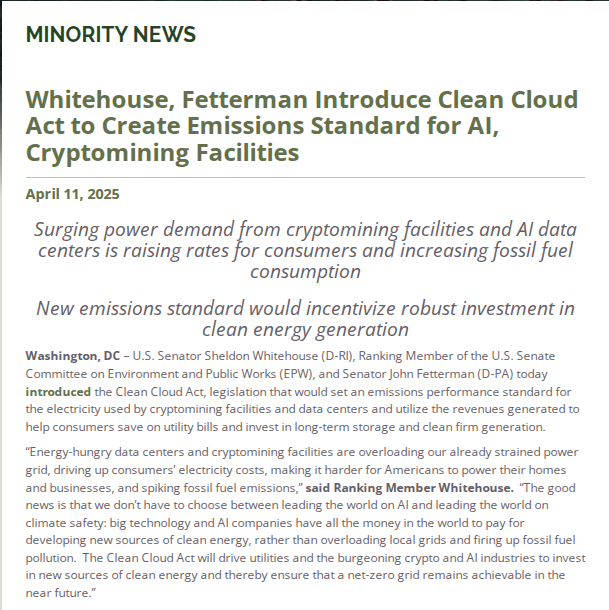
A portion of the Clean Cloud Act paper. Source: US Senate Committee on Environment & Public Works

Political Tensions May Affect Bill’s Future

The Clean Cloud Act may face significant opposition under the current administration. United States President Donald Trump has previously expressed his goal of making the US the “world capital” of both AI and cryptocurrency. Trump also reversed a 2023 executive order from former President Joe Biden that established safety standards for artificial intelligence.

Matthew Sigel, head of research at VanEck, criticized the bill on social media, calling it a “Losing ‘Blame the Server Racks’ Strategy” that unfairly targets Bitcoin miners for their energy use.

Nicholas Roberts-Huntley, CEO of Concrete & Glow Finance, warned that ongoing trade disputes could create additional problems for blockchain networks. The infrastructure supporting crypto, he said, not just the assets, can become “collateral damage” in times of global uncertainty, he said.

The bill has been introduced but has not yet passed in the Senate.

Featured image from Gemini Imagen, chart from TradingView

Editorial Process for bitcoinist is centered on delivering thoroughly researched, accurate, and unbiased content. We uphold strict sourcing standards, and each page undergoes diligent review by our team of top technology experts and seasoned editors. This process ensures the integrity, relevance, and value of our content for our readers.

Christian, a journalist and editor with leadership roles in Philippine and Canadian media, is fueled by his love for writing and cryptocurrency. Off-screen, he's a cook and cinephile who's constantly intrigued by the size of the universe.

Trending Cryptos

Related Reads

Tiger Research: Take RWA Tokenization Overseas First

This article discusses the strategic choices facing financial institutions in jurisdictions lacking mature regulatory frameworks for Real-World Asset (RWA) tokenization. With the market growing rapidly, institutions must choose between waiting for local legislation, using regulatory sandboxes, or—the recommended priority—expanding into overseas markets to gain early experience. Successfully launching cross-border RWA tokenization requires meticulous preparation across six key areas: establishing an overseas base (e.g., Hong Kong, Singapore, the U.S.), securing necessary licenses, defining the tokenized asset (with bonds being simpler than non-standard assets), defining the target investor scope, deciding on settlement currencies/payment flows, and designing operational requirements like custody and on-chain governance. The article outlines two primary strategic paths: a direct "onshore" path and a "native on-chain" path. The direct path involves setting up a legal entity and obtaining licenses in a mature jurisdiction like Hong Kong, Singapore, or the U.S., leveraging existing platforms (e.g., DigiFT, Securitize) for efficiency. The alternative native on-chain path involves partnering with compliant, decentralized platforms (e.g., Ondo, Plume Nest) that use structures like offshore SPVs to facilitate tokenization and access DeFi liquidity, offering speed and broader reach but with greater structural complexity. The core argument is that institutions should not wait for perfect domestic regulation. A detailed hypothetical case study illustrates the multi-step, 6-12 month process of launching an overseas tokenized bond. The key takeaway is that the essence of a tokenization business lies not in the technology but in successfully executing the entire sales and operational process. The market is moving forward, and the time to act is now.

marsbit8m ago

Tiger Research: Take RWA Tokenization Overseas First

marsbit8m ago

Chain Gaming Giant YGG Capitulates, Losing $15 Billion in Value Over 5 Years

The leading blockchain gaming guild Yield Guild Games (YGG) is shutting down its publishing arm, YGG Play, announced on July 6th by its official account and co-founder Gabby Dizon. The platform and its supported games will be phased out by July 31st. While YGG Play successfully validated a market for casual, crypto-native mobile games—generating over $9M in total revenue, including $876,000 in Q1 2026—Dizon stated the closure was a market-driven decision. He cited insufficient liquidity and declining user confidence in the macroeconomic environment, making the business commercially unsustainable. Founded in 2020, YGG rose to prominence during the Play-to-Earn (P2E) boom, particularly with Axie Infinity, organizing players and managing assets. Its token price soared above $10 during the 2021 bull market. However, the 2022 crypto downturn exposed the fragility of P2E economic models. YGG attempted to pivot in 2025 with the YGG Play publishing initiative, focusing on short-session casual games. The shutdown reflects broader struggles in the Web3 gaming sector. An April 2026 report highlighted a "structural mismatch" between speculative financial designs and genuine player entertainment needs, leading to an estimated $15 billion in destroyed capital. The report noted that 93% of roughly 3,200 tracked blockchain game projects are now "functionally dead," with token prices down an average of 95% from 2022 peaks. YGG itself is now pivoting its strategy entirely towards the AI Data Economy, aiming to build B2B pipelines around gaming datasets.

Foresight News26m ago

Chain Gaming Giant YGG Capitulates, Losing $15 Billion in Value Over 5 Years

Foresight News26m ago

Trading

Spot

Hot Articles

Discussions

Welcome to the HTX Community. Here, you can stay informed about the latest platform developments and gain access to professional market insights. Users' opinions on the price of AI (AI) are presented below.

活动图片