10 Charts to Understand the State of AI in 2026: US-China Gap Only 2.7%, Sharp Decline in Programmer Positions for Under-25s

marsbitPublished on 2026-04-15Last updated on 2026-04-15

Abstract

The 2026 AI Index Report from Stanford HAI reveals that AI adoption is accelerating faster than PCs and the internet, with a 53% global adoption rate. However, societal systems, job markets, and measurement tools lag behind. Key findings include: - Benchmark reliability is questionable, with 42% of GSM8K math problems deemed invalid. - The U.S. and China show near-parity in model performance (2.7% gap), with the U.S. leading in compute/capital and China in research/manufacturing. - Top models (Anthropic, xAI, Google, OpenAI) show converging capabilities, shifting competition to cost and reliability. - Employment for young developers (22–25) fell nearly 20%, with McKinsey noting AI-driven reductions in services, supply chain, and engineering. - The U.S. ranks 24th in adoption (28.3%) despite leading investment ($285.9B private AI funding in 2025). - AI agent task success improved but has ~33% failure rates; physical robots struggle outside labs (12.4% home success vs. 89.4% in sim). - A stark expert-public divide exists: 73% of experts vs. 23% of the public view AI’s job impact positively. - GPT-4o’s annual water use exceeds 12M people’s needs; AI data centers consume power equivalent to New York State. The report underscores rapid AI integration amid unresolved ethical, environmental, and economic challenges.

Stanford HAI (Human-Centered Artificial Intelligence Institute) has just released the 2026 AI Index Report, the most authoritative annual check-up for the AI field. Over the past year, Stanford researchers, through a series of observations, reached a core conclusion: AI is being adopted globally at a pace surpassing that of the PC and the internet, but human society's institutions, job markets, and measurement tools are lagging behind comprehensively.

AI is sprinting, while humanity is still looking for its shoes. Ten charts show you where AI is running faster than humans.

1

The Tests Used to Measure AI Are Themselves Useless
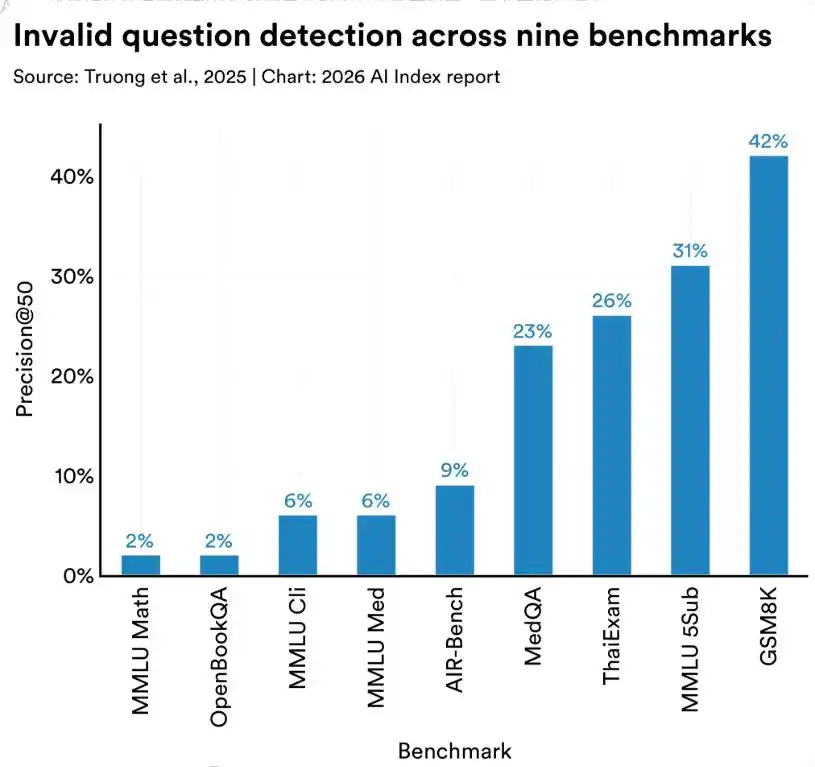
Headlines like "AI Surpasses Humans" are all based on the credibility of benchmarks. But the Stanford report found that nearly 42% of the questions in the widely used math benchmark GSM8K are invalid. Other tests are also suspected of being "gamed"; models can score high after being trained on the test data, but that doesn't mean they've gotten smarter. Many companies refuse to disclose relevant benchmark results. Gil, one of the report's authors, said: "The refusal to disclose results might itself say something."

2

The Substantial US-China Gap Disappeared, Only 2.7% Difference
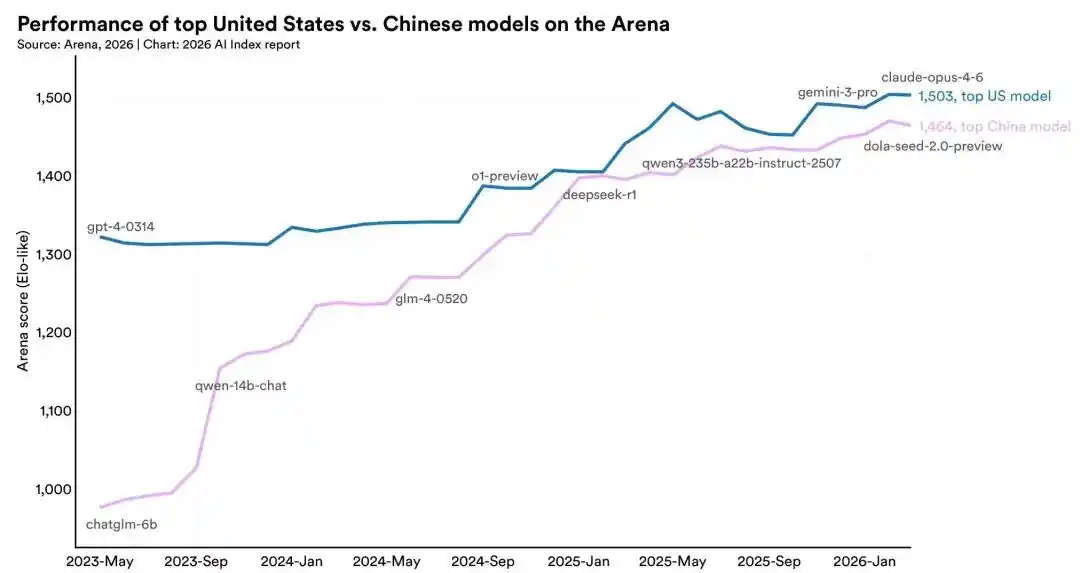
As of March 2026, the Elo rating of the US's strongest model, Claude Opus 4.6, is 1503, with China's strongest model close behind, a gap of only 2.7%. Over the past year, the models from the two countries have taken the lead multiple times. In February 2025, DeepSeek R1 once caught up to the US's strongest model.

However, the AI advantages of the two countries are completely different. The US has stronger models, more capital, and owns 5,427 data centers, more than 10 times that of any other country. China leads in AI research papers, patents, and robot deployment. Simply put, the US wins in computing power and money, China wins in research and manufacturing.

3

Frontier Models Converge, Intelligence Levels Comparable
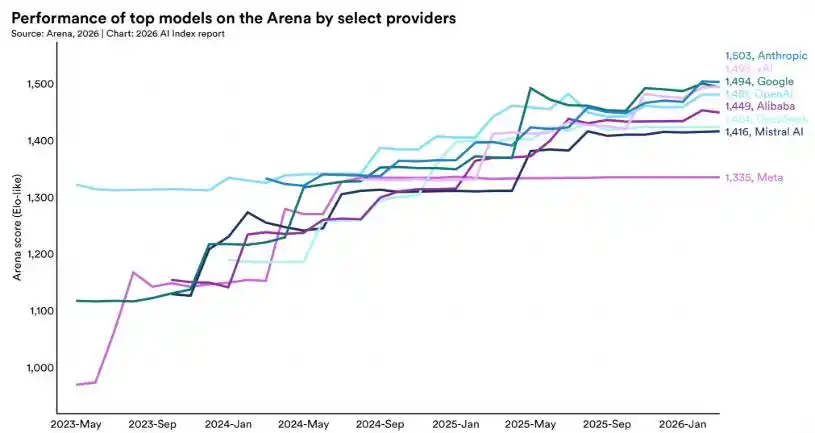
As of March 2026, Anthropic (1503), xAI (1495), Google (1494), and OpenAI (1481) are squeezed into an extremely narrow range. This means "whose model is stronger" is no longer the focus of competition. The focus of competition is shifting to cost, reliability, and optimization for specific domains—this also explains why Anthropic is working on Advisor Tools (to reduce costs), Google is buying Wiz (cloud security), and OpenAI is buying various application-layer companies (to expand scenarios). As the models' own performance converges in intelligence, differentiation must be created elsewhere.

4

Employment for 22-25 Year Old Developers Drops Nearly 20%
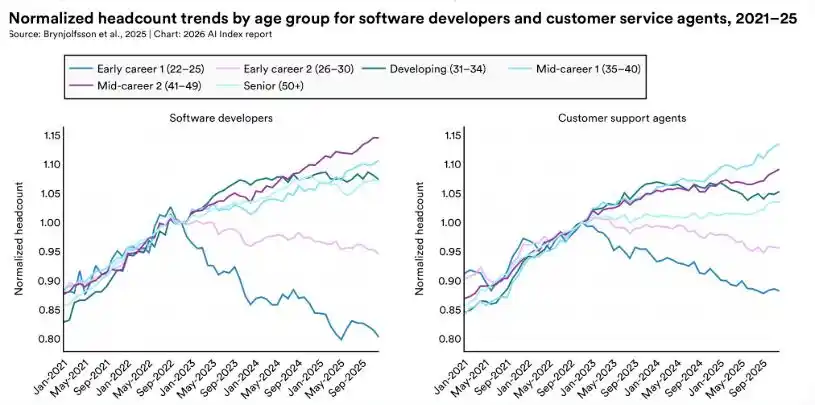
Generative AI achieved an adoption rate of over 53% at the population level within three years, and 88% of organizations are already using AI. But the employment impact is not even. A 2025 study by Stanford economists found that employment of software developers aged 22-25 has fallen by nearly 20% since 2022, while older demographics are still growing. A McKinsey 2025 survey showed that 1/3 of organizations expect to reduce staff due to AI in the next year, with cuts concentrated in service operations, supply chain, and software engineering.

Overall data does not yet show mass unemployment, but this is enough to show that the job market is like a frog in slowly heating water; the crisis is growing gradually.

5

Adoption Speed Surpasses PC and Internet, US Ranks Only 24th
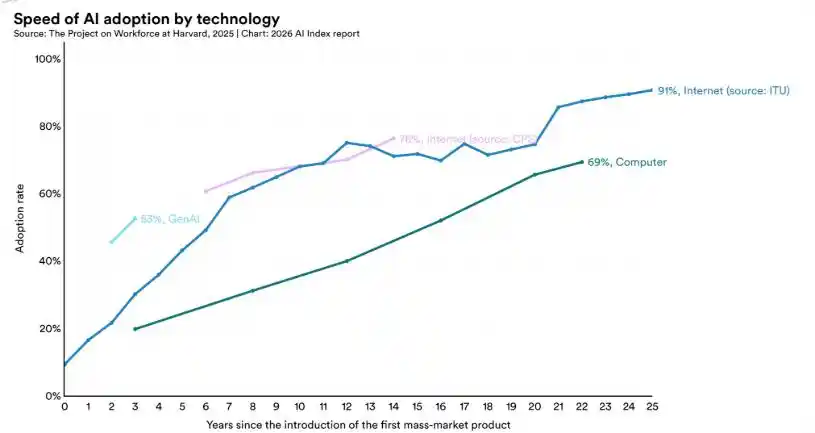
Generative AI reached a 53% population-level adoption rate within three years, a speed that surpassed the personal computer and the internet. But the most counterintuitive data point is: The US leads the world in AI investment and model development, but its population adoption rate is only 28.3%, ranking 24th globally. UAE 64%, Singapore 60.9%. The country that spends the most, uses it the least.

6

Global AI Investment $581.7B, US is 23 Times China's, But...
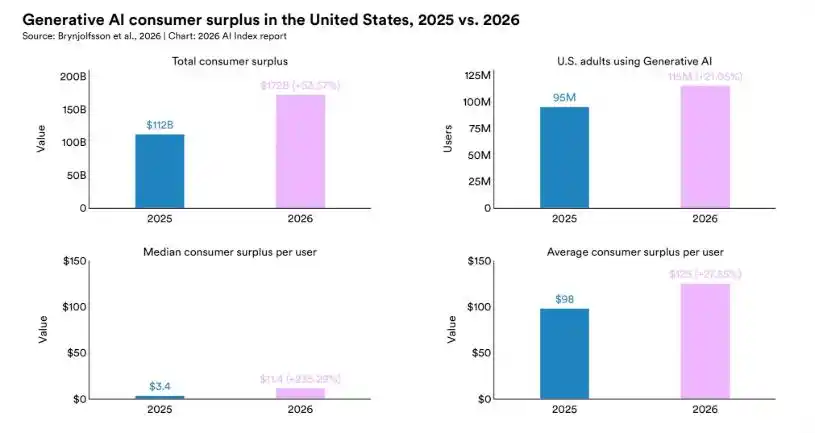
Global corporate AI investment reached $581.7 billion in 2025, a year-on-year increase of 129.9%. US private AI investment was $285.9 billion, 23 times that of China and 48.5 times that of the UK. California alone accounts for over 75% of the US total. Large deals are also dense: OpenAI raised $40 billion, valuation $300 billion; Anthropic raised $13 billion, valuation $183 billion; Cursor raised $2.3 billion at a $29.3 billion valuation.

However, there is a hidden piece of information: Domestically (in China), state-owned funds injected approximately $184 billion into AI companies between 2000 and 2023; this money was not counted in the private investment statistics. Adding this part, the funding gap between the US and China might be much smaller than the numbers on paper suggest.

7

AI Agent: From Chatting to Doing, But Still Has 1/3 Failure Rate
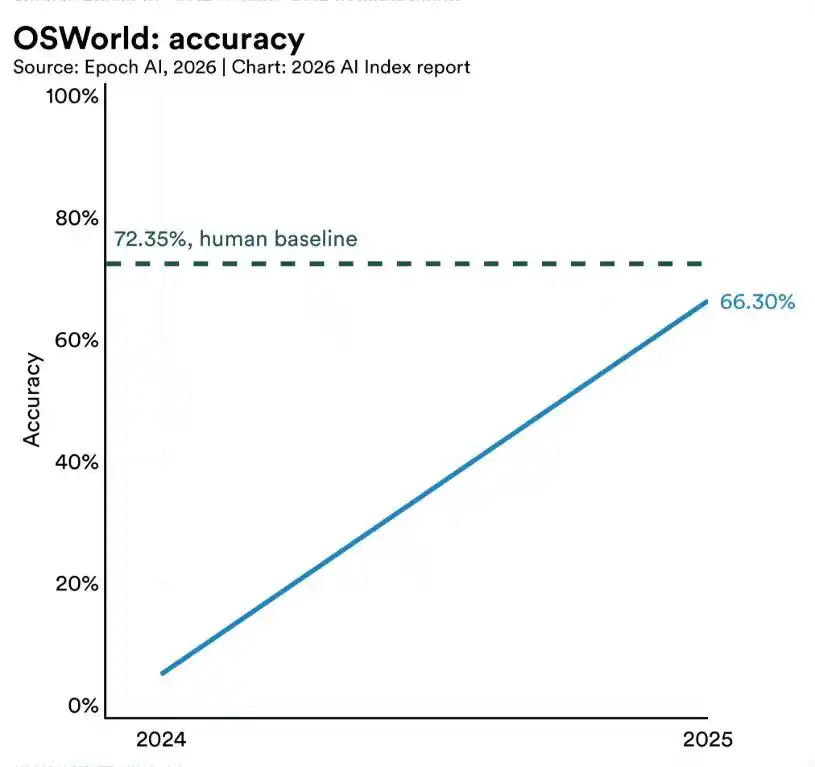
2025 was the year of the AI Agent. Accuracy on OSWorld (testing AI's ability to complete tasks on an operating system) soared from 12% to 66.3%, only 6 percentage points away from human performance. WebArena reached 74.3%, Cybench (cybersecurity tasks) surged from 15% to 93%.

But overall, Agents still have about a 1/3 failure rate. And actual enterprise deployment is still in the single digits—in most business scenarios, over 2/3 of respondents said they do not use AI Agents at all. There is still a big gap between progress on benchmarks and actual deployment.

8

89% of Robots Live in the Lab
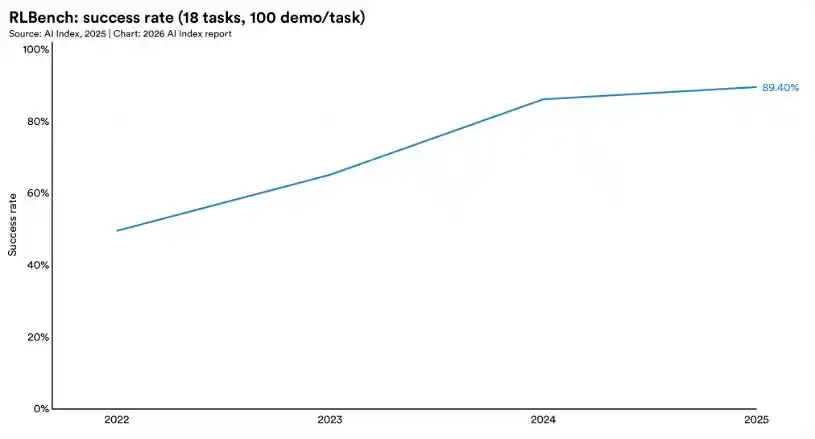
AI is already very strong in the virtual world, but still very weak in the physical world. The success rate for robot manipulation in software simulation environments is 89.4%, but the success rate for real-world household tasks is only 12.4%. One is a clean lab, the other is a messy home; in the latter kind of real environment, robot participation is still negligible.

However, autonomous driving is an exception: Waymo has about 450,000 trips per week, Apollo Go completed about 11 million fully driverless trips in 2025.

9

Experts vs Public: 73% vs 23% Cognitive Divide
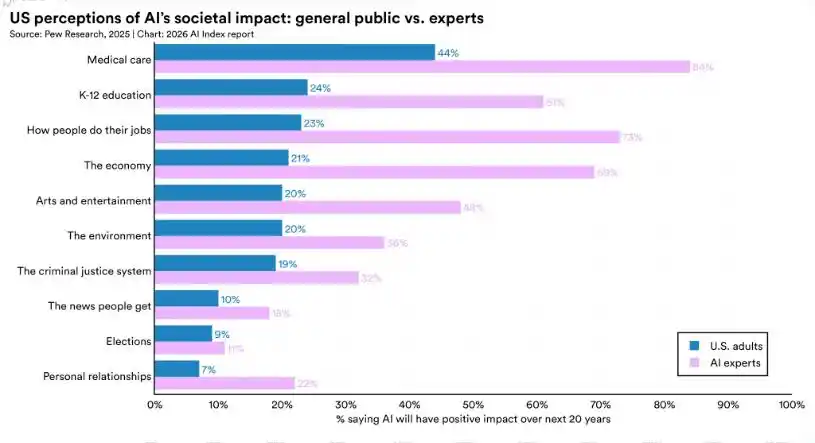
A Pew survey cited in the report reveals a startling divide: 73% of AI experts believe AI will have a positive impact on jobs, but only 23% of the American public thinks so—a complete polarization.

Another interesting data point: Among all countries surveyed, Americans have the lowest trust in government regulation of AI. Experts are also more optimistic about AI's prospects in education and healthcare, but both sides believe AI will harm elections and interpersonal relationships.

10

GPT-4o Uses Water for Over 12M People Annually, Electricity Could Power Entire New York State
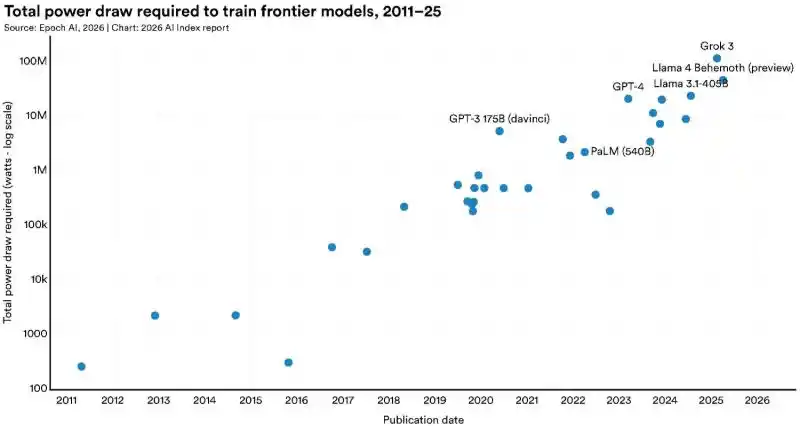
AI's progress comes at an environmental cost. Global AI data centers can now draw 29.6 GW of power, an amount sufficient to power the entire state of New York during peak usage. The annual water consumption of OpenAI's GPT-4o model alone could exceed the drinking water needs of over 12 million people.

These massive consumptions are injected into model training after model training, yet the chip supply chain behind the models is extremely fragile. The US owns most of the world's AI data centers, but almost every cutting-edge AI chip is manufactured by a single company, Taiwan's TSMC. All the computing power, all the investment, all the model progress, is built on this physical foundation.

The above is just the tip of the iceberg of the report, but it is enough to see that we are "embracing" a technology we don't fully understand at the fastest speed in history.

The full report covers more dimensions including AI safety, regulatory dynamics, research trends, and more. Highly recommended for interested friends to read the full original report. Link 👉🏻: https://hai.stanford.edu/ai-index

This article is from the WeChat public account "APPSO", author: APPSO Discovering Tomorrow's Products


Related Questions

QWhat is the core conclusion of the 2026 AI Index Report from Stanford HAI regarding the adoption of AI?

AThe core conclusion is that AI is being adopted globally at a speed surpassing that of the PC and the internet, but human institutions, job markets, and measurement tools are lagging behind.

QAccording to the report, what is the performance gap between the top AI models from the US and China as of March 2026?

AThe performance gap between the top US model (Claude Opus 4.6) and the top Chinese model is only 2.7% in Elo rating.

QWhat significant trend is reported regarding employment for young software developers aged 22-25?

AEmployment for software developers aged 22-25 has declined by nearly 20% since 2022, while employment for older age groups has continued to grow.

QHow does the generative AI adoption rate compare to the adoption rates of personal computers and the internet?

AGenerative AI achieved a population adoption rate of over 53% within three years, a speed that exceeds the adoption rates of both personal computers and the internet.

QWhat is the reported failure rate for AI Agents in 2025, and what does this indicate about their real-world deployment?

AAI Agents had an overall failure rate of about one-third. This high failure rate, along with the fact that most businesses reported no use of AI Agents, indicates a significant gap between benchmark progress and actual real-world deployment.

Related Reads

ETH Bull and Bear Views Compilation: Can Ethereum's Value Flow Back to ETH?

Titled "ETH Bull and Bear Views: Can Ethereum's Value Flow Back to ETH?", this article synthesizes the current heated debate around Ethereum's native token, ETH, following Bankless co-founder David Hoffman's decision to sell his entire ETH holdings. The **bullish case**, represented by figures like Tom Lee (BitMine CEO) and Raoul Pal, argues that ETH's core thesis remains intact. They contend Ethereum is the essential, secure, and neutral foundational layer for future finance—encompassing stablecoins, RWA, DeFi, L2s, and Agentic AI. Bulls bet on ETH's long-term revaluation as institutional adoption of on-chain finance grows, with significant buying activity from entities like BitMine and Consensys cited as evidence. Conversely, the **bearish perspective**, led by Hoffman and analysts like Markus Thielen, questions ETH's value capture mechanism. They acknowledge Ethereum's network success but argue that the value created by L2s, DeFi, and applications does not sufficiently accrue to the ETH token itself. Bears point to ETH's prolonged underperformance versus the broader crypto market, lack of traditional cash flows, weakening "ultrasound money" narrative, and apparent institutional retreat (e.g., Harvard Management Company exiting its ETH ETF position) as key concerns. The debate highlights a pivotal shift: ETH is no longer just a community belief asset. The central question is whether ETH can transition from being a "**used infrastructure**" to a "**continuously bought and held core asset**" as more value enters the Ethereum ecosystem. The market is now critically examining the direct link between network growth and ETH's value.

marsbit45m ago

ETH Bull and Bear Views Compilation: Can Ethereum's Value Flow Back to ETH?

marsbit45m ago

Crypto is dead, Perps are forever

The crypto industry is shifting from a focus on creating native assets (like altcoins and protocol tokens) to becoming a "global asset pipeline." Native cryptocurrencies, except for Bitcoin, are seen as failing in their value storage and utility promises, with demand driven largely by speculation. Attention and liquidity are now moving toward real-world assets (RWAs) like U.S. stocks, bonds, gold, and oil traded on-chain via perpetual contracts (Perps). Stablecoins like USDT and USDC set the precedent, proving blockchain's core strength is efficient global settlement and transfer, not inventing new monetary systems. Meanwhile, assets like Ethereum and many DeFi tokens struggle as their narratives weaken against tangible traditional assets and the rapid real-world progress of AI. Perpetual contracts have emerged as a pivotal innovation. They simplify trading by offering pure price exposure to any asset, bypassing complexities of ownership, custody, and traditional market hours. Projects like Hyperliquid gained traction by combining CEX-like efficiency with on-chain transparency, capitalizing on post-FTX distrust, macroeconomic volatility, and the surge in demand for 24/7 stock trading. In conclusion, while the era of speculative native "crypto assets" may be over, perpetual contracts persist as the industry's most potent financial instrument—transforming all assets into globally accessible, constantly tradable instruments centered on price speculation.

marsbit51m ago

Crypto is dead, Perps are forever

marsbit51m ago

Tencent, Alibaba, ByteDance in a Battle for the Skill Store

Skill is becoming a key concept in the AI field, essentially serving as a structured "instruction manual" for AI Agents that specifies tool calls, decision logic, and output standards. This allows Agents to execute predefined tasks. As the number of Skills grows, distribution platforms have emerged. Major tech companies are swiftly entering this space. In March, Tencent, Alibaba, and ByteDance launched Skill stores within their respective Agent platforms. Subsequently, players like Zhipu AI, Meituan, and Xiaohongshu joined the fray. This competition for the "Skill store" is fundamentally a battle for the AI-era user entry point; whoever controls distribution controls the users. While ByteDance's Coze has experimented with paid Skills, most platforms offer them for free. The real value lies not in the stores themselves but in using them to attract and retain users within an ecosystem, driving revenue from services like cloud computing, model calls, or advertising. The landscape features three main player types: 1) **Internet giants** (e.g., Alibaba, ByteDance, Tencent, Meituan), leveraging Skills to drive traffic and monetize through their broader ecosystems (cloud services, transactions, ads). 2) **Large model companies** (e.g., Zhipu AI, Moonshot AI), using Skill stores to increase user engagement and monetize model API calls. 3) **Content platforms** (e.g., Xiaohongshu), treating Skills as a new content format to generate traffic and ad revenue. However, transforming Skill stores into a sustainable business faces significant hurdles. Key challenges include: the **difficulty in pricing Skills** due to inconsistent outputs across different models and contexts; **lack of cost transparency** (varying token consumption); **security risks** like Skill poisoning; and the **absence of standardized protocols** for development and evaluation. Unlike standardized mobile apps, Skills are often personalized workflows resistant to uniformity, which hinders the establishment of a reliable review and monetization system akin to the App Store. While there is genuine user demand for paid Skills—particularly in enterprise (e.g., contract review) and certain personal productivity scenarios—current platforms offer developers limited and unpredictable distribution. The future of Skill stores depends on overcoming these standardization, evaluation, and safety challenges to make acquiring a Skill as straightforward as downloading an app. For now, the stores function more as display shelves than robust marketplaces.

marsbit51m ago

Tencent, Alibaba, ByteDance in a Battle for the Skill Store

marsbit51m ago

The Crypto Scene Is Dead, Perpetual Swaps Are Eternal

The crypto industry is undergoing a fundamental shift. The era defined by minting novel, native digital assets (altcoins) is fading. These assets, lacking real-world cash flows or clear value, are losing relevance as attention and capital flow elsewhere. Two powerful external forces are reshaping the space. First, traditional assets like U.S. stocks, bonds, gold, and oil are being tokenized and traded on-chain. Second, the explosive growth of AI, with its tangible products, has overshadowed crypto's once-dominant "future narrative." This marks a critical pivot: crypto is transitioning from being a "factory for new assets" to becoming a "global conduit for existing assets." Its validated utility is not complex financial reinvention but efficient global settlement, transfer, and trading—the original promise of blockchain. Stablecoins like USDT and USDC exemplify this, offering faster dollar movement rather than replacing it. Consequently, native ecosystems like Ethereum face profound challenges. While still crucial infrastructure, ETH struggles to capture value as users interact with Layer 2s or trade traditional assets without needing to hold it. DeFi's grand narrative of rebuilding finance has narrowed to core needs like cheap transfers and deep liquidity. The true breakout innovation is the perpetual contract (Perp). It brilliantly bypasses the complexities of direct asset ownership (custody, compliance, dividends) by creating pure price exposure. Users can speculate on the price movement of *any* asset—NVIDIA, gold, oil—24/7, globally, and with leverage. This "price casino" model, while risky and ethically fraught, delivers unmatched liquidity and accessibility. Projects like Hyperliquid succeeded not by inventing new mechanics but by perfecting the timing and execution of this model. Key drivers included making on-chain Perps feel like centralized exchanges, post-FTX trust migration towards transparency, and rising demand to trade macro assets and equities round-the-clock. In conclusion, the crypto world's most enduring successes are the dollar (via stablecoins), Bitcoin, and trading. Its new frontier is not creating alternative assets but providing a seamless, perpetual trading layer—a new API—for the world's existing financial system. The age of native altcoins is over; the age of perpetual synthetic exposure has begun.

Odaily星球日报1h ago

The Crypto Scene Is Dead, Perpetual Swaps Are Eternal

Odaily星球日报1h ago

Trading

Spot
Futures

Hot Articles

Discussions

Welcome to the HTX Community. Here, you can stay informed about the latest platform developments and gain access to professional market insights. Users' opinions on the price of AI (AI) are presented below.

活动图片














